
Revelstoke
Ski Revelstoke's legendary powder and greatest vertical in North America. Epic bowls, gladed terrain, and endless backcountry access.
Season 2026 - 2027
Opens
5 Dec 2026
Closes
11 Apr 2027
Days open
127
Annual snow
10m
The Overview
Michael Fulton
Melbourne-based skier and snowboarder with 50+ resorts across 5 continents. Specialises in Australian resorts and international resort comparisons.
Revelstoke Mountain Resort commands the title of North America's greatest vertical descent, delivering an extraordinary 1,713 metres of lift-accessed terrain from the 512-metre base to the 2,225-metre summit. Located on Mount Mackenzie in British Columbia's Selkirk Mountains, this resort spans 3,121 acres of varied skiing distributed across four distinct alpine bowls and 13 gladed zones. Since opening in December 2007, Revelstoke has established itself as a destination where advanced skiers tackle legendary steep pitches whilst intermediate riders explore perfectly groomed cruisers and accessible tree runs.
The resort's 75 named runs are distributed across 12% beginner, 43% intermediate, and 45% advanced/expert terrain, creating a mountain experience heavily weighted toward accomplished skiers. Revelstoke's terrain features include North Bowl and South Bowl with their powder-filled slopes, extensive gladed areas with perfectly spaced trees, and The Last Spike—at 15.2 kilometres, one of North America's longest ski runs. The resort maintains two terrain parks: the Main Terrain Park beneath the Stoke Chair offers medium-to-large jumps and technical features for progressive riders, whilst the Gnome Zone provides beginner-friendly elements adjacent to the main park.
Revelstoke receives an exceptional 10.5 metres of annual snowfall, positioning it amongst Canada's most reliable powder destinations. The resort's unique geographical location between the cold Rocky Mountain air masses and moist Pacific systems creates consistent dumps of light, dry snow throughout winter. This combination of massive vertical, challenging terrain, and legendary snowfall has earned Revelstoke recognition as one of North America's most demanding ski experiences, attracting powder seekers and expert skiers from around the globe whilst maintaining progressive zones for developing riders.
1713m
Vertical
59
Runs
3,121 acres
Skiable
10m
Annual snow
Ikon / Mountain Collective
Pass
The Terrain
59 runs across 3,121 acres skiable
Revelstoke carries one of the biggest verticals in North America: 1,713 metres from a 512-metre village base to the 2,225-metre summit. Its 59 runs cover roughly 1,263 hectares, graded 12% beginner, 43% intermediate, 30% advanced and 15% expert. The shape is more intermediate than its reputation suggests, though the pitches are long and steep enough that most blue runs feel substantial. Snowfall of about 10.2 metres a year feeds deep, consistent powder in the alpine, and thick glades lower down hold it between storms, so it rewards patience.
The Stoke Chair reaches the summit and the four alpine bowls: South Bowl, North Bowl, Greely Bowl and Separate Reality, an open alpine area a short traverse from the top. The Ripper chair serves more moderate terrain on the north side, and glades lower down stay skiable when visibility closes in. The Last Spike is a long beginner-grade run that winds all the way back to the village. Revelstoke suits strong intermediates and advanced skiers, with experts finding steeper lines just off the lifts, while true beginners have fewer options.
Terrain split
59
runs
59 runs across 4 grades
Beginner7 runs · 12%
Intermediate25 runs · 43%
Advanced18 runs · 30%
Expert9 runs · 15%
Time it right
When to visit Revelstoke
Revelstoke typically operates from late November through mid-April, with the 2025-26 season commencing 29 November 2025 and concluding 13 April 2026. This extended season reflects the resort's substantial elevation range and position deep within British Columbia's interior mountains, where continental weather patterns deliver consistent snowfall throughout winter. The season length allows Revelstoke to capture early-winter storms whilst maintaining quality spring conditions well into April, when lower-elevation resorts struggle with marginal snow coverage.
The resort's position in the Columbia Mountains creates exceptional snow accumulation patterns, with most seasons delivering between 12-18 metres of total snowfall through the convergence of cold Rocky Mountain air and moist Pacific systems. Peak powder conditions occur from December through March, when this meteorological collision produces the consistent light, dry snow that has made British Columbia's interior ranges legendary amongst powder seekers. January and February deliver the most reliable conditions, with frequent storm cycles maintaining deep base depths across all elevations. The predominantly north-facing North Bowl terrain preserves powder quality significantly longer than south-facing runs, which receive more direct sun exposure and transform into excellent spring corn snow as the season progresses.
Revelstoke's substantial elevation range from 512 to 2,225 metres ensures varied snow conditions across different mountain zones throughout the season. Lower terrain benefits from warmer temperatures during marginal periods, whilst upper alpine zones consistently hold cold, dry powder even during transitional weather. The resort's four distinct bowls each develop unique snow characteristics based on aspect and elevation, allowing skiers to chase optimal conditions by selecting terrain that matches daily weather patterns. Spring skiing from March onwards often provides perfect corn snow conditions on groomed runs whilst maintaining deep powder stashes in sheltered glades, extending quality skiing well beyond the traditional winter season.
Season 2026 - 2027
5 Dec 2026
Opens
11 Apr 2027
Closes
127
Days open
10 m
Annual snow
Getting there
Getting to Revelstoke, and where to stay
Positioned in southeastern British Columbia along the Trans-Canada Highway, Revelstoke sits 410 kilometres west of Calgary International Airport (4.5-hour drive) and 187 kilometres east of Kelowna International Airport (2.5-hour drive). The resort's base area lies just 6 kilometres southeast of downtown Revelstoke, a historic mountain town of approximately 8,000 residents situated at the confluence of the Columbia and Illecillewaet Rivers. This proximity allows visitors to experience authentic mountain town culture rather than manufactured resort village atmosphere, with locally owned cafes, gear shops, and restaurants reflecting the community's deep skiing heritage dating to 1914 when the Revelstoke Ski Club established official operations.
The location between the Selkirk and Monashee mountain ranges positions Revelstoke at the heart of British Columbia's renowned Powder Highway, a 1,235-kilometre route connecting eight major resorts and numerous backcountry operations. This geographical placement makes Revelstoke the only resort worldwide offering lift-accessed, cat-skiing, heli-skiing, and guided backcountry experiences from a single base village. The surrounding region supports multiple commercial heli-skiing operations, including Selkirk Tangiers which operates from the resort, providing access to over 515,000 acres of terrain when combined with available cat-skiing zones.
Access routes to Revelstoke traverse some of Canada's most spectacular mountain scenery, with visitors from Calgary passing through Banff National Park, Yoho National Park, and Glacier National Park before crossing Rogers Pass in the Selkirk Mountains. Those approaching from Kelowna drive through the scenic Okanagan Valley wine region before joining the Trans-Canada Highway. The town offers diverse accommodation ranging from luxury slopeside condominiums at The Sutton Place Hotel to heritage bed-and-breakfasts and mountain lodges, all positioned within minutes of the resort base. Winter road conditions require proper preparation, with mountain passes susceptible to closures during heavy snowfall periods and winter tyres mandatory from October through April.
Where to stay
Search all stays →Hotels and lodges near Revelstoke, powered by Stay22.
Latest News
From the SnowStash desk
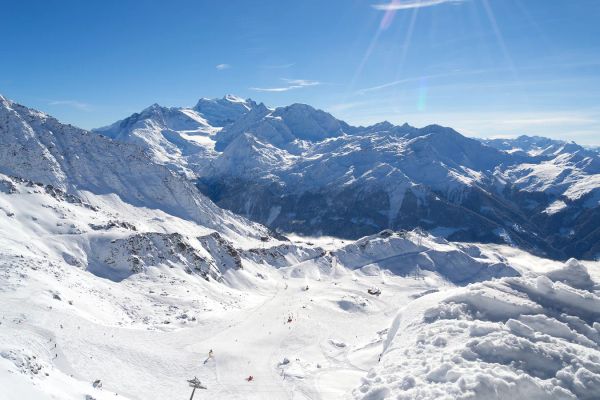
Alps Snow Forecast: Up to 64 cm Headed for the High Glaciers as the Snow Line Drops
The Alps are about to swap mild, sunny October weather for something far more wintry. A cold front arrives Tuesday, and SnowStash forecasts have Monterosa Ski out in front with 64 cm over 14 days, ahead of Blatten Belalp (55 cm) and Verbier (43 cm). The snow line should fall below 2000 metres by Wednesday night, and glaciers across Switzerland, Italy and Austria are in line for the best of it. The wind will have a say too.
20 Oct 2026

Four Dead After Avalanche Near Ski Portillo in Chile
A large avalanche struck near Laguna del Inca adjacent to Ski Portillo on Saturday afternoon, killing four people and injuring four others. The group were day visitors mountaineering in the backcountry after reportedly being warned about elevated avalanche risk by resort staff.
18 Oct 2026

Europe Ski Resorts Open Now: What Is Skiable in Mid-October 2026
Europe’s ski season is open, technically. After a record-warm summer, glaciers in Austria, Switzerland and Italy are running a few pistes apiece, Sölden, Stubai and Kitzsteinhorn started late, Titlis has pushed back to 24 October, and Zermatt reopens a few lifts on 14 October after more than two months shut. Finland’s Levi and Ruka are skiing on stored snow. Here is what is open, and what you actually get at each.
14 Oct 2026

Zermatt Plans World Cup Downhill Return on the Gornergrat for 2028
Zermatt is having another crack at a World Cup downhill, and this time nobody has to cross a border. Around 13 million Swiss francs is going into rebuilding the Gornergrat piste, including a jump fed by a roughly 300-metre in-run across the roof of the Gornergrat Railway gallery, with the Matterhorn lined up behind it for the TV cameras. First men’s race is pencilled in for March 2028, pending FIS homologation.
14 Oct 2026

Mt. Rose Begins Snowmaking for the 2026-27 Season at Lake Tahoe
Lake Tahoe’s highest base elevation is paying off early: Mt. Rose has started making snow for 2026-27 after the first flurries and a cold snap. The Nevada resort is backing it with nearly US$2 million in upgrades, including a replacement snowmaking main line, a new PistenBully groomer and restraint bars on every lift. Opening day is yet to be confirmed, though Heavenly and Northstar are already eyeing 20 November.
13 Oct 2026

Utah Ski Resorts 2026-27: What’s New at Alta, Deer Valley, Powder Mountain and More
Utah is still building flat out. For 2026-27, Powder Mountain opens a steep new Skytrac chair into more than 1,000 acres of advanced terrain, Deer Valley adds 200 acres on Hail Peak, Sundance gets a new quad and Park City adds a gondola from its new parking structure. Snowmaking is expanding almost everywhere, Eagle Point stays closed after the Cottonwood Fire, and the 2034 Games are setting the pace. Here’s what’s new, resort by resort.
13 Oct 2026

Mt Hutt Invests NZ$12 Million in Base Area, Tripling Its Sun Deck
Mt Hutt is getting busier, and its base lodge is about to catch up. NZ$12 million goes into a heated sun deck roughly three times the current size (430 m² to 1,300 m²), plus a new toilet block, heated steps down to snow level, extra storage and a new food and beverage outlet. Building starts after the 2026 season, with everything due for winter 2027.
11 Oct 2026

Vermont Ski Resort Opening Dates 2026-27: Few Dates Set, Killington Waits on the Cold
Vermont's season is slow to take shape. Stratton is tentatively targeting 18 November and Sugarbush 21 November, while Pico has Friday 11 December on the calendar. Killington never sets a date and opens when the snowmaking allows, and Vail Resorts has yet to name days for Stowe, Okemo and Mount Snow. The forecasts disagree about snow, and the main El Niño worry for the Green Mountains is warmth.
9 Oct 2026
Revelstoke Webcams
6 live angles across the mountain. Tap any camera to go full-screen.
About Revelstoke's live webcams
Check live conditions across Revelstoke with 6 real-time webcams showing snow, weather, and lift operations, updated every 10 minutes. Check high-elevation cams for powder visibility and base-area cams for crowd levels before you head up.
Camera guide
- Top of Stoke Chair2225m
- Experience breathtaking alpine perspectives from Revelstoke's highest lifted point through this summit webcam positioned at 2225 meters elevation atop the Stoke Chair. This commanding Revelstoke live cam captures Snow Rodeo run and sweeping views across the resort's legendary high-alpine terrain. Updated every 10 minutes, this Revelstoke webcam delivers crucial visibility information across the upper mountain's challenging bowls and glades, helping advanced skiers assess conditions before tackling North America's longest vertical descent of 1,713 meters.
- Upper Gondola Outpost1695m
- Track mid-mountain conditions at Revelstoke Mountain Resort through this crucial webcam positioned at the Upper Gondola terminal at 1695 meters elevation. This central Revelstoke live cam reveals current weather and snow conditions where skiers transition from the resort's acclaimed gondola system to upper mountain lifts. Essential for planning your descent strategy, this live snow cam provides real-time visibility updates across the terrain hub that connects Revelstoke's 3,121 acres of legendary British Columbia powder skiing.
- Revelstoke Village516m
- Monitor base area activity and arrival conditions through this essential Revelstoke webcam positioned in the heart of the village at 516 meters elevation. This Revelstoke live cam captures the vibrant atmosphere at the resort's base, showing current snow conditions, gondola operations, and mountain weather before you begin your journey up North America's greatest vertical. Perfect for timing your arrival and assessing crowd levels, this Revelstoke web cam provides the real-time intelligence needed to maximize your powder day at this iconic British Columbia ski destination.
- Gnorm the Powder Gnome1960m
- Monitor legendary snowfall accumulation through this iconic Revelstoke webcam focused on Gnorm the Powder Gnome at 1960 meters elevation. This beloved Revelstoke live cam features the resort's 27cm mascot who regularly requires his snorkel during British Columbia's epic powder storms. Essential for powder hunters tracking fresh snow, this Revelstoke web cam provides real-time proof of the resort's famous 40-60 feet of annual snowfall, helping you time your visit to North America's greatest vertical when conditions are prime.
- Top of Stellar Chair1960m
- Discover Revelstoke's welcoming upper mountain beginner terrain through this strategic webcam positioned at the Stellar Chair summit at 1960 meters elevation. This essential Revelstoke live cam showcases the resort's commitment to progressive terrain, revealing perfectly groomed learning runs high on the mountain. Ideal for families and developing skiers, this live snow cam provides real-time snow quality updates across Revelstoke's accessible intermediate zones, proving that world-class powder skiing isn't reserved only for experts at this British Columbia destination.
- Top of Ripper Chair1958m
- Witness Revelstoke's spectacular North Bowl terrain through this perfectly positioned webcam at the Ripper Chair summit at 1958 meters elevation. This strategic Revelstoke webcam captures the lower ridge of North Bowl, revealing current snow conditions across some of the resort's most perfectly pitched glades and groomers. Updated every 10 minutes, this Revelstoke live cam helps skiers assess visibility and snow quality across the diverse terrain that makes this Columbia Mountains resort legendary among powder enthusiasts worldwide.
Revelstoke snow cams FAQ
How often do Revelstoke snow cams update?
All Revelstoke snow cams and webcams update every 10 minutes with fresh images showing current mountain conditions. This frequent update schedule ensures you have access to near real-time conditions for planning your ski day at Revelstoke.
Which Revelstoke webcam shows the best powder conditions?
The high-elevation Top of Stoke Chair webcam at 2,225m provides the clearest view of powder conditions and snowfall. These Revelstoke webcams capture fresh snow accumulation and visibility better than base area cameras.
Can I see Revelstoke lift queues on the webcams?
Yes. Multiple Revelstoke snow cams specifically show lift queue areas and chairlift operations, helping you time your arrival and avoid peak queue periods.
When is the best time to check Revelstoke snow cams?
Check Revelstoke webcams early morning (7-8am) for overnight snowfall assessment, and mid-afternoon for current crowd levels and weather. The live cams are most useful after storm events to assess fresh powder.
How can I check current conditions before buying Revelstoke lift tickets?
Use our Revelstoke webcams alongside the live snow report to assess conditions before purchasing lift tickets. The webcams show real-time visibility, snow quality, and operational status.
Do Revelstoke webcams work on mobile devices?
Yes. All Revelstoke snow cams and webcams are optimized for mobile viewing, so you can check live conditions from anywhere using your phone or tablet.
More Revelstoke intelligence: snow report, lift tickets, trail map, resort overview.