
Gastein
200km of pistes across four ski areas in Salzburgerland. Home to one of Austria's longest runs at 10.4km vertical.
Season 2026 - 2027
Opens
28 Nov 2026
Closes
11 Apr 2027
Days open
134
Annual snow
4.8m
The Overview
Michael Fulton
Melbourne-based skier and snowboarder with 50+ resorts across 5 continents. Specialises in Australian resorts and international resort comparisons.
Gastein spans four ski areas across the Gasteinertal - Schlossalm-Angertal-Stubnerkogel, Sportgastein, Graukogel and Dorfgastein-Großarltal - delivering over 200 kilometres of pistes served by 50 lifts. Elevations reach from 860 metres at valley level to 2,686 metres at Sportgastein's Kreuzkogel summit, the highest point in Ski amadé. The Hohe Scharte Nord run on Schlossalm ranks among the longest descents in the Eastern Alps at 10.4 kilometres with 1,440 metres of vertical drop.
Terrain splits roughly 30 per cent beginner, 55 per cent intermediate and 15 per cent advanced across the combined areas. The main Schlossalm-Angertal-Stubnerkogel circuit carries predominantly red runs with wide, well-groomed pistes linking Bad Hofgastein and Bad Gastein. Sportgastein draws freeriders with three designated off-piste routes and reliable powder conditions at high altitude.
The Belle Époque spa town of Bad Gastein provides a distinctive contrast to typical Austrian ski villages, with grand historic hotels cascading down steep valley slopes and a dramatic waterfall running through the centre. Alpentherme in Bad Hofgastein and Felsentherme in Bad Gastein both tap mineral-rich thermal waters heated to 46°C. The 140-metre suspension bridge atop Stubnerkogel and Glocknerblick viewing platform add non-skiing attractions.
Multi-day passes unlock the entire Ski amadé network spanning 760 kilometres across five regions including Hochkönig and Schladming-Dachstein. Free ski buses connect the valley's dispersed lift bases at 15 to 20-minute intervals. The resort suits intermediate skiers seeking variety without crowds, families drawn to Angertal's dedicated learning zones, and powder seekers heading to Sportgastein's alpine terrain.
1440m
Vertical
77
Runs
83 km
Piste
4.8m
Annual snow
Ski amadé
Pass
Watch
See Gastein in motion
The Terrain
77 runs across 83 km of piste
Gastein spreads 77 runs and 83 kilometres of piste across four separate ski areas, and the terrain changes character from one to the next. Intermediate runs make up 60% of the network, beginners 37% and advanced just 3%, so most of the valley rewards confident cruising rather than steeps. The Schlossalm-Angertal-Stubnerkogel circuit is the largest linked area, reached via the Schlossalmbahn, and it carries the longest descent: the 10.4-kilometre Hohe Scharte Nord run, which drops 1,440 metres towards the valley floor at 860 metres.
The harder skiing sits at the edges of the valley. Graukogel has the steeper pistes, running into black FIS racing stretches, while Sportgastein at the head of the valley reaches 2,686 metres and is the region's powder address for freeriders. On Stubnerkogel, tree skiing through larch forest drops into the Angertal, and Dorfgastein-Großarltal offers sunny, freshly groomed slopes with views of the Hohe Tauern from Fulseck at 2,033 metres. Advanced skiers should plan days around Graukogel and Sportgastein rather than expecting steeps on the main circuit.
Terrain split
77
runs
77 runs across 4 grades
Beginner28 runs · 37%
Intermediate46 runs · 60%
Advanced2 runs · 3%
Expert0 runs · 0%
Time it right
When to visit Gastein
Gastein's 2025-26 season launches 28 November with partial operations on Schlossalm-Angertal-Stubnerkogel, expanding to full service from early December. Dorfgastein-Großarltal opens 5 December and Sportgastein follows 12 December. The season extends through early April on the main circuit, with Sportgastein's high-altitude terrain often holding snow into late April or early May.
Sportgastein sits between 1,584 and 2,650 metres, delivering average summit snow depths around 170 centimetres through the season with February peaks near 200 centimetres. The main Schlossalm-Angertal-Stubnerkogel area benefits from extensive snowmaking covering 85 per cent of runs, backed by that 150,000 cubic metre reservoir installed during the 2018 rebuild.
February typically delivers the most consistent snow with around 4 to 5 snowy days per week at higher elevations. January offers the most sun - averaging 18 clear days - while December provides quieter slopes before holiday crowds arrive. March and April bring spring skiing with longer days and softer afternoon snow on south-facing aspects.
The open-air Gastein Sounds festival marks season opening weekend in December with concerts at the Schlossalm valley station. The North race in late March challenges participants on the Hohe Scharte Nord run with 1,440 metres of vertical descent in a timed super-G format. Sound & Snow events bring headline acts throughout winter.
Season 2026 - 2027
28 Nov 2026
Opens
11 Apr 2027
Closes
134
Days open
4.8 m
Annual snow
The record
Historical snowfall at Gastein
Daily snow reports at Gastein go back to 1996, 31 winters on the books. Open the record to compare winters, lifts and piste.
105 cm
Snowiest day
26 Feb 2026
30 cm
This winter · 2026-27
so far
483 cm
Typical winter
average of complete seasons
Winter totals
cm
Past wintersThis winter
Getting there
Getting to Gastein, and where to stay
The Gasteinertal runs approximately 40 kilometres through the Hohe Tauern mountain range in Salzburgerland, Austria, with three main villages - Dorfgastein, Bad Hofgastein and Bad Gastein - strung along the valley floor. Bad Gastein sits at around 1,000 metres elevation on dramatic steep slopes, while Bad Hofgastein occupies flatter terrain at 860 metres. The valley terminates at Sportgastein beneath 3,000-metre peaks marking the edge of Hohe Tauern National Park.
Salzburg lies 90 kilometres north, accessible via the A10 Tauern motorway with the Gasteinertal exit near Bischofshofen. St Johann im Pongau sits at the valley entrance roughly 16 kilometres from Dorfgastein. The thermal spa heritage dates to the 19th century when Bad Gastein's mineral waters drew European nobility - the town's grand hotels and waterfall retain that Belle Époque character.
From Salzburg, drivers follow the A10 south toward the Tauern Tunnel, exiting before Bischofshofen onto the B167 through St Johann im Pongau and into the valley. The drive takes approximately 75 minutes in good conditions. From Munich, count on 2.5 hours via Salzburg. Access from the south runs through Mallnitz using the car-train shuttle through the Tauern railway tunnel.
Salzburg Airport sits 80 kilometres away, roughly 90 minutes by road or direct train. ÖBB Railjet services run hourly to Bad Gastein station, which connects directly to the Stubnerkogelbahn valley station and Felsentherme thermal spa via an elevated walkway. Bad Hofgastein and Dorfgastein also have railway stations. Free ski buses link all lift bases throughout the valley.
Where to stay
Search all stays →Hotels and lodges near Gastein, powered by Stay22.
Latest News
From the SnowStash desk
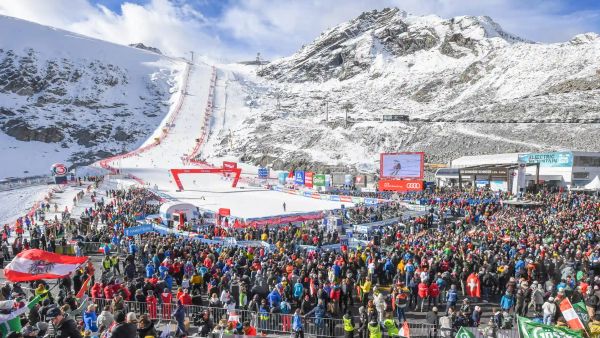
Pinheiro Braathen Wins Sölden Giant Slalom Opener by 0.48 Seconds
Two days at Sölden, two races decided by a hundredth somewhere on the podium, and one very quick Brazilian. Lucas Pinheiro Braathen led from the first run to win the men’s World Cup opener by 0.48 seconds, with Loïc Meillard second and Marco Odermatt third. River Radamus charged from 15th to fourth on a rutted course, and Britain’s Freddy Carrick-Smith banked his first World Cup points. Braathen still hasn’t lost a giant slalom since Olympic gold.
25 Oct 2026

Alps Snow Forecast: Up to 64 cm Headed for the High Glaciers as the Snow Line Drops
The Alps are about to swap mild, sunny October weather for something far more wintry. A cold front arrives Tuesday, and SnowStash forecasts have Monterosa Ski out in front with 64 cm over 14 days, ahead of Blatten Belalp (55 cm) and Verbier (43 cm). The snow line should fall below 2000 metres by Wednesday night, and glaciers across Switzerland, Italy and Austria are in line for the best of it. The wind will have a say too.
20 Oct 2026

Four Dead After Avalanche Near Ski Portillo in Chile
A large avalanche struck near Laguna del Inca adjacent to Ski Portillo on Saturday afternoon, killing four people and injuring four others. The group were day visitors mountaineering in the backcountry after reportedly being warned about elevated avalanche risk by resort staff.
18 Oct 2026

Europe Ski Resorts Open Now: What Is Skiable in Mid-October 2026
Europe’s ski season is open, technically. After a record-warm summer, glaciers in Austria, Switzerland and Italy are running a few pistes apiece, Sölden, Stubai and Kitzsteinhorn started late, Titlis has pushed back to 24 October, and Zermatt reopens a few lifts on 14 October after more than two months shut. Finland’s Levi and Ruka are skiing on stored snow. Here is what is open, and what you actually get at each.
14 Oct 2026

Zermatt Plans World Cup Downhill Return on the Gornergrat for 2028
Zermatt is having another crack at a World Cup downhill, and this time nobody has to cross a border. Around 13 million Swiss francs is going into rebuilding the Gornergrat piste, including a jump fed by a roughly 300-metre in-run across the roof of the Gornergrat Railway gallery, with the Matterhorn lined up behind it for the TV cameras. First men’s race is pencilled in for March 2028, pending FIS homologation.
14 Oct 2026

Mt. Rose Begins Snowmaking for the 2026-27 Season at Lake Tahoe
Lake Tahoe’s highest base elevation is paying off early: Mt. Rose has started making snow for 2026-27 after the first flurries and a cold snap. The Nevada resort is backing it with nearly US$2 million in upgrades, including a replacement snowmaking main line, a new PistenBully groomer and restraint bars on every lift. Opening day is yet to be confirmed, though Heavenly and Northstar are already eyeing 20 November.
13 Oct 2026

Utah Ski Resorts 2026-27: What’s New at Alta, Deer Valley, Powder Mountain and More
Utah is still building flat out. For 2026-27, Powder Mountain opens a steep new Skytrac chair into more than 1,000 acres of advanced terrain, Deer Valley adds 200 acres on Hail Peak, Sundance gets a new quad and Park City adds a gondola from its new parking structure. Snowmaking is expanding almost everywhere, Eagle Point stays closed after the Cottonwood Fire, and the 2034 Games are setting the pace. Here’s what’s new, resort by resort.
13 Oct 2026

Mt Hutt Invests NZ$12 Million in Base Area, Tripling Its Sun Deck
Mt Hutt is getting busier, and its base lodge is about to catch up. NZ$12 million goes into a heated sun deck roughly three times the current size (430 m² to 1,300 m²), plus a new toilet block, heated steps down to snow level, extra storage and a new food and beverage outlet. Building starts after the 2026 season, with everything due for winter 2027.
11 Oct 2026
Gastein Webcams
9 live angles across the mountain. Tap any camera to go full-screen.
About Gastein's live webcams
Check live conditions across Gastein with 9 real-time webcams showing snow, weather, and lift operations, updated every 10 minutes. Check high-elevation cams for powder visibility and base-area cams for crowd levels before you head up.
Camera guide
- Stubnerkogel mountain station II2233m
- The stubnerkogel webcam offers spectacular views from the summit station, where you can monitor conditions on the challenging high-alpine terrain. Watch as skiers tackle the varied runs while taking in panoramic views of Bad Gastein's historic spa town below.
- Bad Hofgastein Schlossalm2051m
- The schlossalm webcam showcases the extensive intermediate terrain and perfectly groomed slopes of the Schlossalm area. Monitor snow conditions and lift operations while enjoying views stretching across the Hohe Tauern mountains.
- Angertal ski center1211m
- The angertal webcam provides a perfect view of this central hub where multiple ski areas converge. Watch as skiers access the connecting lifts and enjoy the sunny slopes of this family-friendly zone.
- Bad Hofgastein Schlossalm Weitmoser1935m
- From the Weitmoser area, this bad hofgastein webcam captures the heart of the resort's intermediate terrain. Monitor conditions on the popular blue runs and watch skiers carving their way down the well-maintained slopes.
- Dorfgastein Fulseck mountain station2033m
- Positioned at the Fulseck summit, this webcam overlooks the diverse terrain of Dorfgastein, showing both challenging slopes and gentle learning areas below.
- Bad Gastein Stubnerkogel Snowpark1800m
- The stubnerkogel webcam at the snowpark lets you check conditions at this popular freestyle zone. Watch riders hitting the jumps and rails while enjoying views of the surrounding peaks.
- Sportgastein Kreuzkogel2605m
- The webcam sportgastein at Kreuzkogel offers stunning views from the highest point in the ski area. Monitor conditions on the high-alpine terrain and watch as advanced skiers tackle the challenging slopes.
- Graukogel mountain station2005m
- From the historic Graukogel area, this webcam provides views of the resort's more traditional skiing terrain, perfect for watching skiers on these classic Alpine runs.
- Bad Gastein 360°1211m
- This panoramic webcam delivers sweeping views of the entire valley, from the Belle Époque architecture of Bad Gastein to the surrounding peaks and waterfalls that make this resort unique.
Gastein snow cams FAQ
How often do Gastein snow cams update?
All Gastein snow cams and webcams update every 10 minutes with fresh images showing current mountain conditions. This frequent update schedule ensures you have access to near real-time conditions for planning your ski day at Gastein.
Which Gastein webcam shows the best powder conditions?
The high-elevation Sportgastein Kreuzkogel webcam at 2,605m provides the clearest view of powder conditions and snowfall. These Gastein webcams capture fresh snow accumulation and visibility better than base area cameras.
Can I see Gastein lift queues on the webcams?
Yes. Multiple Gastein snow cams specifically show lift queue areas and chairlift operations, helping you time your arrival and avoid peak queue periods.
When is the best time to check Gastein snow cams?
Check Gastein webcams early morning (7-8am) for overnight snowfall assessment, and mid-afternoon for current crowd levels and weather. The live cams are most useful after storm events to assess fresh powder.
How can I check current conditions before buying Gastein lift tickets?
Use our Gastein webcams alongside the live snow report to assess conditions before purchasing lift tickets. The webcams show real-time visibility, snow quality, and operational status.
Do Gastein webcams work on mobile devices?
Yes. All Gastein snow cams and webcams are optimized for mobile viewing, so you can check live conditions from anywhere using your phone or tablet.
More Gastein intelligence: snow report, lift tickets, trail map, resort overview.