
Tignes
1906m vertical, 150km of runs, 300km with Val d'Isère. Grande Motte glacier extends season November to May. Tarentaise, France.
Season 2026 - 2027
Opens
28 Nov 2026
Closes
2 May 2027
Days open
155
Annual snow
8m
The Overview
Michael Fulton
Melbourne-based skier and snowboarder with 50+ resorts across 5 continents. Specialises in Australian resorts and international resort comparisons.
Tignes operates across 1550 to 3456 metres, delivering 150 kilometres of marked runs and a vertical drop of 1906 metres. The Grande Motte glacier reaches 3656 metres and guarantees skiing from late November through to early May, with summer sessions running from late June to mid-July. Combined with neighbouring Val d'Isère, the Tignes–Val d'Isère ski area offers 300 kilometres of piste served by 78 lifts across over 10,000 hectares of skiable terrain. The resort hosted freestyle skiing at the 1992 Winter Olympics and remains a training base for national ski teams.
Tignes divides terrain into 57% beginner, 25% intermediate, 10% advanced and 8% expert, though grading runs above 2100 metres elevation. The 10-kilometre La Sache black run descends through the Vallon de la Sache to Les Brévières, whilst the Grande Motte sector provides wide glacier bowls and red runs from 3456 metres. The Aiguille Percée area features the natural rock arch accessed via the Palafour chairlift, and the Tovière sector connects directly to Val d'Isère via gondola. Two terrain parks operate at the Grattalu chairlift, alongside boardercross and mogul training zones.
Five villages form the resort: Val Claret sits at 2100 metres with direct funicular access to the glacier, Tignes Le Lac operates as the main hub at 2100 metres, Le Lavachet lies between the two, Les Boisses sits at 1800 metres, and Les Brévières occupies the valley floor at 1550 metres. Purpose-built architecture dominates the upper villages, prioritising ski-in ski-out access over Alpine charm, though recent redevelopment has softened the 1960s concrete blocks. Free shuttle buses link all villages until midnight, and 113 snow cannons cover 50 kilometres of piste.
A joint Tignes–Val d'Isère pass costs €48 to €71 per day for adults in the 2025-26 season, whilst Tignes-only passes run €38 to €55. Season passes cost €1299 for the combined area. Children under 8 and seniors over 75 ski free, and the Ski Start beginner programme offers three progression levels with free lifts on initial stages. The resort suits confident intermediates and experts seeking high-altitude terrain, with glacier access extending the season well beyond typical French Alps closures.
1906m
Vertical
80
Runs
150 km
Piste
8m
Annual snow
The Terrain
80 runs across 150 km of piste
Tignes spans 150 kilometres of piste and 80 runs from 1,550 metres at Les Brévières up to 3,456 metres, a vertical of 1,906 metres. It is a resort of contrasts: 57% of the terrain is beginner, 25% intermediate, 10% advanced and 8% expert, so few big mountains pair so much easy skiing with a serious expert slice. The bowls around Val Claret and Tignes Le Lac sit above 2,000 metres, and the Grande Motte glacier adds dependable snow in the early and late season. Gondolas, six-seaters and an eight-seat chair do the heavy lifting.
La Sache is the longest run, a 10-kilometre black from the Aiguille Percée down to Les Brévières. On the Grande Motte, the reds are worth repeating for the snow and the views, and Leissée is a favourite. Across Val Claret, the Tichot and Grattalu lifts serve cruising terrain and the freestyle parks. The Tovière and Tommeuses lifts connect over to Val d'Isère for more variety. Freeriders have a set of secured but ungroomed slopes plus wilder lines that need a guide. Tignes suits strong intermediates and experts, with an easy-terrain share large enough for beginners in the villages.
Terrain split
80
runs
80 runs across 4 grades
Beginner46 runs · 57%
Intermediate20 runs · 25%
Advanced8 runs · 10%
Expert6 runs · 8%
Time it right
When to visit Tignes
The 2025-26 season runs from 22 November 2025 to 3 May 2026, spanning 163 days. The Grande Motte glacier opens first with 20 kilometres of piste, then the full Tignes–Val d'Isère link opens from 29 November once lower sectors receive sufficient snow cover. Summer skiing operates from 21 June to 20 July 2026, offering 700 metres of vertical on the glacier with six lifts accessing 20 kilometres of groomed runs. The resort typically reopens in mid-October for autumn glacier skiing before the winter season begins.
Annual snowfall averages around 8 metres at 2100 metres, with over half the ski area lying above 2500 metres and the glacier providing permanent snow cover above 3000 metres. The resort's position against the Italian border captures both Atlantic depressions and Mediterranean low-pressure systems, delivering reliable accumulation from December through April. Snowmaking covers 50 kilometres of piste through 113 cannons, though natural snow depth at 2100 metres typically exceeds 2 metres by mid-season.
January and February deliver the coldest temperatures and most consistent powder, with the highest villages often registering well below freezing. March offers the sweet spot of long daylight hours, stable snow and warming temperatures, whilst April and early May provide spring corn conditions on south-facing slopes and maintained coverage on the glacier. December can see limited terrain until Christmas, and late November relies almost entirely on glacier skiing.
Winter Fest runs 11-13 January 2026 with snowboard film premieres and exhibitions, the FIS Para Alpine Skiing World Cup visits 2-6 February, and the French Alpine Ski Championships occupy 30 March to 8 April. European Snowpride takes place 21-28 March, and Spring Break programming fills 18 April to 3 May. The Live in Tignes music festival traditionally closes the season in early May with performances across multiple stages.
Season 2026 - 2027
28 Nov 2026
Opens
2 May 2027
Closes
155
Days open
8 m
Annual snow
Getting there
Getting to Tignes, and where to stay
Tignes sits in the Tarentaise Valley in the Savoie department of south-eastern France, 30 kilometres from Bourg-Saint-Maurice at the upper end of the Isère valley. The main villages occupy a natural cirque at 2100 metres, enclosed by the Grande Motte massif at 3656 metres, the Grande Casse at 3852 metres, and surrounding peaks forming the gateway to Vanoise National Park. The original village lies submerged beneath Lac du Chevril following construction of the Tignes Dam in 1952, with the dramatic concrete wall now painted with a Hercules fresco visible on the approach road.
Bourg-Saint-Maurice serves as the nearest major town, sitting 30 kilometres and 40 minutes down the valley with supermarkets, a TGV station and the regional hospital. Moutiers lies 45 kilometres north along the N90, whilst Albertville sits 80 kilometres distant at the junction of major Alpine valleys. Val d'Isère occupies the next valley 12 kilometres to the south, connected by lift and piste throughout the ski season. The wider Tarentaise Valley contains Les Arcs, La Plagne and the Trois Vallées within an hour's drive.
The N90 from Albertville and Moutiers provides the sole road access via Bourg-Saint-Maurice, climbing 1000 metres over 30 kilometres of switchbacks with spectacular views of the dam and valley. Geneva Airport lies 220 kilometres and approximately three hours west via the A40 autoroute to Annecy then the N90 through Albertville, with transfer times extending to four hours during Saturday changeover traffic. Chambéry Airport sits 143 kilometres and two hours south via the A43 and N90, offering the shortest airport transfer.
Lyon-Saint-Exupéry Airport lies 220 kilometres and three hours southeast, whilst Grenoble sits 164 kilometres and three hours southwest. Bourg-Saint-Maurice railway station receives direct TGV services from Paris in five hours and weekend Eurostar connections from London via Lyon, with local buses covering the final 30 kilometres to resort in 40-60 minutes. Altibus operates year-round bus services from the station to all five Tignes villages, with tickets costing €12 for adults and departures coordinated with train arrivals.
Where to stay
Search all stays →Hotels and lodges near Tignes, powered by Stay22.
Latest News
From the SnowStash desk
Alps Snow Forecast: Up to 64 cm Headed for the High Glaciers as the Snow Line Drops
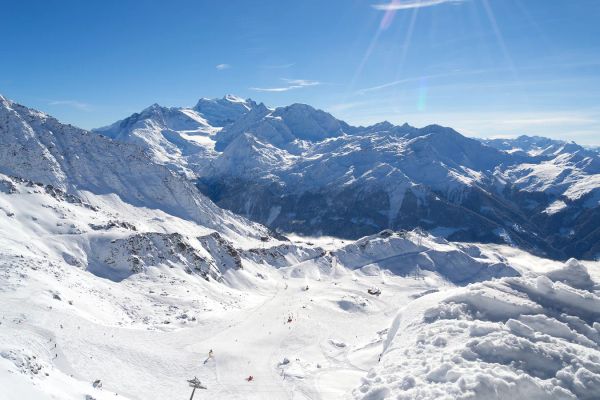
The Alps are about to swap mild, sunny October weather for something far more wintry. A cold front arrives Tuesday, and SnowStash forecasts have Monterosa Ski out in front with 64 cm over 14 days, ahead of Blatten Belalp (55 cm) and Verbier (43 cm). The snow line should fall below 2000 metres by Wednesday night, and glaciers across Switzerland, Italy and Austria are in line for the best of it. The wind will have a say too.
20 Oct 2026
Four Dead After Avalanche Near Ski Portillo in Chile
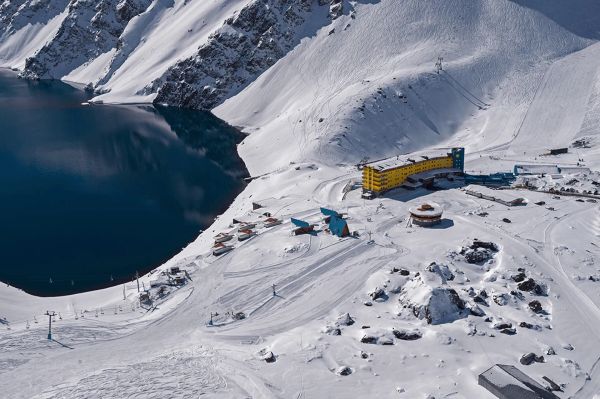
A large avalanche struck near Laguna del Inca adjacent to Ski Portillo on Saturday afternoon, killing four people and injuring four others. The group were day visitors mountaineering in the backcountry after reportedly being warned about elevated avalanche risk by resort staff.
18 Oct 2026

Europe Ski Resorts Open Now: What Is Skiable in Mid-October 2026
Europe’s ski season is open, technically. After a record-warm summer, glaciers in Austria, Switzerland and Italy are running a few pistes apiece, Sölden, Stubai and Kitzsteinhorn started late, Titlis has pushed back to 24 October, and Zermatt reopens a few lifts on 14 October after more than two months shut. Finland’s Levi and Ruka are skiing on stored snow. Here is what is open, and what you actually get at each.
14 Oct 2026

Zermatt Plans World Cup Downhill Return on the Gornergrat for 2028
Zermatt is having another crack at a World Cup downhill, and this time nobody has to cross a border. Around 13 million Swiss francs is going into rebuilding the Gornergrat piste, including a jump fed by a roughly 300-metre in-run across the roof of the Gornergrat Railway gallery, with the Matterhorn lined up behind it for the TV cameras. First men’s race is pencilled in for March 2028, pending FIS homologation.
14 Oct 2026

Mt. Rose Begins Snowmaking for the 2026-27 Season at Lake Tahoe
Lake Tahoe’s highest base elevation is paying off early: Mt. Rose has started making snow for 2026-27 after the first flurries and a cold snap. The Nevada resort is backing it with nearly US$2 million in upgrades, including a replacement snowmaking main line, a new PistenBully groomer and restraint bars on every lift. Opening day is yet to be confirmed, though Heavenly and Northstar are already eyeing 20 November.
13 Oct 2026

Utah Ski Resorts 2026-27: What’s New at Alta, Deer Valley, Powder Mountain and More
Utah is still building flat out. For 2026-27, Powder Mountain opens a steep new Skytrac chair into more than 1,000 acres of advanced terrain, Deer Valley adds 200 acres on Hail Peak, Sundance gets a new quad and Park City adds a gondola from its new parking structure. Snowmaking is expanding almost everywhere, Eagle Point stays closed after the Cottonwood Fire, and the 2034 Games are setting the pace. Here’s what’s new, resort by resort.
13 Oct 2026

Mt Hutt Invests NZ$12 Million in Base Area, Tripling Its Sun Deck
Mt Hutt is getting busier, and its base lodge is about to catch up. NZ$12 million goes into a heated sun deck roughly three times the current size (430 m² to 1,300 m²), plus a new toilet block, heated steps down to snow level, extra storage and a new food and beverage outlet. Building starts after the 2026 season, with everything due for winter 2027.
11 Oct 2026

Vermont Ski Resort Opening Dates 2026-27: Few Dates Set, Killington Waits on the Cold
Vermont's season is slow to take shape. Stratton is tentatively targeting 18 November and Sugarbush 21 November, while Pico has Friday 11 December on the calendar. Killington never sets a date and opens when the snowmaking allows, and Vail Resorts has yet to name days for Stowe, Okemo and Mount Snow. The forecasts disagree about snow, and the main El Niño worry for the Green Mountains is warmth.
9 Oct 2026
Tignes Snow Report
Snow Report
Updated 25 Oct 2026
3456m
summit
+0cm
new snow · last 24 hours
Slight Rain Showers-2°C / 4°C · W 19km/h
Snowfall
24 hours
0cm
48 hours
0cm
7 days
0cm
Base depth
400cm
Season total
532cm
Lifts open7 / 34
28 Nov 2026 - 2 May 2027
Hour by Hour
Next 46 hours· Updated Oct 25, 2026 at 5:02 PM
Scroll for the full outlook · Open-Meteo
7-Day Outlook
3,456 mUpdated Oct 25, 2026 at 5:02 PMOpen-Meteo
Days 1–7
0.3cm
Days 8–14
0.4cm
Sun, Oct 25
Slight Snow Showers
Temp4° / -2°°C
Snow0.3cm(100%)
Wind19 km/h W
Live snow from the resort feed; forecast from Open-Meteo, via Supabase.
Understanding the Tignes snow report
Tignes snow conditions, updated regularly: current snowfall, snow depth, temperatures, and the outlook for this France resort.
Snow measurements
Snow depth at Tignes is tracked at both the base and summit, since the two elevations often see different totals — roughly a 1906m difference here. We report fresh snowfall over the last 24 hours and 7 days alongside the running season total, in both metric and imperial units.
Weather conditions
Wind and temperature swings matter as much as fresh snowfall. Cold, calm conditions hold snow quality well, while wind-loading or a warm-up can change things quickly — especially given the elevation spread between Tignes's base and summit.
Data sources
We pull Tignes's conditions from on-the-ground mountain reporting, then layer in forecast data so you get a fuller picture than either source alone. The mountain is served by 34 lifts, including a 8-person chairlift and 6 quad chairlifts.
When to check
Conditions can change overnight, so mornings and late afternoons are the best times to check back on Tignes.