
Glacier 3000
31km pistes, 1,666m vertical, 6.5m annual snow. Magic Pass included. Black Wall 46° pitch. November-April glacier skiing.
Season 2026 - 2027
Opens
7 Nov 2026
Closes
30 Apr 2027
Days open
174
Annual snow
7m
The Overview
Michael Fulton
Melbourne-based skier and snowboarder with 50+ resorts across 5 continents. Specialises in Australian resorts and international resort comparisons.
Glacier 3000 operates between 1,350 and 3,016 metres across 31 kilometres of pistes split into 13 marked runs. The vertical drop measures 1,666 metres, delivering one of Switzerland's most substantial descents from glacier to valley. Terrain distribution allocates 27 per cent to beginners, 38 per cent to intermediates, 25 per cent to advanced skiers and 10 per cent to experts, whilst 6.5 metres of annual snowfall anchors conditions from November through late April. The resort spans three Swiss cantons - Vaud, Bern and Valais - and holds inclusion in the Magic Pass network at CHF 419 for the 2025-26 season.
Signature descents include the Red Run at eight kilometres and 1,700 metres vertical, the seven-kilometre Combe d'Audon black and the Black Wall, opened in winter 2022-23 with a 46-degree pitch making it Switzerland's steepest groomed piste. Access to Black Wall requires passage through a 265-metre tunnel, the longest ski tunnel in Switzerland. Three T-bars on the Tsanfleuron Glacier serve gentle blue terrain at 3,000 metres, whilst the four-seat Ice Express chairlift links Scex Rouge to the glacier plateau. Off-piste routes descending north through forests to Col du Pillon attract advanced freeriders, though downloading via cable car remains mandatory for novices.
The Scex Rouge summit station, designed by Swiss architect Mario Botta and rebuilt following a 2022 fire, houses Restaurant Botta on the fourth floor with panoramic glazing facing 24 peaks exceeding 4,000 metres including Matterhorn, Mont Blanc and Eiger. The 107-metre Peak Walk by Tissot suspension bridge connects two summits at 3,000 metres and ranks as the only peak-to-peak bridge globally. Refuge l'Espace sits at Quille du Diable on the glacier, accessible via a marked walking trail. High-elevation exposure creates weather sensitivity, with winds exceeding 80 kilometres per hour forcing lift closures.
Magic Pass validity runs 1 November to 30 April, with summer access optional at additional cost. Adult day tickets price at CHF 79, whilst Swiss Travel Pass holders receive 50 per cent discount. The resort links with Villars-Gryon-Diablerets and Leysin under regional pass arrangements. Limited on-piste variety suits the terrain best to strong intermediates and experts comfortable with long, steep descents or extensive off-piste exploration rather than piste-focused intermediates seeking varied groomed cruising.
1666m
Vertical
13
Runs
31 km
Piste
7m
Annual snow
The Terrain
13 runs across 31 km of piste
Glacier 3000 climbs to 3,016 metres and drops a full 1,666 metres down to the valley station at 1,350 metres, but only 13 runs and 31 kilometres of piste share that vertical. The split is more balanced than most Swiss glacier areas: 27% beginner, 38% intermediate, 25% advanced and 10% expert. Access comes by cable car from Col du Pillon or Reusch, backed by quad chairs, T-bars and tows across the Tsanfleuron glacier. Around 6.5 metres of annual snowfall lands on high terrain that holds snow well into the season.
The long descents are the draw. The Red Run covers about 8 kilometres between two cliff faces, the black Combe d'Audon runs roughly 7 kilometres towards the Reusch base station, and the Black Wall pitches at 46 degrees after a 265-metre tunnel, making it the steepest groomed slope in Switzerland. Gentler glacier terrain sits near the top on the T-bars. Strong winds can close the lifts, so check conditions first. Strong intermediates and experts get the most from it, and freeriders find ungroomed lines after fresh snow.
Terrain split
13
runs
13 runs across 4 grades
Beginner4 runs · 27%
Intermediate5 runs · 38%
Advanced3 runs · 25%
Expert1 run · 10%
Time it right
When to visit Glacier 3000
The 2025-26 season operates 8 November 2025 through 30 April 2026, delivering nearly six months of skiing. Glacier elevation enables early opening, often by late October in high-snow years, and extends operations into May when conditions permit. Col du Pillon base at 1,546 metres and Scex Rouge summit at 2,971 metres bracket 1,425 vertical metres of lift-served terrain, with skiing possible down to 1,300 metres via the Black Wall. Cable cars run daily 9:00am to 4:50pm with 20-minute intervals, whilst ski lifts operate 9:15am to 4:00pm.
Annual snowfall averages 6.5 metres, concentrated between December and March. Summit snow depth averages 2.34 metres mid-season with January typically delivering peak accumulation at three metres, whilst base elevations hold minimal natural cover. The resort operates without significant snowmaking infrastructure, relying on natural precipitation and glacier permanence. North-facing aspects on Black Wall and Combe d'Audon retain snow quality into spring. Glacier 3000 ranks among Switzerland's 15 best ski areas for snow reliability according to historical data.
December through February offers optimal powder skiing during storm cycles, though high-altitude exposure creates harsh conditions in poor weather. March and April deliver spring corn snow with longer days and stable weather patterns, attracting fewer crowds than midwinter. Early season November skiing and late-season April dates suit those avoiding peak periods, when only upper glacier terrain operates. The snowpark typically functions November through March at 3,000 metres elevation.
The Glacier Run takes place each August, the 18th edition scheduled for 8 August 2026. Summer cable car operations continue for hikers and sightseers, with the Alpine Coaster running June through September. Winter walking paths total 2.4 kilometres, with snowshoe trails extending three kilometres from Scex Rouge. No night skiing operates. The resort closes 19 October to 6 November 2026 for technical maintenance.
Season 2026 - 2027
7 Nov 2026
Opens
30 Apr 2027
Closes
174
Days open
7 m
Annual snow
Getting there
Getting to Glacier 3000, and where to stay
Glacier 3000 sits in the Alpes Vaudoises within Canton Vaud, straddling borders with Bern and Valais cantons in western Switzerland. The Tsanfleuron Glacier occupies the upper ski area whilst Col du Pillon pass at 1,546 metres marks the valley station position. The Diablerets massif rises to the east, with the Scex Rouge summit reaching 2,971 metres. Lake Geneva lies 50 kilometres west, whilst the Sarine Valley extends north into Bernese Oberland. The resort operates year-round at 3,000 metres elevation with permanent snow cover.
Les Diablerets village sits eight minutes by road from Col du Pillon, positioned 1,200 metres above sea level in the Ormont valley. Gstaad resort lies 20 minutes north via Col du Pillon pass, serving as the primary access point from Bernese Oberland. Les Diablerets offers traditional alpine village character with thermal baths, whilst Gstaad delivers upmarket hotels and shopping. Both towns provide accommodation bases, with Les Diablerets favoured for Magic Pass holders accessing Villars-Gryon-Diablerets and Leysin. Route du Pillon 253 marks the official cable car station address.
Col du Pillon pass road remains open year-round, linking Aigle and Lake Geneva via Les Diablerets from the south with Gstaad and the Saanenland to the north. The 13-kilometre climb from Les Diablerets averages 11 per cent maximum gradient. From Aigle, total drive time reaches 30 minutes; Gstaad requires 20 minutes. Montreux on Lake Geneva sits 45 kilometres south, approximately one hour by car. PostBus line 180 operates hourly between Les Diablerets and Gstaad via Col du Pillon, with free travel for Magic Pass and Glacier 3000 ticket holders between November and April.
Geneva Airport lies 140 kilometres southwest, requiring two hours by car via A9 motorway to Aigle then Route 11 through Les Diablerets. Zurich Airport sits 200 kilometres northeast, approximately 2.5 hours via A12 through Bern. Bern and Sion regional airports serve smaller aircraft. Rail connections run Geneva-Lausanne-Montreux-Aigle with narrow-gauge transfer to Les Diablerets, whilst Zurich-Bern-Spiez-Zweisimmen reaches Gstaad via GoldenPass Line. The Glacier 3000 Express bus coordinates with GoldenPass Express train arrivals in Gstaad. Total journey from Geneva by rail and bus approximates three hours.
Where to stay
Search all stays →Hotels and lodges near Glacier 3000, powered by Stay22.
Latest News
From the SnowStash desk
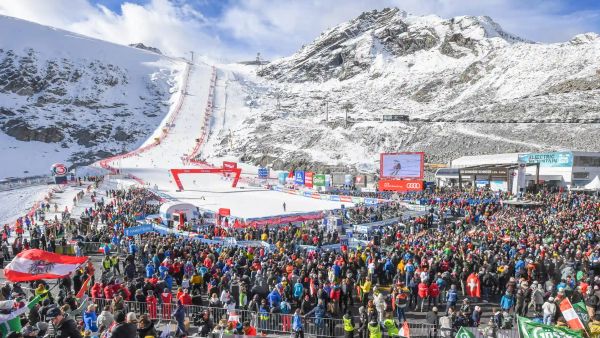
Pinheiro Braathen Wins Sölden Giant Slalom Opener by 0.48 Seconds
Two days at Sölden, two races decided by a hundredth somewhere on the podium, and one very quick Brazilian. Lucas Pinheiro Braathen led from the first run to win the men’s World Cup opener by 0.48 seconds, with Loïc Meillard second and Marco Odermatt third. River Radamus charged from 15th to fourth on a rutted course, and Britain’s Freddy Carrick-Smith banked his first World Cup points. Braathen still hasn’t lost a giant slalom since Olympic gold.
25 Oct 2026

Alps Snow Forecast: Up to 64 cm Headed for the High Glaciers as the Snow Line Drops
The Alps are about to swap mild, sunny October weather for something far more wintry. A cold front arrives Tuesday, and SnowStash forecasts have Monterosa Ski out in front with 64 cm over 14 days, ahead of Blatten Belalp (55 cm) and Verbier (43 cm). The snow line should fall below 2000 metres by Wednesday night, and glaciers across Switzerland, Italy and Austria are in line for the best of it. The wind will have a say too.
20 Oct 2026

Four Dead After Avalanche Near Ski Portillo in Chile
A large avalanche struck near Laguna del Inca adjacent to Ski Portillo on Saturday afternoon, killing four people and injuring four others. The group were day visitors mountaineering in the backcountry after reportedly being warned about elevated avalanche risk by resort staff.
18 Oct 2026

Europe Ski Resorts Open Now: What Is Skiable in Mid-October 2026
Europe’s ski season is open, technically. After a record-warm summer, glaciers in Austria, Switzerland and Italy are running a few pistes apiece, Sölden, Stubai and Kitzsteinhorn started late, Titlis has pushed back to 24 October, and Zermatt reopens a few lifts on 14 October after more than two months shut. Finland’s Levi and Ruka are skiing on stored snow. Here is what is open, and what you actually get at each.
14 Oct 2026

Zermatt Plans World Cup Downhill Return on the Gornergrat for 2028
Zermatt is having another crack at a World Cup downhill, and this time nobody has to cross a border. Around 13 million Swiss francs is going into rebuilding the Gornergrat piste, including a jump fed by a roughly 300-metre in-run across the roof of the Gornergrat Railway gallery, with the Matterhorn lined up behind it for the TV cameras. First men’s race is pencilled in for March 2028, pending FIS homologation.
14 Oct 2026

Mt. Rose Begins Snowmaking for the 2026-27 Season at Lake Tahoe
Lake Tahoe’s highest base elevation is paying off early: Mt. Rose has started making snow for 2026-27 after the first flurries and a cold snap. The Nevada resort is backing it with nearly US$2 million in upgrades, including a replacement snowmaking main line, a new PistenBully groomer and restraint bars on every lift. Opening day is yet to be confirmed, though Heavenly and Northstar are already eyeing 20 November.
13 Oct 2026

Utah Ski Resorts 2026-27: What’s New at Alta, Deer Valley, Powder Mountain and More
Utah is still building flat out. For 2026-27, Powder Mountain opens a steep new Skytrac chair into more than 1,000 acres of advanced terrain, Deer Valley adds 200 acres on Hail Peak, Sundance gets a new quad and Park City adds a gondola from its new parking structure. Snowmaking is expanding almost everywhere, Eagle Point stays closed after the Cottonwood Fire, and the 2034 Games are setting the pace. Here’s what’s new, resort by resort.
13 Oct 2026

Mt Hutt Invests NZ$12 Million in Base Area, Tripling Its Sun Deck
Mt Hutt is getting busier, and its base lodge is about to catch up. NZ$12 million goes into a heated sun deck roughly three times the current size (430 m² to 1,300 m²), plus a new toilet block, heated steps down to snow level, extra storage and a new food and beverage outlet. Building starts after the 2026 season, with everything due for winter 2027.
11 Oct 2026