
Niseko United
Four interconnected resorts, 940m vertical, 10-15m annual snowfall. Ikon Pass access on Mount Annupuri, Hokkaido.
Season 2026 - 2027
Opens
5 Dec 2026
Closes
6 May 2027
Days open
152
Annual snow
18m
The Overview
Michael Fulton
Melbourne-based skier and snowboarder with 50+ resorts across 5 continents. Specialises in Australian resorts and international resort comparisons.
Niseko United comprises four interconnected resorts on Mount Niseko Annupuri spanning 885 hectares with 84 runs, 940 metres of vertical drop, and elevations from 260 to 1,308 metres. Grand Hirafu, Hanazono, Niseko Village, and Annupuri combine under a single All Mountain Pass accepted by Ikon Pass holders. The area averages 10 to 15 metres of annual snowfall driven by Siberian weather systems crossing the Sea of Japan, delivering exceptionally dry powder with 8 per cent moisture content. Mount Yōtei dominates views from below-treeline terrain that wraps the volcanic cone.
Grand Hirafu holds 30 marked runs including the ungroomed Super Course accessible from King Hooded Lift #3, now a high-speed six-seater with heated seats. Hanazono features Strawberry Fields tree runs and terrain parks served by an eight-seat Symphony Gondola. Niseko Village offers the area's longest gondola at 2,660 metres and runs like Superstition, whilst Annupuri delivers family terrain and wide-open groomed slopes. Terrain breaks down to 44 per cent beginner, 36 per cent intermediate, 15 per cent advanced, and 5 per cent expert across 84 runs.
Hirafu village anchors international visitor traffic with lodging, restaurants, and night skiing operating until 9:00pm from mid-December to late March on one of Asia's largest floodlit areas. Backcountry gates provide regulated access from Grand Hirafu and Niseko Village to untracked zones, with CAT operations on adjacent peaks. English signage and staff support a cosmopolitan atmosphere concentrated around Hirafu's base. Free shuttle buses connect all four base areas for All Mountain Pass holders.
The Ikon Pass Full provides seven consecutive days with no blackout dates, whilst Base and Session passes offer five days with restrictions during late December and mid-January. The Mountain Collective grants two free days plus 50 per cent off additional tickets. The 2025-26 season runs from 29 November to 6 May for Hirafu and Annupuri, closing 12 April for Hanazono and Niseko Village. Niseko suits powder seekers, tree skiers, intermediates chasing vertical, and families wanting gentle progression terrain.
940m
Vertical
84
Runs
2,199 acres
Skiable
18m
Annual snow
Ikon Pass / Mountain Collective
Pass
The Terrain
84 runs across 2,199 acres skiable
Niseko United links four resorts on Mount Niseko Annupuri across about 890 hectares, Grand Hirafu, Hanazono, Niseko Village and Annupuri, with 84 runs and 940 vertical metres from 1,200 metres to 260 metres. About 18 metres of dry snow falls in a typical year. The split is 44% beginner, 36% intermediate, 15% advanced and 5% expert, so the headline is breadth rather than extreme pitch. Eleven double chairs, six quads, three single chairs, a six-seater and seven gondolas move people around the mountain, though lift quality varies between sectors, and the full circuit takes planning. Mount Yotei fills the view at lower elevations.
Each sector suits different skiers. Hirafu has the biggest run count, the ungroomed Super Course and the widest night skiing, while Hanazono offers tree runs such as Strawberry Fields, parks and an eight-seat gondola. Niseko Village adds long groomers off its gondola, and Annupuri is the quieter family end with open cruising. Gates at Hirafu, Hanazono, Niseko Village and Annupuri give controlled access to backcountry terrain, with no patrol or avalanche control beyond them, so beacon, probe and shovel are essential. Intermediates get plenty of mileage, and powder skiers can chase trees and open bowls on a single pass.
Terrain split
84
runs
84 runs across 4 grades
Beginner37 runs · 44%
Intermediate30 runs · 36%
Advanced13 runs · 15%
Expert4 runs · 5%
Time it right
When to visit Niseko United
The 2025-26 season opened 29 November across all four areas, with Grand Hirafu and Annupuri operating until 6 May 2026 through Japan's Golden Week, whilst Niseko Village and Hanazono close 12 April. Early-season dates depend on natural snowfall as the resort relies minimally on snowmaking, with full operations typically established by mid-December. Night skiing runs from 13 December 2025 to 22 March 2026 at Hirafu and Annupuri, with lifts operating until 9:00pm. Spring skiing continues into April with reduced lift schedules and warmer temperatures suited to cruising groomed runs.
Annual snowfall averages 10 to 15 metres at village level with significantly more accumulation near the 1,308-metre summit, driven by consistent northwesterly flow from Siberia. The moisture-laden air releases ultra-dry powder with minimal water content across extended storm cycles. January and February deliver peak snowfall with base depths frequently exceeding 300 centimetres and near-daily snowfall replenishing tracked terrain. The low base elevation of 260 metres maintains powder quality through cold ambient temperatures averaging minus 8 degrees Celsius during winter.
Late December through mid-February offers the deepest snowpack and most consistent powder resets, though crowds peak during Christmas, New Year, and mid-January holidays. Late February balances excellent snow with improving visibility and lighter traffic. March transitions to spring conditions with longer daylight, warmer temperatures, and firm morning groomers softening by midday. April and early May suit families and value-seekers with discounted lift tickets, reduced crowds, and reliable coverage on north-facing runs.
Niseko divides pricing into Early Season (late November to early December), Regular Season (mid-December to late December and early March), Peak Season (late December to February), Spring Season (late March to early April), and Final Season (April to May with 30 per cent discounts). Major events include opening ceremonies, Lunar New Year celebrations in late January, and closing festivals during Golden Week. Night skiing from Hirafu Gondola and Ace Quad creates one of Asia's largest illuminated ski areas with tree runs and park features lit until 9:00pm.
Season 2026 - 2027
5 Dec 2026
Opens
6 May 2027
Closes
152
Days open
18 m
Annual snow
Getting there
Getting to Niseko United, and where to stay
Niseko United occupies the eastern slopes of Mount Niseko Annupuri in Shiribeshi Subprefecture on Hokkaido, Japan's northernmost main island, within the Niseko-Shakotan-Otaru Kaigan Quasi-National Park. The resort sits approximately 100 kilometres southwest of Sapporo in the Niseko Volcanic Group, with the 1,898-metre Mount Yōtei volcano dominating southern views. Base villages range from 240 to 300 metres elevation in valleys formed by the Shiribetsu River system. The area straddles the municipalities of Kutchan and Niseko town, with Hirafu village serving as the primary international hub.
Kutchan lies 8 kilometres east of Hirafu with a population near 15,000, whilst Niseko town sits 7 kilometres from Annupuri and Niseko Village bases. Hirafu has evolved into Hokkaido's most cosmopolitan ski village with international restaurants, accommodation, and services concentrated within walking distance of Grand Hirafu lifts. The actual town of Niseko and Kutchan provide supermarkets, train stations, and local dining beyond the resort bubble. The region's Ainu heritage appears in place names, with Niseko derived from Nisekoanbetsu meaning river toward the cliff.
Route 5 runs through Kutchan connecting to Route 230 via Nakayama Pass, the primary road from Sapporo covering approximately 92 kilometres with drive times near two hours in winter conditions. Route 276 links Kimobetsu to Kutchan, whilst Route 343 accesses Hanazono directly from Route 5. Winter driving requires snow tyres or chains, with mountain passes occasionally closing during heavy snowfall. Shuttle buses operate between resort villages, with free inter-resort transport included for All Mountain Pass holders during operational hours.
New Chitose Airport near Sapporo sits approximately 100 kilometres northeast with direct international flights from Australia, Asia, and seasonal connections from North America. Airport buses operate multiple times daily during winter season covering the journey in 2.5 to 3 hours depending on stops and conditions. Train access requires connections from the airport to Sapporo, then via Otaru on the Hakodate Main Line to Kutchan Station, totalling 3.5 hours before a final 15-minute taxi to resort bases. Private transfer services and rental cars offer door-to-door flexibility with winter driving experience recommended for mountain roads.
Where to stay
Search all stays →Hotels and lodges near Niseko United, powered by Stay22.
Latest News
From the SnowStash desk

Europe Ski Resorts Open Now: What Is Skiable in Mid-October 2026
Europe’s ski season is open, technically. After a record-warm summer, glaciers in Austria, Switzerland and Italy are running a few pistes apiece, Sölden, Stubai and Kitzsteinhorn started late, Titlis has pushed back to 24 October, and Zermatt reopens a few lifts on 14 October after more than two months shut. Finland’s Levi and Ruka are skiing on stored snow. Here is what is open, and what you actually get at each.
14 Oct 2026

Zermatt Plans World Cup Downhill Return on the Gornergrat for 2028
Zermatt is having another crack at a World Cup downhill, and this time nobody has to cross a border. Around 13 million Swiss francs is going into rebuilding the Gornergrat piste, including a jump fed by a roughly 300-metre in-run across the roof of the Gornergrat Railway gallery, with the Matterhorn lined up behind it for the TV cameras. First men’s race is pencilled in for March 2028, pending FIS homologation.
14 Oct 2026

Mt. Rose Begins Snowmaking for the 2026-27 Season at Lake Tahoe
Lake Tahoe’s highest base elevation is paying off early: Mt. Rose has started making snow for 2026-27 after the first flurries and a cold snap. The Nevada resort is backing it with nearly US$2 million in upgrades, including a replacement snowmaking main line, a new PistenBully groomer and restraint bars on every lift. Opening day is yet to be confirmed, though Heavenly and Northstar are already eyeing 20 November.
13 Oct 2026

Utah Ski Resorts 2026-27: What’s New at Alta, Deer Valley, Powder Mountain and More
Utah is still building flat out. For 2026-27, Powder Mountain opens a steep new Skytrac chair into more than 1,000 acres of advanced terrain, Deer Valley adds 200 acres on Hail Peak, Sundance gets a new quad and Park City adds a gondola from its new parking structure. Snowmaking is expanding almost everywhere, Eagle Point stays closed after the Cottonwood Fire, and the 2034 Games are setting the pace. Here’s what’s new, resort by resort.
13 Oct 2026

Mt Hutt Invests NZ$12 Million in Base Area, Tripling Its Sun Deck
Mt Hutt is getting busier, and its base lodge is about to catch up. NZ$12 million goes into a heated sun deck roughly three times the current size (430 m² to 1,300 m²), plus a new toilet block, heated steps down to snow level, extra storage and a new food and beverage outlet. Building starts after the 2026 season, with everything due for winter 2027.
11 Oct 2026

Vermont Ski Resort Opening Dates 2026-27: Few Dates Set, Killington Waits on the Cold
Vermont's season is slow to take shape. Stratton is tentatively targeting 18 November and Sugarbush 21 November, while Pico has Friday 11 December on the calendar. Killington never sets a date and opens when the snowmaking allows, and Vail Resorts has yet to name days for Stowe, Okemo and Mount Snow. The forecasts disagree about snow, and the main El Niño worry for the Green Mountains is warmth.
9 Oct 2026

Crans-Montana 2027 World Championships President Resigns Ahead of Fraud Hearing
Less than four months out from the Crans-Montana 2027 World Championships, the man running the organising committee has stepped down. Claude-Alain Schmidhalter resigned as Swiss-Ski vice president and OC president after being indicted over a business dispute unrelated to skiing. He denies the allegations and faces court on October 27. Interim leaders are in place for the February 1-14 event.
9 Oct 2026

Kelly Canyon, Idaho, Adds Snowmaking, a Bigger Terrain Park and More Parking for 2026-27
Kelly Canyon had a rough 2025-26, and the Idaho resort has spent the summer making sure it doesn’t repeat. Snowmaking now reaches the top of Goldrush, the terrain park is doubling in size with a stereo system, lights and a snack shack, and the car park is getting bigger. Grooming is stepping up too. Target opening is December 4, conditions permitting.
9 Oct 2026
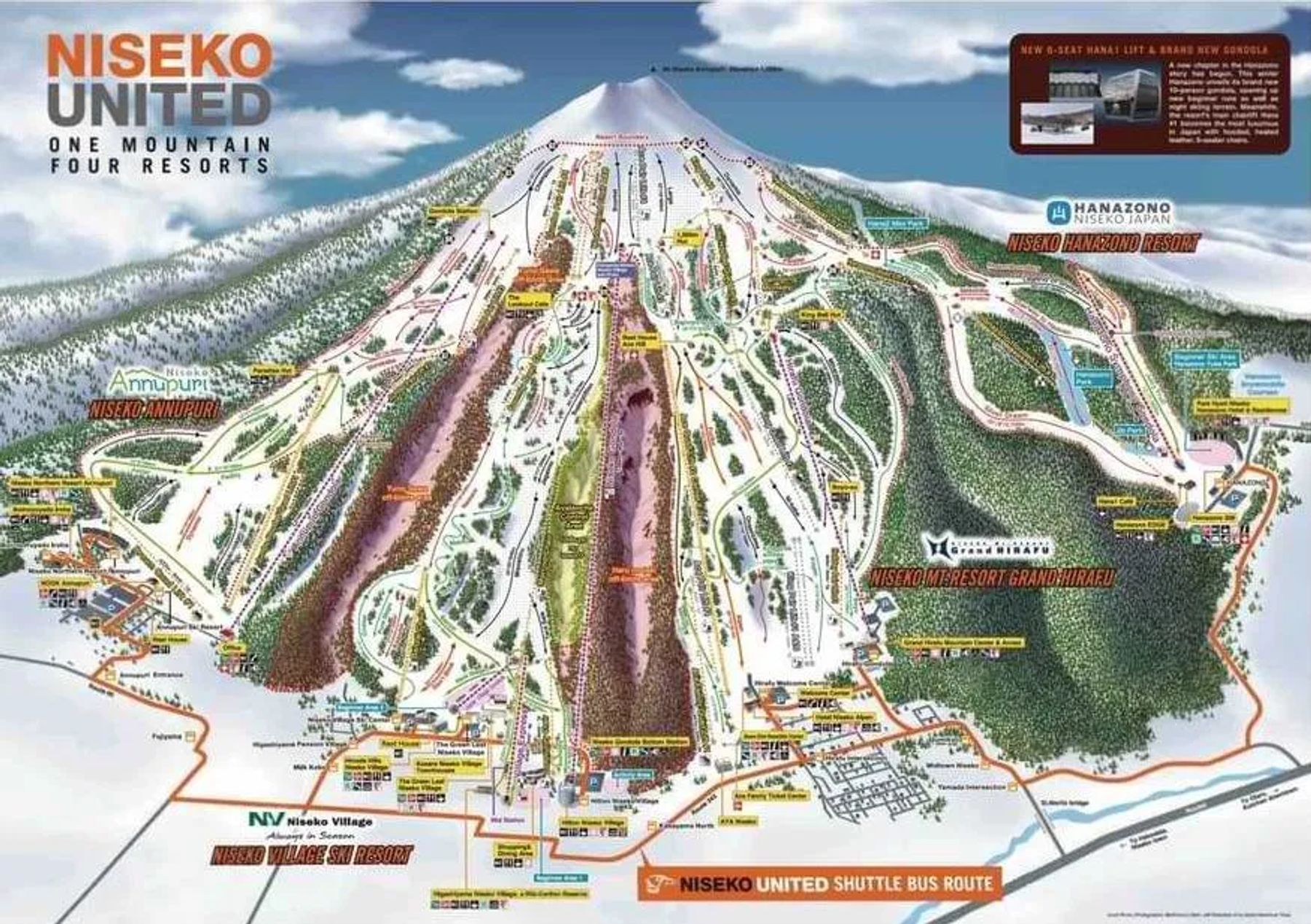
Niseko United Trail Map
Downloadable Niseko United trail map
Terrain split
84
runs
Beginner44%
Intermediate36%
Advanced15%
Expert5%
2,199 acres skiable890 hectares
Resort Stats
Elevation
Base260m
Summit1200m
Annual snowfall
18m
Season
2026 - 2027
5 Dec 2026 - 6 May 2027
Trail coverage
84 runs
2,199 acres (890 ha)
About Niseko United's trail map
Explore Niseko United's full trail map with 84 runs across the mountain, colour-coded by difficulty and shown alongside the terrain split. Use it to plan a day that matches your ability, find lift-served pockets of your favourite grade, and see how the resort links together. Download the piste map (PDF) ↗
More Niseko United intelligence: snow report, lift system, webcams, resort overview.