
Wachusett Mountain
27 runs, 125 acres near Boston. Session-based tickets, extensive night skiing, family-owned since 1969.
Season 2026 - 2027
Opens
21 Nov 2026
Closes
9 Apr 2027
Days open
139
Annual snow
100in
The Overview
Michael Fulton
Melbourne-based skier and snowboarder with 50+ resorts across 5 continents. Specialises in Australian resorts and international resort comparisons.
Wachusett Mountain's summit reaches 2,005 feet, dropping roughly 1,000 vertical feet to a base at 1,007 feet across 27 runs spread over 125 acres in Princeton, Massachusetts. Terrain splits 63 per cent intermediate, 19 per cent beginner and 18 per cent advanced, with no expert-rated runs. Average annual snowfall is modest at roughly 100 inches, so the resort relies heavily on snowmaking. Wachusett carries no major multi-resort pass affiliation and remains independently, family-owned.
Eight lifts, including three quads, one triple and four surface lifts, serve the 27-run network. Session-based ticketing, split across morning, midday, afternoon and night windows, is a distinctive feature reflecting the resort's role serving after-work and evening skiers from the Boston area. Extensive night skiing runs alongside daytime operations. The mountain is close enough to Boston that the city's skyline is visible from some trails.
Ralph D. Crowley won a competitive bid for the ski area's lease in 1968 after a family ski trip to Vermont's Mount Snow sparked his children's interest in the sport; his then ten-year-old son David reportedly suggested the winning bid amount of 16,002 US dollars for a five-year lease. The Crowley family has run Wachusett since 1969, now into a third generation, making it one of the longest continuously family-run ski areas in New England. David Crowley Sr., who spent nearly 50 years in the ski industry, passed away in November 2024.
With no major pass affiliation, Wachusett sells tickets through its own session-based structure rather than a single day-rate model. Adult session tickets range from roughly 59 to 99 US dollars depending on the time window and date, with a Gold Season Pass priced at 699 dollars. The resort suits Boston-area skiers seeking the closest major mountain to the city, particularly for evening and night sessions after work. Its long-standing Crowley family ownership since 1969 distinguishes it from the region's larger corporate-owned resorts.
997ft
Vertical
27
Runs
125 acres
Skiable
100in
Annual snow
The Terrain
27 runs across 125 acres skiable
Wachusett Mountain rises above Princeton in central Massachusetts, with 125 acres (51 hectares) and 27 runs about an hour from Boston. The base is at 1,010 ft (307 m) and the summit at 2,000 ft (611 m), a vertical of about 1,000 ft (304 m). The terrain splits 19% beginner, 63% intermediate and 18% advanced, with no expert runs on the map. Three quad chairs, a triple and four surface lifts keep it moving, which suits the area's crowds of after-work skiers and weekend visitors.
Conifer Connection is the longest run at 1.5 miles, running from the top to the base, and Upper Conifer sits nearby through a stand of conifers. Balance Rock follows a trail designed by Charles Parker and improved by the CCC in 1936, while Smith Walton is named for two skiers who loved the mountain. The Polar Express lift runs to the summit, and two terrain parks sit off the Challenger and Monadnock lifts. Night skiing keeps the lifts busy after dark. It fits families, beginners and intermediates wanting a quick session near the city.
Terrain split
27
runs
27 runs across 4 grades
Beginner5 runs · 19%
Intermediate17 runs · 63%
Advanced5 runs · 18%
Expert0 runs · 0%
Time it right
When to visit Wachusett Mountain
The 2025-26 season at Wachusett Mountain ran from 6 December 2025 to 13 April 2026, a roughly nineteen-week window supported substantially by snowmaking. The resort's modest natural snowfall means season length depends heavily on temperatures suitable for artificial snow production. Season dates can shift based on early and late-season weather. This is a comparatively long season given Wachusett's snowfall totals.
Average annual snowfall of roughly 100 inches is modest for New England, meaning Wachusett depends on snowmaking for the majority of its season-long conditions. This makes temperature, more than storm cycles, the key variable in operating reliability. Base depth is maintained largely through machine-made snow across the season. Specific snowmaking coverage percentage is not confirmed in available resort information, though it is understood to be extensive.
Midwinter, from late December through February, typically offers the most reliable conditions once snowmaking has built a consistent base. Evening and night sessions draw heavy demand from Boston-area commuters throughout the week, not just weekends. Weekend daytime crowds are generally heaviest given the resort's proximity to a large metropolitan population. Late-season visits into April can be inconsistent as temperatures warm and snowmaking becomes less viable.
Wachusett's session-based calendar, split across morning, midday, afternoon and night windows, is itself a distinctive seasonal feature reflecting demand patterns from its Boston-area customer base. The resort's continued Crowley family ownership since 1969 has shaped this operating model over more than five decades. Specific festival or event programming beyond standard session-based operations is not confirmed in available resort information. As the closest major ski area to Boston, the calendar centres on maximising accessible hours across the working week.
Season 2026 - 2027
21 Nov 2026
Opens
9 Apr 2027
Closes
139
Days open
100 in
Annual snow
Getting there
Getting to Wachusett Mountain, and where to stay
Wachusett Mountain sits in Princeton, Massachusetts, with a base elevation of 1,007 feet and a summit at 2,005 feet across a vertical drop of roughly 1,000 feet over 125 acres. This is central Massachusetts, close enough to Boston that the city's skyline is visible from some trails on clear days. The mountain sits within Wachusett Mountain State Reservation. This proximity to a major metropolitan area, combined with a genuine mountain setting, is unusual in New England skiing.
Princeton itself is a small town, with Worcester, Massachusetts' second-largest city, serving as the more substantial nearby service centre. Boston lies further east, the resort's primary source of visitors given the mountain's status as the closest major ski area to the city. The region carries a suburban and semi-rural central Massachusetts character rather than a dedicated ski-town identity. Route 495 and Route 2 corridors connect the area to greater Boston.
Route 62 and other local roads connect Princeton to Route 190 and the broader central Massachusetts highway network. The drive from Boston takes roughly an hour under normal conditions, a key factor in Wachusett's popularity for after-work and evening skiing. Winter driving on the approach roads can include snow and ice, though routes are generally well-maintained given traffic volume from the Boston area. No direct public transport service reaches the resort itself.
Boston Logan International Airport is the nearest major airport with extensive commercial and international service, roughly an hour and a half from the resort by road. Worcester Regional Airport offers a smaller, closer alternative with more limited flight options. Most visitors reach Wachusett by car directly from the Boston metropolitan area rather than flying into a specific regional airport. No rail service reaches the resort directly.
Where to stay
Search all stays →Hotels and lodges near Wachusett Mountain, powered by Stay22.
Latest News
From the SnowStash desk
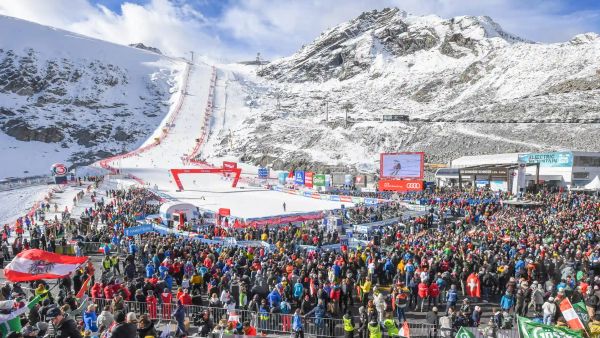
Pinheiro Braathen Wins Sölden Giant Slalom Opener by 0.48 Seconds
Two days at Sölden, two races decided by a hundredth somewhere on the podium, and one very quick Brazilian. Lucas Pinheiro Braathen led from the first run to win the men’s World Cup opener by 0.48 seconds, with Loïc Meillard second and Marco Odermatt third. River Radamus charged from 15th to fourth on a rutted course, and Britain’s Freddy Carrick-Smith banked his first World Cup points. Braathen still hasn’t lost a giant slalom since Olympic gold.
25 Oct 2026

Alps Snow Forecast: Up to 64 cm Headed for the High Glaciers as the Snow Line Drops
The Alps are about to swap mild, sunny October weather for something far more wintry. A cold front arrives Tuesday, and SnowStash forecasts have Monterosa Ski out in front with 64 cm over 14 days, ahead of Blatten Belalp (55 cm) and Verbier (43 cm). The snow line should fall below 2000 metres by Wednesday night, and glaciers across Switzerland, Italy and Austria are in line for the best of it. The wind will have a say too.
20 Oct 2026

Four Dead After Avalanche Near Ski Portillo in Chile
A large avalanche struck near Laguna del Inca adjacent to Ski Portillo on Saturday afternoon, killing four people and injuring four others. The group were day visitors mountaineering in the backcountry after reportedly being warned about elevated avalanche risk by resort staff.
18 Oct 2026

Europe Ski Resorts Open Now: What Is Skiable in Mid-October 2026
Europe’s ski season is open, technically. After a record-warm summer, glaciers in Austria, Switzerland and Italy are running a few pistes apiece, Sölden, Stubai and Kitzsteinhorn started late, Titlis has pushed back to 24 October, and Zermatt reopens a few lifts on 14 October after more than two months shut. Finland’s Levi and Ruka are skiing on stored snow. Here is what is open, and what you actually get at each.
14 Oct 2026

Zermatt Plans World Cup Downhill Return on the Gornergrat for 2028
Zermatt is having another crack at a World Cup downhill, and this time nobody has to cross a border. Around 13 million Swiss francs is going into rebuilding the Gornergrat piste, including a jump fed by a roughly 300-metre in-run across the roof of the Gornergrat Railway gallery, with the Matterhorn lined up behind it for the TV cameras. First men’s race is pencilled in for March 2028, pending FIS homologation.
14 Oct 2026

Mt. Rose Begins Snowmaking for the 2026-27 Season at Lake Tahoe
Lake Tahoe’s highest base elevation is paying off early: Mt. Rose has started making snow for 2026-27 after the first flurries and a cold snap. The Nevada resort is backing it with nearly US$2 million in upgrades, including a replacement snowmaking main line, a new PistenBully groomer and restraint bars on every lift. Opening day is yet to be confirmed, though Heavenly and Northstar are already eyeing 20 November.
13 Oct 2026

Utah Ski Resorts 2026-27: What’s New at Alta, Deer Valley, Powder Mountain and More
Utah is still building flat out. For 2026-27, Powder Mountain opens a steep new Skytrac chair into more than 1,000 acres of advanced terrain, Deer Valley adds 200 acres on Hail Peak, Sundance gets a new quad and Park City adds a gondola from its new parking structure. Snowmaking is expanding almost everywhere, Eagle Point stays closed after the Cottonwood Fire, and the 2034 Games are setting the pace. Here’s what’s new, resort by resort.
13 Oct 2026

Mt Hutt Invests NZ$12 Million in Base Area, Tripling Its Sun Deck
Mt Hutt is getting busier, and its base lodge is about to catch up. NZ$12 million goes into a heated sun deck roughly three times the current size (430 m² to 1,300 m²), plus a new toilet block, heated steps down to snow level, extra storage and a new food and beverage outlet. Building starts after the 2026 season, with everything due for winter 2027.
11 Oct 2026
Wachusett Mountain Webcams
4 live angles across the mountain. Tap any camera to go full-screen.
About Wachusett Mountain's live webcams
Check live conditions across Wachusett Mountain with 4 real-time webcams showing snow, weather, and lift operations, updated every 10 minutes. Check high-elevation cams for powder visibility and base-area cams for crowd levels before you head up.
Camera guide
- Wachusett Mountain Web Cam | Summit Cam1,030ft
- Experience sweeping uphill perspectives through this Wachusett Mountain webcam at the base area positioned at 314 meters elevation. This Wachusett live cam delivers excellent views from the base straight to the summit across the main face. Perfect for checking multiple trail conditions simultaneously, this live snow cam helps Boston-area skiers assess visibility and snow quality at New England's closest major ski resort to the city.
- Wachusett Mountain Web Cam | Nastar Cam1,184ft
- Watch the racing action through this Wachusett Mountain webcam at the NASTAR zone positioned at 361 meters elevation. This Wachusett web cam captures the excitement on the race course and current snow conditions. Racers and spectators use this live snow cam to monitor the popular NASTAR racing program at Massachusetts' largest ski area just an hour from Boston.
- Wachusett Mountain Web Cam | Look Mom Cam1,184ft
- Monitor intermediate terrain through this Wachusett Mountain webcam on Look Mom trail positioned at 361 meters elevation. This Wachusett live cam reveals snow conditions and grooming quality on one of the resort's finest intermediate runs. Skiers use this Wachusett web cam to check carving conditions on this popular trail at central Massachusetts' premier ski destination.
- Wachusett Mountain Web Cam | Beginner Cam1,030ft
- Check beginner terrain through this Wachusett Mountain webcam at the learning area by the Monadnock Express lift positioned at 314 meters elevation. This Wachusett live cam provides comprehensive views of the beginner zone and ski school operations. Families use this live snow cam to assess conditions in the learning area before introducing kids to skiing at Boston's closest mountain.
Wachusett Mountain snow cams FAQ
How often do Wachusett Mountain snow cams update?
All Wachusett Mountain snow cams and webcams update every 10 minutes with fresh images showing current mountain conditions. This frequent update schedule ensures you have access to near real-time conditions for planning your ski day at Wachusett Mountain.
Which Wachusett Mountain webcam shows the best powder conditions?
The high-elevation Wachusett Mountain Web Cam | Nastar Cam webcam at 361m provides the clearest view of powder conditions and snowfall. These Wachusett Mountain webcams capture fresh snow accumulation and visibility better than base area cameras.
Can I see Wachusett Mountain lift queues on the webcams?
Yes. Multiple Wachusett Mountain snow cams specifically show lift queue areas and chairlift operations, helping you time your arrival and avoid peak queue periods.
When is the best time to check Wachusett Mountain snow cams?
Check Wachusett Mountain webcams early morning (7-8am) for overnight snowfall assessment, and mid-afternoon for current crowd levels and weather. The live cams are most useful after storm events to assess fresh powder.
How can I check current conditions before buying Wachusett Mountain lift tickets?
Use our Wachusett Mountain webcams alongside the live snow report to assess conditions before purchasing lift tickets. The webcams show real-time visibility, snow quality, and operational status.
Do Wachusett Mountain webcams work on mobile devices?
Yes. All Wachusett Mountain snow cams and webcams are optimized for mobile viewing, so you can check live conditions from anywhere using your phone or tablet.
More Wachusett Mountain intelligence: snow report, lift tickets, trail map, resort overview.