
Grouse Mountain
86 hectares, 33 runs in North Vancouver. Celebrating 100 years in 2026, closest resort to downtown Vancouver.
Season 2026 - 2027
Opens
18 Dec 2026
Closes
18 Apr 2027
Days open
121
Annual snow
9m
The Overview
Michael Fulton
Melbourne-based skier and snowboarder with 50+ resorts across 5 continents. Specialises in Australian resorts and international resort comparisons.
Grouse Mountain's summit reaches 1,250 metres, dropping 369 vertical metres to a base at 881 metres across 33 runs spread over roughly 86 hectares in North Vancouver, British Columbia. Terrain splits 48 per cent intermediate, 30 per cent advanced, 12 per cent beginner and 10 per cent expert, with average annual snowfall of roughly 9.2 metres. Seven lifts, including one aerial tram, four quad chairs, one triple chair and one gondola, serve the mountain.
Grouse Mountain marks its 100th anniversary as a ski resort in 2026, having operated continuously since its inaugural season in 1926, and remains one of Vancouver's most visited natural attractions across all seasons. Its considerable proximity to downtown Vancouver has built Grouse's reputation as the city's most accessible mountain, drawing both dedicated skiers and casual day visitors.
The mountain was named in October 1894 by the first recorded hikers to reach its summit, who hunted a Blue Grouse along the way and honoured the bird in naming the peak. The Cromie family, then owners of the Vancouver Sun newspaper, purchased Grouse Mountain for 75,000 Canadian dollars in 1945, before Andrew Saxton Sr and a group of investors bought the mountain from the Cromies in 1964.
The McLaughlin family gained a controlling interest in 1974 and purchased the remaining shares in 1989 to achieve full private ownership. Grouse Mountain now operates as a Northland Properties company, remaining locally family owned. A new Grouse Gravity Coaster opened in spring 2026 as part of the resort's centennial celebrations. Adult daily tickets run from 89 to 109 Canadian dollars.
369m
Vertical
33
Runs
213 acres
Skiable
9m
Annual snow
The Terrain
33 runs across 213 acres skiable
Grouse Mountain is a compact city ski area above North Vancouver, with 33 runs over about 86 hectares and a 369-metre vertical between 881 and 1,250 metres. It skis steeper than the size suggests, with 48% intermediate, 30% advanced, 10% expert and 12% beginner. The Skyride aerial tram carries skiers up from the valley, and the mountain is built for short, efficient laps rather than long days of exploring. Around 9.2 metres of snow falls in a typical season, though a low base elevation means conditions can turn soft and wet.
The Cut is the signature run and is floodlit for night skiing, along with Peak, Heaven's Sake and several other favourites. Quad chairs such as the Olympic Express and Screaming Eagle move skiers around the upper mountain, and the Greenway chair serves beginner terrain. Grouse suits after-work skiers, intermediates polishing technique and beginners who want a short trip from the city. Experts and anyone wanting a full day of variety will tire of it quickly, so think of it as a local hill with a great view.
Terrain split
33
runs
33 runs across 4 grades
Beginner4 runs · 12%
Intermediate16 runs · 48%
Advanced10 runs · 30%
Expert3 runs · 10%
Time it right
When to visit Grouse Mountain
The 2025-26 season at Grouse Mountain ran from 22 November 2025 to 5 April 2026, a roughly nineteen-week season supported by average annual snowfall of around 9.2 metres. This season also marked Grouse's 100th anniversary as a ski resort, having first opened for skiing in 1926.
Midwinter, from December through February, typically brings the most consistent conditions to Grouse's intermediate-weighted terrain. Given its considerable proximity to Vancouver, Grouse draws a genuinely broad visitor base, from dedicated local skiers to casual visitors combining skiing with the mountain's other attractions.
Grouse's night-skiing programme continues to draw strong weekday evening visitation from Vancouver throughout the season. School holiday periods bring substantial family visitation given the resort's considerable proximity to the city and year-round attractions.
The resort's centennial celebrations, marketed as Grouse100, ran throughout the 2025-26 season alongside standard operations, including the spring 2026 opening of the new Grouse Gravity Coaster. Grouse Mountain continues to build on a full century of history since its 1926 founding under Northland Properties' family ownership. The resort's Vancouver proximity and centennial milestone remain central to its identity this season.
Season 2026 - 2027
18 Dec 2026
Opens
18 Apr 2027
Closes
121
Days open
9 m
Annual snow
Getting there
Getting to Grouse Mountain, and where to stay
Grouse Mountain sits in North Vancouver, British Columbia, on the North Shore mountains, with a base elevation of 881 metres and a summit at 1,250 metres across a 369-metre vertical drop over roughly 86 hectares. This setting places Grouse within Metro Vancouver, closer to downtown than any other resort in the region.
North Vancouver and the broader Metro Vancouver region offer extensive lodging, dining and services within a short drive of the resort, given Grouse's position essentially within the city's boundaries.
Nancy Greene Way provides direct access to the resort's base, from where the Skyride aerial tram carries visitors up the mountain. Winter driving conditions on the approach road can include snow and ice at higher elevations.
Vancouver International Airport, roughly a 45-minute drive away, is the primary gateway for visitors flying into the region, with Grouse's considerable proximity to downtown Vancouver making it a genuinely convenient option for international visitors and local skiers alike.
Where to stay
Search all stays →Hotels and lodges near Grouse Mountain, powered by Stay22.
Latest News
From the SnowStash desk

Utah Ski Resorts 2026-27: What’s New at Alta, Deer Valley, Powder Mountain and More
Utah is still building flat out. For 2026-27, Powder Mountain opens a steep new Skytrac chair into more than 1,000 acres of advanced terrain, Deer Valley adds 200 acres on Hail Peak, Sundance gets a new quad and Park City adds a gondola from its new parking structure. Snowmaking is expanding almost everywhere, Eagle Point stays closed after the Cottonwood Fire, and the 2034 Games are setting the pace. Here’s what’s new, resort by resort.
13 Oct 2026

Vermont Ski Resort Opening Dates 2026-27: Few Dates Set, Killington Waits on the Cold
Vermont's season is slow to take shape. Stratton is tentatively targeting 18 November and Sugarbush 21 November, while Pico has Friday 11 December on the calendar. Killington never sets a date and opens when the snowmaking allows, and Vail Resorts has yet to name days for Stowe, Okemo and Mount Snow. The forecasts disagree about snow, and the main El Niño worry for the Green Mountains is warmth.
9 Oct 2026
Crans-Montana 2027 World Championships President Resigns Ahead of Fraud Hearing
Less than four months out from the Crans-Montana 2027 World Championships, the man running the organising committee has stepped down. Claude-Alain Schmidhalter resigned as Swiss-Ski vice president and OC president after being indicted over a business dispute unrelated to skiing. He denies the allegations and faces court on October 27. Interim leaders are in place for the February 1-14 event.
9 Oct 2026
Kelly Canyon, Idaho, Adds Snowmaking, a Bigger Terrain Park and More Parking for 2026-27
Kelly Canyon had a rough 2025-26, and the Idaho resort has spent the summer making sure it doesn’t repeat. Snowmaking now reaches the top of Goldrush, the terrain park is doubling in size with a stereo system, lights and a snack shack, and the car park is getting bigger. Grooming is stepping up too. Target opening is December 4, conditions permitting.
9 Oct 2026
Valle Nevado Extends Season to November 8 After 108 cm in 48 Hours
Winter was meant to be winding down in Chile. Then Valle Nevado took 108 cm in 48 hours in early October, and the resort has pushed its closing date out to November 8 - its latest in 38 years of operation. That makes 143 days of skiing since opening day on June 19, with 690 cm banked for the season. Only part of the mountain is running while the storm settles, so check the mountain report before you plan a trip.
9 Oct 2026
Alps Snow Forecast: Cold Front Brings Thursday Snow to the High Alps
The Alps look a lot more like winter today, for a day or so. A cold front is moving west to east, dropping up to 35 cm on high glaciers and peaks, with snow levels falling to around 1,500-1,800 m at times. Don’t plan a trip around it: mid-elevation snow will be thin and wet, every area is closed bar a limited Sölden glacier opening tomorrow, and warmer weather returns by Monday.
8 Oct 2026
California Ski Resort Opening Dates 2026-27: Mammoth Leads, Tahoe Follows
Mammoth Mountain is first up in California, targeting Friday 13 November after a dusting of September snow. Heavenly and Northstar follow on 20 November, Palisades Tahoe on Wednesday 25 November and Sugar Bowl on 27 November, with Kirkwood on 4 December and June Mountain on 19 December. Plenty of smaller areas have no date yet. A super El Niño favours the Sierra, but a warmer storm track is the catch.
7 Oct 2026
Colorado Ski Resort Opening Dates 2026-27: A-Basin and Keystone Race to Be First
Arapahoe Basin, Keystone and Winter Park are all chasing an October start, though none has a firm date yet. The first dated openers are Breckenridge and Copper on Friday 6 November, then Vail on 13 November, with most of the rest bunched around US Thanksgiving. Hesperus did not open at all last season. A super El Niño offers hope but no guarantee, and forecasters say the southern mountains have the better odds.
5 Oct 2026
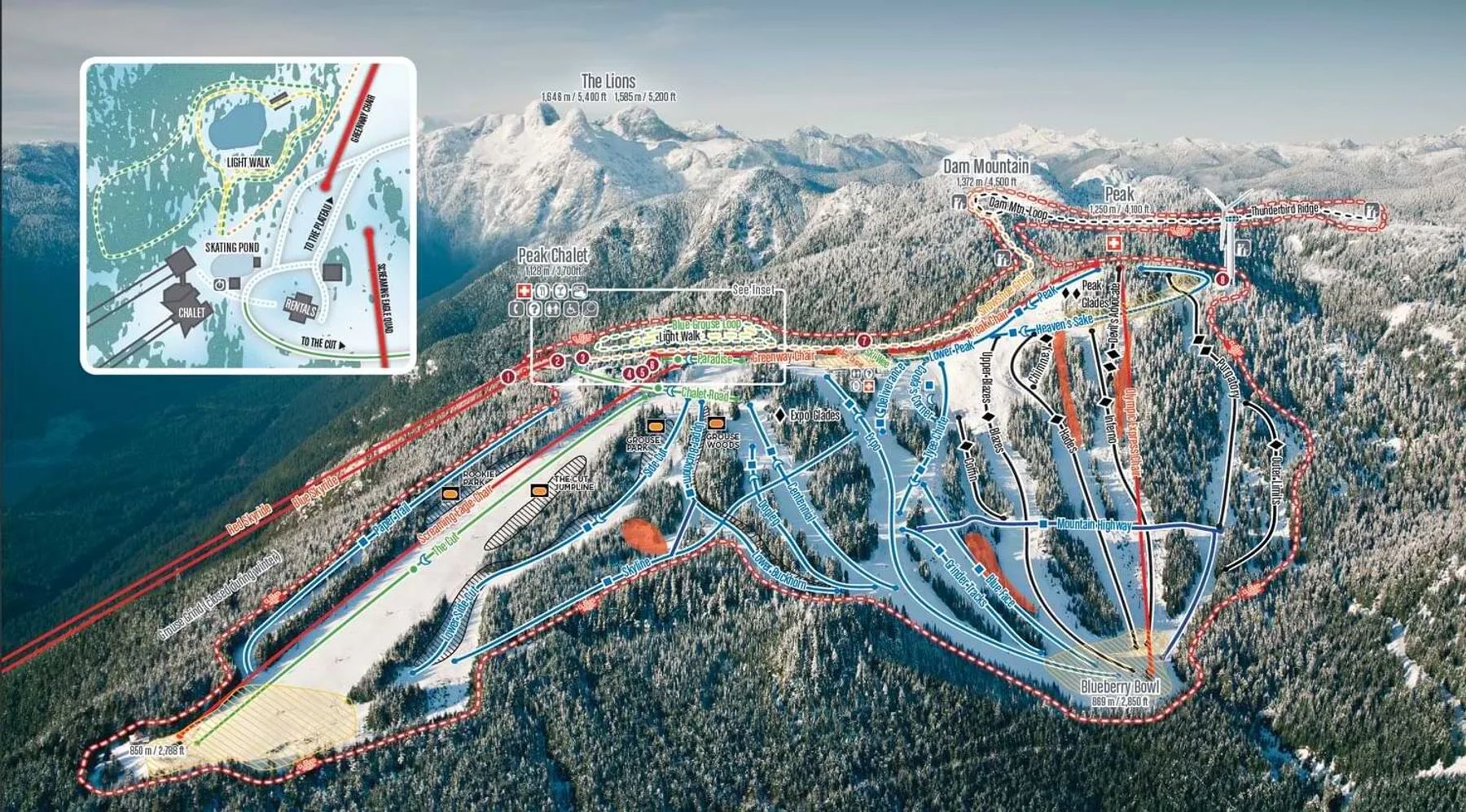
Grouse Mountain Trail Map
Downloadable Grouse Mountain trail map
Terrain split
33
runs
Beginner12%
Intermediate48%
Advanced30%
Expert10%
213 acres skiable86 hectares
Resort Stats
Elevation
Base881m
Summit1250m
Annual snowfall
9m
Season
2026 - 2027
18 Dec 2026 - 18 Apr 2027
Trail coverage
33 runs
213 acres (86 ha)
About Grouse Mountain's trail map
Explore Grouse Mountain's full trail map with 33 runs across the mountain, colour-coded by difficulty and shown alongside the terrain split. Use it to plan a day that matches your ability, find lift-served pockets of your favourite grade, and see how the resort links together. Download the piste map (PDF) ↗
More Grouse Mountain intelligence: snow report, lift system, webcams, resort overview.