
Pitztal Glacier
Ski Austria's highest glacier ski area at 3,440m in Tyrol. 68km of pistes with Rifflsee included, open September to May with guaranteed natural snow.
Season 2026-2027
Opens
26 Sept 2026
Closes
2 May 2027
Days open
218
Annual snow
3.5m
The Overview
Michael Fulton
Melbourne-based skier and snowboarder with 50+ resorts across 5 continents. Specialises in Australian resorts and international resort comparisons.
Pitztal Glacier is Austria's highest glacier ski area, reaching 3,440 metres at the Hinterer Brunnenkogel summit and operating on guaranteed natural snow from September through to May — a season of up to eight months that few ski areas anywhere in the Alps can match. Combined with the adjacent Rifflsee ski area on a single skipass, the two zones cover 68 kilometres of pistes and 30 kilometres of variant descents across 120 hectares of slope area. The terrain is weighted firmly toward experienced skiers: the glacier's open bowls and fall-line runs produce a breakdown of roughly 59% advanced, 25% intermediate and 16% beginner across the glacier zone alone, with the Rifflsee providing a gentler counterpart at up to 2,880 metres for families and progression skiers.
The resort sits at the head of the Pitztal in Tyrol's Imst district, deep in the Ötztal Alps and within close sight of the Wildspitze at 3,774 metres — the highest peak in North Tyrol and Austria's second-highest mountain overall. The Pitztal Wild Face has become a well-established fixture on the Austrian freeride scene, and the glacier's naturally uncrowded character — wide pistes with minimal lift queues even on peak days — makes it a compelling alternative to the heavily trafficked Tyrolean mega-resorts.
The Taschachtal glacier descent is the resort's most spectacular terrain feature: a backcountry variant of over 10 kilometres departing the upper glacier and winding through a vast alpine valley to the Mittelberg funicular base — heli-ski quality terrain accessible on a standard lift ticket.
The full potential vertical across the glacier and these variant descents reaches 1,760 metres, with the core lift-served vertical between the Wildspitzbahn summit and the glacier base delivering a still-substantial 755 metres. The X Park terrain park, a high-altitude cross-country ski trail at the Rifflsee at 2,200 metres, and dedicated freeride zones broaden the resort's appeal across disciplines, and the Cross Park draws national ski and boardercross training squads to the glacier each autumn.
755m
Vertical
20
Runs
40 km
Piste
3.5m
Annual snow
The Terrain
20 runs across 40 km of piste
Pitztal Glacier starts high and stays there: its 40 kilometres of piste over 20 runs fall just 755 metres, from 3,440 metres at the Hinterer Brunnenkogel to the 2,685-metre base. Three quarters of the terrain is intermediate (75%), with 20% beginner and only 5% advanced, so the skiing is wide, open and forgiving rather than steep. The glacier faces broadly north-east and the Wildspitzbahn cable car, Austria's highest lift, delivers skiers straight to the top, where wide upper slopes catch the morning sun.
The longest and most scenic piste is the red Panorama run, number 28, which extends via runs 29 and 23 into a long, technical descent with views across the surrounding peaks. Stronger skiers and freeriders head for the steep gullies and cirques around Mittagskogel, the sharpest ground in the ski area, and the neighbouring Rifflsee area adds gentler terrain on the same lift pass. Pitztal rewards intermediates chasing altitude and snow reliability far more than those hoping for black runs or a large run count.
Terrain split
20
runs
20 runs across 4 grades
Beginner4 runs · 20%
Intermediate15 runs · 75%
Advanced1 run · 5%
Expert0 runs · 0%
Time it right
When to visit Pitztal Glacier
Pitztal Glacier operates from late September through to early May — among the longest ski seasons of any Austrian resort and considerably longer than the December-to-April windows typical of lower-altitude Tyrolean ski areas. Average annual snowfall is approximately 440 centimetres, with January historically the heaviest month at around 101 centimetres.
The glacier's elevation above 2,685 metres means that base depths routinely exceed three metres by mid-winter, and the predominantly north-facing upper bowls preserve snow quality through the spring period when south-facing terrain at lower resorts deteriorates rapidly. The autumn opening — typically the last week of September — makes Pitztal Glacier one of a small number of on-piste ski areas operating in Europe before October, and the early-season period draws national ski teams and professional athletes to the glacier's groomed training terrain and Cross Park facility.
The shoulder-season months reward careful planning. Early season from late September through November delivers reliable glacier snow but limited lower-mountain terrain until the Rifflsee zone opens in mid-December, roughly doubling the accessible piste kilometres. Late April and May offer spring glacier skiing at its most consistent — firm morning surfaces, long daylight hours and the full lift network still operational.
The one persistent caution at this elevation is visibility: the upper glacier is exposed to rapid weather changes, and poor-visibility days are best redirected to the Rifflsee or Hochzeiger zones lower in the valley. In clear conditions, the panorama from the Wildspitzbahn summit across more than 50 peaks above 3,000 metres is among the finest viewpoints accessible by lift in the Eastern Alps.
Season 2026-2027
26 Sept 2026
Opens
2 May 2027
Closes
218
Days open
3.5 m
Annual snow
The record
Historical snowfall at Pitztal Glacier
Daily snow reports at Pitztal Glacier go back to 2017, 10 winters on the books. Open the record to compare winters, lifts and piste.
270 cm
Snowiest day
11 Mar 2024
5.9 cm
This winter · 2026-27
so far
347 cm
Typical winter
average of complete seasons
Winter totals
cm
Past wintersThis winter
Getting there
Getting to Pitztal Glacier, and where to stay
Pitztal Glacier sits at the head of the Pitztal, a south-running side valley off the Inn Valley in Tyrol's Imst district, with the ski area base at Mittelberg — the highest permanently inhabited settlement in the valley at around 1,736 metres. The nearest major town is St. Leonhard im Pitztal, roughly 11 kilometres down-valley from Mittelberg, which provides the bulk of accommodation, services and après-ski options for glacier visitors.
Innsbruck is approximately 80 kilometres from the valley entrance via the A12 motorway and Route 189 through the Pitztal — a drive of around 75 to 90 minutes to the glacier base. Innsbruck Airport is the most convenient air gateway at approximately 75 minutes from the resort, with Munich, Salzburg, Memmingen and Bolzano all within a three-hour drive.
The Pitztal's position deep in the Ötztal Alps gives it a distinct character from the more accessible and more heavily visited resorts of the central Tyrolean ski corridor. The valley is narrow, the approach road is long, and there is no direct rail access to the glacier — visitors arrive by car or the resort shuttle from the Imst-Pitztal station on the main Innsbruck–Landeck rail line.
This geography functions as a natural filter, drawing a ski-focused visitor demographic willing to make the journey specifically for high-altitude terrain and reliable snow. The villages of Mandarfen, Tieflehn and St. Leonhard provide an authentic Tyrolean valley atmosphere, and the Pitztal remains substantially less developed than neighbouring valleys such as the Ötztal to the east or the Paznauntal to the west — a characteristic that forms a significant part of the glacier's appeal to its regular visitor base.
Where to stay
Search all stays →Hotels and lodges near Pitztal Glacier, powered by Stay22.
Latest News
From the SnowStash desk
Pinheiro Braathen Wins Sölden Giant Slalom Opener by 0.48 Seconds
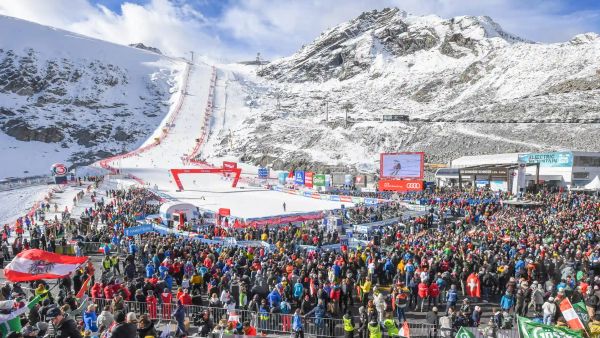
Two days at Sölden, two races decided by a hundredth somewhere on the podium, and one very quick Brazilian. Lucas Pinheiro Braathen led from the first run to win the men’s World Cup opener by 0.48 seconds, with Loïc Meillard second and Marco Odermatt third. River Radamus charged from 15th to fourth on a rutted course, and Britain’s Freddy Carrick-Smith banked his first World Cup points. Braathen still hasn’t lost a giant slalom since Olympic gold.
25 Oct 2026

Alps Snow Forecast: Up to 64 cm Headed for the High Glaciers as the Snow Line Drops
The Alps are about to swap mild, sunny October weather for something far more wintry. A cold front arrives Tuesday, and SnowStash forecasts have Monterosa Ski out in front with 64 cm over 14 days, ahead of Blatten Belalp (55 cm) and Verbier (43 cm). The snow line should fall below 2000 metres by Wednesday night, and glaciers across Switzerland, Italy and Austria are in line for the best of it. The wind will have a say too.
20 Oct 2026

Four Dead After Avalanche Near Ski Portillo in Chile
A large avalanche struck near Laguna del Inca adjacent to Ski Portillo on Saturday afternoon, killing four people and injuring four others. The group were day visitors mountaineering in the backcountry after reportedly being warned about elevated avalanche risk by resort staff.
18 Oct 2026

Europe Ski Resorts Open Now: What Is Skiable in Mid-October 2026
Europe’s ski season is open, technically. After a record-warm summer, glaciers in Austria, Switzerland and Italy are running a few pistes apiece, Sölden, Stubai and Kitzsteinhorn started late, Titlis has pushed back to 24 October, and Zermatt reopens a few lifts on 14 October after more than two months shut. Finland’s Levi and Ruka are skiing on stored snow. Here is what is open, and what you actually get at each.
14 Oct 2026

Zermatt Plans World Cup Downhill Return on the Gornergrat for 2028
Zermatt is having another crack at a World Cup downhill, and this time nobody has to cross a border. Around 13 million Swiss francs is going into rebuilding the Gornergrat piste, including a jump fed by a roughly 300-metre in-run across the roof of the Gornergrat Railway gallery, with the Matterhorn lined up behind it for the TV cameras. First men’s race is pencilled in for March 2028, pending FIS homologation.
14 Oct 2026

Mt. Rose Begins Snowmaking for the 2026-27 Season at Lake Tahoe
Lake Tahoe’s highest base elevation is paying off early: Mt. Rose has started making snow for 2026-27 after the first flurries and a cold snap. The Nevada resort is backing it with nearly US$2 million in upgrades, including a replacement snowmaking main line, a new PistenBully groomer and restraint bars on every lift. Opening day is yet to be confirmed, though Heavenly and Northstar are already eyeing 20 November.
13 Oct 2026

Utah Ski Resorts 2026-27: What’s New at Alta, Deer Valley, Powder Mountain and More
Utah is still building flat out. For 2026-27, Powder Mountain opens a steep new Skytrac chair into more than 1,000 acres of advanced terrain, Deer Valley adds 200 acres on Hail Peak, Sundance gets a new quad and Park City adds a gondola from its new parking structure. Snowmaking is expanding almost everywhere, Eagle Point stays closed after the Cottonwood Fire, and the 2034 Games are setting the pace. Here’s what’s new, resort by resort.
13 Oct 2026

Mt Hutt Invests NZ$12 Million in Base Area, Tripling Its Sun Deck
Mt Hutt is getting busier, and its base lodge is about to catch up. NZ$12 million goes into a heated sun deck roughly three times the current size (430 m² to 1,300 m²), plus a new toilet block, heated steps down to snow level, extra storage and a new food and beverage outlet. Building starts after the 2026 season, with everything due for winter 2027.
11 Oct 2026
Pitztal Glacier Snow Report
Snow Report
Updated 27 Oct 2026
3440m
summit
+0cm
new snow · last 24 hours
Partly Cloudy-4°C / 2°C · NW 25km/h
Snowfall
24 hours
0cm
48 hours
0cm
7 days
6cm
Base depth
50cm
Season total
6cm
Typical winter 347cm
Lifts open2 / 7
26 Sept 2026 - 2 May 2027
Hour by Hour
Next 36 hours· Updated Oct 27, 2026 at 5:02 AM
Scroll for the full outlook · Open-Meteo
7-Day Outlook
3,289 mUpdated Oct 27, 2026 at 5:02 AMOpen-Meteo
Days 1–7
1.5cm
Days 8–14
2.2cm
Tue, Oct 27
Snow Grains
Temp2° / -4°°C
Snow0.0cm
Wind25 km/h NW
Live snow from the resort feed; forecast from Open-Meteo, via Supabase.
Understanding the Pitztal Glacier snow report
Pitztal Glacier snow conditions, updated regularly: current snowfall, snow depth, temperatures, and the outlook for this Austria resort.
Snow measurements
Our snow reports measure snowfall in centimeters over multiple time windows — last 24 hours, last 7 days, and the season total. Base depth reflects accumulation at the 2685m base area, while summit depth captures conditions 755m higher at 3440m, where snow typically stays colder and lingers longer. Imperial conversions are shown alongside for convenience.
Weather conditions
Wind and temperature swings matter as much as fresh snowfall. Cold, calm conditions hold snow quality well, while wind-loading or a warm-up can change things quickly — especially given the elevation spread between Pitztal Glacier's base and summit.
Data sources
Pitztal Glacier snow data is collected through a combination of on-mountain reports and weather forecasting services, giving you both official resort updates and independent forecast data in one place. The mountain is served by 14 lifts, including a 6-person chairlift and 2 gondolas.
When to check
The biggest swings usually happen right after a storm. Check Pitztal Glacier's report in the morning for the freshest numbers, and again in the afternoon as conditions evolve.