
Melchsee-Frutt
Melchsee-Frutt: 36km of pistes, 1,175m vertical, Magic Pass access. Car-free village at 1,920m in Central Switzerland.
Season 2026 - 2027
Opens
12 Dec 2026
Closes
4 Apr 2027
Days open
113
Annual snow
4m
The Overview
Michael Fulton
Melbourne-based skier and snowboarder with 50+ resorts across 5 continents. Specialises in Australian resorts and international resort comparisons.
Melchsee-Frutt operates between 1,080 metres at Stöckalp and 2,255 metres at Balmeregghorn, delivering 1,175 metres of vertical drop across 36 kilometres of piste. The resort comprises 10 marked runs split between three peaks: Erzegg at 2,150 metres, Balmeregg at 2,255 metres and Bonistock at 2,160 metres. An average of 4.3 metres of annual snowfall blankets the high-altitude terrain, whilst modern snowmaking systems provide additional coverage. Since May 2025, all lifts are included in the Magic Pass, a multi-resort season ticket covering over 100 Swiss destinations.
Terrain splits 56% beginner, 17% intermediate and 27% advanced, with no expert-rated runs. Wide, gentle slopes descend from Balmeregghorn and Erzegg to the sunny valley floor, ideal for progression. The north-facing Bonistock sector delivers steeper pitches dropping over 1,000 vertical metres to the Stöckalp base. The Fruttpark on Erzegg features up to 40 obstacles for freestylers, ranked amongst Central Switzerland's largest terrain parks.
The car-free village sits at 1,920 metres on a high plateau beside Melchsee lake, creating ski-in ski-out access. All terrain lies above the treeline, guaranteeing open views and abundant sunshine. The resort attracts Swiss school groups and families rather than international crowds. On-mountain restaurants at Bonistock, Erzegg and Bettenalp serve traditional Swiss fare, whilst the 8-kilometre toboggan run from village to Stöckalp ranks as Switzerland's longest illuminated sledge track.
The 2025-2026 season runs from 21 December 2025 to 6 April 2026, spanning 107 days. Melchsee-Frutt suits families seeking accessible terrain, beginners building confidence on wide pistes, and locals holding Magic Pass subscriptions. The compact layout and high base elevation deliver reliable conditions without the scale or challenge of neighbouring Engelberg. Daily adult passes cost €64, with youth tickets at €48 and children at €27.
1175m
Vertical
10
Runs
36 km
Piste
4m
Annual snow
The Terrain
10 runs across 36 km of piste
Melchsee-Frutt has 10 runs over 36 kilometres, dropping 1,175 metres between the 2,255-metre top and the 1,080-metre valley base. Beginners take 56% of the terrain, advanced skiers 27% and intermediates only 17%, with no expert runs, so the split is more polarised than most. A gondola, an aerial tram, two quads and two double chairs shift people around, along with a few T-bars and surface lifts. Everything sits above the treeline on a high plateau beside the Melchsee, which keeps views open and snow in decent shape. With so few runs, the trick is choosing the right sector for your level.
The ski area runs across three main peaks: Balmeregghorn, Erzegg and Bonistock. Balmeregg and Erzegg offer wide, sunny pistes, while Bonistock holds the steeper descents and over 1,000 metres of vertical on the way down to Stöckalp. The Fruttpark on Erzegg is one of the larger terrain parks in Central Switzerland, with up to 40 obstacles. Off the snow, a long illuminated toboggan run drops to Stöckalp. Novices, families and freestylers will feel at home here, and advanced skiers can find real pitch on Bonistock without a long trip from Lucerne.
Terrain split
10
runs
10 runs across 4 grades
Beginner6 runs · 56%
Intermediate2 runs · 17%
Advanced3 runs · 27%
Expert0 runs · 0%
Time it right
When to visit Melchsee-Frutt
The 2025-2026 winter season operates from 21 December 2025 until 6 April 2026, spanning 107 days. Typical opening dates fall in mid-December, with closures in early April dependent on snow cover. Summer operations run mid-June to mid-October, when the gondola, Bonistock tramway and Frutt train provide hiking access. The resort maintains consistent winter schedules, with lifts spinning 8:00 to 17:30 daily, extended Friday and Saturday evenings for night skiing and toboggan sessions.
Average annual snowfall reaches 4.3 metres, aided by the 1,920-metre village elevation and 2,255-metre summit. Mid-winter base depths typically exceed 130 centimetres at plateau level, with summit accumulations above 160 centimetres. March delivers the deepest snowpack, averaging 164 centimetres at the top and 25 centimetres at Stöckalp. The high-altitude terrain and north-facing Bonistock sector hold snow quality longer than lower resorts. Snowmaking systems cover key runs, ensuring coverage during lean periods.
January through March offers peak conditions, with February delivering the most consistent powder and coldest temperatures. Late December and early April see variable snow quality as temperatures fluctuate. Weekdays remain quieter than weekends, when Swiss families and Lucerne day-trippers crowd the slopes. The resort averages 57 sunny days per season, slightly below Switzerland's 65-day mean, though March claims 19 sunny days. Spring skiing extends into April on upper slopes.
Night sledging operates Friday and Saturday evenings from 3 December 2025 to 8 March 2025, illuminating the full 8-kilometre run to Stöckalp. Ice fishing on frozen Melchsee lake attracts winter visitors, alongside 15 kilometres of cross-country trails. No major seasonal events punctuate the calendar, maintaining a low-key atmosphere. The car-free village and Magic Pass access make mid-week visits particularly attractive for powder seekers avoiding weekend crowds.
Season 2026 - 2027
12 Dec 2026
Opens
4 Apr 2027
Closes
113
Days open
4 m
Annual snow
Getting there
Getting to Melchsee-Frutt, and where to stay
Melchsee-Frutt lies in the Melch Valley within the municipality of Kerns, Canton Obwalden, Central Switzerland. The Stöckalp base station sits at 1,080 metres at the valley's southern terminus, where the Melch Valley extends from Kerns between Lake Sarnen and Lake Lucerne. The plateau village at 1,920 metres perches on a high alpine shelf, surrounded by the peaks of Balmeregghorn, Erzegg and Bonistock. This car-free settlement comprises around 60 buildings, predominantly chalets, alpine huts and four hotels.
Kerns lies 13 kilometres north of the gondola base, with Sarnen, the cantonal capital, 18 kilometres distant. Melchtal village sits 4 kilometres from Stöckalp along the access road. Lucerne, Central Switzerland's largest city, lies 35 kilometres northeast, whilst Engelberg's ski area sits 25 kilometres east. The resort's position between Engelberg and Hasliberg makes Melchsee-Frutt a stop on classic high-altitude hiking routes, including the four-lake trek connecting Jochpass and Trübsee.
By car, take the A8 motorway to the Sarnen Nord exit, then follow cantonal roads through Kerns and Melchtal to Stöckalp, with ample parking at the gondola base. The drive from Lucerne takes 45 minutes, Zurich 75 minutes via the A2 and A8. Winter parking costs CHF 5 per 24 hours outdoors or CHF 12 in the covered structure. A single-lane mountain road connects Stöckalp to Melchsee-Frutt village during snow-free summer months, operating one-way uphill in even hours.
Zurich Airport lies 103 kilometres away, a 90-minute drive or three hours by public transport. Berne Airport sits 60 kilometres west. By train, take the Luzern-Interlaken Express to Sarnen station, then board PostBus route 343 to Stöckalp, with departures coordinating to gondola schedules. The combined train-bus journey from Zurich takes 2.5 hours, from Lucerne 90 minutes. Winter ÖV integration for local passholders includes free PostBus travel from Sarnen, Kerns and Sachseln postcodes.
Where to stay
Search all stays →Hotels and lodges near Melchsee-Frutt, powered by Stay22.
Latest News
From the SnowStash desk

Europe Ski Resorts Open Now: What Is Skiable in Mid-October 2026
Europe’s ski season is open, technically. After a record-warm summer, glaciers in Austria, Switzerland and Italy are running a few pistes apiece, Sölden, Stubai and Kitzsteinhorn started late, Titlis has pushed back to 24 October, and Zermatt reopens a few lifts on 14 October after more than two months shut. Finland’s Levi and Ruka are skiing on stored snow. Here is what is open, and what you actually get at each.
14 Oct 2026

Zermatt Plans World Cup Downhill Return on the Gornergrat for 2028
Zermatt is having another crack at a World Cup downhill, and this time nobody has to cross a border. Around 13 million Swiss francs is going into rebuilding the Gornergrat piste, including a jump fed by a roughly 300-metre in-run across the roof of the Gornergrat Railway gallery, with the Matterhorn lined up behind it for the TV cameras. First men’s race is pencilled in for March 2028, pending FIS homologation.
14 Oct 2026

Mt. Rose Begins Snowmaking for the 2026-27 Season at Lake Tahoe
Lake Tahoe’s highest base elevation is paying off early: Mt. Rose has started making snow for 2026-27 after the first flurries and a cold snap. The Nevada resort is backing it with nearly US$2 million in upgrades, including a replacement snowmaking main line, a new PistenBully groomer and restraint bars on every lift. Opening day is yet to be confirmed, though Heavenly and Northstar are already eyeing 20 November.
13 Oct 2026

Utah Ski Resorts 2026-27: What’s New at Alta, Deer Valley, Powder Mountain and More
Utah is still building flat out. For 2026-27, Powder Mountain opens a steep new Skytrac chair into more than 1,000 acres of advanced terrain, Deer Valley adds 200 acres on Hail Peak, Sundance gets a new quad and Park City adds a gondola from its new parking structure. Snowmaking is expanding almost everywhere, Eagle Point stays closed after the Cottonwood Fire, and the 2034 Games are setting the pace. Here’s what’s new, resort by resort.
13 Oct 2026

Mt Hutt Invests NZ$12 Million in Base Area, Tripling Its Sun Deck
Mt Hutt is getting busier, and its base lodge is about to catch up. NZ$12 million goes into a heated sun deck roughly three times the current size (430 m² to 1,300 m²), plus a new toilet block, heated steps down to snow level, extra storage and a new food and beverage outlet. Building starts after the 2026 season, with everything due for winter 2027.
11 Oct 2026

Vermont Ski Resort Opening Dates 2026-27: Few Dates Set, Killington Waits on the Cold
Vermont's season is slow to take shape. Stratton is tentatively targeting 18 November and Sugarbush 21 November, while Pico has Friday 11 December on the calendar. Killington never sets a date and opens when the snowmaking allows, and Vail Resorts has yet to name days for Stowe, Okemo and Mount Snow. The forecasts disagree about snow, and the main El Niño worry for the Green Mountains is warmth.
9 Oct 2026
Crans-Montana 2027 World Championships President Resigns Ahead of Fraud Hearing
Less than four months out from the Crans-Montana 2027 World Championships, the man running the organising committee has stepped down. Claude-Alain Schmidhalter resigned as Swiss-Ski vice president and OC president after being indicted over a business dispute unrelated to skiing. He denies the allegations and faces court on October 27. Interim leaders are in place for the February 1-14 event.
9 Oct 2026
Kelly Canyon, Idaho, Adds Snowmaking, a Bigger Terrain Park and More Parking for 2026-27
Kelly Canyon had a rough 2025-26, and the Idaho resort has spent the summer making sure it doesn’t repeat. Snowmaking now reaches the top of Goldrush, the terrain park is doubling in size with a stereo system, lights and a snack shack, and the car park is getting bigger. Grooming is stepping up too. Target opening is December 4, conditions permitting.
9 Oct 2026
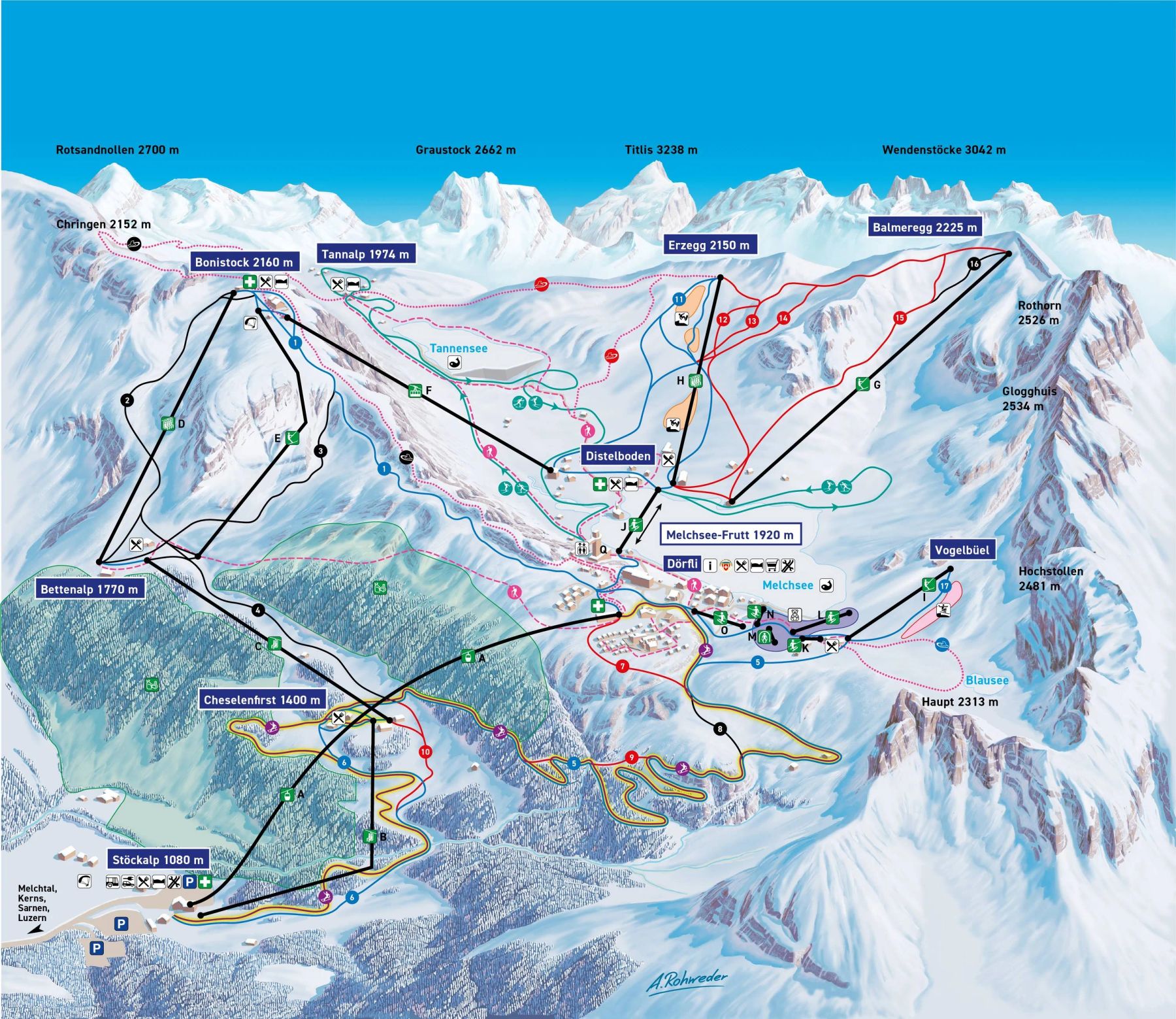
Melchsee-Frutt Trail Map
Downloadable Melchsee-Frutt trail map
Terrain split
10
runs
Beginner56%
Intermediate17%
Advanced27%
Expert0%
36 km of piste
Resort Stats
Elevation
Base1080m
Summit2255m
Annual snowfall
4m
Season
2026 - 2027
12 Dec 2026 - 4 Apr 2027
Trail coverage
10 runs
36 km
About Melchsee-Frutt's trail map
Explore Melchsee-Frutt's full trail map with 10 runs across the mountain, colour-coded by difficulty and shown alongside the terrain split. Use it to plan a day that matches your ability, find lift-served pockets of your favourite grade, and see how the resort links together. Download the piste map (PDF) ↗
More Melchsee-Frutt intelligence: snow report, lift system, webcams, resort overview.