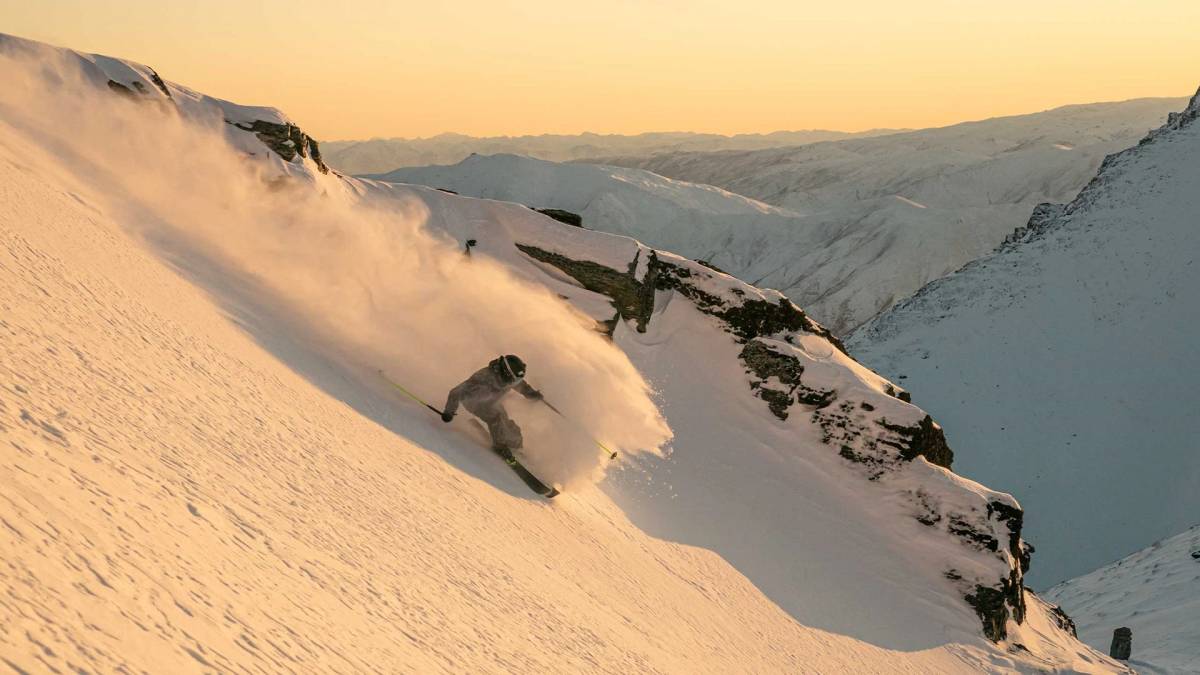
The Remarkables
Ski 385 hectares across three alpine bowls from 1,475–1,943m, with the Southern Hemisphere's only Burton Stash, 45 min from Queenstown.

Season 2026
Opens
13 June 2026
Closes
11 Oct 2026
Days open
120
Annual snow
3m
The Overview
Michael Fulton
Melbourne-based skier and snowboarder with 50+ resorts across 5 continents. Specialises in Australian resorts and international resort comparisons.
The Remarkables is a big-mountain ski area set high in one of the world's most visually striking alpine ranges, rising sharply from the southeastern shore of Lake Wakatipu just 45 minutes from downtown Queenstown. The resort spans 385 hectares across three sheltered mountain bowls between 1,475m and 1,943m, with a 468m vertical drop and 46 runs graded 30% beginner, 40% intermediate and 30% advanced.
The Remarkables mountain range is one of only two in the world that runs directly north to south, and the ski area's horseshoe-shaped bowl layout provides natural protection from prevailing weather while catching generous afternoon sun on the base-area deck. Average annual snowfall of 3.67 metres — the highest of any resort in the Queenstown region — is supplemented by 158 snowmaking guns covering all key trails and terrain parks.
The resort hosts the Burton Stash, one of only six in the world and the only one in the Southern Hemisphere — a terrain feature designed in partnership with Burton Snowboards using natural materials integrated into the mountainside. Two additional terrain parks and a dedicated freestyle zone in Curvey Basin round out a strong freestyle offering. The Remarkables has also been selected to host the Freeride World Tour Academy, recognising the quality of its steep, natural big-mountain terrain.
The resort is operated by NZSki alongside Coronet Peak and Mt Hutt, with all three covered by the 3 Peak Season Pass. The Remarkables is also accessible on the Ikon Pass and Mountain Collective, and NZSki offers a unique Parent Pass — a shared day ticket for two parents to take turns on the mountain while the other stays with the family.
468m
Vertical
46
Runs
951 acres
Skiable
3m
Annual snow
Ikon / Mountain Collective
Pass
The Terrain
46 runs across 951 acres skiable
This is a test to see if the content comes through.
Terrain split
46
runs
46 runs across 4 grades
Beginner14 runs · 30%
Intermediate18 runs · 40%
Advanced14 runs · 30%
Expert0 runs · 0%
Time it right
When to visit The Remarkables
The Remarkables operates from mid-June through to early October, with the 2026 season running from 13 June to 11 October. The resort's higher elevation relative to neighbouring Coronet Peak — base at 1,475m versus 1,187m — delivers both heavier natural snowfall and better snow preservation, with an average of 3.67 metres per season excluding snowmaking contributions.
The most reliable conditions fall between mid-July and September, with base depths at their peak through August and September. The resort's sheltered bowl terrain holds snow well even during warmer spells, and the extensive snowmaking system ensures key runs remain in good condition throughout the season window.
Spring skiing in September and early October offers warmer days, softer snow and thinner crowds. The afternoon sun that floods the base area and lower bowls makes late-season sessions particularly pleasant, with the deck outside the base lodge a popular spot for soaking up the views across to Coronet Peak and the Wakatipu Basin.
New Zealand school holidays in July typically bring the highest visitor numbers. The three-bowl layout helps distribute skier traffic, and the combination of covered learner conveyors at the base and high-capacity six-person chairs on the upper mountain keeps the system moving efficiently even on busy days.
Season 2026
13 June 2026
Opens
11 Oct 2026
Closes
120
Days open
3 m
Annual snow
The record
Historical snowfall at The Remarkables
Daily snow reports at The Remarkables go back to 2025, 2 winters on the books. Open the record to compare winters, lifts and piste.
55 cm
Snowiest day
24 Aug 2026
1195 cm
This winter · 2026
so far
666 cm
Typical winter
average of complete seasons
Winter totals
cm
Past wintersThis winter
Getting there
Getting to The Remarkables, and where to stay
The Remarkables sits 24km from central Queenstown, accessed via the Remarkables Road — a route that begins on sealed highway before transitioning to an unsealed mountain road for the final kilometres up to the base area at 1,475m. The drive takes approximately 45 minutes from town, and chains may be required on the upper access road during and after snowfall. Several car parks are staggered along the approach, with a shuttle service running between them and the base building.
Daily ski bus services operate from Queenstown's Snow Centre at 25 Shotover Street, with hotel pick-ups available en route. Carpooling incentives give vehicles with three or more passengers access to priority parking closer to the base. MyPass kiosks are located at Queenstown Airport (beside baggage claim), the Snow Centre in town, and on the mountain.
Queenstown Airport is the nearest gateway, approximately 30 minutes from the base of the access road, with domestic connections from Auckland, Wellington and Christchurch and direct international flights from Australian east-coast cities. Wānaka is roughly one hour away, and Invercargill approximately two hours to the south.
The base building houses a fully licensed restaurant and bar, a café, a retail shop, rental department, snowsports school and the Skiwiland childcare centre. The striking visual backdrop of the Remarkables range — sheer rock faces, glacial cirques and the towering Double Cone summit at 2,319m above — makes the drive up and the views from the ski area among the most dramatic of any resort in Australasia.
Where to stay
Search all stays →Stays map loads when you scroll here
Hotels and lodges near The Remarkables, powered by Stay22.
Latest News
From the SnowStash desk

Mt Rose Aims to Open First in Tahoe on November 6
Mt Rose is going for the first-in-Tahoe title, with the Lakeview Express due to spin at 9 a.m. on Friday, November 6. One main lift, three runs and plenty of snowmaking, sitting on the highest base elevation in the region at 8,260 ft. Here is what is open, what is not (sorry, tubing fans), and how the early North American openings are stacking up.
4 Nov 2026

Europe Snow Forecast: Serre Chevalier Leads With 82 cm Over the Next 10 Days
Europe has had a quiet start to November, but our 10-day forecast has Serre Chevalier on 82 cm and Les 2 Alpes on 71 cm. Two pushes are lined up: a western Alps top-up from Friday, then a bigger, wider system on Thursday, November 12 and Friday, November 13 that reaches Italy and Switzerland. Full leaderboard inside.
4 Nov 2026

Mammoth Mountain Opens Early on November 5 With Up to 33 Inches of Snow in the Forecast
Mammoth just moved opening day forward to Thursday, November 5, eight days ahead of schedule. A snowy weekend and cold snowmaking nights did the work, and our forecast shows up to 33 inches more landing on November 13 and 14. Here is what opens, what the weather looks like and where Mammoth sits among the early Ikon Pass openers.
3 Nov 2026

Utah Snow Storm Builds Early-Season Base Ahead of November Openings
Rain down low, snow up high, and a snow report full of zeros that mostly means ‘not updated yet’. Utah’s first proper storm of 2026-27 is rolling through the Wasatch, Snowbird’s snow stake is closing in on 10 inches, and Brian Head is five days from opening day. Early November snow rarely looks like much, but it is the layer every November opening date is built on. Here is where it stands.
1 Nov 2026
Sierra Nevada Halloween Storm: Dodge Ridge Forecast to Lead With 19 Inches
Halloween weekend brings a wet, windy storm to the Sierra Nevada. Our five-day forecast has Dodge Ridge on top with 19 in, followed by Bear Valley at 15 in and Mammoth Mountain at 12 in, with most of it landing on Saturday. A winter weather advisory covers the Tahoe Basin and Mono County until 7 AM Sunday, gusts could reach 47 mph and the freezing level swings between 4,900 and 8,700 ft, so some bases will see rain. A dry spell follows from Monday.
31 Oct 2026
Lake Louise Opens Early on 1 November With Juniper Express and Easy Street
The Rockies get their first lift-served turns of the season early. Lake Louise opens Sunday 1 November, five days ahead of schedule, after a cold October and round-the-clock work from the snowmaking and mountain crews. Terrain is limited to Juniper Express Chair and Easy Street, with two small terrain parks and the beginner area for lessons. Opening-day tickets are over 60% off, with prices rising as more lifts open. First chair is at 9:30 am under the resort’s new lift hours.
31 Oct 2026
Kitzbüheler Horn Summit Cable Car to Be Replaced After 70 Years
A Tyrolean summit lift that has been carrying guests up the Kitzbüheler Horn since 1955 is on borrowed time. Its licence runs to 2045, but a new inspection rule has made refurbishment uneconomic, so Bergbahn AG Kitzbühel will spend around €15 million on a replacement on the same line. It should hold roughly 100 people and keep running in winds that would stop today’s lift. Building starts in autumn 2027, which makes this winter and next summer the last chances to ride the old one.
30 Oct 2026
What’s New in Japan Skiing This Winter: Niseko Gondola, a Private Resort and a Bigger Ikon Pass
Niseko Village is replacing a lift from the early 1980s with an eight-person gondola, Tsugaike gets a six-person chairlift, Madarao joins the Ikon Pass and Togari opens Asia’s first private ski resort. Here’s what is actually new in Japan skiing for 2026/27, plus what is still a year or two away.
30 Oct 2026
The Remarkables Trail Map
Downloadable The Remarkables trail map
Terrain split
46
runs
Beginner30%
Intermediate40%
Advanced30%
Expert0%
951 acres skiable385 hectares
Resort Stats
Elevation
Base1475m
Summit1943m
Annual snowfall
3m
Season
2026
13 June 2026 - 11 Oct 2026
Trail coverage
46 runs
951 acres (385 ha)
About The Remarkables's trail map
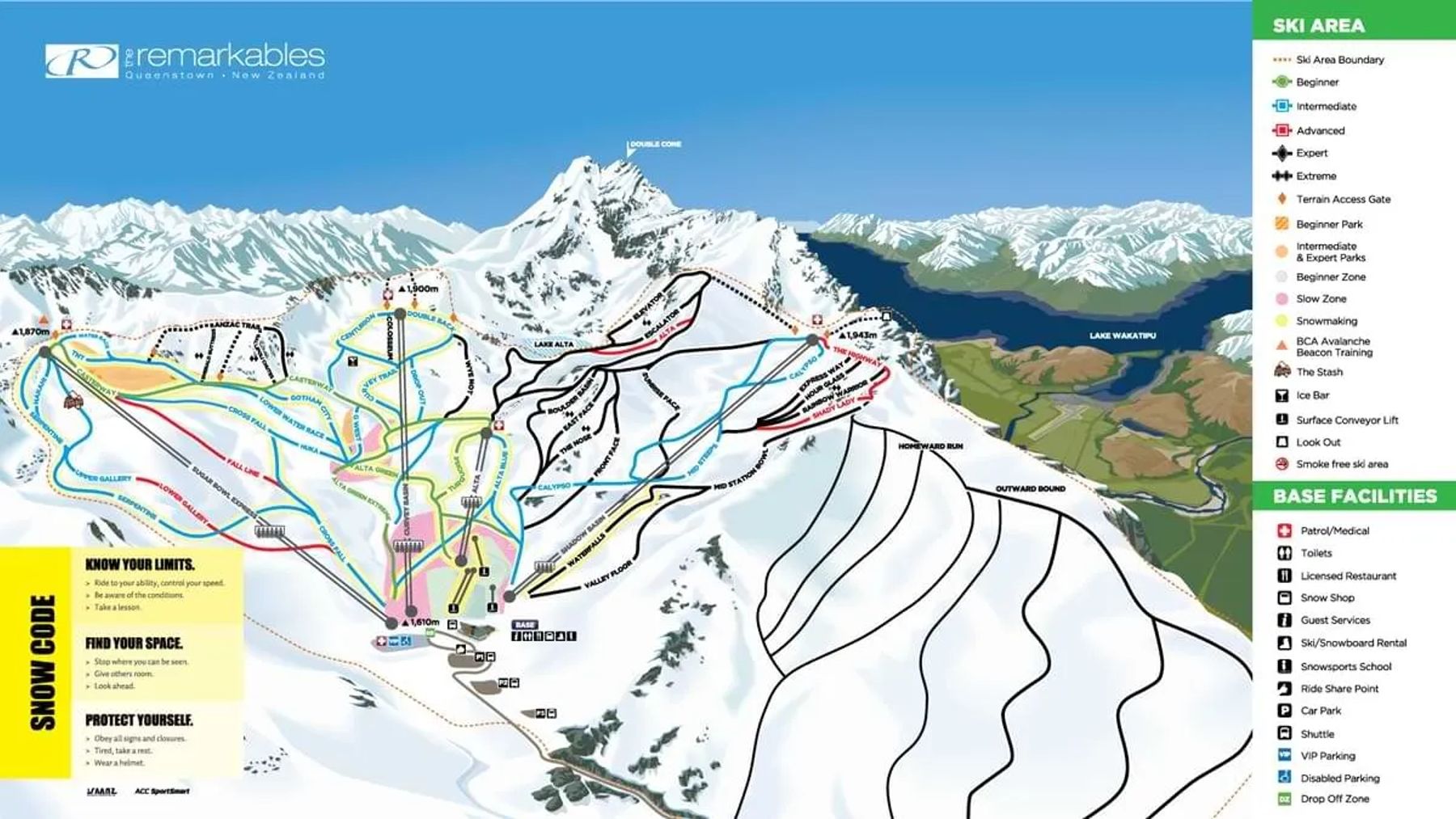
Explore The Remarkables's full trail map with 46 runs across the mountain, colour-coded by difficulty and shown alongside the terrain split. Use it to plan a day that matches your ability, find lift-served pockets of your favourite grade, and see how the resort links together. Download the piste map (PDF) ↗
More The Remarkables intelligence: snow report, lift system, webcams, resort overview.