By Kiera Elliot-PickettWhat do you get when you ask a passionate group of Australian skiers and snowboarders whether they think there is a “gender gap” in the snow community?The short answer is, over 300 comments and a heated discussion in mere hours, but who decides if there is a gender gap?We took the question to Facebook groups and forums to see who has experienced a male vs female dynamic in the snow community, and exactly what has contributed to them feeling whether there is or there isn’t. Firstly, we asked if there is a general assumption that males are the dominant gender in the industry, particularly when it comes to involvement, marketing, apparel/equipment, ability or skill level? The consensus was - yes! So, let’s start with the stats!The Australian snow season last year, as we all know, was complete rubbish with COVID and hardly a dump (the total opposite to this season - yew!), so let’s look at the 2019 involvement numbers from Mount Buller and Falls Creek."In 2019 the Woolcott survey told us that females were 44% of visitors to Falls Creek AND 56% male. A fairly even split really", says Sarah Watt, Director of Marketing & Communications, Falls Creek Resort. While Mount Buller Resort indicated the majority of visitors to be female, "Our latest data indicates around 56% of our resort visitors are female", reports Rhylla Morgan, Buller Communications. Falls Creek Visitors Mt Buller Visitors Surprising?Well, in three Facebook groups, we took a poll – how many males vs females ski and/or snowboard. In a total of 1232 participants – 638 were male, and 594 were female. Females took out the majority win for skiing with a total of 419 vs males who ski, 365. Snowboarding proved to be slightly more popular amongst men with 210 votes vs women, 179. So, where does this assumption that there are more males in the community than females, stem from? Skiers Snowboarders Apparently, one of the contributing factors comes from the lack of women’s apparel and equipment – a gap recognised by both males and females participating in this conversation.Walking into a snow store is one of the first points of contact you have in the industry; buying or hiring gear, chains, or purchasing a lift-pass. And, as you look around, more often than not, half (or more) of the shop is displaying male equipment and apparel, giving an immediate impression that the community and industry is skewed towards men. Ok, there is a limitation or shortage of women’s apparel available, would you call that a “gender gap”? We dug deeper to find out why there might be such a limited range. “It’s not personal, it’s economics”. In a report published by Grand View Research in 2019, that analyzed market size, share and trends reported the global snow sports apparel market size was valued at USD 2.4 billion (approx. AUD 3.3 billion) in 2018. Of that, the men segment led the market and generated a revenue of USD 1.5 billion (AUD 2.04 billion).When you look at sales figures and retail predictions, males gear is the clear headliner of revenue, so, is there is demand for female gear, at all? But - how can true sales be determined, and market trends predicted when manufacturers don’t know whether the skis purchased, or outer-wear is, in fact, purchased by a man or a woman?It’s clear from the discussion, women feel (and most men agreed) there is definitely a gender gap when it comes to equipment and apparel. And they’d like to see it closed. What if we removed the gender labels altogether? boards and skis were unisex? Should there be a gender label on boards and skis, at all? Would this solve the “gender gap” issue?Are existing brands complacent? Would it not make more sense to focus on where the category can significantly grow and adapt?Professional abilities Which leads us to the last impressions of marketing; A controversially popular subject, gender pay gap in competition which follows through to marketing.Despite comments on the mountain, such as “ski like a girl” having a negative connotation – suggesting men have a greater ability to ski or snowboard; Olympic Skier, Greta Small is living proof that this is simply a generalisation. Or, if we look at it from another angle, quite the compliment.“The biggest gender gap I see at ALL levels of competition from World Cup down to FIS races in Australia is the Race Jury’s risk assessment when course conditions are poor”, says Greta, “I’ve been at multiple races where males and females are racing on the same slope and course, the men’s competition gets cancelled as the slope or weather conditions are considered “too dangerous”, while the women’s race goes ahead in the poor conditions”, she continues. “The decision making behind this is that women are on less aggressive skis than the men, and they are “lighter” therefore not producing the same power making it “not as dangerous” - I know myself I am producing as much power on my skis and am heavier than some of the males.”
Credit: Greta Small Facebook There are two ways to look at this –The assumption women are less aggressive on skis is correct orWomen are just as able, if not tougher, performing under tougher conditions.In 2013, FIS conducted research into male skiers’ injuries and changes in men’s ski radius. There was no female research conducted. This raises the question - how can male vs female ability be measured without research into both genders? Does this contribute to a gap and have a trickle-down effect? Up until a few years ago the National Alpine Ski Team (NAST) selection criteria were different for males and females. For example, NAST – A-criteria Women needed to be Top 50 World Rank, while Men needed Top 75 World Rank; this continued down the tiers to level C/D females required a Top 3 podium performance at ANC competition, while Men only required a Top 6 performance.“This is not current, honestly, I was angered every time I read the criteria I stopped looking”, Greta says. It seems the industry has come a long way in the past years to close the gender gap seen in professional skiing.“From my experience racing at the highest level in Australia (ANC) and internationally for the past 12 years, the FIS is actually one of the few sports organisations that has equal prize money for as long as I’ve been involved which is fantastic” says Greta, “female athletes are actually the highest earners in FIS alpine skiing.”
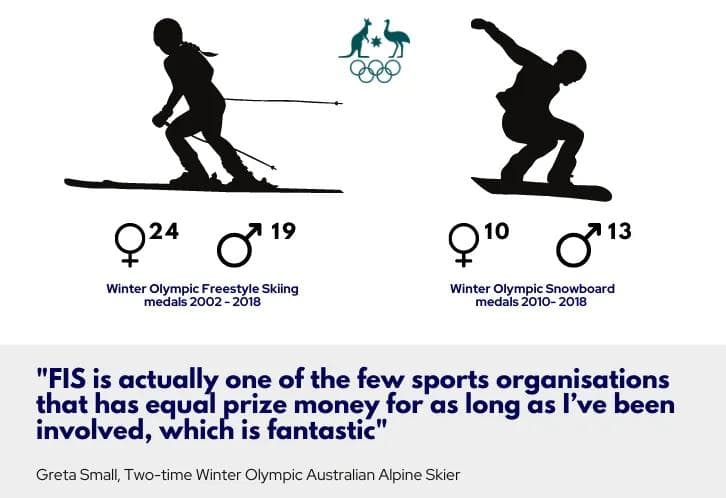
Data Source: Wikipedia Winter Olympic Medal Tally ConclusionIn conclusion, there is no question that there isn’t much of a gender gap when it comes to male vs female involvement; as a recreational activity or competitively. However, there is evidently a gender gap in apparel and ski/snowboard equipment. Even Greta Small has experienced difficulty finding appropriately fitting women’s gear, “ “I have always worn unisex/ men’s ski gear”, she says, “I have trouble fitting into female snow pants or jackets as the arms are generally cut smaller on the biceps and shoulders restricting my movement, you try and go up in sizing but it just goes wider; just because my arms are bigger doesn’t mean my waist is!”.It’s clear from discussing the male vs female apparel gap in snow-fanatic Facebook groups that there is a demand for female gear – if designed correctly, and with a size range that is inclusive of all body shapes and sizes. This is a gap that Maria Baker has recognised and taken the initiative to resolve with her brand, Nobody’s Princess.“I have made an active effort to have conversations with women about their challenges when it comes to snow gear, and conducted substantial market research”, Maria says, “9 times out of 10 the participants said they wanted more options, if designed properly. I think the advantage I have is that I’ve taken the time and effort to listen and act to create a product that women fit into properly, and are happy with. If more brands did the same, they would see the financial benefit”.
Image Credit: Nobody’s Princess
Source: Nobody’s Princess Survey Data This isn’t to say there aren't brands out there already giving it a shot - especially those who are female owned, and cater specifically for women. One of the biggest players making an impact is Coalition Snow. Coalition Snow is the first to concentrate specifically on women’s snow equipment; where most brands are merely offshoots of male-focussed companies, who later realised they could also capture a female market (Quicksilver & Roxy... Anyone?).Then there is EIvy who have absolutely dominated the base layer and accessory game. They focus on fun prints that aren’t just pink and girly (the usual designs you seem to find for women!), and produce clothing up to a size XL.One of the “less-spoken about” brands that deserve the spotlight is Nikita. Nikita have created outerwear for women that captures the edgy street style that has evolved from skateboarding. They stand for confidence (much like Nobody’s Princess) through their range, and cater for off-mountains as much as they do, on.Last, but not least of our honourable mentions is Rojo Outerwear. Rojo is an Australian-owned outerwear and base-layer company that has been operating since the 80’s. They have provided a great size range offering upto a true-to-size XL/16 - unlike some brands whose XL barely passes as an Australian size 12. The Australian duo behind the brand focus on snow gear for women and girls. Rojo has even managed to shift their production into an environmentally sustainable realm this year.So, there you have it, a very public insight to male vs female gender gaps in the snow-world. There seems to be a lot of assumptions to the male vs female gap in skiing and snowboarding. But the important thing to remember is to never assume, or you might make an ass-out of u-m-e. One thing everyone who participated in contributing to this article agreed on, is that snow sports is one hell of a welcoming and inclusive community, and that’s certainly something that we can all be proud of. Nobody’s Princess is currently raising almost $100,000 towards manufacturing life-changing women’s snow pants. To pre-purchase your pair or show your support, head to their Kickstarter by August 19. Kickstarter
About the author

Michael Fulton
Melbourne-based skier and snowboarder with 50+ resorts across 5 continents. Specialises in Australian resorts and international resort comparisons.