Why this season became so dangerous
In early to mid-December 2025, the Alps received a thin early snowfall followed by an extended cold, clear stretch. During that window, a persistent weak layer formed inside the snowpack - and it's been sitting there ever since.
The technical term doesn't matter as much as the practical reality: avalanche professionals call it sugar snow. Large, angular crystals with almost no cohesion between them, sitting in the snowpack like a layer of ball bearings. Then January and February hit, depositing up to two and a half metres of new snow directly on top of that fragile layer. A massive, dense slab now sitting on something that can't support it - and none of it visible from the surface.
Avalanche expert Henry Schniewind, based in Val d'Isère with more than 30 seasons in the French Alps, described the structural instability as a once-in-five-to-ten-year scenario. The EAWS has been warning all season that the absence of warning signs does not mean conditions are safe. There were documented cases where 20 people skied a slope safely before the next person triggered a full slab release.
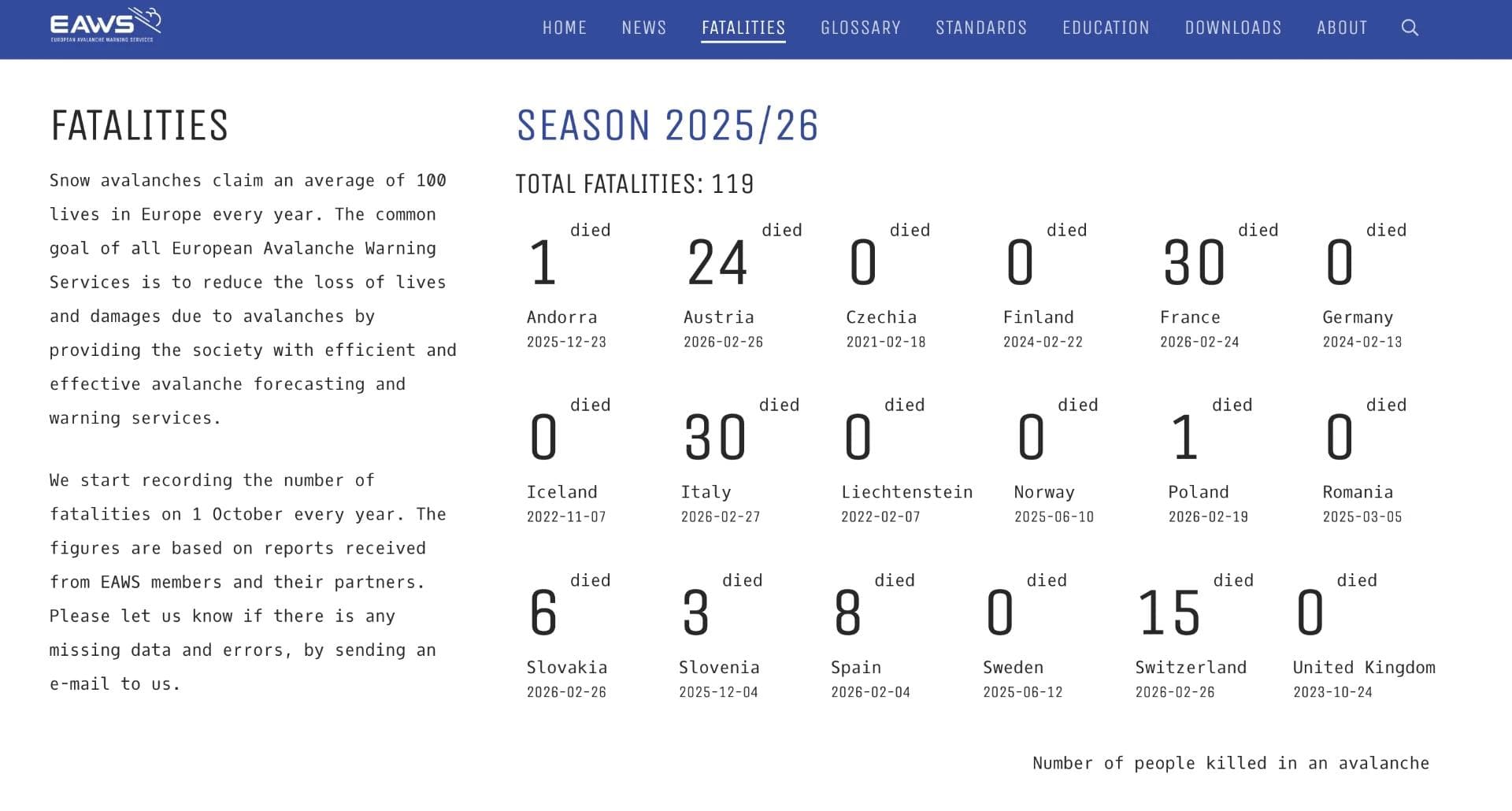
Three successive storm cycles through February loaded that already-compromised snowpack further, pushing the death toll past 80, then 100, then 119 in the space of three weeks.
Country by country
France leads the toll at 30 deaths - the highest of any country - driven by the sheer volume of people in the mountains and a legal framework where off-piste terrain is completely accessible and unrestricted. The worst single incident was on the 13th of February at Val d'Isère, where a slab released on a group of five skiers in the Vallée du Manchet at danger Level 4, killing three of them. A formal manslaughter investigation remains open.
Italy has matched France at 30 deaths. The worst stretch came in the week after the Milano-Cortina 2026 Winter Olympics opened on the 6th of February - 13 deaths in seven days, which Italian Alpine Rescue described as the deadliest single week in the organisation's history. Three experienced French skiers were killed at Courmayeur on the 15th of February at danger Level 4, and a natural avalanche two days later sent a powder cloud through a chairlift queue at the same resort - captured on video and shared widely. No deaths in that incident, but the footage is confronting.
Austria recorded between 24 and 26 deaths, with the 20th of February standing as the deadliest single day of the season across Europe. Five freeriders triggered a slab above St. Anton am Arlberg that ran nearly a kilometre - visible from the streets of the town. Three died. Two more fatal avalanches struck Austria the same day, prompting the country's Chief Inspector to summarise it as simply: "today we had many, many, many avalanches."
Switzerland recorded 15 deaths, with most occurring at danger Level 3 - not Level 4 or 5. That's worth noting because Level 3 is forecast on roughly 30 percent of all winter days. It's the level people treat as an all-clear after a storm passes. It isn't - particularly when there's a buried weak layer that hasn't gone anywhere.
What the research says about survival
Approximately half of all avalanche fatalities across Europe this season involved victims who were not wearing a transceiver. Research published in 2024 puts the high-survival window for a buried person at around 10 minutes from burial - after that, survival rates drop sharply. The median professional rescue response time in France and Austria is around 45 minutes. Organised rescue arrives, in the vast majority of cases, too late to help.
The only rescue that reliably saves lives is companion rescue - the people who were skiing with you, who have beacons and shovels, and who start digging immediately. Studies put companion rescue survival rates at 2.9 times higher than professional team rescue.
What's happening now
The extreme storm danger of mid-February has eased, but that buried weak layer hasn't gone away. Warming temperatures and rising freezing levels are now destabilising it from below and above simultaneously. Italy's ARPA Lombardia has noted increasing spontaneous avalanche activity as a direct result. The risk has shifted, not disappeared.
If you're heading to the Alps this season, check the EAWS forecasts before you go - they consolidate bulletins across every European country in English. A forecast of Considerable doesn't mean the mountains are open for business. It means you need to understand where the hazardous terrain is and make a clear-eyed decision about whether you belong in it.
The full breakdown of the science, the storm cycles, the safety equipment research, and every major incident is in the video above. Worth watching before your next trip.