
Sierra at Tahoe
2,000 acres, 400+ inches annual snow, 14 lifts. Ikon Pass and Powder Alliance access 19km from South Lake Tahoe, California.
Season 2026 - 2027
Opens
5 Dec 2026
Closes
11 Apr 2027
Days open
127
Annual snow
38ft
The Overview
Michael Fulton
Melbourne-based skier and snowboarder with 50+ resorts across 5 continents. Specialises in Australian resorts and international resort comparisons.
Sierra at Tahoe spreads 2,000 acres across elevations from 6,640 to 8,852 feet, delivering 2,212 feet of vertical drop across 47 trails. The resort divides terrain into 25 percent beginner, 50 percent intermediate, and 25 percent advanced runs, backed by an average annual snowfall exceeding 400 inches. Sierra holds Ikon Pass access with limited days and full Powder Alliance membership, whilst season passholders receive three free days at 17 other partner resorts across North America and New Zealand.
The Frontside offers groomed cruisers and dedicated learning zones, whilst West Bowl serves up consistent intermediate terrain accessed by high-speed quads. Grandview Express climbs to the 8,852-foot summit, accessing blue and black runs through widely spaced old-growth red fir trees left by 1850s loggers. Huckleberry Canyon's five backcountry gates open 320 acres of expert-only terrain with cliff drops, cornices, and steep chutes rated extremely challenging.
Seven terrain parks include Broadway Park, Burton Progression Park, and Upper Snowshoe's roller park, alongside a superpipe and 18 maintained rail features. The resort sits below timberline within Eldorado National Forest, sheltered from winds that often close lifts at competing resorts. Sugar n' Spice, a 2.5-mile green run, stretches from summit to base as the mountain's longest descent.
Sierra operates 12 miles west of South Lake Tahoe on Highway 50, positioned as the closest major resort to Sacramento and the Bay Area. The family-oriented atmosphere draws fewer crowds than north shore resorts, with shorter lift queues and uncongested base facilities. Operating hours run 9:00am to 4:00pm weekdays and 8:30am to 4:00pm weekends, with the 2025-26 season opening November 28 and closing March 22.
2,211ft
Vertical
47
Runs
2,000 acres
Skiable
38ft
Annual snow
Powder Alliance
Pass
The Terrain
47 runs across 2,000 acres skiable
Sierra at Tahoe has 2,000 acres (809 hectares) and 47 runs on the south side of Echo Summit, dropping 2,210 ft (674 m) from 8,850 ft (2,698 m) to a base near 6,640 ft (2,024 m). Intermediate terrain makes up half of the mountain, with 25% beginner and 25% advanced, and no runs rated expert. Trees cover much of the mountain, which shelters skiers from wind and keeps visibility workable when storms hit. The lift network is mostly quads, doubles and surface lifts, with a straightforward layout that keeps navigation easy.
West Bowl is the intermediate heartland, with long blues such as Sugar n' Spice and Bashful, while Grandview serves mostly black runs and tree skiing off the top. Huckleberry Canyon, reached through gates, is the expert-level backcountry-style zone, with chutes, cliffs and spots such as Avalanche Bowl and Jack's Bowl. Broadway Park and the Burton Progression Park anchor a well-regarded set of terrain parks. Sierra at Tahoe suits families, mixed-ability groups and tree skiers, and it often draws smaller crowds than the larger north shore resorts.
Terrain split
47
runs
47 runs across 4 grades
Beginner12 runs · 25%
Intermediate24 runs · 50%
Advanced12 runs · 25%
Expert0 runs · 0%
Time it right
When to visit Sierra at Tahoe
The 2025-26 season runs from November 28, 2025, through March 22, 2026, spanning 115 operating days. Projected opening dates typically fall in late November, though delayed starts occur during marginal snow years. The resort historically closes in mid-April, with spring operations dependent on snowpack and visitation levels through March and early April.
Annual snowfall averages exceed 400 inches at mid-mountain, with the resort ranking 41st in North America for total seasonal accumulation. Snow density measures approximately 12 percent water content—wetter than interior Rocky Mountain resorts but manageable on modern wide skis. The summit elevation of 8,852 feet and forested terrain below timberline preserve snow quality during Sierra storms, whilst northwest-facing aspects on Grandview and West Bowl hold coverage better than the sun-exposed backside.
February and March deliver peak snowfall, with the third week of February historically producing 44 centimetres and 2.7 snowy days per week. January through March offer the most consistent conditions, whilst November and early December require patience as base depths build. Spring riding from late March into April features corn snow cycles on south-facing terrain, though freeze-thaw conditions can create variable surfaces at lower elevations.
Signature events include Subaru Winterfest, Vans Methodology, and Sierra Playgrounds Party, alongside weekly live music in the Sierra Pub. The resort does not offer night skiing, closing daily at 4:00pm. Weekend and holiday periods from December 20 through January 4, January 17-19, and February 14-22 see peak crowds and require parking reservations starting in the 2026-27 season.
Season 2026 - 2027
5 Dec 2026
Opens
11 Apr 2027
Closes
127
Days open
38 ft
Annual snow
Getting there
Getting to Sierra at Tahoe, and where to stay
Sierra at Tahoe occupies the south slope of Echo Summit in Twin Bridges, California, within Eldorado National Forest approximately 19 kilometres south of South Lake Tahoe. The base area sits at 6,640 feet elevation where Sierra at Tahoe Road meets Highway 50, positioned five miles west of Echo Summit's 7,382-foot crest. Lake Tahoe itself lies 19 kilometres northeast, visible from upper mountain ridges alongside Desolation Wilderness and Pyramid Peak.
South Lake Tahoe, 19 kilometres east, provides the nearest full-service town with 30,000 residents, lodging, dining, and casino entertainment. Meyers sits 20 minutes away with additional accommodation options. Twin Bridges, the immediate locality at 6,115 feet elevation, functions as a chain control checkpoint when winter storms close Echo Summit. Stateline, Nevada, lies 26 kilometres southeast on the California-Nevada border.
Highway 50 provides direct access from both Sacramento and Reno, with the resort located just off the highway requiring a brief turn onto Sierra at Tahoe Road. Westbound travellers from South Lake Tahoe drive 19 kilometres, passing Echo Summit before descending to the resort entrance. Sacramento lies 161 kilometres west via Highway 50, whilst Reno sits 193 kilometres northeast via Highway 50 and I-580 through Carson City.
Reno-Tahoe International Airport sits 120 kilometres away with 90-minute drive times, offering over 130 daily flights to 20-plus nonstop destinations. Sacramento International Airport lies 158 kilometres distant, approximately two hours by car with service from major carriers. Sports Basement operates a Bay Area shuttle for $99 roundtrip. San Francisco International Airport, 301 kilometres west, provides the closest major hub with extensive international connections, requiring 3.5 hours driving time.
Where to stay
Search all stays →Hotels and lodges near Sierra at Tahoe, powered by Stay22.
Latest News
From the SnowStash desk

Utah Ski Resorts 2026-27: What’s New at Alta, Deer Valley, Powder Mountain and More
Utah is still building flat out. For 2026-27, Powder Mountain opens a steep new Skytrac chair into more than 1,000 acres of advanced terrain, Deer Valley adds 200 acres on Hail Peak, Sundance gets a new quad and Park City adds a gondola from its new parking structure. Snowmaking is expanding almost everywhere, Eagle Point stays closed after the Cottonwood Fire, and the 2034 Games are setting the pace. Here’s what’s new, resort by resort.
13 Oct 2026

Vermont Ski Resort Opening Dates 2026-27: Few Dates Set, Killington Waits on the Cold
Vermont's season is slow to take shape. Stratton is tentatively targeting 18 November and Sugarbush 21 November, while Pico has Friday 11 December on the calendar. Killington never sets a date and opens when the snowmaking allows, and Vail Resorts has yet to name days for Stowe, Okemo and Mount Snow. The forecasts disagree about snow, and the main El Niño worry for the Green Mountains is warmth.
9 Oct 2026

Crans-Montana 2027 World Championships President Resigns Ahead of Fraud Hearing
Less than four months out from the Crans-Montana 2027 World Championships, the man running the organising committee has stepped down. Claude-Alain Schmidhalter resigned as Swiss-Ski vice president and OC president after being indicted over a business dispute unrelated to skiing. He denies the allegations and faces court on October 27. Interim leaders are in place for the February 1-14 event.
9 Oct 2026

Kelly Canyon, Idaho, Adds Snowmaking, a Bigger Terrain Park and More Parking for 2026-27
Kelly Canyon had a rough 2025-26, and the Idaho resort has spent the summer making sure it doesn’t repeat. Snowmaking now reaches the top of Goldrush, the terrain park is doubling in size with a stereo system, lights and a snack shack, and the car park is getting bigger. Grooming is stepping up too. Target opening is December 4, conditions permitting.
9 Oct 2026

Valle Nevado Extends Season to November 8 After 108 cm in 48 Hours
Winter was meant to be winding down in Chile. Then Valle Nevado took 108 cm in 48 hours in early October, and the resort has pushed its closing date out to November 8 - its latest in 38 years of operation. That makes 143 days of skiing since opening day on June 19, with 690 cm banked for the season. Only part of the mountain is running while the storm settles, so check the mountain report before you plan a trip.
9 Oct 2026

Alps Snow Forecast: Cold Front Brings Thursday Snow to the High Alps
The Alps look a lot more like winter today, for a day or so. A cold front is moving west to east, dropping up to 35 cm on high glaciers and peaks, with snow levels falling to around 1,500-1,800 m at times. Don’t plan a trip around it: mid-elevation snow will be thin and wet, every area is closed bar a limited Sölden glacier opening tomorrow, and warmer weather returns by Monday.
8 Oct 2026

California Ski Resort Opening Dates 2026-27: Mammoth Leads, Tahoe Follows
Mammoth Mountain is first up in California, targeting Friday 13 November after a dusting of September snow. Heavenly and Northstar follow on 20 November, Palisades Tahoe on Wednesday 25 November and Sugar Bowl on 27 November, with Kirkwood on 4 December and June Mountain on 19 December. Plenty of smaller areas have no date yet. A super El Niño favours the Sierra, but a warmer storm track is the catch.
7 Oct 2026

Colorado Ski Resort Opening Dates 2026-27: A-Basin and Keystone Race to Be First
Arapahoe Basin, Keystone and Winter Park are all chasing an October start, though none has a firm date yet. The first dated openers are Breckenridge and Copper on Friday 6 November, then Vail on 13 November, with most of the rest bunched around US Thanksgiving. Hesperus did not open at all last season. A super El Niño offers hope but no guarantee, and forecasters say the southern mountains have the better odds.
5 Oct 2026
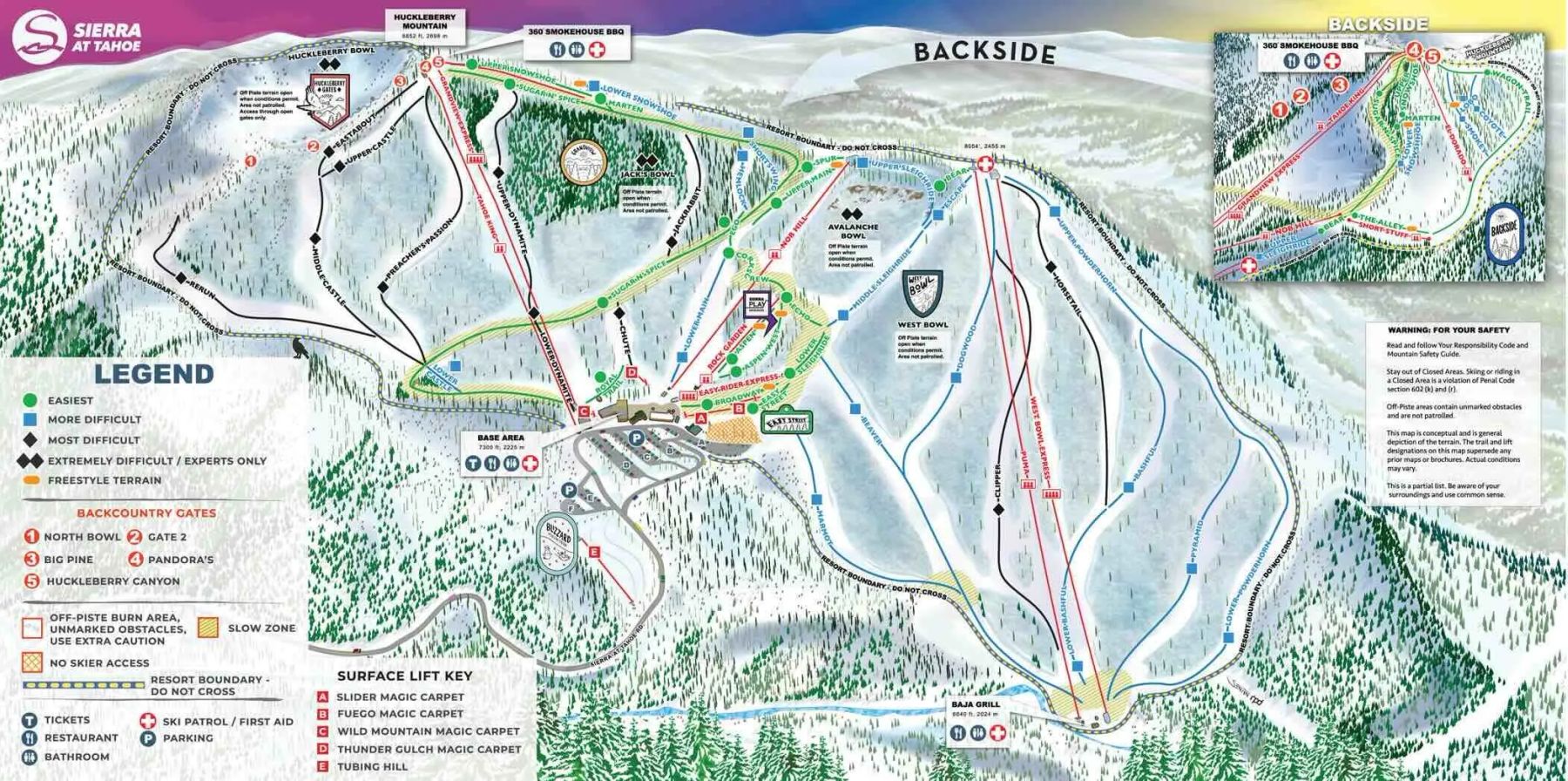
Sierra at Tahoe Trail Map
Downloadable Sierra at Tahoe trail map
Terrain split
47
runs
Beginner25%
Intermediate50%
Advanced25%
Expert0%
2,000 acres skiable809 hectares
Resort Stats
Elevation
Base6,640ft
Summit8,852ft
Annual snowfall
38ft
Season
2026 - 2027
5 Dec 2026 - 11 Apr 2027
Trail coverage
47 runs
2,000 acres (809 ha)
About Sierra at Tahoe's trail map
Explore Sierra at Tahoe's full trail map with 47 runs across the mountain, colour-coded by difficulty and shown alongside the terrain split. Use it to plan a day that matches your ability, find lift-served pockets of your favourite grade, and see how the resort links together. Download the piste map (PDF) ↗
More Sierra at Tahoe intelligence: snow report, lift system, webcams, resort overview.