
Ski Apache
750 acres, 55 runs on Sierra Blanca. America's southernmost major resort, Mescalero Apache owned.
Season 2026 - 2027
Opens
28 Nov 2026
Closes
7 Mar 2027
Days open
99
Annual snow
15ft
The Overview
Michael Fulton
Melbourne-based skier and snowboarder with 50+ resorts across 5 continents. Specialises in Australian resorts and international resort comparisons.
Ski Apache's summit reaches 11,499 feet, dropping 1,900 vertical feet to a base at 9,599 feet across 55 runs spread over 750 acres on Sierra Blanca in southern New Mexico. Terrain splits 60 per cent intermediate, 20 per cent advanced and 20 per cent beginner, with no expert-rated runs, and average annual snowfall of roughly 180 inches. The resort is owned and operated by the Mescalero Apache Tribe. Eleven lifts, including three quad chairs, five triple chairs and a gondola, serve the mountain alongside two t-bars.
Ski Apache holds a singular place in American ski history as the first ski resort owned and operated by a Native American tribe, a status it has held since the Mescalero Apache Tribe's purchase in 1963. Its location on Sierra Blanca makes it America's southernmost major ski resort, offering genuine high-elevation skiing in a part of the country better known for desert landscapes. The resort's substantial eleven-lift network is unusually extensive for its 750-acre footprint.
The resort opened at Christmas 1961 as Sierra Blanca Ski Resort, with three T-bars capable of carrying 2,600 skiers an hour up the mountain. In 1963, the Mescalero Apache Tribe did something no one thought possible at the time: they purchased the ski resort for 1.5 million US dollars, becoming the first Native American tribe to own and run a ski resort in America, at a point when most tribal members lived in poverty and none had ever skied.
The resort operated under its original name for more than two decades before being renamed Ski Apache for the 1984-85 season. The Mescalero Apache Tribe also owns and operates the nearby Inn of the Mountain Gods Resort and Casino, along with other reservation-based enterprises, making Ski Apache part of a broader tribal economic portfolio. Adult daily tickets run from 89 to 109 US dollars, with a season pass at 899 dollars.
1,900ft
Vertical
55
Runs
750 acres
Skiable
15ft
Annual snow
The Terrain
55 runs across 750 acres skiable
Ski Apache climbs Sierra Blanca on the Mescalero Apache Reservation in southern New Mexico, covering 750 acres (304 hectares) with 55 runs. The base is at 9,600 feet and the summit reaches 11,500 feet (3,505 m), for a vertical of 1,900 feet (579 m). Intermediate terrain dominates at 60%, with 20% advanced and 20% beginner and no expert-graded runs. A gondola, along with quad chairs, triple chairs and T-bars, serves the mountain, and snowfall averages about 180 inches a year. It is real alpine-elevation skiing in a part of the country better known for desert.
Apache Bowl, on the upper west side, is a wide intermediate run with open space and views from the top of Chairlift 6. Capitan is a steep pitch that drops 475 feet, and the Gondola Liftline is a narrow advanced run from the top of the mountain down to the main lodge. A terrain park with jumps, tubes and rails gives freestyle riders something to do. With 60% of the terrain intermediate, Ski Apache suits cruising skiers and families, and visitors from Texas and southern New Mexico, while experts will find only a handful of steep runs.
Terrain split
55
runs
55 runs across 4 grades
Beginner11 runs · 20%
Intermediate33 runs · 60%
Advanced11 runs · 20%
Expert0 runs · 0%
Time it right
When to visit Ski Apache
The 2025-26 season at Ski Apache ran from 13 December 2025 to 8 March 2026, a roughly twelve-week season. Average annual snowfall of around 180 inches supports this window, with the resort's high elevation above 9,500 feet helping maintain cold temperatures despite its southern New Mexico location. Season dates can shift depending on early and late-season conditions.
Midwinter, from January through February, typically offers the most reliable natural conditions across the resort's intermediate-weighted terrain. As America's southernmost major ski resort, Ski Apache draws visitors from Texas and southern New Mexico who might otherwise face a much longer drive to reach comparable skiing. Weekend crowds are generally heavier than weekdays.
As a tribally owned resort, Ski Apache's operations connect to the broader Mescalero Apache Tribe's tourism enterprises, including the nearby Inn of the Mountain Gods Resort and Casino. School holiday periods bring increased family visitation given the resort's substantial intermediate and beginner-friendly terrain and absence of expert runs. Military discount ticket options reflect the resort's proximity to nearby military communities in southern New Mexico and Texas.
Specific event programming beyond standard operations is not confirmed in available resort information. The resort's identity as the first Native American tribally owned ski resort in the country remains a significant part of how Ski Apache presents itself each season. More than sixty years of continuous Mescalero Apache Tribe ownership since 1963 continues to shape the resort's operations and community ties.
Season 2026 - 2027
28 Nov 2026
Opens
7 Mar 2027
Closes
99
Days open
15 ft
Annual snow
Getting there
Getting to Ski Apache, and where to stay
Ski Apache sits on Sierra Blanca on the Mescalero Apache Reservation in southern New Mexico, with a base elevation of 9,599 feet and a summit at 11,499 feet across a 1,900-foot vertical drop over 750 acres. This is a genuinely high-elevation mountain rising dramatically above the surrounding southern New Mexico desert landscape.
The town of Ruidoso, a well-established mountain resort community, lies at the base of Sierra Blanca and provides the bulk of lodging, dining and services for Ski Apache visitors. The Mescalero Apache Reservation surrounds much of the mountain, and the tribe's Inn of the Mountain Gods Resort and Casino offers additional accommodation nearby. El Paso, Texas, lies within a few hours' drive to the south, a significant source of the resort's visitor base.
New Mexico State Highway 48 and local roads connect Ruidoso to the resort, climbing into the Sierra Blanca massif from the town below. Winter driving conditions on the mountain roads can include snow and ice, and the elevation gain from Ruidoso to the resort is substantial. There is no direct public transport service to the mountain.
Roswell Air Center and El Paso International Airport both offer commercial service within a few hours' drive, with El Paso providing more extensive flight options for visitors travelling from further afield, particularly Texas. Most Ski Apache visitors drive from Texas or southern New Mexico, drawn by the resort's status as the region's closest genuine mountain skiing.
Where to stay
Search all stays →Hotels and lodges near Ski Apache, powered by Stay22.
Latest News
From the SnowStash desk

Zermatt Plans World Cup Downhill Return on the Gornergrat for 2028
Zermatt is having another crack at a World Cup downhill, and this time nobody has to cross a border. Around 13 million Swiss francs is going into rebuilding the Gornergrat piste, including a jump fed by a roughly 300-metre in-run across the roof of the Gornergrat Railway gallery, with the Matterhorn lined up behind it for the TV cameras. First men’s race is pencilled in for March 2028, pending FIS homologation.
14 Oct 2026

Mt. Rose Begins Snowmaking for the 2026-27 Season at Lake Tahoe
Lake Tahoe’s highest base elevation is paying off early: Mt. Rose has started making snow for 2026-27 after the first flurries and a cold snap. The Nevada resort is backing it with nearly US$2 million in upgrades, including a replacement snowmaking main line, a new PistenBully groomer and restraint bars on every lift. Opening day is yet to be confirmed, though Heavenly and Northstar are already eyeing 20 November.
13 Oct 2026

Utah Ski Resorts 2026-27: What’s New at Alta, Deer Valley, Powder Mountain and More
Utah is still building flat out. For 2026-27, Powder Mountain opens a steep new Skytrac chair into more than 1,000 acres of advanced terrain, Deer Valley adds 200 acres on Hail Peak, Sundance gets a new quad and Park City adds a gondola from its new parking structure. Snowmaking is expanding almost everywhere, Eagle Point stays closed after the Cottonwood Fire, and the 2034 Games are setting the pace. Here’s what’s new, resort by resort.
13 Oct 2026

Mt Hutt Invests NZ$12 Million in Base Area, Tripling Its Sun Deck
Mt Hutt is getting busier, and its base lodge is about to catch up. NZ$12 million goes into a heated sun deck roughly three times the current size (430 m² to 1,300 m²), plus a new toilet block, heated steps down to snow level, extra storage and a new food and beverage outlet. Building starts after the 2026 season, with everything due for winter 2027.
11 Oct 2026

Vermont Ski Resort Opening Dates 2026-27: Few Dates Set, Killington Waits on the Cold
Vermont's season is slow to take shape. Stratton is tentatively targeting 18 November and Sugarbush 21 November, while Pico has Friday 11 December on the calendar. Killington never sets a date and opens when the snowmaking allows, and Vail Resorts has yet to name days for Stowe, Okemo and Mount Snow. The forecasts disagree about snow, and the main El Niño worry for the Green Mountains is warmth.
9 Oct 2026
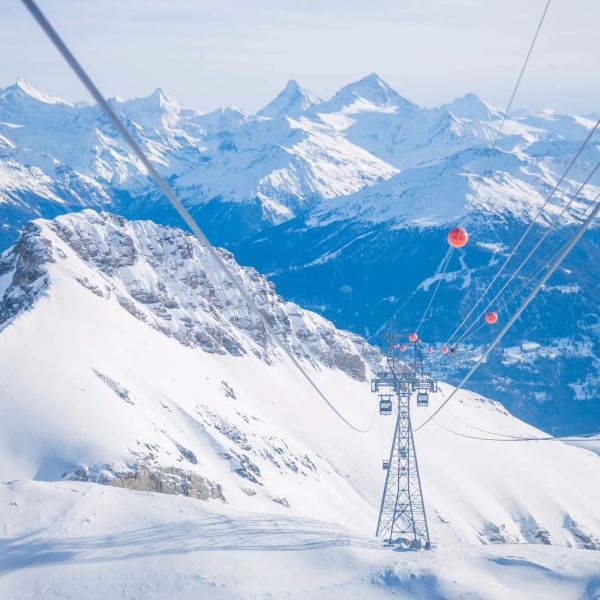
Crans-Montana 2027 World Championships President Resigns Ahead of Fraud Hearing
Less than four months out from the Crans-Montana 2027 World Championships, the man running the organising committee has stepped down. Claude-Alain Schmidhalter resigned as Swiss-Ski vice president and OC president after being indicted over a business dispute unrelated to skiing. He denies the allegations and faces court on October 27. Interim leaders are in place for the February 1-14 event.
9 Oct 2026
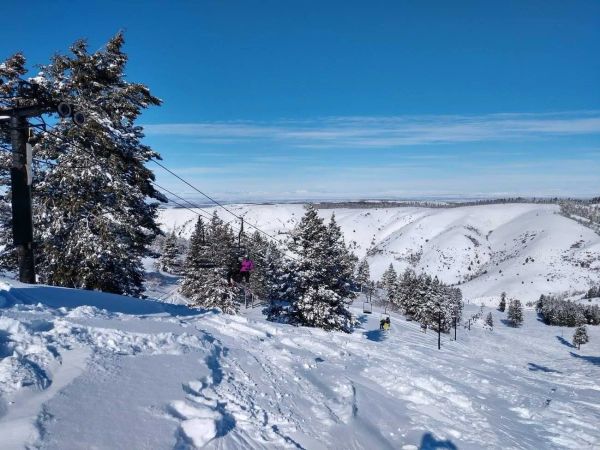
Kelly Canyon, Idaho, Adds Snowmaking, a Bigger Terrain Park and More Parking for 2026-27
Kelly Canyon had a rough 2025-26, and the Idaho resort has spent the summer making sure it doesn’t repeat. Snowmaking now reaches the top of Goldrush, the terrain park is doubling in size with a stereo system, lights and a snack shack, and the car park is getting bigger. Grooming is stepping up too. Target opening is December 4, conditions permitting.
9 Oct 2026
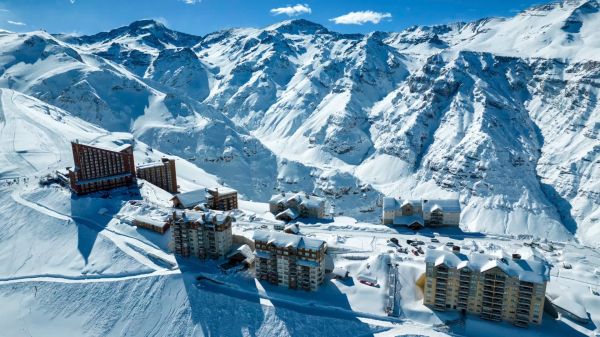
Valle Nevado Extends Season to November 8 After 108 cm in 48 Hours
Winter was meant to be winding down in Chile. Then Valle Nevado took 108 cm in 48 hours in early October, and the resort has pushed its closing date out to November 8 - its latest in 38 years of operation. That makes 143 days of skiing since opening day on June 19, with 690 cm banked for the season. Only part of the mountain is running while the storm settles, so check the mountain report before you plan a trip.
9 Oct 2026
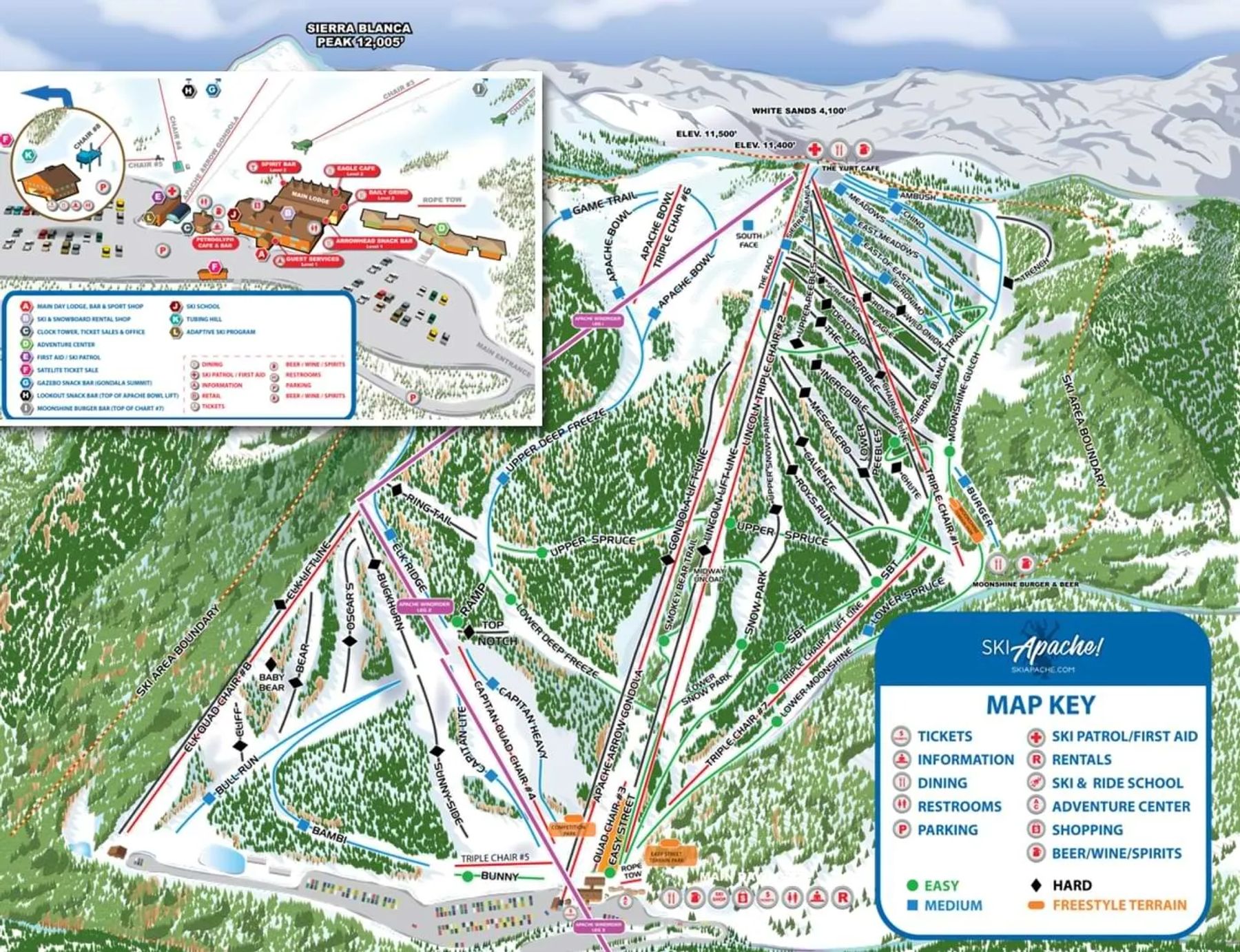
Ski Apache Trail Map
Downloadable Ski Apache trail map
Terrain split
55
runs
Beginner20%
Intermediate60%
Advanced20%
Expert0%
750 acres skiable304 hectares
Resort Stats
Elevation
Base9,600ft
Summit11,499ft
Annual snowfall
15ft
Season
2026 - 2027
28 Nov 2026 - 7 Mar 2027
Trail coverage
55 runs
750 acres (304 ha)
About Ski Apache's trail map
Explore Ski Apache's full trail map with 55 runs across the mountain, colour-coded by difficulty and shown alongside the terrain split. Use it to plan a day that matches your ability, find lift-served pockets of your favourite grade, and see how the resort links together. Download the piste map (PDF) ↗
More Ski Apache intelligence: snow report, lift system, webcams, resort overview.