
Kitzsteinhorn Resort
61km of pistes, 2,261m vertical drop, October-May season. Austria's first glacier ski area in Kaprun, Salzburg.
Season 2026 - 2027
Opens
2 Oct 2026
Closes
17 May 2027
Days open
227
Annual snow
5m
The Overview
Michael Fulton
Melbourne-based skier and snowboarder with 50+ resorts across 5 continents. Specialises in Australian resorts and international resort comparisons.
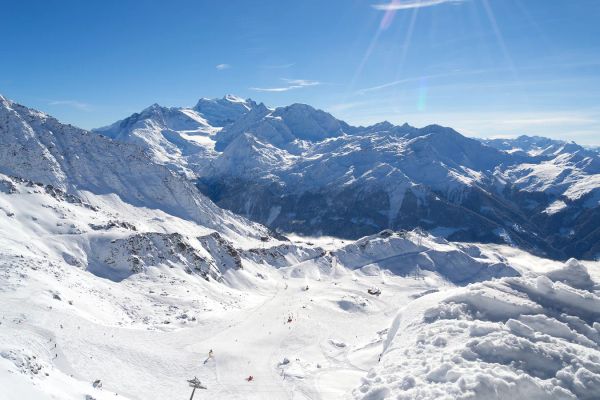
Austria's first glacier ski area opened in 1965 and spans 61 kilometres of marked pistes across terrain ranging from 768 metres at Maiskogel to 3,029 metres at the TOP OF SALZBURG summit platform. The resort delivers 2,261 metres of vertical - the greatest elevation change accessible by continuous gondola in the Eastern Alps. Twenty-four lifts serve 68 runs across three distinct zones: the high-alpine glacier above 2,600 metres, the intermediate Langwied sector, and the family-oriented Maiskogel below the treeline.
Terrain splits favour progression-focused skiers: 47% beginner, 37% intermediate, 10% advanced, and 6% expert. The glacier plateau hosts wide, open runs ideal for carving, whilst the Black Mamba delivers a 63% gradient challenge dropping 290 vertical metres from the Kristall lift base. Five marked freeride routes sit close to lifts in the Langwied area, with the X1 route accessible via a gated entry near the summit funicular. Red runs dominate the glacier proper, making up roughly two-thirds of that sector's terrain.
The ICE CAMP presented by Audi occupies a plateau at 2,600 metres from mid-January through mid-April - three igloos constructed from 60 tonnes of ice and 2,500 cubic metres of snow housing an ice bar and sun deck. The TOP OF SALZBURG attraction at the summit includes Austria's highest cinema (Cinema 3000) and a 360-metre tunnel called the National Park Gallery cutting through the mountain. On clear days, views extend to the Grossglockner, Austria's highest peak at 3,798 metres.
The Ski ALPIN CARD connects Kitzsteinhorn with Schmittenhöhe in Zell am See and Skicircus Saalbach Hinterglemm Leogang Fieberbrunn - 408 kilometres of combined terrain accessible on a single pass. Free ski buses operate between resorts throughout winter. The extended October-to-May season suits skiers seeking guaranteed snow outside typical Alps operating dates, whilst the four terrain parks and Austria's largest superpipe - shaped by Olympic shaper Alli Zehetner with walls up to 6.5 metres - attract freestyle riders.
2262m
Vertical
68
Runs
61 km
Piste
5m
Annual snow
Ski Alpin
Pass
Watch
See Kitzsteinhorn Resort in motion
The Terrain
68 runs across 61 km of piste
Kitzsteinhorn offers 2,262 metres of vertical from the Maiskogel base at 766 metres to the 3,028-metre summit, spread over 68 runs and 61 kilometres of piste. The split is unusually beginner-friendly for a glacier, with 47% beginner, 37% intermediate, 10% advanced and 6% expert terrain, because the gentle lower slopes of Maiskogel sit near Kaprun and the wide glacier plateau suits carving. Three zones stack on top of each other: Maiskogel below the treeline, the Langwied sector at mid-height, and the high alpine glacier above it.
The sharpest piste on the mountain is the Black Mamba, a 63% gradient that falls 290 vertical metres from the Kristall lift base, which makes it the obvious run for strong skiers to warm up on. Freeriders have five marked routes close to the lifts around Langwied, with the X1 route reached through a gated entry near the summit funicular. Because the glacier is where the open, high-altitude terrain is, the best skiing for most visitors is the long, wide red runs between the glacier and Langwied.
Terrain split
68
runs
68 runs across 4 grades
Beginner32 runs · 47%
Intermediate25 runs · 37%
Advanced7 runs · 10%
Expert4 runs · 6%
Time it right
When to visit Kitzsteinhorn Resort
The 2025/26 season runs from 11 October 2025 to 25 May 2026, delivering over seven months of operations - among the longest in the Alps. Kitzsteinhorn typically opens first in Salzburgerland each autumn and closes last, making it the regional choice for pre-season training and late-spring skiing. Lift operations run daily from 8:15 to 16:15, with hours adjusted based on conditions and daylight.
The glacier receives between 7 and 10 metres of natural snowfall annually, with the high-altitude terrain above 2,600 metres maintaining reliable coverage throughout the season. Snowmaking covers 29 kilometres of runs using 200 snow cannons, concentrating on the Maiskogel slopes and key glacier connections. Base depths regularly exceed 2 metres mid-winter; the resort reported 135 centimetres in mid-May 2026 with a season total surpassing 534 centimetres.
Early-season visitors (October-December) find fewer crowds and racing teams using the glacier for training - arrive after 8:45 to avoid the first-lift rush. Freeride conditions peak from mid-January onwards once rocks and gullies fill in completely. Spring skiing (March-May) brings warmer temperatures, corn snow, and the ICE CAMP Sounds DJ sessions every Saturday at 2,600 metres - the sun deck draws skiers for afternoon lounging.
The Glacier Spring Festival on 2 May 2026 closes the season with live music, culinary highlights, and free ski testing on spring snow. Weekly programming includes Tuesday Kitzsteinhorn Explorer Tours with National Park rangers, Wednesday snowshoe hikes to the ICE CAMP, and Thursday guided ski touring to the 2,762-metre Tristkogel. The SnowTime opening weekend in November combines the Freeride Film Festival, expert talks, and equipment testing.
Season 2026 - 2027
2 Oct 2026
Opens
17 May 2027
Closes
227
Days open
5 m
Annual snow
Getting there
Getting to Kitzsteinhorn Resort, and where to stay
Kitzsteinhorn rises within the Glockner Group of the High Tauern range in Austria's Salzburg province, positioned at the northern boundary of Hohe Tauern National Park - the largest protected alpine area in Europe. The mountain itself reaches 3,203 metres, though skiable terrain tops out at the 3,029-metre summit platform. The base village of Kaprun sits at 786 metres in the Pinzgau region, a former mining settlement of 3,000 residents now centred on tourism and the nearby hydroelectric power stations.
Zell am See lies 8 kilometres east along Lake Zell, offering additional accommodation, dining, and the Schmittenhöhe ski area connected via the ALPIN CARD. The city of Salzburg sits 100 kilometres north, reachable in approximately 80 minutes by car through the Salzach valley. The Grossglockner High Alpine Road - Austria's most famous mountain pass - begins south of Kaprun during summer months.
Drivers from Salzburg follow the A10 motorway south toward the Tauern tunnel, exiting before Bischofshofen and continuing through St Johann im Pongau and Bruck to Kaprun. From Innsbruck (150 kilometres), the route follows the motorway to Wörgl, then crosses Pass Thurn via Kitzbühel. Munich travellers (220 kilometres) head south through Rosenheim and cross at Kufstein. Free parking is available at both the Kaprun Center and the Gletscherjet valley station.
Salzburg Airport (SZG) provides the primary access point at 80-100 kilometres distance, with transfer times around 80 minutes. Innsbruck Airport sits 154 kilometres away; Munich Airport 223 kilometres. Zell am See railway station connects to Salzburg and Innsbruck, with Postbus line 660 running directly to Kaprun and the lift stations. From December 2025, WESTbahn operates three daily direct services from Vienna, and the ICE Großglockner runs weekend services from Hamburg and Munich through April 2026.
Where to stay
Search all stays →Hotels and lodges near Kitzsteinhorn Resort, powered by Stay22.
Latest News
From the SnowStash desk
Alps Snow Forecast: Up to 64 cm Headed for the High Glaciers as the Snow Line Drops
The Alps are about to swap mild, sunny October weather for something far more wintry. A cold front arrives Tuesday, and SnowStash forecasts have Monterosa Ski out in front with 64 cm over 14 days, ahead of Blatten Belalp (55 cm) and Verbier (43 cm). The snow line should fall below 2000 metres by Wednesday night, and glaciers across Switzerland, Italy and Austria are in line for the best of it. The wind will have a say too.
20 Oct 2026

Four Dead After Avalanche Near Ski Portillo in Chile
A large avalanche struck near Laguna del Inca adjacent to Ski Portillo on Saturday afternoon, killing four people and injuring four others. The group were day visitors mountaineering in the backcountry after reportedly being warned about elevated avalanche risk by resort staff.
18 Oct 2026

Europe Ski Resorts Open Now: What Is Skiable in Mid-October 2026
Europe’s ski season is open, technically. After a record-warm summer, glaciers in Austria, Switzerland and Italy are running a few pistes apiece, Sölden, Stubai and Kitzsteinhorn started late, Titlis has pushed back to 24 October, and Zermatt reopens a few lifts on 14 October after more than two months shut. Finland’s Levi and Ruka are skiing on stored snow. Here is what is open, and what you actually get at each.
14 Oct 2026

Zermatt Plans World Cup Downhill Return on the Gornergrat for 2028
Zermatt is having another crack at a World Cup downhill, and this time nobody has to cross a border. Around 13 million Swiss francs is going into rebuilding the Gornergrat piste, including a jump fed by a roughly 300-metre in-run across the roof of the Gornergrat Railway gallery, with the Matterhorn lined up behind it for the TV cameras. First men’s race is pencilled in for March 2028, pending FIS homologation.
14 Oct 2026

Mt. Rose Begins Snowmaking for the 2026-27 Season at Lake Tahoe
Lake Tahoe’s highest base elevation is paying off early: Mt. Rose has started making snow for 2026-27 after the first flurries and a cold snap. The Nevada resort is backing it with nearly US$2 million in upgrades, including a replacement snowmaking main line, a new PistenBully groomer and restraint bars on every lift. Opening day is yet to be confirmed, though Heavenly and Northstar are already eyeing 20 November.
13 Oct 2026

Utah Ski Resorts 2026-27: What’s New at Alta, Deer Valley, Powder Mountain and More
Utah is still building flat out. For 2026-27, Powder Mountain opens a steep new Skytrac chair into more than 1,000 acres of advanced terrain, Deer Valley adds 200 acres on Hail Peak, Sundance gets a new quad and Park City adds a gondola from its new parking structure. Snowmaking is expanding almost everywhere, Eagle Point stays closed after the Cottonwood Fire, and the 2034 Games are setting the pace. Here’s what’s new, resort by resort.
13 Oct 2026

Mt Hutt Invests NZ$12 Million in Base Area, Tripling Its Sun Deck
Mt Hutt is getting busier, and its base lodge is about to catch up. NZ$12 million goes into a heated sun deck roughly three times the current size (430 m² to 1,300 m²), plus a new toilet block, heated steps down to snow level, extra storage and a new food and beverage outlet. Building starts after the 2026 season, with everything due for winter 2027.
11 Oct 2026

Vermont Ski Resort Opening Dates 2026-27: Few Dates Set, Killington Waits on the Cold
Vermont's season is slow to take shape. Stratton is tentatively targeting 18 November and Sugarbush 21 November, while Pico has Friday 11 December on the calendar. Killington never sets a date and opens when the snowmaking allows, and Vail Resorts has yet to name days for Stowe, Okemo and Mount Snow. The forecasts disagree about snow, and the main El Niño worry for the Green Mountains is warmth.
9 Oct 2026
Kitzsteinhorn Resort Snow Report
Snow Report
Updated 23 Oct 2026
3028m
summit
+7cm
new snow · last 24 hours
Partly Cloudy-5°C / -1°C · SW 27km/h
Snowfall
24 hours
7cm
48 hours
14cm
7 days
20cm
Base depth
70cm
Season total
30cm
Lifts open9 / 24
2 Oct 2026 - 17 May 2027
Hour by Hour
Next 46 hours· Updated Oct 23, 2026 at 6:02 PM
Scroll for the full outlook · Open-Meteo
7-Day Outlook
3,028 mUpdated Oct 23, 2026 at 6:02 PMOpen-Meteo
Days 1–7
4.3cm
Days 8–14
0.0cm
Fri, Oct 23
Slight Snow Showers
Temp-1° / -5°°C
Snow0.1cm(80%)
Wind27 km/h SW
Live snow from the resort feed; forecast from Open-Meteo, via Supabase.
Understanding the Kitzsteinhorn Resort snow report
Get the latest Kitzsteinhorn Resort snow report — real-time snowfall, snow depth, and mountain weather for this Austria resort, spanning 766m to 3028m in elevation.
Snow measurements
Base depth, summit depth, and recent snowfall are the core numbers to watch. At Kitzsteinhorn Resort, summit conditions (3028m) can differ noticeably from the base, so we break both out separately rather than showing a single average.
Weather conditions
Current weather conditions affect snow quality. Cold temperatures with low wind typically preserve snow quality, while warm temperatures or rain can impact conditions negatively — something worth watching closely at Kitzsteinhorn Resort's 766m base elevation, where temperatures run milder than the summit.
Data sources
Snowfall and depth figures for Kitzsteinhorn Resort come from official mountain sources; weather and outlook data comes from independent forecasting services. The mountain is served by 24 lifts, including an aerial tram and 2 8-person chairlifts.
When to check
The biggest swings usually happen right after a storm. Check Kitzsteinhorn Resort's report in the morning for the freshest numbers, and again in the afternoon as conditions evolve.