
Schladming Dachstein
Schladming-Dachstein: Austria's 4-mountain ski area with 123km slopes and Ski amadé from €33.50. World Cup racing heritage, 90km from Salzburg.
Season 2026 - 2027
Opens
28 Nov 2026
Closes
11 Apr 2027
Days open
134
Annual snow
4m
The Overview
Michael Fulton
Melbourne-based skier and snowboarder with 50+ resorts across 5 continents. Specialises in Australian resorts and international resort comparisons.
Schladming-Dachstein delivers Austria's most comprehensive 4-mountain skiing experience across 123km of interconnected terrain in Styria's largest winter sports centre, reaching 2,015m elevation across Hauser Kaibling, Planai, Hochwurzen, and Reiteralm. This legendary destination combines World Cup racing heritage with exceptional recreational skiing, hosting the famous Planai night race annually whilst maintaining 37% beginner, 55% intermediate, and 8% advanced terrain distribution across 95 trails. The resort's integration within the massive Ski amadé network provides access to 760km of slopes across five connected regions, positioning Schladming as a strategic base for exploring Austria's largest interconnected ski area.
The 4-mountain circuit operates seamlessly with direct slope connections between all peaks, creating natural touring routes ranging from gentle valley floor approaches to challenging summit descents exceeding 5km length. The predominantly north-facing orientation across 1,287m vertical drop ensures excellent snow preservation throughout the season, supplemented by comprehensive snowmaking across the network. Schladming's Olympic pedigree from hosting the 2013 FIS Alpine World Championships and 1993 Special Olympics World Games demonstrates the infrastructure quality, with perfectly groomed slopes maintained by professional racing standards attracting elite competitions alongside recreational skiers.
The town of Schladming provides authentic Austrian charm with pedestrianised historic centre dating to its 1322 town charter, combining traditional architecture with modern resort amenities including over 90 ski huts serving Styrian specialties. The free ski bus network eliminates car requirements whilst eight dedicated children's areas create exceptional family infrastructure across the 4-mountain circuit, with annual season-opening concerts featuring international artists creating vibrant winter atmosphere.
1287m
Vertical
95
Runs
123 km
Piste
4m
Annual snow
Ski Amadé
Pass
The Terrain
95 runs across 123 km of piste
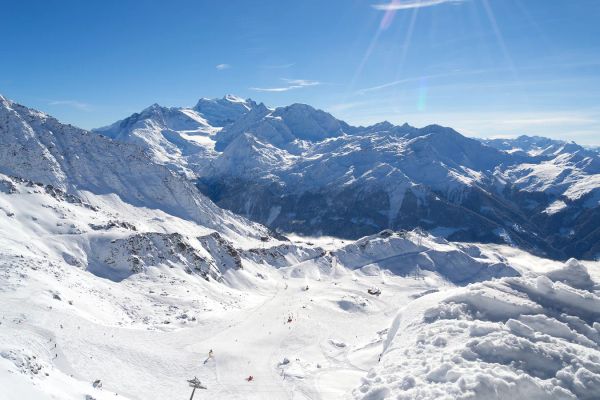
Schladming-Dachstein links four mountains, Hauser Kaibling, Planai, Hochwurzen and Reiteralm, into 123 kilometres of piste across 95 runs, dropping 1,287 metres from the 2,015-metre top of Hauser Kaibling to the valley at 728 metres. Intermediates take 55% of the terrain, beginners 37% and advanced skiers only 8%, with no expert pistes, so most of the circuit is groomed cruising. Hochwurzen and Reiteralm lean towards the wider, more relaxed end of that range, which makes them the easiest places to find your feet.
Planai is the mountain with the pedigree. It hosts the Nightrace, the men's World Cup slalom held under floodlights each year since 1997, and its piste is used for downhill and Super-G, with slaloms run on the steeper lower finish slope. Recreational skiers can ski the same hill, which makes Planai the obvious place on the circuit to try a World Cup venue. For serious steeps, though, the area offers few options, so advanced skiers will find it limited after a couple of days.
Terrain split
95
runs
95 runs across 4 grades
Beginner35 runs · 37%
Intermediate52 runs · 55%
Advanced8 runs · 8%
Expert0 runs · 0%
Time it right
When to visit Schladming Dachstein
Schladming-Dachstein typically operates from late November through mid-April, with peak conditions occurring January through March when Styrian snowfall averaging 4m annually combines with the predominantly north-facing terrain between 728m and 2,015m elevation. The extended season length reflects reliable natural snowfall supplemented by comprehensive snowmaking infrastructure maintaining consistent coverage across the 123km network even during lean natural snowfall periods. The professional grooming standards developed through decades of World Cup race hosting ensure immaculate piste conditions throughout winter.
The north-facing orientation across Planai, Hochwurzen, and Hauser Kaibling maintains excellent snow preservation well into spring, with the elevation range providing altitude diversity for reliable coverage top to bottom. The 2013 World Championship legacy includes world-class slope maintenance with extensive grooming fleets operating nightly across the 4-mountain circuit. Weekend and Austrian holiday periods attract substantial visitor numbers from Vienna, Graz, and neighbouring regions, though the extensive terrain and modern lift capacity maintain comfortable skiing conditions throughout peak periods.
Spring skiing extends reliably through April with pleasant temperatures and softening snow creating enjoyable recreational conditions across higher elevations, whilst the famous Planai night race in January creates spectacular atmosphere with floodlit World Cup racing drawing thousands of spectators. The Ski amadé pass validity across 760km provides weather insurance, allowing skiers to explore alternative sectors if conditions vary across the five connected regions spanning Salzburg and Styria.
Season 2026 - 2027
28 Nov 2026
Opens
11 Apr 2027
Closes
134
Days open
4 m
Annual snow
Getting there
Getting to Schladming Dachstein, and where to stay
Situated in Styria's Enns Valley approximately 95km south of Salzburg, Schladming occupies exceptional positioning with straightforward accessibility from Austria's major cities and international airports without high mountain pass navigation. Salzburg Airport lies 95km north with transfer times around 90 minutes via the A10 Tauern motorway, whilst Munich Airport 260km northwest provides major international connections with 2.5-hour transfers. Innsbruck Airport 200km west offers alternative alpine access, with Vienna 370km east positioning Schladming within weekend reach of Austria's capital.
The exceptional rail connectivity distinguishes Schladming from many Austrian resorts, with three train stations including Schladming Hauptbahnhof, Pichl, and Haus im Ennstal providing direct services from Salzburg requiring just 90 minutes journey time. The railway infrastructure eliminates road transfer requirements for environmentally conscious travellers, with regular connections throughout the day maintaining convenient schedules. The E651 Ennstal highway provides straightforward road access from multiple directions without challenging mountain pass driving, creating accessible year-round connectivity.
The historic mining town of Schladming at 745m elevation serves as the geographical and cultural centrepiece, offering comprehensive accommodation ranging from traditional gasthofs to modern wellness hotels within walking distance of Planai gondola base station. Multiple surrounding villages including Haus im Ennstal, Rohrmoos, Pichl, and Gleiming provide alternative lodging options with direct lift access eliminating daily commutes. The Ski amadé network integration creates strategic positioning for exploring neighbouring sectors including Flachau, Zauchensee, and the Gastein Valley, with the single pass providing unprecedented touring opportunities across Salzburg and Styria's premier winter sports destinations.
Where to stay
Search all stays →Hotels and lodges near Schladming Dachstein, powered by Stay22.
Latest News
From the SnowStash desk
Alps Snow Forecast: Up to 64 cm Headed for the High Glaciers as the Snow Line Drops
The Alps are about to swap mild, sunny October weather for something far more wintry. A cold front arrives Tuesday, and SnowStash forecasts have Monterosa Ski out in front with 64 cm over 14 days, ahead of Blatten Belalp (55 cm) and Verbier (43 cm). The snow line should fall below 2000 metres by Wednesday night, and glaciers across Switzerland, Italy and Austria are in line for the best of it. The wind will have a say too.
20 Oct 2026

Four Dead After Avalanche Near Ski Portillo in Chile
A large avalanche struck near Laguna del Inca adjacent to Ski Portillo on Saturday afternoon, killing four people and injuring four others. The group were day visitors mountaineering in the backcountry after reportedly being warned about elevated avalanche risk by resort staff.
18 Oct 2026

Europe Ski Resorts Open Now: What Is Skiable in Mid-October 2026
Europe’s ski season is open, technically. After a record-warm summer, glaciers in Austria, Switzerland and Italy are running a few pistes apiece, Sölden, Stubai and Kitzsteinhorn started late, Titlis has pushed back to 24 October, and Zermatt reopens a few lifts on 14 October after more than two months shut. Finland’s Levi and Ruka are skiing on stored snow. Here is what is open, and what you actually get at each.
14 Oct 2026

Zermatt Plans World Cup Downhill Return on the Gornergrat for 2028
Zermatt is having another crack at a World Cup downhill, and this time nobody has to cross a border. Around 13 million Swiss francs is going into rebuilding the Gornergrat piste, including a jump fed by a roughly 300-metre in-run across the roof of the Gornergrat Railway gallery, with the Matterhorn lined up behind it for the TV cameras. First men’s race is pencilled in for March 2028, pending FIS homologation.
14 Oct 2026

Mt. Rose Begins Snowmaking for the 2026-27 Season at Lake Tahoe
Lake Tahoe’s highest base elevation is paying off early: Mt. Rose has started making snow for 2026-27 after the first flurries and a cold snap. The Nevada resort is backing it with nearly US$2 million in upgrades, including a replacement snowmaking main line, a new PistenBully groomer and restraint bars on every lift. Opening day is yet to be confirmed, though Heavenly and Northstar are already eyeing 20 November.
13 Oct 2026

Utah Ski Resorts 2026-27: What’s New at Alta, Deer Valley, Powder Mountain and More
Utah is still building flat out. For 2026-27, Powder Mountain opens a steep new Skytrac chair into more than 1,000 acres of advanced terrain, Deer Valley adds 200 acres on Hail Peak, Sundance gets a new quad and Park City adds a gondola from its new parking structure. Snowmaking is expanding almost everywhere, Eagle Point stays closed after the Cottonwood Fire, and the 2034 Games are setting the pace. Here’s what’s new, resort by resort.
13 Oct 2026

Mt Hutt Invests NZ$12 Million in Base Area, Tripling Its Sun Deck
Mt Hutt is getting busier, and its base lodge is about to catch up. NZ$12 million goes into a heated sun deck roughly three times the current size (430 m² to 1,300 m²), plus a new toilet block, heated steps down to snow level, extra storage and a new food and beverage outlet. Building starts after the 2026 season, with everything due for winter 2027.
11 Oct 2026

Vermont Ski Resort Opening Dates 2026-27: Few Dates Set, Killington Waits on the Cold
Vermont's season is slow to take shape. Stratton is tentatively targeting 18 November and Sugarbush 21 November, while Pico has Friday 11 December on the calendar. Killington never sets a date and opens when the snowmaking allows, and Vail Resorts has yet to name days for Stowe, Okemo and Mount Snow. The forecasts disagree about snow, and the main El Niño worry for the Green Mountains is warmth.
9 Oct 2026
Schladming Dachstein Lift System
Schladming-Dachstein operates 47 modern lifts including 12 gondolas, 6 eight-seat chairlifts, 6 six-seat chairs, 5 quads, 1 double chair, 1 aerial tram, 1 train, and surface infrastructure efficiently serving the 1,287m vertical drop across four interconnected mountains. This ultra-modern network features high-capacity eight-seat chairlifts on key circulation routes maintaining exceptional uphill efficiency, with the gondola concentration eliminating weather-related closures whilst providing comfortable transport for non-skiers accessing mountain restaurants. The lift modernisation reflects continuous investment in world-class infrastructure supporting both recreational skiing and international racing events.
The strategic lift distribution creates distinct access points from valley villages including Schladming, Haus im Ennstal, Rohrmoos, and Pichl, with multiple base stations spreading arrivals across the 4-mountain circuit preventing single-point congestion. The Planai gondola from Schladming town centre provides direct ski-in ski-out access, whilst separate gondola systems serve Hochwurzen from Rohrmoos and Hauser Kaibling from Haus im Ennstal, creating flexible touring options. The interconnections maintain seamless flow between mountains without requiring extensive traversing or walking sections.
Night skiing operations on Hochwurzen illuminate 3km of slopes served by dedicated evening lift service, extending skiing beyond daylight hours with well-lit terrain accessible via separate evening tickets. The 7km Hochwurzen toboggan run creates additional nighttime entertainment, whilst the lift infrastructure supports summer operations including the renowned Planai Bike Park with downhill mountain biking tracks served by gondola transport throughout warmer months.
47lifts across 9 types
1
Train
1
Aerial Tram
12
Gondolas
6
8-Person Chairs
6
6-Person Chairs
5
Quad Chairs
1
Double Chair
12
T-Bars
3
Surface Lifts
Schladming Dachstein lift system
Schladming Dachstein is served by 47 lifts, listed here by type. Check which lifts are turning against the live conditions before you plan your first laps - early lifts and high-speed chairs get you to the best snow fastest.
More Schladming Dachstein intelligence: trail map, snow report, webcams, resort overview.