
Serre Chevalier
250km piste, 1,600m vertical, 4 villages. North-facing larch forests in France's Hautes-Alpes. Grande Galaxie pass benefits.
Season 2026 - 2027
Opens
5 Dec 2026
Closes
18 Apr 2027
Days open
134
Annual snow
5m
The Overview
Michael Fulton
Melbourne-based skier and snowboarder with 50+ resorts across 5 continents. Specialises in Australian resorts and international resort comparisons.
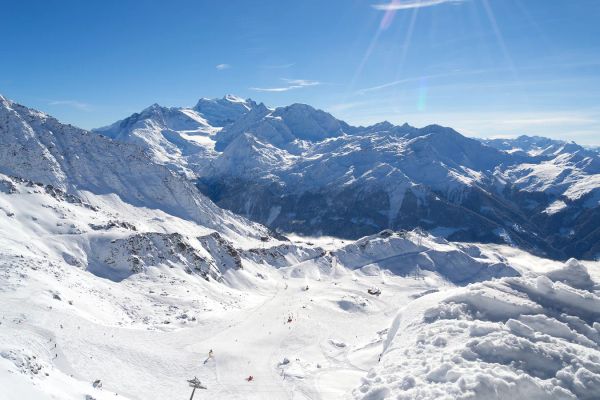
Serre Chevalier spans 250 kilometres of piste across a 1,600-metre vertical drop, running from 1,200 to 2,800 metres elevation along the Guisane Valley in the Hautes-Alpes. The resort comprises four interconnected villages - Briançon, Chantemerle, Villeneuve and Le Monêtier-les-Bains - stretching 15 kilometres along a predominantly north-facing ridge. With 80 runs tracked across nearly 4,000 hectares of terrain, it ranks among France's largest ski areas by piste length. Snow reliability benefits from the high-altitude profile, with 80 per cent of terrain above 1,800 metres and 493 snow cannons covering 146 kilometres of piste.
Terrain distribution favours progression, with 55 per cent beginner, 32 per cent intermediate, 10 per cent advanced and 3 per cent expert runs. The treeline reaches 2,150 metres - significantly higher than northern Alpine resorts - providing 700 metres of vertical drop through larch forests that retain powder longer than typical pine coverage. Named black runs include Luc Alphand, a World Cup piste dropping into Chantemerle, Casse du Boeuf to Villeneuve, and the technical Tabuc. The Cucumelle sector at 2,505 metres links Villeneuve and Monêtier, whilst the Yret chairlift accesses steep alpine bowls at 2,830 metres.
The valley character varies distinctly between sectors. Briançon, a UNESCO World Heritage fortified town at 1,200 metres, offers urban amenities and the Prorel gondola access. Chantemerle serves as a functional ski hub at 1,350 metres, whilst Villeneuve at 1,400 metres provides central access and livelier après options. Le Monêtier-les-Bains at 1,500 metres retains village authenticity and thermal spa facilities. The atmosphere skews more laid-back than northern French resorts, with fewer queues outside French school holidays and a southern Alpine mentality.
Six-day lift passes include Grande Galaxie benefits - one free day each at Alpe d'Huez, Les Deux Alpes, Puy Saint-Vincent, Montgenèvre and Sestrières. The season typically runs mid-November through late April, with peak conditions January through March. The north-facing orientation and larch forest coverage suit intermediates exploring long cruisers, families wanting tree-protected runs, and off-piste skiers accessing marked freeride zones. Adult day passes range €42-59 depending on season, with children under six skiing free.
1600m
Vertical
80
Runs
250 km
Piste
5m
Annual snow
The Terrain
80 runs across 250 km of piste
Serre Chevalier is a long, linear ski area of 250 kilometres of piste and 80 runs along the Guisane valley, from 1,200 metres up to 2,800 metres, a vertical of 1,600 metres. The grading is 55% beginner, 32% intermediate, 10% advanced and 3% expert, a gentle spread on a mountain that feels bigger and wilder than its numbers suggest. Four villages, Briançon, Chantemerle, Villeneuve and Le Monêtier-les-Bains, are strung along the valley, and you can ski between them, with gondolas, six-packs and a long line of T-bars working the slopes above.
Larch forest covers the mid-mountain, with the treeline around 2,150 metres, so you can see your line in winter and keep definition in flat light. Luc Alphand is the World Cup piste dropping into Chantemerle, and Tabuc is a black above Le Monêtier. Cucumelle at 2,505 metres links Villeneuve with Monêtier, and the Yret lift reaches steeper open bowls near 2,830 metres. Freeriders head for the fields and trees off the Cibouït chair in Monêtier, ideally with a guide. Intermediates and families will enjoy the cruising, and the small expert slice is balanced by plenty of off-piste.
Terrain split
80
runs
80 runs across 4 grades
Beginner44 runs · 55%
Intermediate26 runs · 32%
Advanced8 runs · 10%
Expert2 runs · 3%
Time it right
When to visit Serre Chevalier
The 2025-26 season opened 15 November 2025 and runs through 21 April 2026, spanning 22 weeks. Typical operating windows stretch mid-December through late April, though early-season opening depends on snowmaking capacity at lower elevations. The resort closes progressively by sector, with higher lifts often extending operations into late April when lower villages cease mid-month. Historic opening patterns show consistency around mid-December starts when natural base depth proves insufficient for full terrain access.
Serre Chevalier receives approximately 415 centimetres average annual snowfall, with historic February peaks reaching 199 centimetres at summit and 88 centimetres base depth. Early March produces the snowiest week statistically, averaging 37 centimetres across 3.7 snowy days. The north-facing orientation and high treeline preserve snow quality through spring, with 80 per cent of terrain above 1,800 metres maintaining coverage when lower slopes thin. January and February deliver coldest temperatures, making tree-protected runs valuable for wind protection, whilst March balances powder refresh cycles with increasing sunshine.
Optimal timing targets January through early March for powder conditions and deepest base depths, historically averaging 171 centimetres summit and 59 centimetres base in January. Late March and April suit spring skiing, with firmer mornings and soft afternoon snow on south-facing sectors. December and early January can show variable coverage at village level despite upper-mountain operations. The resort enjoys approximately 300 days of annual sunshine, contributing to bright mid-winter conditions that offset the colder north-facing exposure. Avoid French February school holidays unless prepared for significant crowds and lift queues.
The events calendar includes World Cup racing heritage tied to local champion Luc Alphand. Night skiing operates from Briançon's Prorel sector during peak holiday periods, with the Vauban descent remaining floodlit. No major international competitions currently anchor the season schedule. The Grande Galaxie reciprocal agreement activates 21 December 2025, allowing six-day pass holders access to partner resorts through respective closing dates. Summer operations shift to mountain biking, with gondola access supporting trail networks and altitude activities.
Season 2026 - 2027
5 Dec 2026
Opens
18 Apr 2027
Closes
134
Days open
5 m
Annual snow
Getting there
Getting to Serre Chevalier, and where to stay
Serre Chevalier occupies the Vallée de la Guisane in the Hautes-Alpes département of southeastern France, within the Provence-Alpes-Côte d'Azur region. The valley descends northwest from the Col du Lautaret at 2,058 metres to Briançon at 1,200 metres, where it meets the Durance Valley. The ski area borders Écrins National Park to the southwest, with the Dôme des Écrins rising to 4,102 metres across the valley. The location sits at the convergence of four valleys - Guisane, Clarée, Haute Durance and Cerveyrette - creating a high-altitude crossroads in the southern Alps.
Briançon, France's highest city at 1,326 metres, anchors the valley base with UNESCO-listed Vauban fortifications dating to 1692. The fortified upper town maintains cobbled streets and military architecture, whilst modern Briançon provides full urban services including supermarkets and medical facilities. Saint-Chaffrey encompasses Chantemerle village, La Salle-les-Alpes contains Villeneuve, and Le Monêtier-les-Bains sits at the valley's western end beneath alpine terrain. The area belongs to the Briançonnais region, historically significant for trans-Alpine trade routes and military positioning near the Italian border. The southern Alps climate produces drier, sunnier conditions than northern Savoie resorts, with Mediterranean influence tempering extreme cold.
Road access from northern France follows Autoroute A51 to exit Pont de Claix, then 80 kilometres via Route Nationale N91 and the Col du Lautaret, occasionally closed in severe weather though prioritised for clearance. From southern France, A51 exits La Saulce, followed by 90 kilometres through Gap. From Italy, the Fréjus Tunnel and Autoroute A43 exit at Oulx-Montgenèvre, 35 kilometres east. Drive times from Grenoble reach two hours 10 minutes covering 143 kilometres, Lyon requires two hours 30 minutes for 190 kilometres, and Gap sits 90 kilometres south. The valley road links all four villages continuously, with free shuttle buses supplementing private transport.
Turin Caselle Airport lies 127 kilometres distant, typically requiring two hours transfer time through the Montgenevre pass. Grenoble-Alpes-Isère Airport sits 143 kilometres away at two hours 10 minutes, Lyon Saint-Exupéry reaches 190 kilometres at two hours 30 minutes, and Marseille Provence extends 256 kilometres. Geneva Airport at 254 kilometres requires three hours 50 minutes, making it less practical despite larger flight networks. Briançon maintains a railway station with direct services to Paris including overnight trains, plus connections to Grenoble, Marseille and Lyon. Regional LER buses link Grenoble to Briançon twice daily in high season, covering 112 kilometres in two hours 20 minutes.
Where to stay
Search all stays →Hotels and lodges near Serre Chevalier, powered by Stay22.
Latest News
From the SnowStash desk
Alps Snow Forecast: Up to 64 cm Headed for the High Glaciers as the Snow Line Drops
The Alps are about to swap mild, sunny October weather for something far more wintry. A cold front arrives Tuesday, and SnowStash forecasts have Monterosa Ski out in front with 64 cm over 14 days, ahead of Blatten Belalp (55 cm) and Verbier (43 cm). The snow line should fall below 2000 metres by Wednesday night, and glaciers across Switzerland, Italy and Austria are in line for the best of it. The wind will have a say too.
20 Oct 2026

Four Dead After Avalanche Near Ski Portillo in Chile
A large avalanche struck near Laguna del Inca adjacent to Ski Portillo on Saturday afternoon, killing four people and injuring four others. The group were day visitors mountaineering in the backcountry after reportedly being warned about elevated avalanche risk by resort staff.
18 Oct 2026

Europe Ski Resorts Open Now: What Is Skiable in Mid-October 2026
Europe’s ski season is open, technically. After a record-warm summer, glaciers in Austria, Switzerland and Italy are running a few pistes apiece, Sölden, Stubai and Kitzsteinhorn started late, Titlis has pushed back to 24 October, and Zermatt reopens a few lifts on 14 October after more than two months shut. Finland’s Levi and Ruka are skiing on stored snow. Here is what is open, and what you actually get at each.
14 Oct 2026

Zermatt Plans World Cup Downhill Return on the Gornergrat for 2028
Zermatt is having another crack at a World Cup downhill, and this time nobody has to cross a border. Around 13 million Swiss francs is going into rebuilding the Gornergrat piste, including a jump fed by a roughly 300-metre in-run across the roof of the Gornergrat Railway gallery, with the Matterhorn lined up behind it for the TV cameras. First men’s race is pencilled in for March 2028, pending FIS homologation.
14 Oct 2026

Mt. Rose Begins Snowmaking for the 2026-27 Season at Lake Tahoe
Lake Tahoe’s highest base elevation is paying off early: Mt. Rose has started making snow for 2026-27 after the first flurries and a cold snap. The Nevada resort is backing it with nearly US$2 million in upgrades, including a replacement snowmaking main line, a new PistenBully groomer and restraint bars on every lift. Opening day is yet to be confirmed, though Heavenly and Northstar are already eyeing 20 November.
13 Oct 2026

Utah Ski Resorts 2026-27: What’s New at Alta, Deer Valley, Powder Mountain and More
Utah is still building flat out. For 2026-27, Powder Mountain opens a steep new Skytrac chair into more than 1,000 acres of advanced terrain, Deer Valley adds 200 acres on Hail Peak, Sundance gets a new quad and Park City adds a gondola from its new parking structure. Snowmaking is expanding almost everywhere, Eagle Point stays closed after the Cottonwood Fire, and the 2034 Games are setting the pace. Here’s what’s new, resort by resort.
13 Oct 2026

Mt Hutt Invests NZ$12 Million in Base Area, Tripling Its Sun Deck
Mt Hutt is getting busier, and its base lodge is about to catch up. NZ$12 million goes into a heated sun deck roughly three times the current size (430 m² to 1,300 m²), plus a new toilet block, heated steps down to snow level, extra storage and a new food and beverage outlet. Building starts after the 2026 season, with everything due for winter 2027.
11 Oct 2026

Vermont Ski Resort Opening Dates 2026-27: Few Dates Set, Killington Waits on the Cold
Vermont's season is slow to take shape. Stratton is tentatively targeting 18 November and Sugarbush 21 November, while Pico has Friday 11 December on the calendar. Killington never sets a date and opens when the snowmaking allows, and Vail Resorts has yet to name days for Stowe, Okemo and Mount Snow. The forecasts disagree about snow, and the main El Niño worry for the Green Mountains is warmth.
9 Oct 2026
Serre Chevalier Lift System
Serre Chevalier operates 59 lifts across the four valley sectors, comprising one cable car, five gondolas, 20 chairlifts and 33 surface lifts. The breakdown includes nine six-seat chairlifts, 10 quad chairs, one triple chair and 27 T-bars, with total uphill capacity exceeding 70,500 skiers per hour. Five moving carpets serve beginner zones. The infrastructure reflects mixed generations, with recent modernisation addressing older fixed-grip installations that previously dominated valley access.
Key gondola installations include the 12-person Prorel from Briançon, reaching mid-mountain at 2,070 metres in approximately eight minutes. The Ratier gondola services Chantemerle's main access, whilst the Aravet gondola at Villeneuve reaches 1,972 metres for beginner terrain. The Pontillas gondola, opened December 2023, climbs to the Méa plateau at 2,255 metres, creating a high-altitude beginner zone. Le Monêtier sector relies on the older Bancas and Yret chairlifts, with the six-seat Eychauda replacement significantly improving the Monêtier-Villeneuve link from 2019.
Sector connectivity functions primarily via chairlifts above mid-mountain, allowing ski-on traverses between villages. The Casse du Boeuf six-seat chair from Villeneuve reaches 2,273 metres in under 10 minutes, providing efficient vertical. The Combes and Grand Serre six-packs service core intermediate terrain above Villeneuve. Surface lifts still dominate upper sectors, particularly around Cucumelle and the Yret area, though several run only during peak periods. Free valley shuttle buses supplement lift connections between villages when descending off skis proves necessary.
Compagnie des Alpes, the operating company, maintains a programme replacing one major lift annually, with recent installations including the Cibouït quad chair and continued upgrades to fixed-grip infrastructure. Some six-pack chairs feature solar panel coverage, part of broader renewable energy initiatives. Night skiing operates on the floodlit Vauban red run from Briançon during French school holidays, with sessions running until 22:30. Lift queues remain manageable outside February holiday weeks, when French family visits intensify pressure on base-area gondolas and popular mid-mountain chairs.
59lifts across 7 types
1
Aerial Tram
5
Gondolas
9
6-Person Chairs
10
Quad Chairs
1
Triple Chair
27
T-Bars
6
Surface Lifts
Serre Chevalier lift system
Serre Chevalier is served by 59 lifts, listed here by type. Check which lifts are turning against the live conditions before you plan your first laps - early lifts and high-speed chairs get you to the best snow fastest.
More Serre Chevalier intelligence: trail map, snow report, webcams, resort overview.