
Livigno
Ski Livigno's 115km of high-altitude slopes. Snow-sure skiing at 1816m, duty-free shopping, and 2026 Olympic venue.
Season 2026 - 2027
Opens
28 Nov 2026
Closes
2 May 2027
Days open
155
Annual snow
4m
The Overview
Michael Fulton
Melbourne-based skier and snowboarder with 50+ resorts across 5 continents. Specialises in Australian resorts and international resort comparisons.
Livigno provides a distinctive high-altitude skiing experience in the Italian Alps, known as "Little Tibet" due to its remote location and cold, dry microclimate. The resort features 115km of slopes distributed across two distinct mountain sides—Mottolino and Carosello 3000—which are currently separated by the town valley. At an elevation of 1,816m, the village is one of the highest in Europe, with terrain extending to a summit of 2,798m, offering a significant vertical drop of 982m. The trail network is well-balanced for various skill levels, comprising 28% beginner, 55% intermediate, and 17% advanced terrain across 78 designated runs.
The skiing infrastructure is split between the eastern Mottolino side, favoured for its renowned snow park and wide-open freeride zones, and the western Carosello 3000 and Sitas sectors, which offer extensive sun-drenched cruising pistes. As a duty-free zone since the Napoleonic era, Livigno maintains a unique economic status that influences its vibrant après-ski culture and retail sector, featuring over 250 shops. The resort has been selected as the official host venue for freestyle skiing and snowboarding events for the Milano Cortina 2026 Olympic Winter Games, cementing its reputation as a global hub for gravity sports.
The village atmosphere reflects its Lombardy heritage, with traditional stone and wood architecture stretching along the 4km valley floor. While the two ski areas are not yet physically connected by a lift, a frequent and free shuttle bus service provides efficient transit between base stations. Family-specific infrastructure is a core focus, with multiple dedicated children’s areas and nursery slopes situated at the village level, allowing easy access for beginners before they progress to the high-altitude plateaus.
982m
Vertical
78
Runs
115 km
Piste
4m
Annual snow
The Terrain
78 runs across 115 km of piste
Livigno sits in a high valley at 1,816 metres, with 115 kilometres of piste across 78 runs rising to 2,798 metres. The vertical is 982 metres, and the cold, dry climate helps keep the snow in good shape. Grading is 28% beginner, 55% intermediate and 17% advanced, with no expert pistes. The skiing is split between two sides of the valley, Mottolino on one flank and Carosello 3000 with Costaccia on the other, and a shuttle bus connects the base stations. Intermediates dominate the map, so mixed groups can find plenty of easy cruising and the odd steeper pitch.
Mottolino is the freestyle and freeride side, with its snowpark and off-piste routes from Monte della Neve into the Vallaccia. Carosello 3000 has broad sunny pistes and the gentler beginner slopes, and the longest run, from Vetta Blesaccia down to the village, covers about 6 kilometres. Blue runs such as San Rocco and Tagliede help intermediates progress. Park riders and freeriders will like Mottolino, while families and cruisers favour Carosello. Advanced skiers will find limited pitch on the groomed runs, so the off-piste is where the challenge lies, and a guide is the sensible way to explore it.
Terrain split
78
runs
78 runs across 4 grades
Beginner22 runs · 28%
Intermediate43 runs · 55%
Advanced13 runs · 17%
Expert0 runs · 0%
Time it right
When to visit Livigno
The winter season in Livigno is among the longest in Italy, typically spanning from late November through to the beginning of May. The resort’s high base elevation of 1,816m and its geographical positioning near the Swiss border result in a cold microclimate that ensures reliable snow preservation. Average annual snowfall reaches approximately 3.5m, but the resort’s primary advantage is the consistent sub-zero temperatures that allow for highly effective snowmaking across the majority of the 115km trail network.
Peak skiing conditions are generally found between January and March, when the snowpack is at its deepest and the "Little Tibet" dry powder is most prevalent. The north-south orientation of the valley allows skiers to follow the sun, starting the morning on the Mottolino side and moving to the Carosello slopes in the afternoon. Late-season skiing in April remains a significant drawcard, as the altitude prevents the rapid softening of snow common in lower-lying Alpine resorts, maintaining firm morning pistes well into spring.
Livigno frequently offers "Ski Free" promotions during the shoulder seasons in December and April, where lift passes are included with local accommodation bookings, making it a strategic choice for early or late-season trips. The professional grooming teams operate a large fleet of snowcats nightly to manage the 78 runs, ensuring that even during periods of low natural precipitation, the World Cup-standard pistes remain in optimal condition for recreational and professional use.
Season 2026 - 2027
28 Nov 2026
Opens
2 May 2027
Closes
155
Days open
4 m
Annual snow
Getting there
Getting to Livigno, and where to stay
Livigno is situated in the province of Sondrio in the Lombardy region of Northern Italy, positioned within a high-altitude valley between the Engadine and the Upper Valtellina. Access to the resort is unique due to the Munt La Schera tunnel, a single-lane regulated passage that connects Livigno to Switzerland and provides the primary northern entry point. This tunnel requires a toll and operates on a timed schedule, particularly on Saturdays, which is a critical consideration for self-drive travellers from Northern Europe.
The closest major international gateway is Innsbruck Airport (INN) in Austria, approximately 180km away with a transfer time of roughly 2.5 to 3 hours depending on weather and tunnel traffic. Zurich Airport (ZRH) is 210km to the northwest, offering a reliable alternative for international arrivals via the Swiss motorway network. From within Italy, Milan Malpensa (MXP) and Milan Linate (LIN) are approximately 250km away, with transfers typically taking 3.5 to 4 hours via the scenic route through Lecco and Bormio.
For rail travellers, the nearest station is Tirano, located 70km away, which serves as the terminus for the scenic Bernina Express and provides bus connections to the resort. Despite its secluded Alpine positioning, the village is highly navigable, with a pedestrianised central zone that encourages walking between hotels and the duty-free retail boutiques. The proximity to Bormio (38km) and the Swiss resort of St. Moritz (45km) allows visitors to explore multiple world-class ski destinations within a single regional itinerary.
Where to stay
Search all stays →Hotels and lodges near Livigno, powered by Stay22.
Latest News
From the SnowStash desk
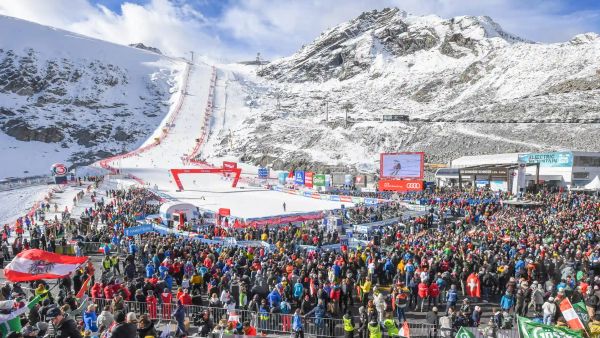
Pinheiro Braathen Wins Sölden Giant Slalom Opener by 0.48 Seconds
Two days at Sölden, two races decided by a hundredth somewhere on the podium, and one very quick Brazilian. Lucas Pinheiro Braathen led from the first run to win the men’s World Cup opener by 0.48 seconds, with Loïc Meillard second and Marco Odermatt third. River Radamus charged from 15th to fourth on a rutted course, and Britain’s Freddy Carrick-Smith banked his first World Cup points. Braathen still hasn’t lost a giant slalom since Olympic gold.
25 Oct 2026

Alps Snow Forecast: Up to 64 cm Headed for the High Glaciers as the Snow Line Drops
The Alps are about to swap mild, sunny October weather for something far more wintry. A cold front arrives Tuesday, and SnowStash forecasts have Monterosa Ski out in front with 64 cm over 14 days, ahead of Blatten Belalp (55 cm) and Verbier (43 cm). The snow line should fall below 2000 metres by Wednesday night, and glaciers across Switzerland, Italy and Austria are in line for the best of it. The wind will have a say too.
20 Oct 2026

Four Dead After Avalanche Near Ski Portillo in Chile
A large avalanche struck near Laguna del Inca adjacent to Ski Portillo on Saturday afternoon, killing four people and injuring four others. The group were day visitors mountaineering in the backcountry after reportedly being warned about elevated avalanche risk by resort staff.
18 Oct 2026

Europe Ski Resorts Open Now: What Is Skiable in Mid-October 2026
Europe’s ski season is open, technically. After a record-warm summer, glaciers in Austria, Switzerland and Italy are running a few pistes apiece, Sölden, Stubai and Kitzsteinhorn started late, Titlis has pushed back to 24 October, and Zermatt reopens a few lifts on 14 October after more than two months shut. Finland’s Levi and Ruka are skiing on stored snow. Here is what is open, and what you actually get at each.
14 Oct 2026

Zermatt Plans World Cup Downhill Return on the Gornergrat for 2028
Zermatt is having another crack at a World Cup downhill, and this time nobody has to cross a border. Around 13 million Swiss francs is going into rebuilding the Gornergrat piste, including a jump fed by a roughly 300-metre in-run across the roof of the Gornergrat Railway gallery, with the Matterhorn lined up behind it for the TV cameras. First men’s race is pencilled in for March 2028, pending FIS homologation.
14 Oct 2026

Mt. Rose Begins Snowmaking for the 2026-27 Season at Lake Tahoe
Lake Tahoe’s highest base elevation is paying off early: Mt. Rose has started making snow for 2026-27 after the first flurries and a cold snap. The Nevada resort is backing it with nearly US$2 million in upgrades, including a replacement snowmaking main line, a new PistenBully groomer and restraint bars on every lift. Opening day is yet to be confirmed, though Heavenly and Northstar are already eyeing 20 November.
13 Oct 2026

Utah Ski Resorts 2026-27: What’s New at Alta, Deer Valley, Powder Mountain and More
Utah is still building flat out. For 2026-27, Powder Mountain opens a steep new Skytrac chair into more than 1,000 acres of advanced terrain, Deer Valley adds 200 acres on Hail Peak, Sundance gets a new quad and Park City adds a gondola from its new parking structure. Snowmaking is expanding almost everywhere, Eagle Point stays closed after the Cottonwood Fire, and the 2034 Games are setting the pace. Here’s what’s new, resort by resort.
13 Oct 2026

Mt Hutt Invests NZ$12 Million in Base Area, Tripling Its Sun Deck
Mt Hutt is getting busier, and its base lodge is about to catch up. NZ$12 million goes into a heated sun deck roughly three times the current size (430 m² to 1,300 m²), plus a new toilet block, heated steps down to snow level, extra storage and a new food and beverage outlet. Building starts after the 2026 season, with everything due for winter 2027.
11 Oct 2026
Livigno Snow Report
Snow Report
Updated 26 Oct 2026
2798m
summit
+0cm
new snow · last 24 hours
Clear-4°C / 8°C · SE 11km/h
Snowfall
24 hours
0cm
48 hours
4cm
7 days
9cm
Base depth
0cm
Season total
9cm
Total lifts46
Live open status isn’t available right now.
28 Nov 2026 - 2 May 2027
Hour by Hour
Next 39 hours· Updated Oct 26, 2026 at 5:02 AM
Scroll for the full outlook · Open-Meteo
7-Day Outlook
2,602 mUpdated Oct 26, 2026 at 5:02 AMOpen-Meteo
Days 1–7
0.0cm
Days 8–14
9.2cm
Mon, Oct 26
Overcast
Temp8° / -4°°C
Snow0.0cm
Wind11 km/h SE
Live snow from the resort feed; forecast from Open-Meteo, via Supabase.
Understanding the Livigno snow report
Get the latest Livigno snow report — real-time snowfall, snow depth, and mountain weather for this Italy resort, spanning 1816m to 2798m in elevation.
Snow measurements
Snow depth at Livigno is tracked at both the base and summit, since the two elevations often see different totals — roughly a 982m difference here. We report fresh snowfall over the last 24 hours and 7 days alongside the running season total, in both metric and imperial units.
Weather conditions
Current weather conditions affect snow quality. Cold temperatures with low wind typically preserve snow quality, while warm temperatures or rain can impact conditions negatively — something worth watching closely at Livigno's 1816m base elevation, where temperatures run milder than the summit.
Data sources
Snowfall and depth figures for Livigno come from official mountain sources; weather and outlook data comes from independent forecasting services. The mountain is served by 46 lifts, including 4 8-person chairlifts and 6 quad chairlifts.
When to check
The biggest swings usually happen right after a storm. Check Livigno's report in the morning for the freshest numbers, and again in the afternoon as conditions evolve.