
Anzère
58km of piste, 904m vertical, Magic Pass included. South-facing Valais resort 20 minutes from Sion with new 10-person Bâté gondola.
Season 2026 - 2027
Opens
11 Dec 2026
Closes
4 Apr 2027
Days open
114
Annual snow
4m
The Overview
Michael Fulton
Melbourne-based skier and snowboarder with 50+ resorts across 5 continents. Specialises in Australian resorts and international resort comparisons.
Anzère operates 58 kilometres of piste spread across 27 runs between 1,516 and 2,420 metres elevation, delivering 904 metres of vertical drop from the resort's highest point at Le Bâté. The terrain breaks down to 21% beginner, 64% intermediate and 15% advanced, with no expert-rated piste, though off-piste opportunities exist across the south-facing ski area. The resort sits at 1,500 metres in the municipality of Ayent, part of Valais canton in southwest Switzerland, and receives an average annual snowfall of 4.3 metres supplemented by 10 kilometres of snowmaking coverage across 84 cannons.
Intermediate skiers dominate the mountain with 37 kilometres of red runs forming the core of the ski area, whilst 12 kilometres of blue terrain serve progression skiers and 9 kilometres of black piste challenge advanced riders. Piste des Masques offers the longest descent at 5 kilometres from Pas de Maimbré back to the village, whilst the Les Rousses sector delivers technical terrain and open slopes reached via the new Bâté gondola. The resort layout centres on two summit access points: Pas de Maimbré at 2,362 metres and Le Bâté at 2,420 metres, each feeding distinct sectors of the ski area.
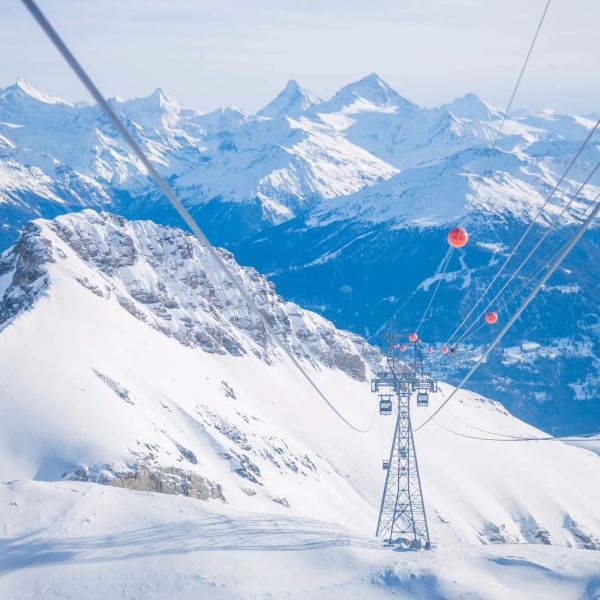
The purpose-built village maintains consistent wood-and-stone architecture dating from the 1960s development, creating a compact, pedestrian-friendly central square called Place du Village. South-facing orientation guarantees exceptional sun exposure throughout winter, with daily sunshine often exceeding seven hours when conditions allow, though the aspect can accelerate snow deterioration during warm spells. Pas de Maimbré mountain restaurant serves regional specialities including fondue and rösti on a panoramic terrace overlooking the Rhône Valley and Alpine peaks including Mont Blanc, the Weisshorn and the Matterhorn on clear days.
Anzère holds Magic Pass membership, granting annual passholders free access alongside 80-plus partner resorts across Switzerland and France. The 2025-26 season runs from 13 December 2025 through 6 April 2026, with lifts operating daily 8:45am to 4pm subject to snow and weather conditions. Adult day passes cost CHF 68, with discounted beginner passes at CHF 26 covering the gondola, La Cuvette area and Turin lift, whilst children under six ski free when passing turnstiles with an accompanying adult. The resort suits intermediate families seeking reliable sunshine, manageable terrain and proximity to Sion, whilst midweek visits outside school holidays deliver near-empty pistes.
904m
Vertical
27
Runs
58 km
Piste
4m
Annual snow
The Terrain
27 runs across 58 km of piste
Sunshine and rolling reds define Anzère, a compact Valais ski area facing south over the Rhône Valley. It offers 58 kilometres of piste across 27 runs and 904 metres of vertical, from 1,516 up to 2,420 metres. Intermediates dominate, with 64% of the terrain graded for them, alongside 21% beginner and 15% advanced and nothing rated expert. That makes it a comfortable place to build confidence on long, flowing runs without feeling cramped. The aspect brings plenty of sun but also means the snow can soften quickly in warm spells, so mornings are usually the best skiing of the day.
Pas de Maimbré is the main gateway to the mountain, with a view across the valley to a line of 4,000-metre peaks. From there the Piste des Masques runs about 5 kilometres back towards the village and is the longest descent in the area, while Le Bâté, the highest lift-served point, opens up the more technical Les Rousses sector. Freeriders can find some off-piste options below the Les Rousses and Le Bâté lifts, though the choice is limited. It suits families and intermediate skiers who value sun, manageable terrain and quieter slopes outside school holidays.
Terrain split
27
runs
27 runs across 4 grades
Beginner6 runs · 21%
Intermediate17 runs · 64%
Advanced4 runs · 15%
Expert0 runs · 0%
Time it right
When to visit Anzère
The 2025-26 winter season operates from 13 December 2025 through 6 April 2026, with lift hours set at 8:45am to 4pm daily subject to snow and weather conditions. Early opening occasionally occurs from late November when snowfall permits, whilst the Magic Carpet at Village Square runs 19 December 2025 through 22 March 2026 from 9am to 4pm for beginners. The resort typically opens mid-December and closes mid-April annually, delivering a four-month operating window that capitalises on Valais snowfall patterns and the south-facing elevation advantage from 1,516 to 2,420 metres.
Anzère receives 4.3 metres of average annual snowfall across the ski area, with natural accumulation supplemented by 84 snow cannons covering 10 kilometres of key piste including lower altitude runs and village connections. The south-facing aspect delivers exceptional sunshine but accelerates melt during warm periods, making snowmaking critical for season-long base coverage below 2,000 metres. Peak season base depths average 80 centimetres, with the 2025-26 season recording 150 centimetres on-mountain and 20 centimetres at village level by mid-March, demonstrating reliable mid-winter conditions at upper elevations.
January through March delivers optimal powder conditions when storm cycles from the northwest dump fresh snow across the Valais Alps, whilst December and April offer variable coverage dependent on temperature patterns. Spring skiing develops from mid-March onwards as daytime sun softens south-facing piste into corn snow by afternoon, rewarding early morning sessions before surfaces turn heavy. Midweek visits from Monday to Thursday outside school holidays guarantee near-empty slopes, a sharp contrast to weekend congestion when Sion residents flood the resort just 20 minutes from the cantonal capital.
The resort calendar remains light on major events compared to larger Valais destinations, though night ski touring operates on the Masques piste for motivated climbers seeking after-hours vertical. Anzère hosts occasional ski school competitions and regional race events throughout winter, whilst the resort's inclusion in the Magic Pass network attracts passholders exploring the 80-plus partner areas. The 4.1-kilometre cross-country trail at Gô forest provides Nordic skiing when snow permits, whilst marked ski touring routes to La Brune-Tsalan (450 metres ascent) and Rousses (670 metres ascent) serve backcountry enthusiasts.
Season 2026 - 2027
11 Dec 2026
Opens
4 Apr 2027
Closes
114
Days open
4 m
Annual snow
Getting there
Getting to Anzère, and where to stay
Anzère occupies a south-facing plateau at 1,500 metres elevation in the municipality of Ayent, Valais canton, southwest Switzerland, positioned 15 kilometres from Sion on the north side of the Rhône River valley. The purpose-built resort sits above the valley floor with unobstructed views across to 4,000-metre peaks including the Bishorn, Weisshorn, Dent d'Hérens and Mont Blanc visible from Pas de Maimbré on clear days. Larch and pine forests surround the village, which emerged from a collection of five chalets in the 1960s to become a compact ski destination characterised by architectural cohesion uncommon in Alpine resorts developed during that era.
Sion, the Valais capital with extensive rail connections and commercial services, lies 20 minutes downvalley by road, whilst the larger resort of Crans-Montana sits 16 kilometres northwest across the Rhône Valley. The municipality of Ayent encompasses Anzère alongside traditional mayens (alpine pastures) and the Bisse d'Ayent irrigation channel, part of the historic suonen system dating to the 15th century that funnelled water across the dry Valais slopes. Geneva, Switzerland's second city, lies 160 kilometres west with Lake Geneva (Lac Léman) positioned between.
Road access follows a winding mountain route climbing from the Rhône Valley via either Ayent or Arbaz, both connecting to the A9 motorway running the length of Valais from Lake Geneva to Brig. Drive time from Sion measures 20 minutes under normal conditions, whilst Geneva requires approximately two hours via the A9 and A1 motorways covering 160 kilometres. Lausanne sits 80 minutes west, and parking at Anzère includes free village lots connected by complimentary shuttle buses, plus paid parking at the gondola base and Les Rousses where enforcement issues fines for non-payment particularly during weekends.
Geneva International Airport, the primary gateway at 136 kilometres distance, offers two-hour train connections to Sion via direct Swiss Federal Railways services departing hourly, followed by bus transfer to Anzère. Sion Airport operates 30 kilometres from the resort handling limited commercial traffic, whilst Bern Airport lies three hours distant. Public transport from Sion station to Anzère runs via bus services operated through Ayent or Arbaz routes, depositing passengers at the central Place du Village with ski-in access to lifts and amenities within the pedestrianised core.
Where to stay
Search all stays →Hotels and lodges near Anzère, powered by Stay22.
Latest News
From the SnowStash desk

Four Dead After Avalanche Near Ski Portillo in Chile
A large avalanche struck near Laguna del Inca adjacent to Ski Portillo on Saturday afternoon, killing four people and injuring four others. The group were day visitors mountaineering in the backcountry after reportedly being warned about elevated avalanche risk by resort staff.
18 Oct 2026

Europe Ski Resorts Open Now: What Is Skiable in Mid-October 2026
Europe’s ski season is open, technically. After a record-warm summer, glaciers in Austria, Switzerland and Italy are running a few pistes apiece, Sölden, Stubai and Kitzsteinhorn started late, Titlis has pushed back to 24 October, and Zermatt reopens a few lifts on 14 October after more than two months shut. Finland’s Levi and Ruka are skiing on stored snow. Here is what is open, and what you actually get at each.
14 Oct 2026

Zermatt Plans World Cup Downhill Return on the Gornergrat for 2028
Zermatt is having another crack at a World Cup downhill, and this time nobody has to cross a border. Around 13 million Swiss francs is going into rebuilding the Gornergrat piste, including a jump fed by a roughly 300-metre in-run across the roof of the Gornergrat Railway gallery, with the Matterhorn lined up behind it for the TV cameras. First men’s race is pencilled in for March 2028, pending FIS homologation.
14 Oct 2026

Mt. Rose Begins Snowmaking for the 2026-27 Season at Lake Tahoe
Lake Tahoe’s highest base elevation is paying off early: Mt. Rose has started making snow for 2026-27 after the first flurries and a cold snap. The Nevada resort is backing it with nearly US$2 million in upgrades, including a replacement snowmaking main line, a new PistenBully groomer and restraint bars on every lift. Opening day is yet to be confirmed, though Heavenly and Northstar are already eyeing 20 November.
13 Oct 2026

Utah Ski Resorts 2026-27: What’s New at Alta, Deer Valley, Powder Mountain and More
Utah is still building flat out. For 2026-27, Powder Mountain opens a steep new Skytrac chair into more than 1,000 acres of advanced terrain, Deer Valley adds 200 acres on Hail Peak, Sundance gets a new quad and Park City adds a gondola from its new parking structure. Snowmaking is expanding almost everywhere, Eagle Point stays closed after the Cottonwood Fire, and the 2034 Games are setting the pace. Here’s what’s new, resort by resort.
13 Oct 2026

Mt Hutt Invests NZ$12 Million in Base Area, Tripling Its Sun Deck
Mt Hutt is getting busier, and its base lodge is about to catch up. NZ$12 million goes into a heated sun deck roughly three times the current size (430 m² to 1,300 m²), plus a new toilet block, heated steps down to snow level, extra storage and a new food and beverage outlet. Building starts after the 2026 season, with everything due for winter 2027.
11 Oct 2026

Vermont Ski Resort Opening Dates 2026-27: Few Dates Set, Killington Waits on the Cold
Vermont's season is slow to take shape. Stratton is tentatively targeting 18 November and Sugarbush 21 November, while Pico has Friday 11 December on the calendar. Killington never sets a date and opens when the snowmaking allows, and Vail Resorts has yet to name days for Stowe, Okemo and Mount Snow. The forecasts disagree about snow, and the main El Niño worry for the Green Mountains is warmth.
9 Oct 2026
Crans-Montana 2027 World Championships President Resigns Ahead of Fraud Hearing
Less than four months out from the Crans-Montana 2027 World Championships, the man running the organising committee has stepped down. Claude-Alain Schmidhalter resigned as Swiss-Ski vice president and OC president after being indicted over a business dispute unrelated to skiing. He denies the allegations and faces court on October 27. Interim leaders are in place for the February 1-14 event.
9 Oct 2026
Anzère Lift System
Anzère operates 13 lifts comprising one 8-person gondola, one 8-person chairlift, two quad chairs, one triple chair, one double chair, three surface lifts and four T-bars, with total uphill capacity of 9,250 skiers per hour. The base gondola Anzère-Tsalan-Pas de Maimbré spans 2,133 metres with 2,000 persons per hour capacity manufactured by Doppelmayr, spinning from 8:45am and serving as the primary village access. Two detachable quad chairlifts include the 1,575-metre Les Luys-Pas de Maimbré carrying 1,600 per hour and the 1,630-metre Garaventa installation moving 1,800 per hour, whilst the Rousses triple chair climbs 650 vertical metres from 1,770 metres to the La Bâté summit.
The headline installation for 2025-26 is the new Grillesses-Duez-Le Bâté 10-person gondola engineered by Garaventa, replacing a fixed-grip double chair dating from 1970 that had become a notorious bottleneck. Spanning 1,746 metres with 580 metres of vertical rise and 2,000 persons per hour capacity, the weather-protected cabins slash travel time into the Les Rousses sector whilst eliminating mid-mountain congestion. The CHF 11 million project opened December 2025 as part of Télé Anzère's broader Mountain Plan modernisation strategy, transforming access to the sunny, technical terrain in the eastern ski area.
Base-to-summit flow follows a straightforward pattern: the main gondola climbs from village level at 1,500 metres to Pas de Maimbré at 2,362 metres, where skiers access the western sectors via the Les Luys quad chair or descend towards the Grillesses mid-station. From Grillesses at approximately 2,000 metres, the new 10-person gondola continues to Le Bâté at 2,420 metres, the resort's highest lifted point. The Rousses triple chair provides an alternative eastern access from 1,770 metres directly to Le Bâté, though this lift typically closes during storm days due to exposure.
The 2025-26 season marks a significant capacity upgrade following decades of infrastructure stagnation, with the 54-year-old Duez chairlift replacement representing the first major mid-mountain renewal since the 1990s. Future plans include potential gondola replacement of the Rousses triple chair to reduce CO2 emissions and streamline sledge transport on the designated toboggan run. Free village shuttle buses circulate throughout the day connecting parking areas to lift bases, whilst paid parking at the gondola base and Les Rousses enforces strict fines for non-payment during weekends.
13lifts across 7 types
1
Gondola
1
8-Person Chair
2
Quad Chairs
1
Triple Chair
1
Double Chair
4
T-Bars
3
Surface Lifts
Anzère lift system
Anzère is served by 13 lifts, listed here by type. Check which lifts are turning against the live conditions before you plan your first laps - early lifts and high-speed chairs get you to the best snow fastest.
More Anzère intelligence: trail map, snow report, webcams, resort overview.