
St Moritz - Corviglia
St Moritz - Corviglia: 1,322m vertical, 23 lifts, 155km of piste from 1,735-3,057m. South-facing Engadin skiing on Ikon Pass.
Season 2026 - 2027
Opens
28 Nov 2026
Closes
4 Apr 2027
Days open
127
Annual snow
8m
The Overview
Michael Fulton
Melbourne-based skier and snowboarder with 50+ resorts across 5 continents. Specialises in Australian resorts and international resort comparisons.
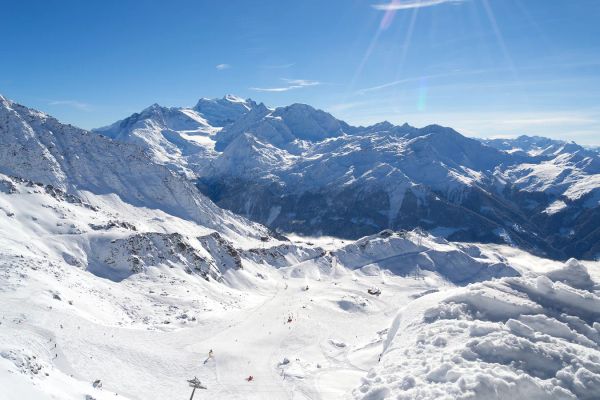
St Moritz - Corviglia spans 1,735 to 3,057 metres elevation across 155 kilometres of piste, delivering 1,322 metres of vertical drop serviced by 23 lifts. The ski area ranks within the top 10 in Switzerland for size and snow reliability, with 110 kilometres covered by snowmaking and an average season depth of 108 centimetres at summit. Piz Nair at 3,057 metres anchors the terrain, accessible via funicular and aerial tramway from the village at 1,856 metres elevation. The resort joined the Ikon Pass in 2024, offering passholders five to seven days across the Engadin St Moritz Mountain Pool.
Terrain breaks down to 27 per cent beginner, 51 per cent intermediate, 15 per cent advanced and 7 per cent expert across 36 marked runs. South-facing slopes catch early sun and deliver consistent grooming, whilst the western descent from Piz Nair opens freeride terrain beyond marked boundaries. The 6.5-kilometre run to Celerina offers one of the longest continuous descents, whilst the 2-kilometre Olympic downhill route tests advanced skiers. Corviglia Snowpark Crowland near the mid-station features over 30 obstacles across easy and medium lines, plus a 600-metre funslope for beginners.
The mountain opens at 0745 with the Chantarella funicular and Marguns gondola, allowing early access to freshly groomed pistes before crowds arrive after 1000. On-mountain infrastructure includes 20 restaurants and huts, ranging from rustic alpine dining to upscale establishments with panoramic glacier views. The Salastrains beginner area mid-mountain provides dedicated learner terrain with magic carpets and low-angle slopes. Lift-served terrain stays quiet through mid-morning, then fills with an international clientele mixing resort guests and day visitors from the Upper Engadin valley.
The Engadin St Moritz Mountain Pool pass covers Corviglia, Corvatsch and Diavolezza ski areas plus smaller satellites across 325 kilometres of combined terrain. The 2025-26 season ran 22 November to 5 April, typical of the resort's reliable mid-winter to spring window. Corviglia suits confident intermediates and families seeking variety, groomed reliability and high-altitude snow security. The resort hosted Winter Olympics in 1928 and 1948, along with four FIS Alpine World Ski Championships, cementing its competition pedigree alongside recreational appeal.
1322m
Vertical
36
Runs
155 km
Piste
8m
Annual snow
Ikon Pass
Pass
The Terrain
36 runs across 155 km of piste
St Moritz Corviglia covers 155 kilometres across 36 runs, falling 1,322 vertical metres from the 3,057-metre summit of Piz Nair to the village at 1,735 metres. Intermediates hold the biggest share at 51%, with 27% beginner, 15% advanced and 7% expert. The wide, sunny slopes suit long, fast cruising, and the uphill network mixes two trains, two aerial trams, a gondola and a stack of quad and six-seat chairs. The area is part of the Ikon Pass, which adds to the traffic in peak weeks.
Piz Nair is the focal point, with the Corviglia sector below it serving long blues and reds above the Engadin lakes. Freeriders can leave the summit by the western descent or head into the Val Suvretta, and a guide is sensible for either. Groomed expert terrain is limited, so skiers chasing steep pistes may find the network tame. St Moritz suits confident intermediates and strong cruisers who value sunshine, scenery and a polished resort, and who do not mind paying for the privilege. Lunch stops are plentiful and well placed.
Terrain split
36
runs
36 runs across 4 grades
Beginner10 runs · 27%
Intermediate18 runs · 51%
Advanced5 runs · 15%
Expert3 runs · 7%
Time it right
When to visit St Moritz - Corviglia
The 2025-26 season operated 22 November to 5 April, spanning 19 weeks across early winter through spring closure. Corviglia typically opens late November with snowmaking support across 110 kilometres of piste, closing early to mid-April depending on snow cover and visitor demand. High-elevation terrain above 2,500 metres extends the operating window compared to lower Swiss resorts, with Piz Nair holding snow into April most seasons. The resort averages 264 centimetres annual snowfall, with December through February delivering the heaviest accumulation at 64-67 centimetres per month.
Snow reliability benefits from 3,057-metre summit elevation and extensive snowmaking infrastructure covering roughly two-thirds of marked terrain. Average mid-season depths reach 108 centimetres at summit and 44 centimetres at base, with March historically offering the deepest coverage at 136 centimetres high and 50 centimetres low. South-facing slopes receive strong sun exposure, creating firm morning corduroy followed by softer afternoon conditions from January onwards. The Engadin's dry continental climate produces 300-plus sunny days annually, though precipitation when it arrives typically falls as snow above 2,000 metres through March.
January and February deliver peak powder conditions with cold temperatures and mid-winter storms, whilst March balances snow quality with longer daylight and warming trends. Early December and late March offer quieter slopes and discounted accommodation, ideal for skiers prioritising empty pistes over guaranteed fresh snow. November opening depends on early-season snowmaking, with limited terrain until December storms fill in coverage. April spring skiing concentrates on north-facing runs and higher sectors, with afternoon slush developing below 2,200 metres as sun intensity increases.
The Snow Polo World Cup takes place late January on the frozen lake below the resort, whilst White Turf horse racing runs three Sundays in February, both drawing international crowds. The Engadin Skimarathon cross-country race typically occurs early March, filling valley accommodation. Corviglia does not offer night skiing, though neighbouring Corvatsch operates Switzerland's longest illuminated piste (4.2 kilometres) on Friday evenings. The season calendar favours mid-winter through early spring, with January to March representing optimal timing for snow quality, coverage and operational consistency.
Season 2026 - 2027
28 Nov 2026
Opens
4 Apr 2027
Closes
127
Days open
8 m
Annual snow
Getting there
Getting to St Moritz - Corviglia, and where to stay
St Moritz sits at 1,856 metres elevation in the Upper Engadin valley, a broad glaciated basin in southeast Switzerland's canton of Graubünden. The valley stretches approximately 80 kilometres from Maloja Pass to the Austrian border, with St Moritz positioned centrally amongst a chain of lakes including Lake St Moritz, Lake Silvaplana and Lake Sils. Piz Bernina at 4,049 metres dominates the southern skyline 15 kilometres away as the Eastern Alps' highest summit, whilst the Albula range rises north of the valley. The Corviglia ski area occupies the southern slopes of Piz Nair directly above the resort, with south-facing exposure delivering sun from early morning through afternoon.
The town divides into St Moritz Dorf on the hillside and St Moritz Bad in the valley floor, with neighbouring Celerina 2 kilometres northeast and Samedan 4 kilometres distant serving as the Upper Engadin's administrative capital. The area lies within the Maloja administrative region, historically a Romansh-speaking territory now predominantly German and Italian-speaking due to tourism growth. Engadin Airport in Samedan sits 5 kilometres from St Moritz at 1,707 metres elevation, Europe's second-highest commercial airfield, handling private jets and charters but no scheduled passenger service. The frozen lake hosts winter events including polo and horse racing on its 1,800-metre-elevation surface.
Road access centres on the Julier Pass from the north, open year-round and reaching 2,284 metres elevation via a well-maintained route from Chur and Thusis. The A13 motorway from Zurich runs to Thusis, where Route 3 continues via Tiefencastel and Savognin to Silvaplana, with the final segment on Route 27 into St Moritz. The Maloja Pass at 1,815 metres connects southwest to Italy via Val Bregaglia and Chiavenna, descending steeply through 22 hairpins toward Lake Como. Zurich lies approximately 200 kilometres northwest with a 3-hour drive, whilst Milan sits 180 kilometres south requiring 3 hours via Italian motorways and the Maloja or Bernina approaches.
Zurich Airport (ZRH) serves as the primary international gateway 220 kilometres distant, with Milan Malpensa (MXP) 180 kilometres and Milan Bergamo (BGY) 155 kilometres offering southern alternatives. The Rhaetian Railway operates direct trains from Zurich Hauptbahnhof to St Moritz in 3 hours via the UNESCO-listed Albula line through Chur, Filisur and the Albula Tunnel. Trains also connect south via the Bernina Pass to Tirano in Italy, whilst the Vereina Tunnel links the Lower Engadin to Klosters. PostBus services cover valley villages and connect Maloja Pass routes to Lugano and routes east through the Swiss National Park to South Tyrol.
Where to stay
Search all stays →Hotels and lodges near St Moritz - Corviglia, powered by Stay22.
Latest News
From the SnowStash desk
Alps Snow Forecast: Up to 64 cm Headed for the High Glaciers as the Snow Line Drops
The Alps are about to swap mild, sunny October weather for something far more wintry. A cold front arrives Tuesday, and SnowStash forecasts have Monterosa Ski out in front with 64 cm over 14 days, ahead of Blatten Belalp (55 cm) and Verbier (43 cm). The snow line should fall below 2000 metres by Wednesday night, and glaciers across Switzerland, Italy and Austria are in line for the best of it. The wind will have a say too.
20 Oct 2026

Four Dead After Avalanche Near Ski Portillo in Chile
A large avalanche struck near Laguna del Inca adjacent to Ski Portillo on Saturday afternoon, killing four people and injuring four others. The group were day visitors mountaineering in the backcountry after reportedly being warned about elevated avalanche risk by resort staff.
18 Oct 2026

Europe Ski Resorts Open Now: What Is Skiable in Mid-October 2026
Europe’s ski season is open, technically. After a record-warm summer, glaciers in Austria, Switzerland and Italy are running a few pistes apiece, Sölden, Stubai and Kitzsteinhorn started late, Titlis has pushed back to 24 October, and Zermatt reopens a few lifts on 14 October after more than two months shut. Finland’s Levi and Ruka are skiing on stored snow. Here is what is open, and what you actually get at each.
14 Oct 2026

Zermatt Plans World Cup Downhill Return on the Gornergrat for 2028
Zermatt is having another crack at a World Cup downhill, and this time nobody has to cross a border. Around 13 million Swiss francs is going into rebuilding the Gornergrat piste, including a jump fed by a roughly 300-metre in-run across the roof of the Gornergrat Railway gallery, with the Matterhorn lined up behind it for the TV cameras. First men’s race is pencilled in for March 2028, pending FIS homologation.
14 Oct 2026

Mt. Rose Begins Snowmaking for the 2026-27 Season at Lake Tahoe
Lake Tahoe’s highest base elevation is paying off early: Mt. Rose has started making snow for 2026-27 after the first flurries and a cold snap. The Nevada resort is backing it with nearly US$2 million in upgrades, including a replacement snowmaking main line, a new PistenBully groomer and restraint bars on every lift. Opening day is yet to be confirmed, though Heavenly and Northstar are already eyeing 20 November.
13 Oct 2026

Utah Ski Resorts 2026-27: What’s New at Alta, Deer Valley, Powder Mountain and More
Utah is still building flat out. For 2026-27, Powder Mountain opens a steep new Skytrac chair into more than 1,000 acres of advanced terrain, Deer Valley adds 200 acres on Hail Peak, Sundance gets a new quad and Park City adds a gondola from its new parking structure. Snowmaking is expanding almost everywhere, Eagle Point stays closed after the Cottonwood Fire, and the 2034 Games are setting the pace. Here’s what’s new, resort by resort.
13 Oct 2026

Mt Hutt Invests NZ$12 Million in Base Area, Tripling Its Sun Deck
Mt Hutt is getting busier, and its base lodge is about to catch up. NZ$12 million goes into a heated sun deck roughly three times the current size (430 m² to 1,300 m²), plus a new toilet block, heated steps down to snow level, extra storage and a new food and beverage outlet. Building starts after the 2026 season, with everything due for winter 2027.
11 Oct 2026

Vermont Ski Resort Opening Dates 2026-27: Few Dates Set, Killington Waits on the Cold
Vermont's season is slow to take shape. Stratton is tentatively targeting 18 November and Sugarbush 21 November, while Pico has Friday 11 December on the calendar. Killington never sets a date and opens when the snowmaking allows, and Vail Resorts has yet to name days for Stowe, Okemo and Mount Snow. The forecasts disagree about snow, and the main El Niño worry for the Green Mountains is warmth.
9 Oct 2026
St Moritz - Corviglia Snow Report
Snow Report
Updated 24 Oct 2026
3057m
summit
+0cm
new snow · last 24 hours
Slight Snow-9°C / -5°C · NW 19km/h
Snowfall
24 hours
0cm
48 hours
0cm
7 days
0cm
Base depth
78cm
Season total
0cm
Total lifts23
Live open status isn’t available right now.
28 Nov 2026 - 4 Apr 2027
Hour by Hour
Next 44 hours· Updated Oct 24, 2026 at 6:02 PM
Scroll for the full outlook · Open-Meteo
7-Day Outlook
3,057 mUpdated Oct 24, 2026 at 6:02 PMOpen-Meteo
Days 1–7
0.4cm
Days 8–14
0.3cm
Sat, Oct 24
Heavy Snow Showers
Temp-5° / -9°°C
Snow0.2cm(53%)
Wind19 km/h NW
Live snow from the resort feed; forecast from Open-Meteo, via Supabase.
Understanding the St Moritz - Corviglia snow report
Get the latest St Moritz - Corviglia snow report — real-time snowfall, snow depth, and mountain weather for this Switzerland resort, spanning 1735m to 3057m in elevation.
Snow measurements
Base depth, summit depth, and recent snowfall are the core numbers to watch. At St Moritz - Corviglia, summit conditions (3057m) can differ noticeably from the base, so we break both out separately rather than showing a single average.
Weather conditions
Current weather conditions affect snow quality. Cold temperatures with low wind typically preserve snow quality, while warm temperatures or rain can impact conditions negatively — something worth watching closely at St Moritz - Corviglia's 1735m base elevation, where temperatures run milder than the summit.
Data sources
Snowfall and depth figures for St Moritz - Corviglia come from official mountain sources; weather and outlook data comes from independent forecasting services. The mountain is served by 23 lifts, including 2 aerial trams and 8 quad chairlifts.
When to check
Conditions can change overnight, so mornings and late afternoons are the best times to check back on St Moritz - Corviglia.