
Karuizawa
30 hectares, 16 runs, 215m vertical. Nagano's closest resort to Tokyo. Opens November with extensive snowmaking.
Season 2026 - 2027
Opens
31 Oct 2026
Closes
31 Mar 2027
Days open
151
Annual snow
7m
The Overview
Michael Fulton
Melbourne-based skier and snowboarder with 50+ resorts across 5 continents. Specialises in Australian resorts and international resort comparisons.
Karuizawa Prince Hotel Ski Resort spreads across 30 hectares with 16 runs spanning elevations from 940 to 1,155 metres, delivering 215 metres of vertical drop. The terrain splits evenly for accessibility, with 50 per cent beginner runs, 25 per cent intermediate, and 25 per cent advanced slopes. Operated by the Prince Hotel group since 1973, the resort ranks as Nagano Prefecture's first to open each season thanks to 195 snow machines and 7 ice crushers that guarantee cover from early November through late March. The modest vertical and heavy reliance on snowmaking position this as an access-driven resort rather than a powder destination.
The ski area divides into eastern and western sectors served by parallel lift lines, with the Prince Slope forming the main descent from the 1,155-metre summit. Beginner terrain dominates the lower mountain, whilst the upper slopes feature gradients reaching 30 degrees on select advanced runs including the Panorama Course and Slalom Barn. The compact layout allows beginners to progress quickly whilst limiting appeal for advanced skiers seeking varied challenge. A terrain park caters primarily to novice riders, and the longest run measures 1,519 metres from top to bottom.
The resort sits adjacent to the 200-shop Karuizawa Prince Shopping Plaza outlet mall, creating an unusual hybrid atmosphere where retail often eclipses skiing as the main draw. Base facilities include two ski centres flanking the East and West High-Speed Lifts, with rental shops, ski schools offering English instruction, and a snow park for children aged three and above. Daily lift operations run from 08:00 to 17:00 with no night skiing, and elementary school children ride free. The high percentage of clear winter days and views of Mount Asama provide scenic compensation for the artificial snow base.
Karuizawa functions as a day-trip ski introduction for Tokyo residents rather than a standalone ski holiday, particularly suited to first-time skiers, families with young children, and visitors prioritising convenience over snow quality. The resort operates independently without connections to nearby ski areas or multi-resort pass schemes. The 2025-2026 season runs from 1 November 2025 through 31 March 2026, amongst the longest in Japan due to extensive snowmaking infrastructure. Proximity to luxury hotels, hot springs, and the historic Kyu-Karuizawa shopping district offers substantial off-slope diversions for non-skiing companions.
215m
Vertical
16
Runs
74 acres
Skiable
7m
Annual snow
The Terrain
16 runs across 74 acres skiable
Karuizawa is a small, gentle ski area in Nagano Prefecture with 16 runs across a compact 30-hectare area, dropping 215 metres from 1,155 metres to a 940-metre base. Half the terrain is graded beginner, a quarter intermediate and a quarter advanced, with no expert pistes. Eight lifts, made up of five double chairs, two quads and a triple, cover the whole slope area. Nothing here is long or very steep, so the appeal is easy progression and a relaxed day on snow rather than big mileage, which is a point worth weighing before booking a ski-focused trip.
The Prince Slope is the broad main run in front of the hotel and the natural place for first turns. The Panorama course is the pick for stronger skiers, with a view of Mt Asama on a clear day, while the Slalom run is the steepest option on the mountain. Terrain is split into eastern and western sectors, and a snow park caters mostly to novice riders. Karuizawa suits families, first-timers and anyone on a short trip from Tokyo by Shinkansen. Experienced skiers will burn through it quickly, so treat it as a day outing rather than a base for serious skiing.
Terrain split
16
runs
16 runs across 4 grades
Beginner8 runs · 50%
Intermediate4 runs · 25%
Advanced4 runs · 25%
Expert0 runs · 0%
Time it right
When to visit Karuizawa
The 2025-2026 season operates from 1 November 2025 through 31 March 2026, delivering a five-month window amongst Japan's longest ski seasons. Early opening dates stem from intensive snowmaking rather than natural accumulation, with the resort historically opening in early November ahead of most Japanese competitors. Closing dates in late March depend on sustained cold temperatures to maintain machine-made snow coverage. Hours remain consistent at 08:00 to 17:00 throughout the season with no extended operations or night skiing currently available.
Natural snowfall averages 6 to 7 metres annually at the 940 to 1,155-metre elevation band, significantly below the 10 to 15-metre averages at higher Nagano resorts. The relatively low altitude and southern Nagano location reduce reliable natural snow, necessitating the deployment of 195 snow guns and 7 ice crushers across the terrain. Base depths of 100 centimetres during peak season combine natural and artificial snow, with machine-made cover dominating most surfaces. The snowiest period typically occurs in mid-February, averaging 11 centimetres across 3.5 snowy days per week, whilst January sees marginally lighter accumulation.
December through February offers optimal conditions when cold temperatures preserve snowmaking efforts and occasional natural snowfall supplements the base. The resort's high clear-sky rate throughout winter delivers sunny skiing days but also accelerates deterioration of machine-made snow under heavy skier traffic. March spring conditions arrive earlier than at higher-altitude resorts, with reduced lift ticket prices from 21 March through season close reflecting softer snow and thinner coverage. Weekday visits avoid the weekend crowds that strain the artificial snow base.
The Karuizawa Winter Festival runs from 22 November 2025 through 28 February 2026, featuring illuminations and Christmas markets throughout the town rather than on-mountain events. A snow park operating 08:00 to 17:00 provides tubing, sledding, and snow play for non-skiers, with entry at 2,300 yen for children aged three and above. No major race events or terrain park competitions feature on the seasonal calendar, keeping programming focused on recreational skiing and family activities.
Season 2026 - 2027
31 Oct 2026
Opens
31 Mar 2027
Closes
151
Days open
7 m
Annual snow
Getting there
Getting to Karuizawa, and where to stay
Karuizawa town occupies the border between Nagano and Gunma prefectures at 900 to 1,000 metres elevation in the Kitasaku District of eastern Nagano. The resort sits at the southern base of Mount Asama, an active volcano rising to 2,568 metres, with the ski area positioned 143 kilometres northwest of central Tokyo. The location places Karuizawa 77 kilometres south of Nagano city, distancing it from the major northern Nagano ski clusters. The base village at 940 metres provides a cooler summer climate that established Karuizawa as a highland resort town since the 1880s, when Canadian missionary Alexander Croft Shaw promoted the area as a Western-style retreat.
Karuizawa Station on the Hokuriku Shinkansen sits approximately 500 metres from the ski resort base, with the Prince Hotel complex and outlet mall occupying the intervening ground. Tokyo Station lies 1 hour 5 minutes away via direct Hokuriku Shinkansen service, whilst connections from Ueno Station require similar transit times. The bullet train also links Karuizawa to Nagano Station in 30 minutes, Kanazawa in 2 hours, and Tsuruga in 3 hours 15 minutes. Free shuttle buses meet arriving trains during peak season, and the walk from station to slopes takes 10 to 15 minutes. The Kyu-Karuizawa Ginza shopping street, Shiraito Falls, and Hoshino resort area provide nearby attractions within the greater Karuizawa tourism zone.
Road access via the Joshinetsu Expressway reaches the Usui-Karuizawa Interchange, positioned 2.5 hours from Tokyo's Nerima Interchange via the Kanetsu and Joetsu expressways covering approximately 180 kilometres. Driving time from central Tokyo typically ranges from 2 to 2.5 hours depending on traffic conditions. The expressway exit sits about 35 minutes from Karuizawa Station, though actual proximity to the ski resort base reduces this to under 10 minutes. Local roads connect to nearby Komoro city and the Nagano region's broader network, with Route 146 running north through the area.
Tokyo Haneda Airport lies 170 kilometres southeast, requiring 2 to 2.5 hours via train connections through Tokyo Station or Hamamatsucho, with total journey time including monorail and Shinkansen transfers reaching approximately 2 hours 30 minutes. Tokyo Narita Airport sits 175 kilometres away with similar transfer requirements extending total travel to 3 hours or more. Matsumoto Airport at 50 kilometres provides the closest air access but offers limited international service. Express bus services connect Tokyo's Shinjuku district to Karuizawa, though the Shinkansen delivers faster, more convenient access for most visitors prioritising the resort's proximity to the capital.
Where to stay
Search all stays →Hotels and lodges near Karuizawa, powered by Stay22.
Latest News
From the SnowStash desk
Alps Snow Forecast: Up to 64 cm Headed for the High Glaciers as the Snow Line Drops
The Alps are about to swap mild, sunny October weather for something far more wintry. A cold front arrives Tuesday, and SnowStash forecasts have Monterosa Ski out in front with 64 cm over 14 days, ahead of Blatten Belalp (55 cm) and Verbier (43 cm). The snow line should fall below 2000 metres by Wednesday night, and glaciers across Switzerland, Italy and Austria are in line for the best of it. The wind will have a say too.
20 Oct 2026
Four Dead After Avalanche Near Ski Portillo in Chile
A large avalanche struck near Laguna del Inca adjacent to Ski Portillo on Saturday afternoon, killing four people and injuring four others. The group were day visitors mountaineering in the backcountry after reportedly being warned about elevated avalanche risk by resort staff.
18 Oct 2026
Europe Ski Resorts Open Now: What Is Skiable in Mid-October 2026
Europe’s ski season is open, technically. After a record-warm summer, glaciers in Austria, Switzerland and Italy are running a few pistes apiece, Sölden, Stubai and Kitzsteinhorn started late, Titlis has pushed back to 24 October, and Zermatt reopens a few lifts on 14 October after more than two months shut. Finland’s Levi and Ruka are skiing on stored snow. Here is what is open, and what you actually get at each.
14 Oct 2026

Zermatt Plans World Cup Downhill Return on the Gornergrat for 2028
Zermatt is having another crack at a World Cup downhill, and this time nobody has to cross a border. Around 13 million Swiss francs is going into rebuilding the Gornergrat piste, including a jump fed by a roughly 300-metre in-run across the roof of the Gornergrat Railway gallery, with the Matterhorn lined up behind it for the TV cameras. First men’s race is pencilled in for March 2028, pending FIS homologation.
14 Oct 2026

Mt. Rose Begins Snowmaking for the 2026-27 Season at Lake Tahoe
Lake Tahoe’s highest base elevation is paying off early: Mt. Rose has started making snow for 2026-27 after the first flurries and a cold snap. The Nevada resort is backing it with nearly US$2 million in upgrades, including a replacement snowmaking main line, a new PistenBully groomer and restraint bars on every lift. Opening day is yet to be confirmed, though Heavenly and Northstar are already eyeing 20 November.
13 Oct 2026

Utah Ski Resorts 2026-27: What’s New at Alta, Deer Valley, Powder Mountain and More
Utah is still building flat out. For 2026-27, Powder Mountain opens a steep new Skytrac chair into more than 1,000 acres of advanced terrain, Deer Valley adds 200 acres on Hail Peak, Sundance gets a new quad and Park City adds a gondola from its new parking structure. Snowmaking is expanding almost everywhere, Eagle Point stays closed after the Cottonwood Fire, and the 2034 Games are setting the pace. Here’s what’s new, resort by resort.
13 Oct 2026

Mt Hutt Invests NZ$12 Million in Base Area, Tripling Its Sun Deck
Mt Hutt is getting busier, and its base lodge is about to catch up. NZ$12 million goes into a heated sun deck roughly three times the current size (430 m² to 1,300 m²), plus a new toilet block, heated steps down to snow level, extra storage and a new food and beverage outlet. Building starts after the 2026 season, with everything due for winter 2027.
11 Oct 2026

Vermont Ski Resort Opening Dates 2026-27: Few Dates Set, Killington Waits on the Cold
Vermont's season is slow to take shape. Stratton is tentatively targeting 18 November and Sugarbush 21 November, while Pico has Friday 11 December on the calendar. Killington never sets a date and opens when the snowmaking allows, and Vail Resorts has yet to name days for Stowe, Okemo and Mount Snow. The forecasts disagree about snow, and the main El Niño worry for the Green Mountains is warmth.
9 Oct 2026
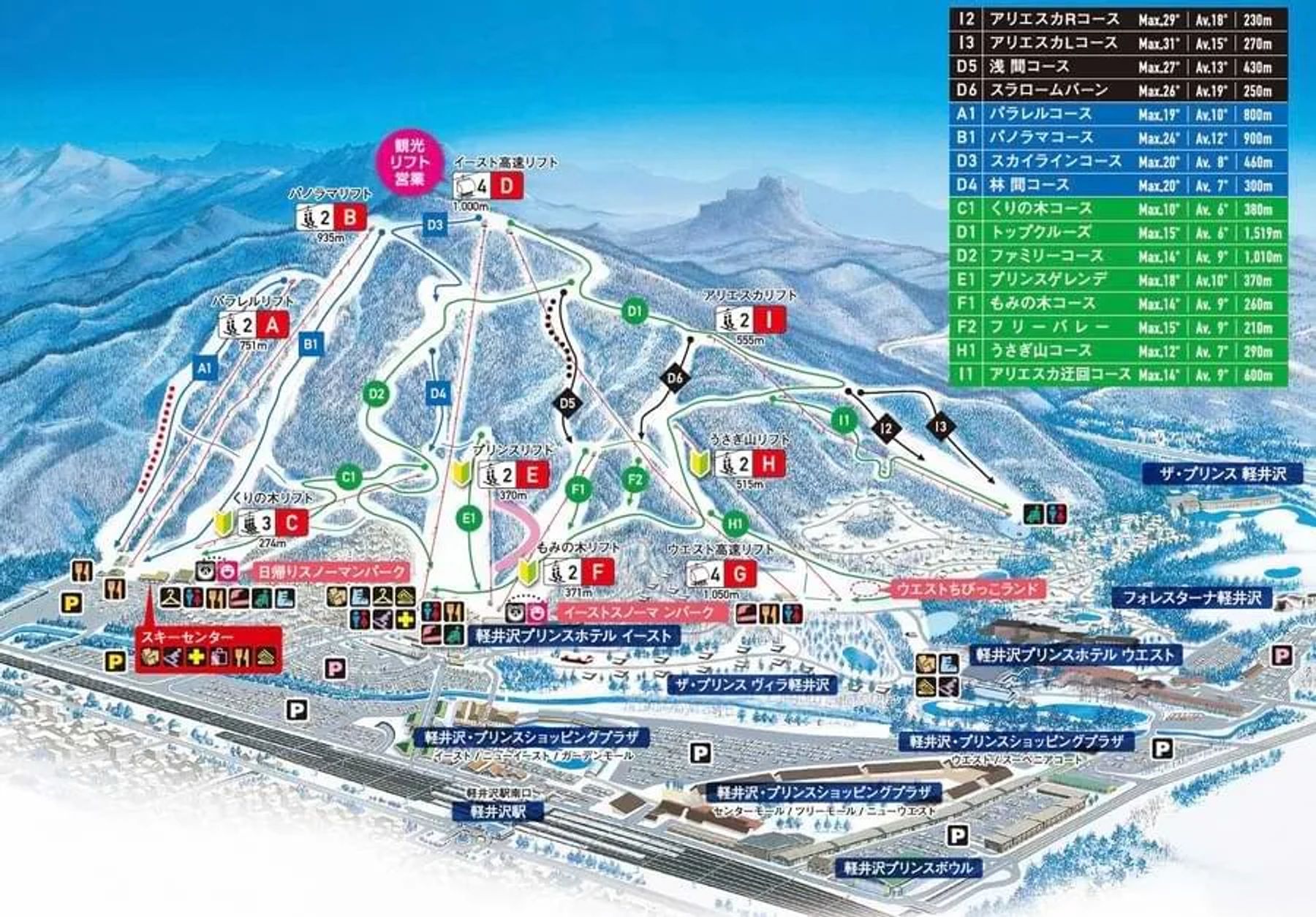
Karuizawa Trail Map
Downloadable Karuizawa trail map
Terrain split
16
runs
Beginner50%
Intermediate25%
Advanced25%
Expert0%
74 acres skiable30 hectares
Resort Stats
Elevation
Base940m
Summit1155m
Annual snowfall
7m
Season
2026 - 2027
31 Oct 2026 - 31 Mar 2027
Trail coverage
16 runs
74 acres (30 ha)
About Karuizawa's trail map
Explore Karuizawa's full trail map with 16 runs across the mountain, colour-coded by difficulty and shown alongside the terrain split. Use it to plan a day that matches your ability, find lift-served pockets of your favourite grade, and see how the resort links together. Download the piste map (PDF) ↗
More Karuizawa intelligence: snow report, lift system, webcams, resort overview.