A professional ski guide has died following an avalanche that buried four skiers in the Rodzins Couloir at La Plagne on Boxing Day. The incident involved two separate slides and highlights ongoing risks in off-piste terrain despite moderate avalanche ratings.
Professional Guide Fatality Raises Questions About Off-Piste Risk Assessment
A professional ski guide has died following an avalanche that struck a guided group of six skiers descending the Rodzins Couloir on Bellecôte's north face at La Plagne on 26 December. The 60-year-old guide was among four skiers caught in the slide, buried in debris, and found in cardiac arrest. Despite being revived at the scene after 15 minutes of resuscitation, he died later in hospital. Three other skiers were injured, including a 50-year-old woman airlifted to Grenoble with multiple traumatic injuries.
The incident occurred around 11:47 a.m. on what Météo-France had rated as a moderate avalanche day—level 2 out of 5. That rating tends to lull skiers into a false sense of security, though anyone who spends time in the mountains knows that "moderate" doesn't mean "safe." The Rodzins Couloir is a well-trafficked off-piste line, the sort of terrain that gets skied regularly without incident until conditions align in exactly the wrong way.
What makes this particularly sobering is that the group appeared to be doing everything correctly on paper—they had a professional guide, they were wearing avalanche beacons, and they were in a known route rather than exploring untracked terrain. The response from the High Mountain Gendarmerie Platoon was textbook: two helicopters, five rescuers, two doctors, and avalanche dogs on scene quickly enough to locate two buried victims by 12:10 p.m. Yet the outcome remained tragic.
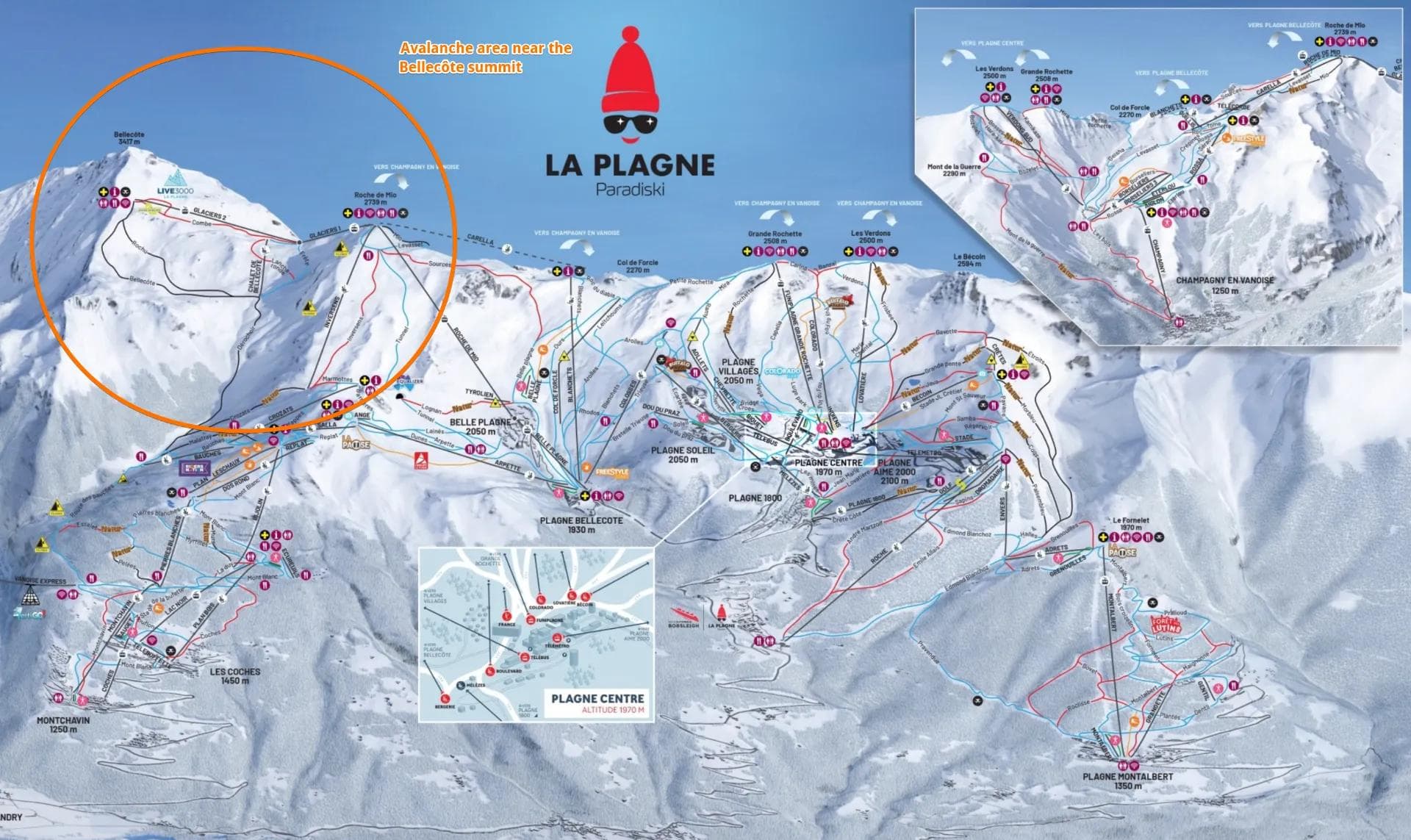
Location of the incident on the Le Plagne trail map.
According to rescuers, the avalanche developed in two stages. An initial slab fracture roughly 2 metres wide released near the top of the couloir, followed by a significantly larger slide measuring up to 200 metres wide. This progression—a smaller trigger avalanche setting off a much larger release—is textbook terrain trap behaviour and exactly the scenario that makes steep couloirs particularly hazardous.
Four members of the group were caught: three buried completely, one remaining on the surface. A third skier was partially buried but managed to self-extricate and was transported to Bourg-Saint-Maurice hospital with minor injuries. The two skiers who escaped the slide alerted authorities immediately.
The avalanche beacon technology worked as designed—two buried victims were located within 23 minutes of the initial alert. But as this incident demonstrates, even rapid response times don't guarantee survival when dealing with traumatic injuries and the physiological effects of burial.
Separately, another fatal avalanche occurred the same day near Albertville at Mount Jovet (2,300 metres), killing one of four backcountry skiers caught in the slide around 4 p.m. Two others were evacuated with minor injuries. Two deaths in the same region on the same day, both on terrain rated at moderate avalanche risk, suggests conditions were more volatile than the official rating indicated.
PGHM Savoie has opened an investigation to determine the exact causes of the La Plagne avalanche. The standard questions will be asked: Was there a weak layer that wasn't detected in the bulletin? Did human triggering play a role? Was the group's spacing appropriate? These inquiries tend to focus on technical factors, though they rarely change the outcome for those involved.
What's worth examining is whether moderate avalanche ratings create complacency. A level 2 day suggests manageable risk with appropriate precautions, yet north-facing couloirs at altitude hold snow differently than sun-exposed slopes. The Bellecôte massif's north face is exactly the sort of terrain that can harbour persistent weak layers while south-facing aspects consolidate.
The fact that a professional guide was leading this group will inevitably raise questions about route selection and decision-making. Guides operate under enormous pressure—clients book trips expecting to ski good terrain, and saying "no" repeatedly doesn't build a sustainable business. But that's not speculation appropriate for this stage, and the investigation will presumably address whether any judgment errors occurred.
This incident serves as another reminder that off-piste skiing carries inherent risks that can't be fully mitigated by equipment, training, or professional guidance. Avalanche beacons, probes, and shovels are recovery tools, not prevention tools. A moderate avalanche rating doesn't mean moderate consequences—it means moderate likelihood, and when things go wrong in steep terrain, the outcomes are often severe.
The timing is particularly grim—Boxing Day, when many skiers and riders are in the mountains for the holiday period. The Savoie region sees heavy traffic during this period, and it's likely numerous other groups were skiing similar terrain under the same conditions without incident. That's the nature of avalanche risk: largely probabilistic until it isn't.
For those planning off-piste excursions in the Alps this season, the standard advice applies with renewed emphasis: check the bulletin, but don't treat it as gospel. A moderate day can still kill you, especially in terrain traps like couloirs where even a small slide can bury you deep. Hire qualified guides, but understand they're not infallible and they're working with imperfect information about subsurface snowpack conditions.
The investigation results, when they eventually emerge, may provide additional technical details about snowpack structure and trigger mechanisms. For now, what's clear is that two families are grieving losses that occurred on terrain that didn't appear obviously dangerous on paper. That's perhaps the most unsettling aspect—the routine nature of the decisions that led to this outcome.
La Plagne hasn't released any official statement beyond confirming the incident and cooperating with authorities. The resort has no particular obligation to do so—this occurred in uncontrolled off-piste terrain, not within the ski area boundary. But the death of one of their professional guides is a significant loss for the local guiding community, regardless of the circumstances.