The modern version of the race owes a great deal to Kurt Huggler, the tourism director who effectively rebuilt the Inferno's identity from the 1960s onward. He positioned it as a more accessible alternative to the elite Kandahar race and focused on making it the amateur race to enter. When the cable car opened during that period, attendance jumped from under 200 participants to 1,400. It's now capped at 1,850 — and the waiting list is real, with between 2,200 and 2,300 applicants for those spots each year.
The Course: What You're Actually Signing Up For
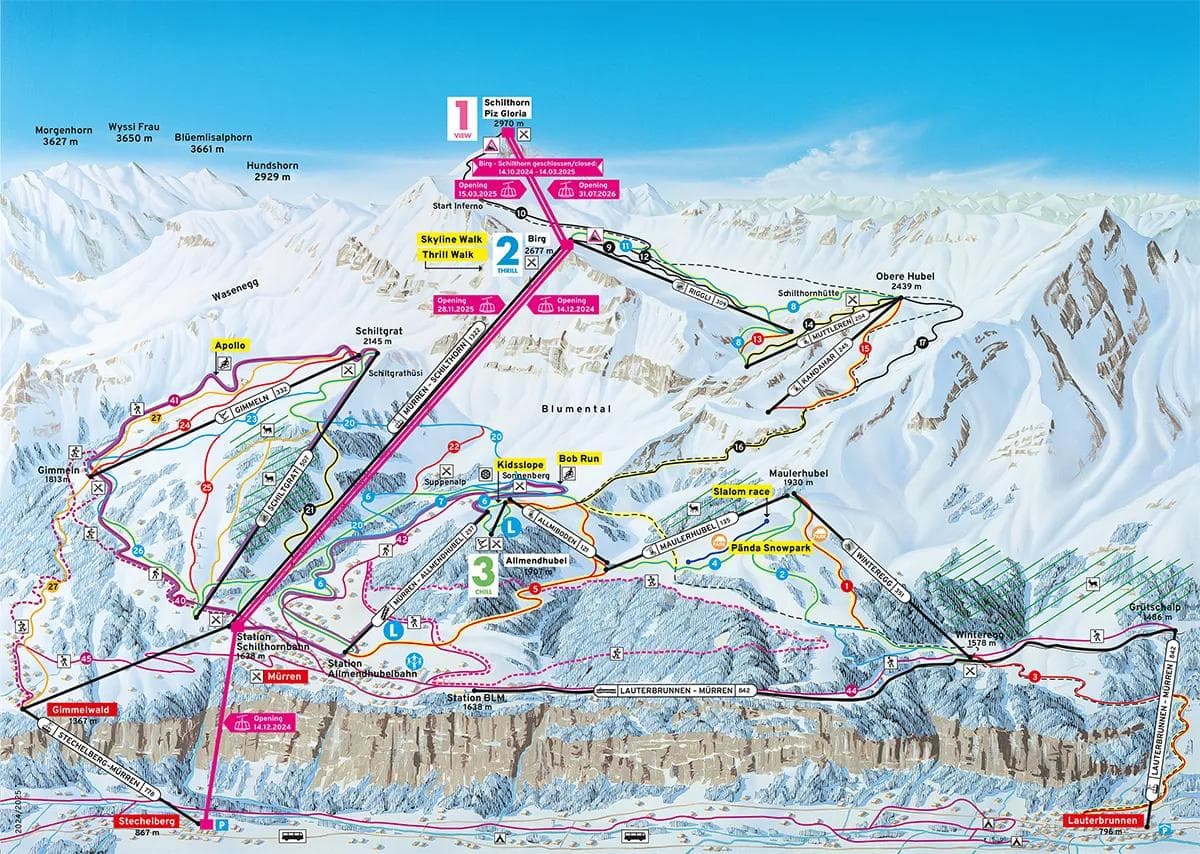
The race starts at 2,790 metres on the Schilthorn and finishes at 1,582 metres in Winteregg — a vertical drop of 1,207 metres over 9.5km. The fastest competitors complete it in six to seven minutes. Everyone else takes considerably longer and is fine with that.
It's not a pure downhill. The course includes a giant slalom section at Winteregg and, in the full version of the event, a 3.6km cross-country leg that runs from Stechelberg. This year the cross-country was held down in Stechelberg rather than the village due to better snow conditions in the valley, which tells you something about the lengths the organisers go to in order to keep the event running.
Of the 323 starters in the giant slalom this year, 305 were officially ranked — which gives you an idea of the scale of the logistics involved in running something like this.
The finish in Winteregg is the standard modern endpoint. The race historically finished all the way down in Lauterbrunnen, but that only happened every five years and is now determined by snowfall conditions rather than a fixed schedule.
In terms of safety, the race averages around five to ten incidents per year, and until this year had never recorded a fatality across its entire history — a remarkable record given the terrain, the field size, and the conditions competitors sometimes race in. Modern piste preparation has made the course significantly safer than its early years, when the run was reportedly mogulled from start to finish.
One other thing worth knowing: it's skis only. No snowboards. The organisers are clear on that, and given the nature of the cross-country sections and the course design, it's not difficult to understand why.
The Field and the Traditions
Around 1,850 skiers from 29 countries compete, split roughly 88% men to 12% women. The Kandahar Ski Club from Britain remains the largest contingent by a significant margin, which tracks given they started the whole thing.
The Friday before race day involves a procession and the devil dance — a tradition that includes burning the devil to bring luck to the competitors. There were apparently some discussions at some point about discontinuing it, but the decision was made to keep it going. It's an outdoor event, it's been part of the race culture since the beginning, and abandoning it would feel like losing something that actually matters about the Inferno's identity.
The race's own motto — that the strength and pain of the course is what gives it meaning — isn't just copy. It's accurate. There's a reason people enter year after year, and it has nothing to do with the prize money. One competitor, Peter Aeschiemann, has completed the Inferno 50 times. That's a level of commitment to voluntary suffering that deserves some acknowledgement.
What It's Like to Actually Race It
I switched from snowboarding to skiing two years ago. Entering the Inferno was either a logical next step or a significant overestimation of my current ability, depending on who you ask.
The day starts at 5:30am with a drive to the base of the Stechelberg aerial tram — the world's steepest — and a series of lifts up to the Schilthorn before the resort opens to the public. Breakfast at the Gloria 360 rotating restaurant at the summit, with 2-3cm of fresh overnight snow sitting on the course and the Alps visible in every direction, is an experience that doesn't have a direct equivalent in normal recreational skiing.
Getting to the start line involves navigating down a black run before you've properly warmed up, which is its own test. The race itself is long, physically demanding in ways that purely downhill skiing isn't, and contains an uphill finish that felt specifically designed to break whatever was left in your legs by that point.
I finished. I didn't fall. Those were the goals and they were met. Watching the fast competitors go past at speeds that bore no resemblance to what I was doing was a useful calibration exercise, and not in a discouraging way — more in the way that seeing something done really well makes you appreciate what's actually possible on skis.
The Inferno is worth entering if you meet the ability threshold and can handle the fitness demands. Go in without illusions about your finishing time, train specifically for sustained mixed-terrain effort, and be comfortable with the fact that you will be overtaken — frequently and by a wide margin. None of that takes anything away from the experience of completing it.
The 2026 race will be remembered differently to all that came before it. The Inferno had run for nearly a century without losing a competitor. That record is now gone, and the race was rightly stopped when it was. We hope the event continues in 2027 — not in spite of its history, but because of it.