
The Overview
Michael Fulton
Melbourne-based skier and snowboarder with 50+ resorts across 5 continents. Specialises in Australian resorts and international resort comparisons.
Telluride's summit reaches 13,150 feet, dropping 4,425 vertical feet to a base at 8,725 feet across 148 runs spread over 2,000 acres in Telluride, Colorado. Terrain splits 39 per cent expert, 23 per cent each for advanced and intermediate, and 15 per cent beginner, with average annual snowfall of roughly 300 inches. Nineteen lifts, including six quad chairs and one gondola, serve the mountain alongside four six-person chairs, three double chairs, one triple chair and four surface lifts.
Telluride holds a genuinely distinctive place among Colorado resorts, combining a National Historic Landmark Victorian mining town with some of the state's most dramatic, expert-weighted terrain and a free public gondola connecting the historic town to the newer Mountain Village. Its considerable 4,425-foot vertical drop ranks among the largest in Colorado.
Telluride was founded in 1878 during the San Juan Mountains' silver and gold mining boom, and the town's name is popularly said to derive from tellurium, though it more likely stems from a corruption of 'to-hell-you-ride,' reflecting the area's rugged remoteness. Mining sustained the town for decades before its decline in the early twentieth century.
Telluride Ski Resort opened in 1972, developed by Joseph T. Zoline on the mountain above the historic town, bringing renewed prosperity to a community that had fallen into decline. The resort has remained under a series of private ownership groups, with the free gondola, opened in 1996, connecting the historic town to the purpose-built Mountain Village. Adult daily tickets run from 169 to 249 US dollars.
3,789ft
Vertical
148
Runs
2,000 acres
Skiable
23ft
Annual snow
Epic
Pass
The Terrain
148 runs across 2,000 acres skiable
Telluride covers 2,000 acres (809 hectares) across 148 runs in Colorado's San Juan Mountains, with lifts rising from 8,720 ft (2,659 m) to 12,510 ft (3,814 m), a vertical of 3,790 ft (1,155 m). Intermediate runs lead at 36 per cent, then beginner at 23 per cent, expert at 21 per cent and advanced at 20 per cent, a more even spread than most big resorts offer. About 280 inches of snow falls in a typical season. A free gondola links the historic town to Mountain Village, and the groomed cruising sits on the village side of the mountain.
See Forever is the long, gentle run prized for expansive views along the ridgeline, while The Plunge drops steeply toward the town of Telluride. Gold Hill Chutes, reached by a hike from the top of Gold Hill Express, give experts narrow, steep lines, and Black Iron Bowl, off Chair 12, adds couloirs and rock features. Revelation Bowl is an above-treeline, northeast-facing bowl behind Gold Hill that gathers deep snow, and Prospect Bowl added beginner, intermediate and expert terrain in the early 2000s. Palmyra Peak adds almost 2,000 ft of in-bounds vertical. Telluride suits confident intermediates and advanced skiers, with beginner terrain on the Mountain Village side for the rest of the group.
Terrain split
148
runs
148 runs across 4 grades
Beginner34 runs · 23%
Intermediate53 runs · 36%
Advanced30 runs · 20%
Expert31 runs · 21%
Time it right
When to visit Telluride
The 2025-26 season at Telluride ran from 27 November 2025 to 12 April 2026, a roughly nineteen-week season supported by average annual snowfall of around 300 inches. Season dates can shift depending on early and late-season weather conditions in the San Juan Mountains.
Midwinter, from December through February, typically brings the most consistent conditions to Telluride's dramatic, expert-weighted terrain. Telluride draws a genuinely dedicated destination visitor base seeking the resort's considerable vertical drop and historic Victorian mining town setting, well away from the Interstate 70 corridor.
Telluride's free gondola continues to support strong visitation between the historic town and Mountain Village throughout the season. School holiday periods bring family visitation to the resort's more moderate terrain, though the overall visitor base skews toward experienced skiers drawn by the considerable expert terrain.
Specific event programming beyond standard operations is not confirmed in available resort information. Telluride continues to build on more than five decades of skiing history since its 1972 founding, itself following a century of mining heritage dating to the town's 1878 founding. The resort's Victorian town character and dramatic terrain remain central to its enduring destination appeal.
Season 2026 - 2027
26 Nov 2026
Opens
11 Apr 2027
Closes
136
Days open
23 ft
Annual snow
Getting there
Getting to Telluride, and where to stay
Telluride sits in Telluride, Colorado, in the San Juan Mountains, with a base elevation of 8,725 feet and a summit at 13,150 feet across a 4,425-foot vertical drop over 2,000 acres. This dramatic, remote setting places the resort in one of Colorado's most historically significant and visually striking mountain towns.
The town of Telluride itself, a National Historic Landmark Victorian mining town, offers extensive lodging, dining and considerable historic character directly at the resort's base, connected by free gondola to the newer Mountain Village.
Colorado State Highway 145 provides access to the resort. Winter driving conditions on this remote mountain route can include significant snow and ice, and the resort's considerable distance from major population centres means travellers should allow additional time compared with more centrally located Colorado destinations.
Telluride Regional Airport, one of the highest commercial airports in North America, offers direct seasonal flights from several major US cities, providing a genuinely convenient gateway for visitors flying directly into this otherwise remote destination, alongside the more distant Montrose Regional Airport.
Where to stay
Search all stays →Hotels and lodges near Telluride, powered by Stay22.
Latest News
From the SnowStash desk

Vermont Ski Resort Opening Dates 2026-27: Few Dates Set, Killington Waits on the Cold
Vermont's season is slow to take shape. Stratton is tentatively targeting 18 November and Sugarbush 21 November, while Pico has Friday 11 December on the calendar. Killington never sets a date and opens when the snowmaking allows, and Vail Resorts has yet to name days for Stowe, Okemo and Mount Snow. The forecasts disagree about snow, and the main El Niño worry for the Green Mountains is warmth.
9 Oct 2026

Crans-Montana 2027 World Championships President Resigns Ahead of Fraud Hearing
Less than four months out from the Crans-Montana 2027 World Championships, the man running the organising committee has stepped down. Claude-Alain Schmidhalter resigned as Swiss-Ski vice president and OC president after being indicted over a business dispute unrelated to skiing. He denies the allegations and faces court on October 27. Interim leaders are in place for the February 1-14 event.
9 Oct 2026

Kelly Canyon, Idaho, Adds Snowmaking, a Bigger Terrain Park and More Parking for 2026-27
Kelly Canyon had a rough 2025-26, and the Idaho resort has spent the summer making sure it doesn’t repeat. Snowmaking now reaches the top of Goldrush, the terrain park is doubling in size with a stereo system, lights and a snack shack, and the car park is getting bigger. Grooming is stepping up too. Target opening is December 4, conditions permitting.
9 Oct 2026

Valle Nevado Extends Season to November 8 After 108 cm in 48 Hours
Winter was meant to be winding down in Chile. Then Valle Nevado took 108 cm in 48 hours in early October, and the resort has pushed its closing date out to November 8 - its latest in 38 years of operation. That makes 143 days of skiing since opening day on June 19, with 690 cm banked for the season. Only part of the mountain is running while the storm settles, so check the mountain report before you plan a trip.
9 Oct 2026

Alps Snow Forecast: Cold Front Brings Thursday Snow to the High Alps
The Alps look a lot more like winter today, for a day or so. A cold front is moving west to east, dropping up to 35 cm on high glaciers and peaks, with snow levels falling to around 1,500-1,800 m at times. Don’t plan a trip around it: mid-elevation snow will be thin and wet, every area is closed bar a limited Sölden glacier opening tomorrow, and warmer weather returns by Monday.
8 Oct 2026

California Ski Resort Opening Dates 2026-27: Mammoth Leads, Tahoe Follows
Mammoth Mountain is first up in California, targeting Friday 13 November after a dusting of September snow. Heavenly and Northstar follow on 20 November, Palisades Tahoe on Wednesday 25 November and Sugar Bowl on 27 November, with Kirkwood on 4 December and June Mountain on 19 December. Plenty of smaller areas have no date yet. A super El Niño favours the Sierra, but a warmer storm track is the catch.
7 Oct 2026

Colorado Ski Resort Opening Dates 2026-27: A-Basin and Keystone Race to Be First
Arapahoe Basin, Keystone and Winter Park are all chasing an October start, though none has a firm date yet. The first dated openers are Breckenridge and Copper on Friday 6 November, then Vail on 13 November, with most of the rest bunched around US Thanksgiving. Hesperus did not open at all last season. A super El Niño offers hope but no guarantee, and forecasters say the southern mountains have the better odds.
5 Oct 2026
Dolomiti Superski 2026-27: Four New Gondolas, New Reservoirs and an €89 Peak Day Pass
Dolomiti Superski is spending around €100 million across its 12 areas before winter. Kronplatz gets a new 10-passenger gondola with a middle station, 3 Zinnen gets Helmissimo, and Val di Fassa swaps a chairlift for a gondola above Col Valvacin. New water-storage basins and upgraded snowmaking follow, and construction has started on the San Martino to Passo Rolle link. A peak adult day pass is €89.
4 Oct 2026
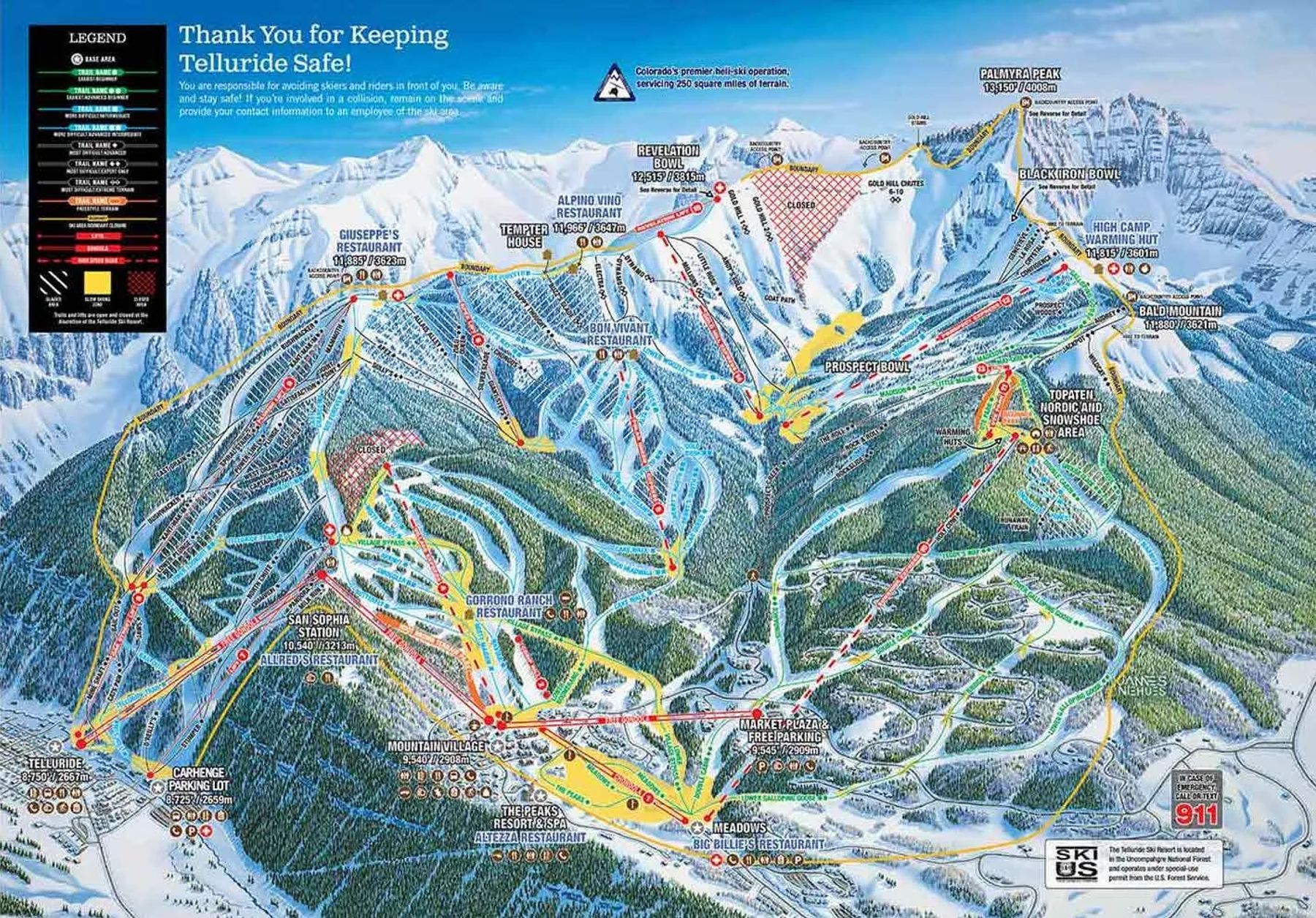
Telluride Trail Map
Downloadable Telluride trail map
Terrain split
148
runs
Beginner23%
Intermediate36%
Advanced20%
Expert21%
2,000 acres skiable809 hectares
Resort Stats
Elevation
Base8,724ft
Summit12,513ft
Annual snowfall
23ft
Season
2026 - 2027
26 Nov 2026 - 11 Apr 2027
Trail coverage
148 runs
2,000 acres (809 ha)
About Telluride's trail map
Explore Telluride's full trail map with 148 runs across the mountain, colour-coded by difficulty and shown alongside the terrain split. Use it to plan a day that matches your ability, find lift-served pockets of your favourite grade, and see how the resort links together. Download the piste map (PDF) ↗
More Telluride intelligence: snow report, lift system, webcams, resort overview.