
Great Divide
1,600 acres, 110 runs near Helena. Montana's sunniest ski area, extensive night skiing.
Season 2026 - 2027
Opens
27 Nov 2026
Closes
2 Apr 2027
Days open
126
Annual snow
13ft
The Overview
Michael Fulton
Melbourne-based skier and snowboarder with 50+ resorts across 5 continents. Specialises in Australian resorts and international resort comparisons.
Great Divide's summit reaches 7,330 feet, dropping 1,579 vertical feet to a base at 5,751 feet across 110 runs spread over 1,600 acres northwest of Helena, Montana. Terrain splits 45 per cent intermediate, 40 per cent advanced, 10 per cent beginner and 5 per cent expert, with average annual snowfall of roughly 160 inches, among the lower totals of Montana's ski areas. The resort carries no major multi-resort pass affiliation and markets itself as Montana's sunniest ski area. Six lifts, including five double chairs, serve the mountain alongside one surface lift.
Great Divide's extensive night-skiing operation and reputation for the longest season in the Helena area distinguish it from the state's more remote resorts. Its hourly lift ticket option, priced from just 10 US dollars, reflects a deliberately accessible pricing philosophy aimed at maximising affordable access for Helena-area skiers. The comparatively lower snowfall total is offset by the resort's sunny, reliable conditions.
The mountain's first trail was built to host the 1942 Northern Rocky Mountain Ski Races, and the ski area opened that year as Belmont Ski Hill, operated by the nonprofit Belmont Ski Club with a rope tow and basic facilities. The nonprofit club ran the ski area from 1941 through much of 1985, when it sold the operation to the Taylor family, who developed and operated the resort from that point forward, installing the first chairlift, the Mt Belmont chair, to the summit in 1986.
In 2020, Great Divide began a new chapter when it was purchased by the Crawford and Moran families, both deeply rooted in the Helena community, continuing the resort's long tradition of locally invested ownership. Adult daily tickets run from 30 to 40 US dollars, with hourly tickets available from 10 dollars, reflecting the resort's identity as an accessible, affordable local mountain.
1,578ft
Vertical
110
Runs
1,600 acres
Skiable
13ft
Annual snow
The Terrain
110 runs across 1,600 acres skiable
Great Divide, near Marysville northwest of Helena, offers 110 runs across about 1,600 acres (648 hectares) on the slopes of Mount Belmont. The base is 5,750 ft (1,753 m) and the summit sits at 7,330 ft (2,234 m), a vertical drop of 1,580 ft (481 m). Intermediate runs lead at 45%, advanced terrain is a strong 40%, beginners take 10% and expert 5%, so it is better suited to confident skiers than a first-timer. Five double chairs and a surface lift handle the mountain, with average snowfall of about 160 inches adding to the sense of a classic Montana hill.
Mount Belmont holds the beginner runs, groomed intermediate trails and some steeper, mogul-covered lines. Rawhide Gulch is a broad open bowl that rewards skiers after a storm, and the Wide Open run drops through exposed bowl terrain there. The Wild West area adds glades and tree skiing for a quieter powder day. Great Divide suits intermediates ready to try black diamond runs, along with powder-chasing locals and families who value empty slopes over resort amenities. Skiers expecting high-speed lifts will notice the double chairs, but few will mind the trade-off given the quiet runs, the bowl skiing and the lack of crowds.
Terrain split
110
runs
110 runs across 4 grades
Beginner11 runs · 10%
Intermediate50 runs · 45%
Advanced44 runs · 40%
Expert6 runs · 5%
Time it right
When to visit Great Divide
The 2025-26 season at Great Divide ran from 6 December 2025 to 13 April 2026, a roughly nineteen-week season, among the longest in the Helena area, supported by average annual snowfall of around 160 inches. This snowfall total is more modest than at Montana's higher-elevation resorts, but the area's reputation for reliable sunshine helps offset this with generally stable conditions. Season dates can shift depending on early and late-season weather.
Midwinter, from December through February, typically brings the most consistent conditions to the mountain's intermediate and advanced-weighted terrain. Night skiing is a defining seasonal feature, extending the useful ski day for Helena-area residents well beyond daylight hours throughout the season. The resort's hourly ticket option supports flexible, short visits alongside standard full-day skiing.
As an independently operated resort without major pass affiliation, Great Divide draws primarily from Helena and the surrounding capital region rather than national destination traffic. School holiday periods bring increased family visitation given the resort's accessible pricing and substantial intermediate terrain. Weekday evenings see strong local demand given the extensive night-skiing infrastructure.
Specific event programming beyond standard operations and night skiing is not confirmed in available resort information. Since the 2020 purchase by the Crawford and Moran families, the resort has continued its long tradition of locally invested ownership dating back to the nonprofit Belmont Ski Club's founding in 1941. Great Divide's identity as Montana's sunniest ski area, combined with its long season, remains central to its appeal each winter.
Season 2026 - 2027
27 Nov 2026
Opens
2 Apr 2027
Closes
126
Days open
13 ft
Annual snow
Getting there
Getting to Great Divide, and where to stay
Great Divide sits northwest of Helena, Montana, roughly 22 miles from the city off Highway 279 and a further seven miles up Marysville Road near the small community of Marysville, with a base elevation of 5,751 feet and a summit at 7,330 feet across a 1,579-foot vertical drop over 1,600 acres. This places the resort within a historic mining region in the Montana capital's backyard.
Helena, Montana's state capital, provides the resort's primary lodging, dining and visitor base, with the ski area serving as the city's genuine local mountain. The small community of Marysville, near the resort itself, adds a historic mining-town character to the immediate surroundings. The broader region combines skiing with Montana's capital-city amenities.
Highway 279, known as Lincoln Road, connects Helena to the Marysville area, with Marysville Road then leading the final distance to the resort. Winter driving conditions on this route can include snow and ice, though the well-travelled road is regularly maintained given the resort's role as Helena's primary local ski destination. There is no direct public transport service to the mountain.
Helena Regional Airport, within the city itself, is the nearest airport with commercial service, making Great Divide one of the more airport-accessible ski areas in Montana relative to its modest scale. Most visitors, however, are Helena-area locals driving up for day trips or evening night-skiing sessions rather than fly-in destination travellers.
Where to stay
Search all stays →Hotels and lodges near Great Divide, powered by Stay22.
Latest News
From the SnowStash desk

Europe Ski Resorts Open Now: What Is Skiable in Mid-October 2026
Europe’s ski season is open, technically. After a record-warm summer, glaciers in Austria, Switzerland and Italy are running a few pistes apiece, Sölden, Stubai and Kitzsteinhorn started late, Titlis has pushed back to 24 October, and Zermatt reopens a few lifts on 14 October after more than two months shut. Finland’s Levi and Ruka are skiing on stored snow. Here is what is open, and what you actually get at each.
14 Oct 2026

Zermatt Plans World Cup Downhill Return on the Gornergrat for 2028
Zermatt is having another crack at a World Cup downhill, and this time nobody has to cross a border. Around 13 million Swiss francs is going into rebuilding the Gornergrat piste, including a jump fed by a roughly 300-metre in-run across the roof of the Gornergrat Railway gallery, with the Matterhorn lined up behind it for the TV cameras. First men’s race is pencilled in for March 2028, pending FIS homologation.
14 Oct 2026

Mt. Rose Begins Snowmaking for the 2026-27 Season at Lake Tahoe
Lake Tahoe’s highest base elevation is paying off early: Mt. Rose has started making snow for 2026-27 after the first flurries and a cold snap. The Nevada resort is backing it with nearly US$2 million in upgrades, including a replacement snowmaking main line, a new PistenBully groomer and restraint bars on every lift. Opening day is yet to be confirmed, though Heavenly and Northstar are already eyeing 20 November.
13 Oct 2026

Utah Ski Resorts 2026-27: What’s New at Alta, Deer Valley, Powder Mountain and More
Utah is still building flat out. For 2026-27, Powder Mountain opens a steep new Skytrac chair into more than 1,000 acres of advanced terrain, Deer Valley adds 200 acres on Hail Peak, Sundance gets a new quad and Park City adds a gondola from its new parking structure. Snowmaking is expanding almost everywhere, Eagle Point stays closed after the Cottonwood Fire, and the 2034 Games are setting the pace. Here’s what’s new, resort by resort.
13 Oct 2026

Mt Hutt Invests NZ$12 Million in Base Area, Tripling Its Sun Deck
Mt Hutt is getting busier, and its base lodge is about to catch up. NZ$12 million goes into a heated sun deck roughly three times the current size (430 m² to 1,300 m²), plus a new toilet block, heated steps down to snow level, extra storage and a new food and beverage outlet. Building starts after the 2026 season, with everything due for winter 2027.
11 Oct 2026

Vermont Ski Resort Opening Dates 2026-27: Few Dates Set, Killington Waits on the Cold
Vermont's season is slow to take shape. Stratton is tentatively targeting 18 November and Sugarbush 21 November, while Pico has Friday 11 December on the calendar. Killington never sets a date and opens when the snowmaking allows, and Vail Resorts has yet to name days for Stowe, Okemo and Mount Snow. The forecasts disagree about snow, and the main El Niño worry for the Green Mountains is warmth.
9 Oct 2026
Crans-Montana 2027 World Championships President Resigns Ahead of Fraud Hearing
Less than four months out from the Crans-Montana 2027 World Championships, the man running the organising committee has stepped down. Claude-Alain Schmidhalter resigned as Swiss-Ski vice president and OC president after being indicted over a business dispute unrelated to skiing. He denies the allegations and faces court on October 27. Interim leaders are in place for the February 1-14 event.
9 Oct 2026
Kelly Canyon, Idaho, Adds Snowmaking, a Bigger Terrain Park and More Parking for 2026-27
Kelly Canyon had a rough 2025-26, and the Idaho resort has spent the summer making sure it doesn’t repeat. Snowmaking now reaches the top of Goldrush, the terrain park is doubling in size with a stereo system, lights and a snack shack, and the car park is getting bigger. Grooming is stepping up too. Target opening is December 4, conditions permitting.
9 Oct 2026
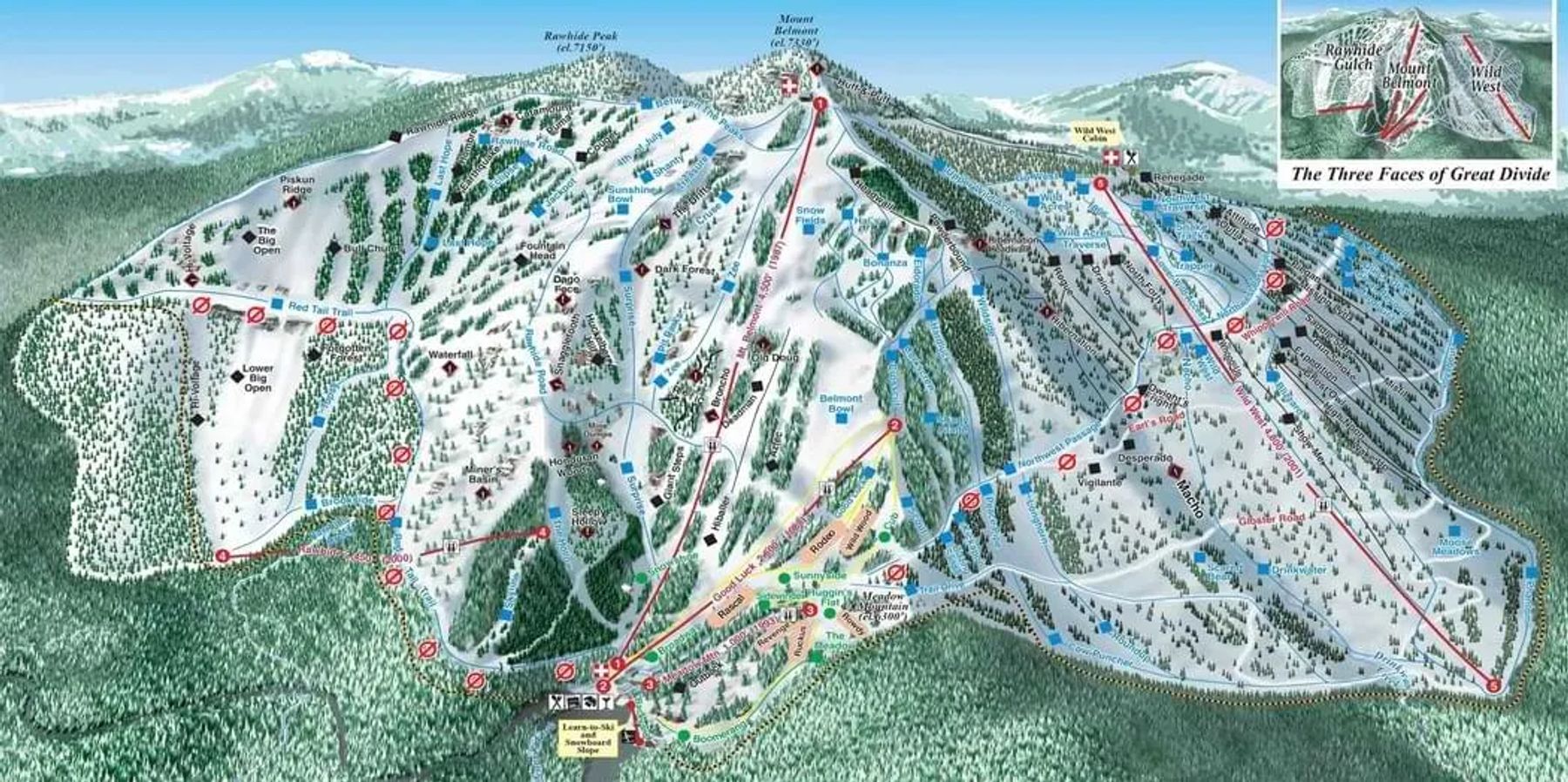
Great Divide Trail Map
Downloadable Great Divide trail map
Terrain split
110
runs
Beginner10%
Intermediate45%
Advanced40%
Expert5%
1,600 acres skiable647 hectares
Resort Stats
Elevation
Base5,751ft
Summit7,329ft
Annual snowfall
13ft
Season
2026 - 2027
27 Nov 2026 - 2 Apr 2027
Trail coverage
110 runs
1,600 acres (647 ha)
About Great Divide's trail map
Explore Great Divide's full trail map with 110 runs across the mountain, colour-coded by difficulty and shown alongside the terrain split. Use it to plan a day that matches your ability, find lift-served pockets of your favourite grade, and see how the resort links together. Download the piste map (PDF) ↗
More Great Divide intelligence: snow report, lift system, webcams, resort overview.