
SkiWelt Wilder (Kaiser-Brixental)
275km of piste across nine Tyrolean villages, 81 lifts, Austria's largest night skiing. One hour from Innsbruck, Salzburg and Munich airports.
Season 2026 - 2027
Opens
5 Dec 2026
Closes
29 Mar 2027
Days open
114
Annual snow
5m
The Overview
Michael Fulton
Melbourne-based skier and snowboarder with 50+ resorts across 5 continents. Specialises in Australian resorts and international resort comparisons.
SkiWelt Wilder Kaiser-Brixental ranks among Austria's largest interconnected ski areas, spreading 275 kilometres of piste across terrain between 620 and 1,869 metres elevation. The 1,249-metre vertical drop spans nine traditional Tyrolean villages - Brixen im Thale, Ellmau, Going, Hopfgarten, Itter, Kelchsau, Scheffau, Söll and Westendorf - each offering direct lift access. Hohe Salve (1,829m) serves as the area's most prominent summit, delivering panoramic views across more than 70 peaks exceeding 3,000 metres, from the Wilder Kaiser range to the Grossglockner.
Terrain distribution favours cruising intermediates, with 42% of runs graded blue and 44% red, leaving 14% for advanced skiers seeking steeper challenges. The black runs descending from Hohe Salve feature pitches reaching 80% gradient, whilst the 7.3-kilometre valley descent to Söll offers over 1,200 metres of continuous vertical. Three dedicated terrain parks and multiple adventure slopes cater to freestyle progression, whilst 22 ski schools operate across the villages with programmes tailored for all ages.
The mountain atmosphere balances efficient modern infrastructure with authentic Tyrolean character through 80 family-run mountain huts - statistically one every 3.3 kilometres of piste. The Alpeniglu Village at Hochbrixen presents an igloo complex with ice restaurant and bar carved from snow. Village bases retain traditional architecture alongside practical amenities, with free ski bus connections linking all entry points throughout the operating day.
The KitzSkiWelt Tour connection links SkiWelt to neighbouring Kitzbühel via Kirchberg, creating an 88-kilometre safari route - marketed as the longest ski tour in the world. The Kitzbüheler Alpen AllStarCard extends coverage to 1,088 kilometres across ten regional ski areas including Saalbach-Hinterglemm and Zell am See. The resort suits intermediate skiers and families seeking extensive cruising terrain with minimal lift queues, whilst advanced skiers can find challenge on Hohe Salve's steeper aspects.
1249m
Vertical
228
Runs
275 km
Piste
5m
Annual snow
The Terrain
228 runs across 275 km of piste
SkiWelt is the biggest network in this batch, with 228 runs and 275 kilometres of piste dropping 1,249 metres from 1,869 metres to the valley floor at 620. The terrain is overwhelmingly intermediate-friendly: 44% red, 42% beginner and 14% advanced, with nothing graded expert. Most villages, among them Ellmau, Going, Scheffau, Söll, Brixen, Hopfgarten and Westendorf, connect by ski run, so skiers can cruise from one valley to the next on groomed slopes, which is why the area works so well for groups of mixed ability and for skiers who like to keep moving.
The Hohe Salve at 1,829 metres is the focal point for stronger skiers. Black runs lead down to Söll and Brixen, pitches reach 80%, and the Südhang, piste 2c, drops straight from the summit towards Brixen and Hopfgarten in the morning sun. The Black-Pipe freeride piste and the 7.3-kilometre valley run to Söll, with over 1,200 metres of vertical, add variety, while the Hartkaiser valley descent includes the Black East alternative. The Salve is the main reason an advanced skier would choose the SkiWelt over a steeper but smaller area.
Terrain split
228
runs
228 runs across 4 grades
Beginner96 runs · 42%
Intermediate100 runs · 44%
Advanced32 runs · 14%
Expert0 runs · 0%
Time it right
When to visit SkiWelt Wilder (Kaiser-Brixental)
The 2025-26 season officially runs from 6 December 2025 through 6 April 2026, delivering a core operating window exceeding four months. Early weekend operations commence on 29-30 November when snow conditions permit, with children skiing free during this launch period. Daily operations from all nine entry points begin on the official opening date, maintaining continuous service through to the Easter closure.
Annual snowfall averages approximately 254 centimetres across the ski area, though lower base elevations around 620 metres can experience variable natural coverage. The resort compensates through extensive snowmaking infrastructure - 1,700 snow cannons service 225 kilometres of the 275-kilometre network, drawing from 16 purpose-built storage reservoirs. This capacity enables the entire system to reach operational condition within three days of suitable temperatures.
January typically delivers the most reliable powder conditions, with the second week averaging 2.9 snowy days and 25 centimetres of accumulation. Peak season crowds concentrate during Christmas-New Year and the February half-term weeks, whilst the SuperSkiWeeks promotion (early December and mid-March to closing) offers 15% lift pass discounts and free passes for children under 15 when parents purchase multi-day tickets. Spring skiing from mid-March onwards features extended afternoon operating hours and early bird access from 7:30am on Fridays and Saturdays at Brixen and Westendorf.
Night skiing operates Wednesday through Saturday at Söll, illuminating 10 kilometres of piste - Austria's largest floodlit area - from 18:30 to 22:30. Three toboggan runs including the 4-kilometre Mondrodelbahn and 3-kilometre Hexenritt operate under lights simultaneously. Retro Week at Hopfgarten and Itter brings live music to multiple mountain huts in early March, whilst Ellmi's Christmas market runs weekends from 5-21 December at the Hartkaiser mountain station.
Season 2026 - 2027
5 Dec 2026
Opens
29 Mar 2027
Closes
114
Days open
5 m
Annual snow
Getting there
Getting to SkiWelt Wilder (Kaiser-Brixental), and where to stay
SkiWelt occupies the northern Kitzbüheler Alps in Austria's Tyrol, positioned where the Wilder Kaiser mountain range meets the Brixental valley. The base villages range from 620 metres at Hopfgarten to approximately 800 metres at Westendorf, with the Wilder Kaiser's dramatic limestone walls forming the northern horizon. The area sits within the Tiroler Unterland administrative district, roughly equidistant from Innsbruck to the west and Salzburg to the east.
The historic fortress town of Kufstein lies 20 kilometres north, connected by free daily ski bus services. Wörgl, one of Tyrol's primary shopping centres, sits just 10 kilometres from Hopfgarten. The villages themselves maintain traditional Tyrolean character - Hopfgarten ranks among Austria's oldest market towns with baroque church and cobbled streets, whilst Söll functions as the unofficial resort capital with the region's highest concentration of hotel beds.
The A12 Inntal motorway provides the primary road access, with the Wörgl Ost exit serving all eastern villages and Kufstein Süd exit serving Söll, Scheffau, Ellmau and Going. From Innsbruck, the 80-kilometre drive takes approximately one hour; from Munich, 120-150 kilometres requires 90 minutes under normal conditions. From Salzburg, routes via the A10 and A12 cover 80-90 kilometres in roughly 75 minutes. Winter tyre requirements apply on Austrian roads from November through April.
Innsbruck Airport lies 80 kilometres distant with transfer times around one hour. Salzburg Airport sits approximately 80 kilometres away, taking 75-90 minutes by road. Munich Airport, at 120-150 kilometres depending on destination village, requires 90 minutes to two hours including potential city traffic delays. Rail travellers benefit from direct stations at Hopfgarten, Westendorf and Brixen im Thale - Hopfgarten station sits metres from the Salvenbahn gondola base. Wörgl and Kufstein stations connect via ski bus to remaining villages.
Where to stay
Search all stays →Hotels and lodges near SkiWelt Wilder (Kaiser-Brixental), powered by Stay22.
Latest News
From the SnowStash desk
Alps Snow Forecast: Up to 64 cm Headed for the High Glaciers as the Snow Line Drops
The Alps are about to swap mild, sunny October weather for something far more wintry. A cold front arrives Tuesday, and SnowStash forecasts have Monterosa Ski out in front with 64 cm over 14 days, ahead of Blatten Belalp (55 cm) and Verbier (43 cm). The snow line should fall below 2000 metres by Wednesday night, and glaciers across Switzerland, Italy and Austria are in line for the best of it. The wind will have a say too.
20 Oct 2026

Four Dead After Avalanche Near Ski Portillo in Chile
A large avalanche struck near Laguna del Inca adjacent to Ski Portillo on Saturday afternoon, killing four people and injuring four others. The group were day visitors mountaineering in the backcountry after reportedly being warned about elevated avalanche risk by resort staff.
18 Oct 2026

Europe Ski Resorts Open Now: What Is Skiable in Mid-October 2026
Europe’s ski season is open, technically. After a record-warm summer, glaciers in Austria, Switzerland and Italy are running a few pistes apiece, Sölden, Stubai and Kitzsteinhorn started late, Titlis has pushed back to 24 October, and Zermatt reopens a few lifts on 14 October after more than two months shut. Finland’s Levi and Ruka are skiing on stored snow. Here is what is open, and what you actually get at each.
14 Oct 2026

Zermatt Plans World Cup Downhill Return on the Gornergrat for 2028
Zermatt is having another crack at a World Cup downhill, and this time nobody has to cross a border. Around 13 million Swiss francs is going into rebuilding the Gornergrat piste, including a jump fed by a roughly 300-metre in-run across the roof of the Gornergrat Railway gallery, with the Matterhorn lined up behind it for the TV cameras. First men’s race is pencilled in for March 2028, pending FIS homologation.
14 Oct 2026

Mt. Rose Begins Snowmaking for the 2026-27 Season at Lake Tahoe
Lake Tahoe’s highest base elevation is paying off early: Mt. Rose has started making snow for 2026-27 after the first flurries and a cold snap. The Nevada resort is backing it with nearly US$2 million in upgrades, including a replacement snowmaking main line, a new PistenBully groomer and restraint bars on every lift. Opening day is yet to be confirmed, though Heavenly and Northstar are already eyeing 20 November.
13 Oct 2026

Utah Ski Resorts 2026-27: What’s New at Alta, Deer Valley, Powder Mountain and More
Utah is still building flat out. For 2026-27, Powder Mountain opens a steep new Skytrac chair into more than 1,000 acres of advanced terrain, Deer Valley adds 200 acres on Hail Peak, Sundance gets a new quad and Park City adds a gondola from its new parking structure. Snowmaking is expanding almost everywhere, Eagle Point stays closed after the Cottonwood Fire, and the 2034 Games are setting the pace. Here’s what’s new, resort by resort.
13 Oct 2026

Mt Hutt Invests NZ$12 Million in Base Area, Tripling Its Sun Deck
Mt Hutt is getting busier, and its base lodge is about to catch up. NZ$12 million goes into a heated sun deck roughly three times the current size (430 m² to 1,300 m²), plus a new toilet block, heated steps down to snow level, extra storage and a new food and beverage outlet. Building starts after the 2026 season, with everything due for winter 2027.
11 Oct 2026

Vermont Ski Resort Opening Dates 2026-27: Few Dates Set, Killington Waits on the Cold
Vermont's season is slow to take shape. Stratton is tentatively targeting 18 November and Sugarbush 21 November, while Pico has Friday 11 December on the calendar. Killington never sets a date and opens when the snowmaking allows, and Vail Resorts has yet to name days for Stowe, Okemo and Mount Snow. The forecasts disagree about snow, and the main El Niño worry for the Green Mountains is warmth.
9 Oct 2026
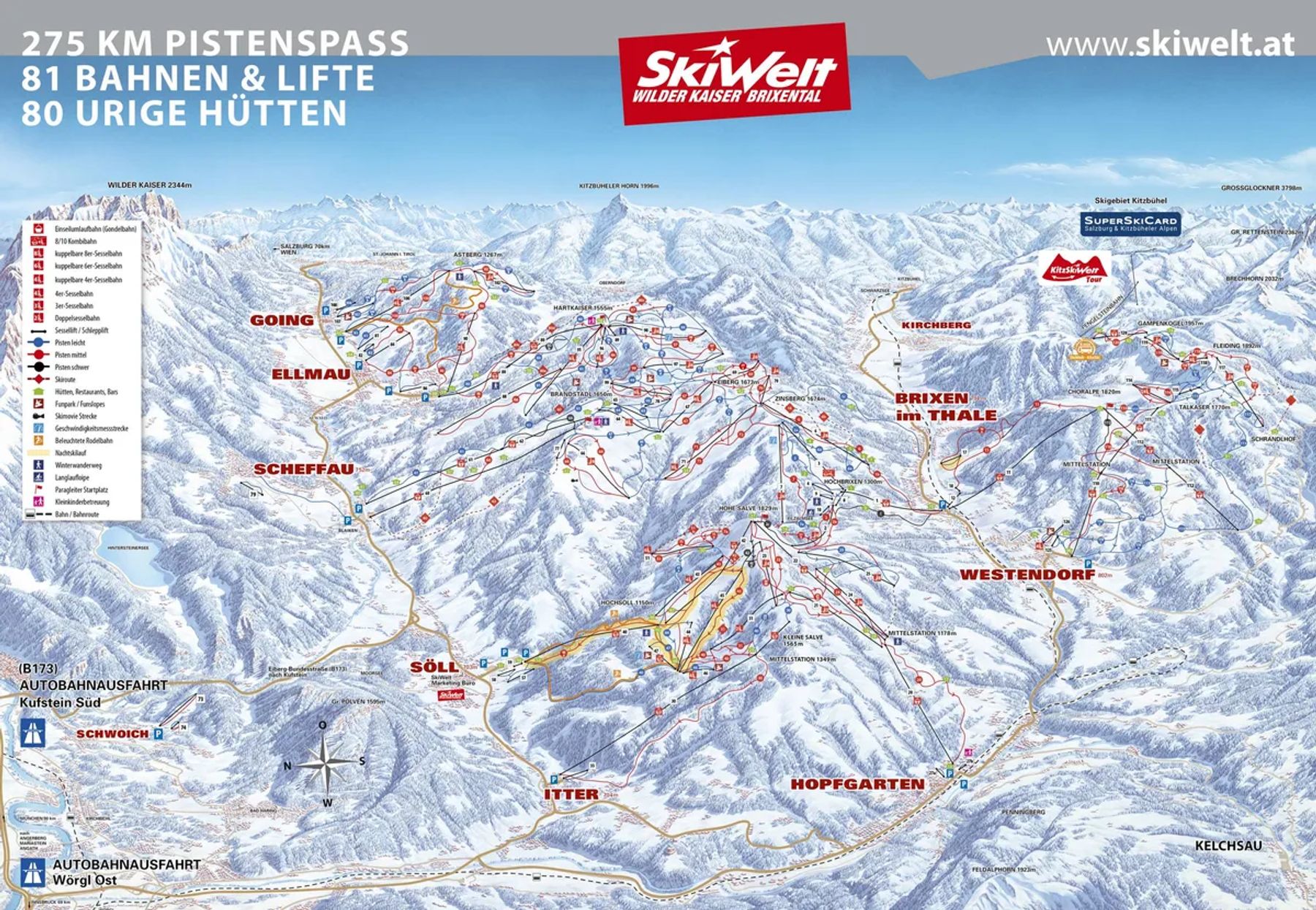
SkiWelt Wilder (Kaiser-Brixental) Trail Map
Downloadable SkiWelt Wilder (Kaiser-Brixental) trail map
Terrain split
228
runs
Beginner42%
Intermediate44%
Advanced14%
Expert0%
275 km of piste
Resort Stats
Elevation
Base620m
Summit1869m
Annual snowfall
5m
Season
2026 - 2027
5 Dec 2026 - 29 Mar 2027
Trail coverage
228 runs
275 km
About SkiWelt Wilder (Kaiser-Brixental)'s trail map
Explore SkiWelt Wilder (Kaiser-Brixental)'s full trail map with 228 runs across the mountain, colour-coded by difficulty and shown alongside the terrain split. Use it to plan a day that matches your ability, find lift-served pockets of your favourite grade, and see how the resort links together. Download the piste map (PDF) ↗
More SkiWelt Wilder (Kaiser-Brixental) intelligence: snow report, lift system, webcams, resort overview.