SnowStash
ForecastsCompareNews
SnowStash Logo

Live snow, webcams and expert resort guides for the world's mountains - plan your next day on snow.

hello@snowstash.com
Download on the App Store

Destinations

  • Australia
  • Canada
  • Europe
  • Japan
  • New Zealand
  • United States

Company

  • About Us
  • Work With Us
  • Privacy Policy

Explore

  • Compare Resorts
  • News & Updates
  • Snow Forecast
  • Mobile App

© 2026 SnowStash. All rights reserved.

    1. Home
    2. /
    3. News
    GlaciersArabba ​Marmolada

    Why Glaciers Are Collapsing - And What Happens When They Do

    Michael FultonMichael Fulton·27 Aug 2026

    TL;DR

    A deadly flood on the Nepal-China border, a decade-old tragedy on Italy's Marmolada, and an unstable glacier right now above a village near Zermatt - three very different mountain ranges, the same underlying story. Warming ice is destabilising terrain that was considered settled for generations, and the results range from catastrophic floods to slow-motion monitoring situations that could go either way.

    Level Up Your Ski Day — Download SnowStash on the App Store

    A glacier gave way on the Nepal-China border this week, and the death toll is still climbing

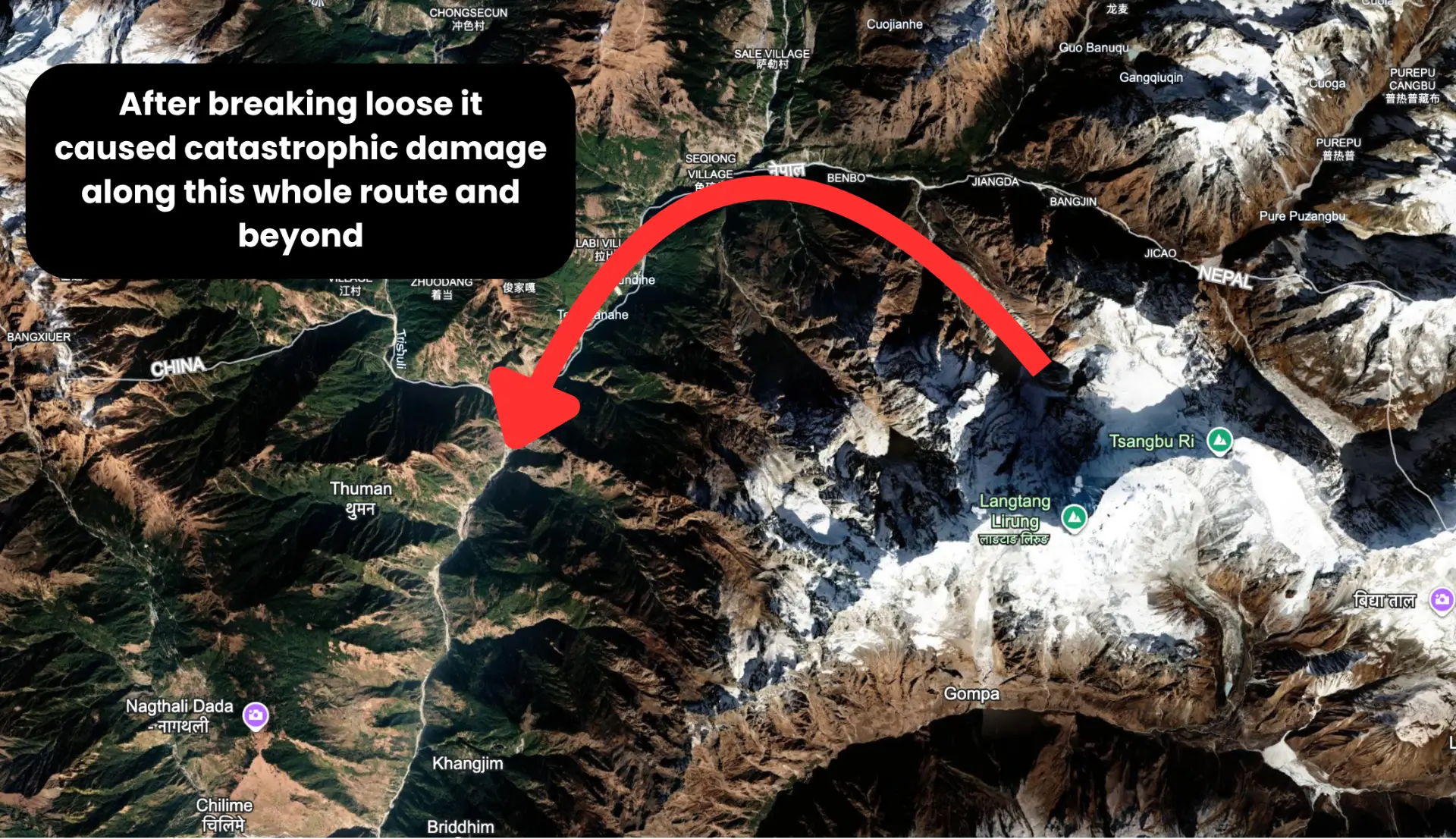
    On 26 August 2026, an ice-and-rock avalanche broke off a glacier above the Bhotekoshi River system on the Nepal-China border, damming a tributary called the Lhende Khola before the blockage gave way and sent a surge of water and debris down into the Rasuwa and Nuwakot districts.

    As of the most recent reporting, more than 160 people are confirmed dead across Nepal and China, with hundreds still missing, including more than 300 foreign nationals. Villages, hydropower stations, bridges and a major trade crossing at Gyirong were swept away or damaged. It is the second time this same river system has flooded in fourteen months.

    This kind of event has a name - a glacial lake outburst flood, or GLOF - and it's one end of a spectrum of glacier failure that's showing up across every major mountain range on earth, including two much closer to SnowStash's usual patch: the Dolomites and the Alps around Zermatt.
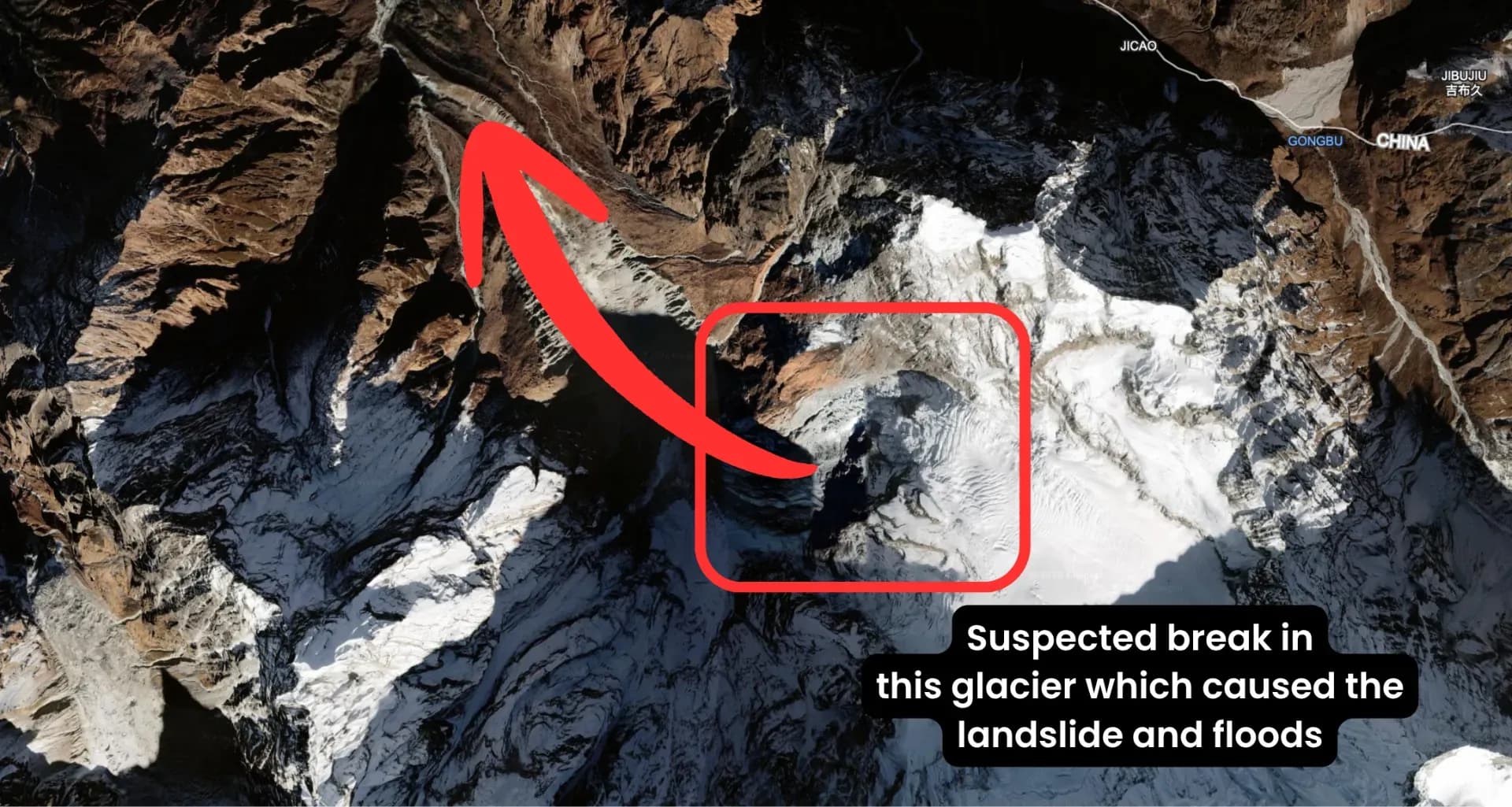
    The location of the glacier is found high in the Himalayan mountains.
    The location of the glacier is found high in the Himalayan mountains.

    What actually happens in a glacial lake outburst flood

    Glaciers retreating under warming conditions leave meltwater pooling behind natural dams made of loose rock, ice or moraine debris. These dams are not built for the job - they are simply whatever happened to be left behind as the ice pulled back. When the dam fails, either through an avalanche crashing into the lake and displacing a surge wave, through the ice or rock structure itself giving way, or through the lake overtopping after heavy rain or snowmelt, the water is released almost instantly rather than gradually. The resulting flood carries a scale of debris and sediment far beyond an ordinary flash flood, which is why the damage extends so far downstream. Nepal's case fits the more common regional pattern: researchers at the Kathmandu-based International Centre for Integrated Mountain Development pointed to an ice-and-rock avalanche from a glacier as the likely trigger, rather than rainfall alone.
    Nepal is a particularly exposed case study. A 2018 assessment identified more than 25,000 glacial lakes across the Hindu Kush-Himalaya region, and both the number and size of these lakes have grown as glaciers retreat further. A similar event hit close to the same area only last year, when a glacial lake across the border in Tibet overflowed during a period of unusually high temperatures, destroying a bridge linking Nepal and China and killing at least eight people.

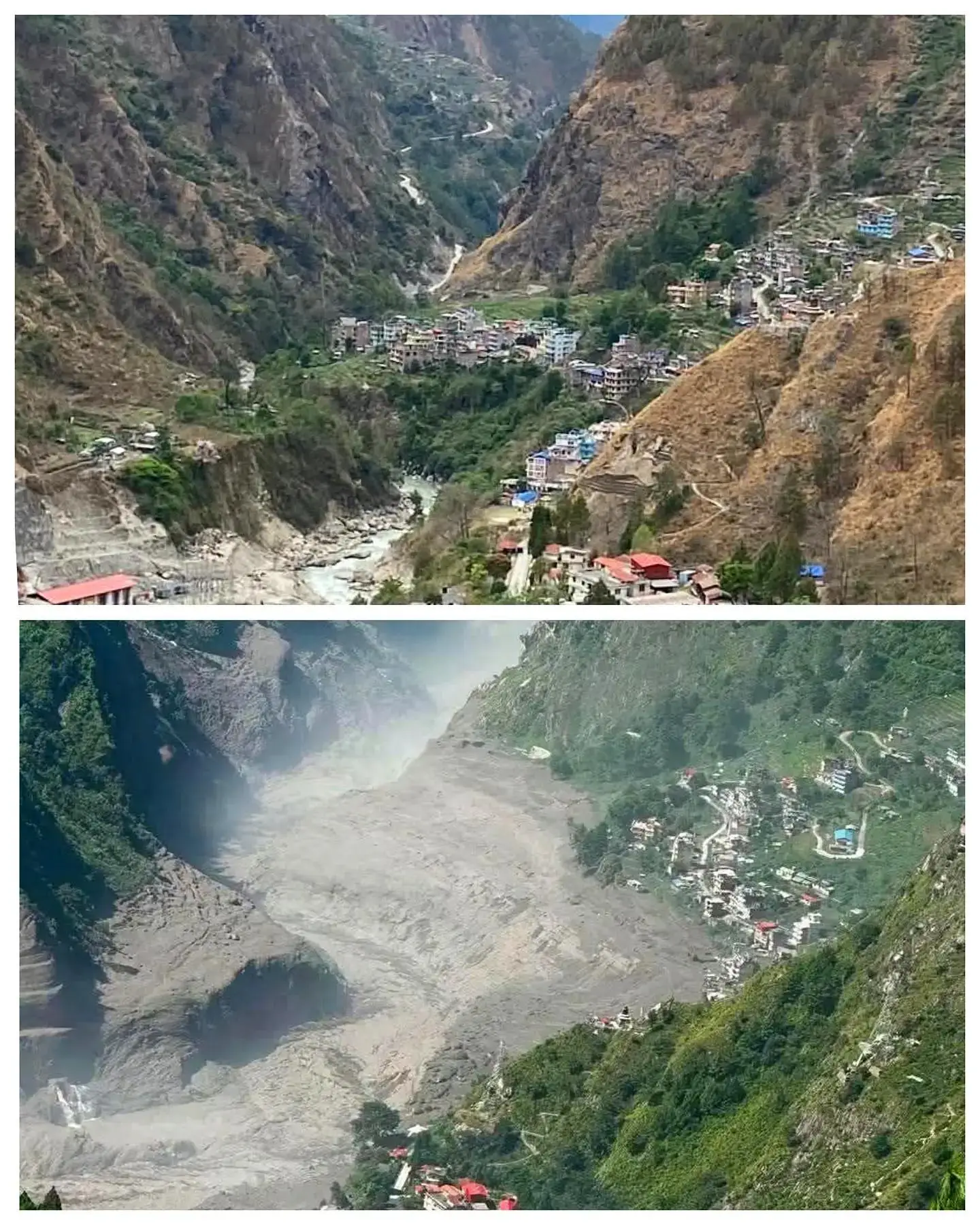
    A view of the valley before and after the devastating flood and landside debris ripped through.
    A view of the valley before and after the devastating flood and landside debris ripped through.

    It isn't only a Himalayan problem - the Alps have two live examples of their own

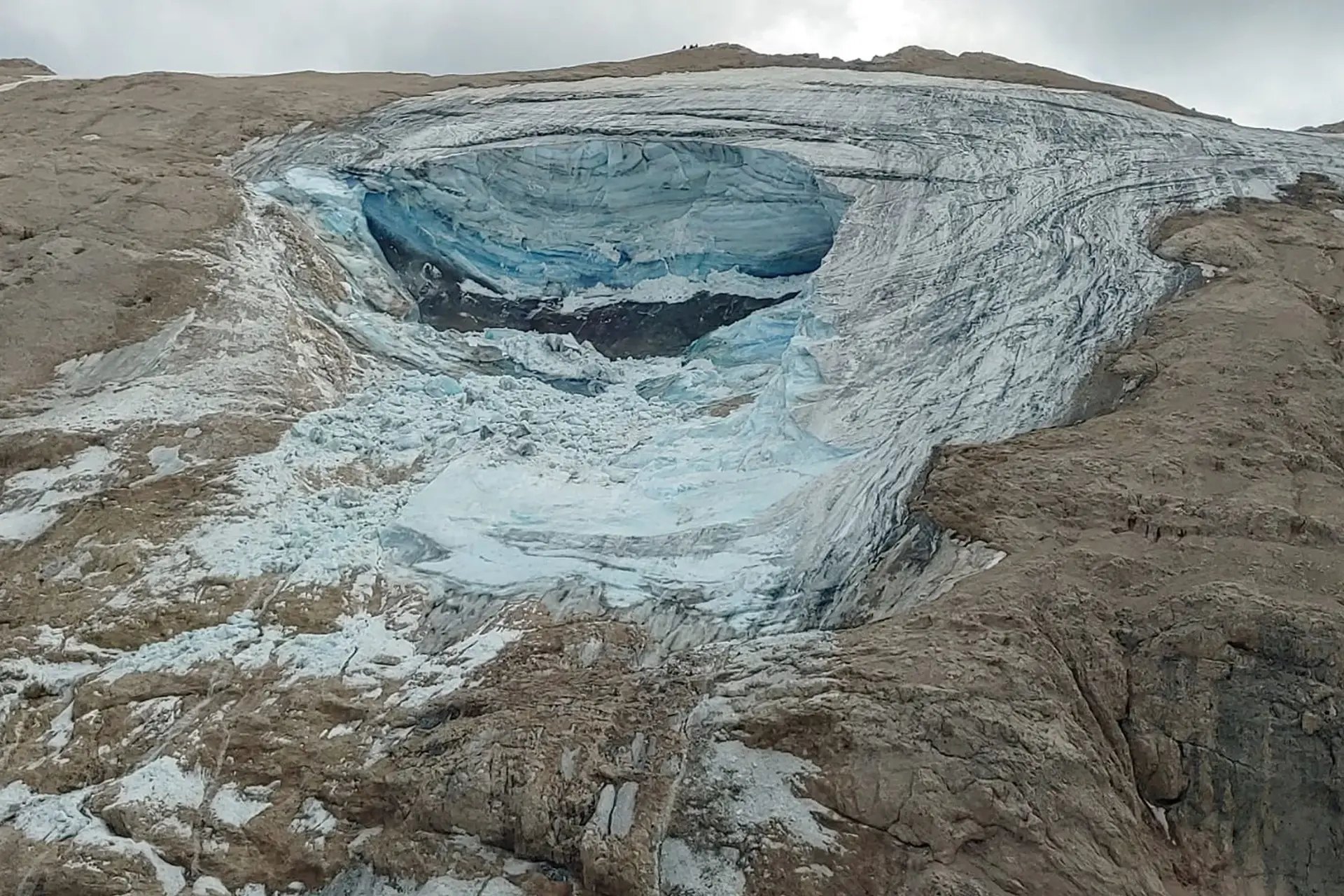
    The Dolomites have already seen a fatal version of this. In July 2022, a section of the Marmolada glacier - the highest peak in the range, and a working ski area - broke away and killed 11 mountaineers after an unusually warm spring left the glacier's internal drainage overpressurised with meltwater.

    Researchers who later reconstructed the collapse found that rising ice temperature combined with existing fractures had left the glacier in what they described as critical equilibrium, meaning it was already close to failure before the final trigger.

    Right now, a slower-moving version of the same underlying problem is playing out above the village of Randa, in the Mattertal valley just south of Zermatt. The Weisshorn East hanging glacier has been under formal surveillance since June 2026 after showing signs of instability, and shed large chunks of ice on three separate occasions in a single day in late August.

    Canton Valais's natural hazards engineer says further icefalls are likely, and in a worst case, several hundred thousand cubic metres of ice could come down at once - though officials are clear that even that scenario wouldn't reach the village itself. Glaciologist Martin Funk, who monitored a comparable episode on the same glacier back in 2005, describes the current movement as fairly typical behaviour for a hanging glacier that has simply grown beyond what it can support, rather than something out of the ordinary.

    Randa has form here too: the largest recorded event was in 1819, with smaller break-offs in 1972 and 1973 that both stopped short of the village.

    The common thread across the Himalaya, the Alps and other glaciated ranges such as the Andes is the same: ice that has been stable for generations is losing structural strength as it warms, and the meltwater it produces has to go somewhere.

    The glacier on the Marmolada which collapsed killing 11 people.
    The glacier on the Marmolada which collapsed killing 11 people.

    Why this matters beyond the immediate disaster zones

    None of this means every glaciated slope near a resort is at imminent risk. Officials monitoring the Weisshorn have specifically pushed back on comparisons to the 2025 Blatten disaster, where a different glacier destroyed most of a Swiss village - they describe it as a completely different type of failure, with a glacial plateau standing between the unstable ice and Randa itself.

    And glaciologists remain cautious about naming individual glaciers as the next site of a Marmolada-scale collapse, since the general warning signs - retreat, heat, low snowfall - are present on countless glaciers at once. What has changed is the frequency of the underlying conditions. Warmer summers, reduced snowfall insulation and faster ice retreat are now a persistent backdrop across most of the world's mountain regions, rather than an occasional anomaly.

    For anyone travelling, working or skiing near glaciated terrain, that shift is showing up in more active monitoring, more early-warning systems in exposed valleys, and, occasionally, restricted access to routes and slopes that were previously considered stable. It's also showing up in the pace of change to the terrain itself - lakes forming where there weren't lakes before, and glaciers behaving differently to how longstanding local knowledge would predict.

    What's being done

    Nepal, along with international partners including the World Bank and ICIMOD, has spent over a decade mapping and assessing glacial lake risk across the Hindu Kush-Himalaya region specifically because of this hazard. Early-warning systems and satellite monitoring are improving, though researchers still describe high-mountain GLOF forecasting as difficult given how remote and data-scarce much of this terrain is.

    In the Alps, monitoring of specific unstable glaciers and rock faces has become standard practice in the years since Marmolada - automated systems above Randa, for instance, close the road and railway the moment a significant avalanche or rockfall is detected, and the Weisshorn situation is being tracked continuously for exactly this reason.

    About the author

    Michael Fulton

    Michael Fulton

    Melbourne-based skier and snowboarder with 50+ resorts across 5 continents. Specialises in Australian resorts and international resort comparisons.

    50+ resorts visited15 years skiing

    Keep reading

    More from the SnowStash desk

    View all news →
    Pitztal Glacier Set to Reopen for the 2026/27 Ski Season on 26 September

    Pitztal Glacier Set to Reopen for the 2026/27 Ski Season on 26 September

    Tyrol's highest ski area is gearing up to open a full month ahead of most of the Alps. The Pitztal Glacier is scheduled to start its 2026/27 season on Saturday 26 September, running through to 2 May 2027, with the lower-altitude Rifflsee area following in December. High-altitude terrain up to 3,440 metres gives the glacier a head start on snow, though as always, the actual opening extent will depend on how September's weather plays out. Early online ski pass bookings can save up to 30%.

    26 Aug 2026
    Unstable Glacier Above Randa Puts Zermatt-Area Village on Alert

    Unstable Glacier Above Randa Puts Zermatt-Area Village on Alert

    A hanging glacier above the Swiss village of Randa, just south of Zermatt, has been shedding large chunks of ice for weeks, with authorities warning more break-offs are likely. A danger zone has been closed off since June, though officials say the village's 479 residents aren't at risk. It's a familiar pattern for this glacier - it's done this before, in 1819, 1972 and 1973 - but a reminder of how closely Alpine authorities now watch terrain once considered stable.

    26 Aug 2026
    Thredbo Is 'On the Table' as EVT Reviews Its Whole Business

    Thredbo Is 'On the Table' as EVT Reviews Its Whole Business

    Thredbo is officially 'on the table.' EVT Limited, owner of Australia's most decorated ski resort, has hired Rothschild & Co to review its entire corporate structure - and confirmed Thredbo isn't off limits, even as it books a stronger year of earnings. The resort's own valuation has nearly halved after a brutal 2026 season, and speculation is already running toward Vail Resorts, Alterra, or a New Zealand operator picking it up. Here's what EVT actually said, and who could buy it.

    25 Aug 2026
    Ski-E-O! Is the Ski Resort Tycoon Game We Didn't Know We Needed

    Ski-E-O! Is the Ski Resort Tycoon Game We Didn't Know We Needed

    I'm not a gamer. I'm a skier and snowboarder who happens to have a laptop. So when a ski resort management game called Ski-E-O! landed on Steam, I wasn't expecting to lose an afternoon to it - but here we are. Real mountain terrain, a full weather system, storms that roll in and wreck your snow base, avalanche danger, and enough depth to make RollerCoaster Tycoon feel simple by comparison. Early access lands in November. Here's what a few hours in the free demo actually looks like.

    23 Aug 2026
    Sugar Bowl, California, Rebuilds Its Historic Village Gondola

    Sugar Bowl, California, Rebuilds Its Historic Village Gondola

    The rumours are true: Sugar Bowl is tearing out its Emerald gondola, in place since 1983, and replacing it with a new 8-person Doppelmayr system - nearly doubling uphill capacity to 1,800 people an hour. It's the fourth generation of a gondola line that dates back to 1953, when Sugar Bowl became the first resort on the West Coast to run one at all, and it's just one piece of a $100 million overhaul touching lodges, parking and snowmaking. Here's what's changing, and what's staying the same.

    23 Aug 2026
    Two Confirmed Dead as Search Continues After Swiss Alps Fire

    Two Confirmed Dead as Search Continues After Swiss Alps Fire

    The death toll from Thursday night's fire at Restaurant Beverin in Thusis, Switzerland, has begun to firm up. One Swiss outlet, citing Graubünden Cantonal Police, reports that two of the five people initially reported missing have now been confirmed dead, leaving three unaccounted for. The building's collapsed stairwell and structural instability have slowed recovery efforts throughout. Here's what's changed since the fire broke out, and what's still unconfirmed.

    22 Aug 2026
    Selwyn Snow Resort Closes Early as Rain Ends Its 2026 Season

    Selwyn Snow Resort Closes Early as Rain Ends Its 2026 Season

    Selwyn Snow Resort has called an early end to its 2026 season, a day after Victoria's Mount Baw Baw did the same. Rain on Thursday stripped what was left of the snowpack, and the cold nights needed to rebuild it through snowmaking never arrived. It's a rough result for a resort that only just found its footing again after being burned to the ground in the 2019-20 Black Summer bushfires and a multi-year rebuild. Here's how the season fell apart, and where Selwyn's been since the fire.

    22 Aug 2026