A hanging glacier above the Swiss village of Randa, just south of Zermatt, has been shedding large chunks of ice for weeks, with authorities warning more break-offs are likely. A danger zone has been closed off since June, though officials say the village's 479 residents aren't at risk. It's a familiar pattern for this glacier - it's done this before, in 1819, 1972 and 1973 - but a reminder of how closely Alpine authorities now watch terrain once considered stable.
A hanging glacier above the Swiss village of Randa, just south of Zermatt, has been shedding large sections of ice for weeks, and authorities say further break-offs are likely in the days ahead
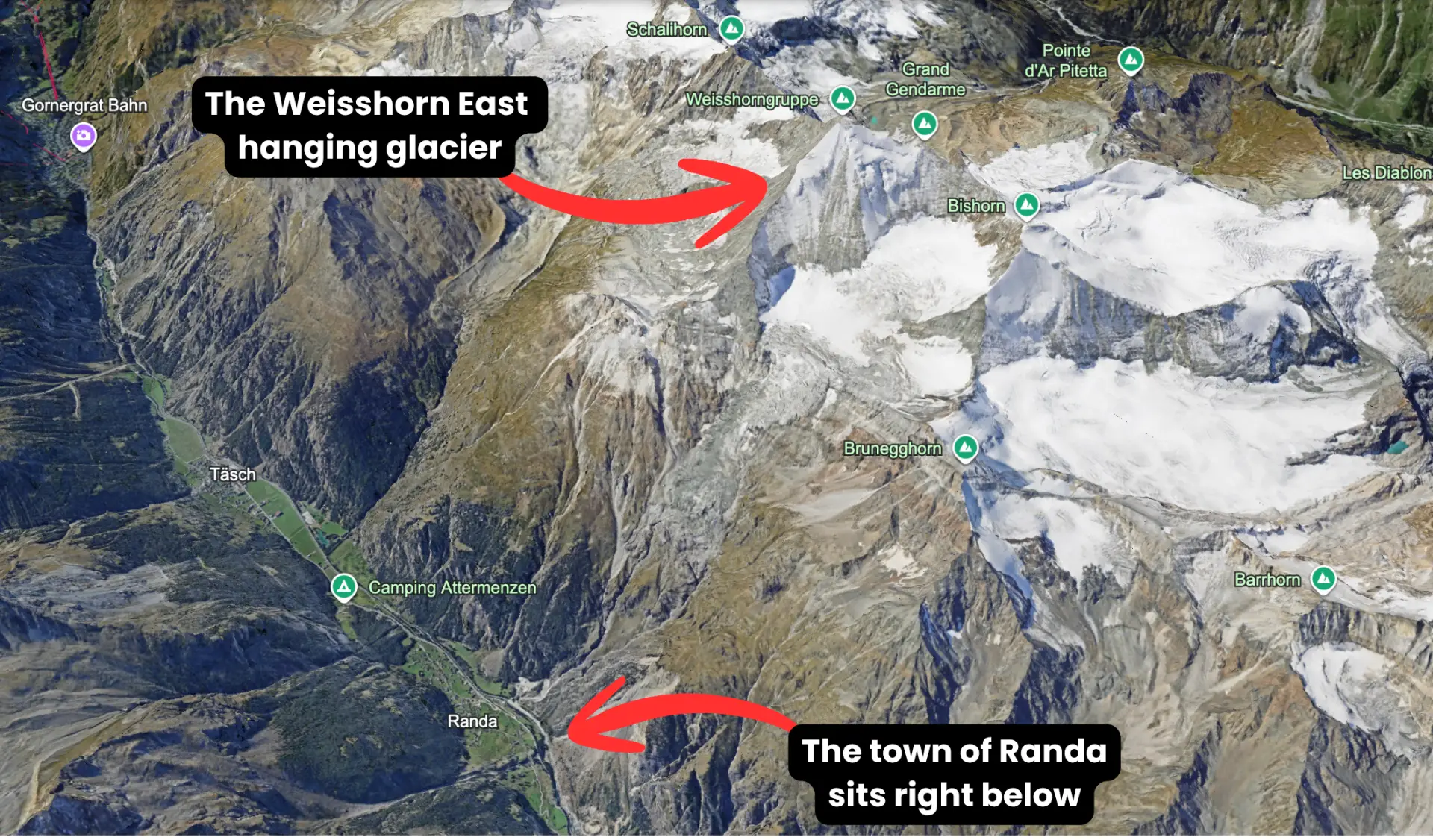
The Weisshorn East hanging glacier, sitting above Randa in canton Valais, has been under formal surveillance since the end of June after showing signs of instability. Movement accelerated significantly over the past week, with large chunks of ice breaking away on three separate occasions on 24 August. That prompted authorities to step up monitoring further, though officials have been careful to stress that the situation, while being watched closely, doesn't currently threaten the village itself.
A view from Google earth showing the glacier and the town.
What's actually moving on the Weisshorn
A danger zone has been marked out and closed to entry since June, covering the terrain directly beneath the unstable ice, along with the pedestrian and cycling routes that normally cross it. Norbert Carlen, a natural hazards engineer for canton Valais, says further icefalls are expected, though it's impossible to say in advance whether the next one will be a small shedding of ice or a much larger event.
In a genuine worst case, he estimates several hundred thousand cubic metres of ice could come down at once - but even then, he says the village would not be endangered.
Glaciologist Martin Funk, who monitored a comparable episode on the same glacier back in 2005, described the current movement as fairly ordinary behaviour for a hanging glacier rather than anything unusual: eventually a glacier grows to a size it can no longer support, and part of it lets go.
Randa's mayor, Frédéric Imboden, has taken a similar line, telling residents the glacier has been watched for years and that movement of this kind - more in some periods, less in others - isn't new. The village's 479 residents, he notes, live outside the marked danger zone.
Why officials keep saying this isn't Blatten
Given that a glacier collapse destroyed most of the village of Blatten, elsewhere in Valais, in May 2025, comparisons were inevitable. Guillaume Favre-Bulle, head of the canton's natural hazards service, has pushed back on them directly, describing Randa's situation as a completely different type of phenomenon.
There's currently no indication that an ice avalanche from the Weisshorn could reach the village, he says, partly because there's a glacial plateau the ice would have to cross first - terrain that doesn't exist in the same way at Blatten. His assessment is that the glacier will either keep disintegrating gradually, in smaller pieces, or the unstable mass will eventually break away in one larger event. Either way, monitoring will pick up the acceleration before it happens.
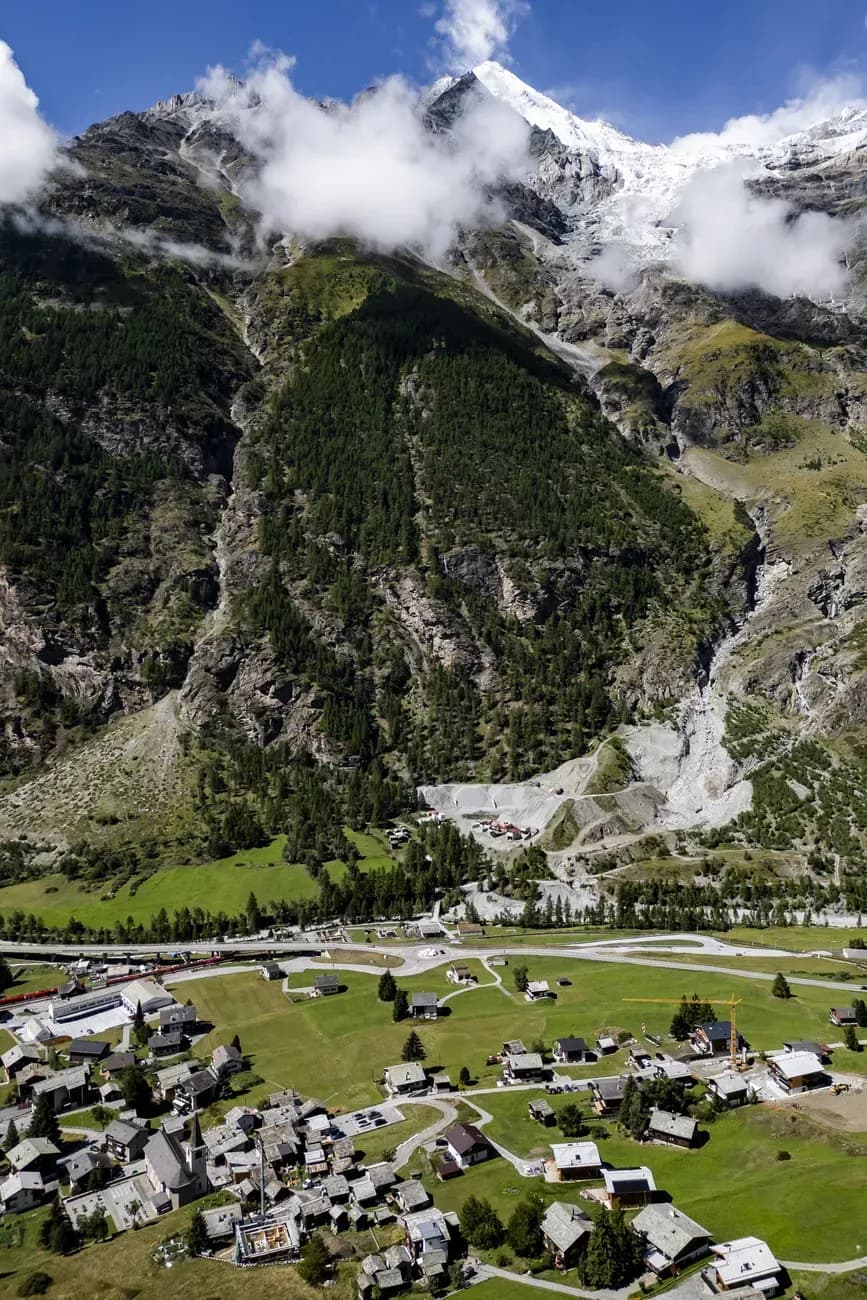
The village sits right below the Weisshorn mountain peak.
A village that has seen this before
Randa isn't new to this particular hazard. The largest recorded event at this glacier was in 1819, when an ice avalanche caused extensive damage in the village. Smaller break-offs followed in 1972 and 1973, both of which stopped on the glacier field short of reaching inhabited areas.
The village has also weathered other mountain hazards unrelated to the glacier - a major rockslide in 1991 sent close to 50 million cubic metres of rock into the valley below, burying the railway line and road and destroying 33 buildings, though no one was killed. Automated systems installed since then close the road and railway the moment a significant avalanche or rockfall is detected coming off the mountain.
What it means if you're heading to Zermatt
For now, this is a monitoring story rather than a disaster - the marked danger zone excludes the village itself, and no evacuation order is in place. It's a useful reminder, though, of how much closer attention Alpine authorities are now paying to terrain that would once have been considered dormant.
Randa sits in the Mattertal valley on the approach to Zermatt, and access routes through the area are worth checking directly with local authorities if you're travelling through in the immediate term, rather than assuming normal conditions.