
Kagura
1,225m vertical, 10m annual snowfall, November-May season. Three zones, 32 runs, backcountry gates. Niigata, Japan.
Season 2026 - 2027
Opens
28 Nov 2026
Closes
16 May 2027
Days open
169
Annual snow
10m
The Overview
Michael Fulton
Melbourne-based skier and snowboarder with 50+ resorts across 5 continents. Specialises in Australian resorts and international resort comparisons.
Kagura operates across three interconnected zones spanning 620 to 1,845 metres elevation with 1,225 metres vertical drop. The resort delivers 32 runs across 418 acres, divided 37% beginner, 40% intermediate, 19% advanced and 4% expert terrain. Annual snowfall averages 10 metres, making Kagura one of Niigata's most reliable powder destinations with a summit elevation that guarantees dry, light snow throughout the season. The longest run extends 6 kilometres from top to bottom.
The Kagura zone delivers the steepest terrain and best tree skiing, whilst Mitsumata and Tashiro offer gentler progression for developing skiers. Kagura Main Gerende runs 1,512 metres with a 27-degree maximum pitch, and the Kobu Kobu Course provides mogul challenges. Backcountry access via gated entry at the summit attracts experienced riders, with English-speaking guides and permit systems in place. Two terrain parks cater to freestyle progression.
The resort maintains a local Japanese atmosphere with limited international crowds, drawing Tokyo weekenders and serious powder hunters. Mid-mountain Wada Goya offers traditional mountain hut accommodation at 1,380 metres elevation with ski-in access. On-mountain facilities focus on function over luxury, with rental shops at both Mitsumata and Tashiro stations. Wind holds occasionally affect upper lifts during storms.
The 5.5-kilometre Dragondola connects Kagura to neighbouring Naeba, creating Japan's third-largest linked ski area under the Mt Naeba designation. Joint lift tickets cover both resorts plus shuttle buses between base areas. Kagura suits confident intermediates seeking uncrowded powder, backcountry enthusiasts, and skiers prioritising snow quality and season length over resort amenities. Children 12 and under ski free with parents.
1225m
Vertical
32
Runs
418 acres
Skiable
10m
Annual snow
The Terrain
32 runs across 418 acres skiable
Kagura is one of the bigger ski areas in Niigata at 169 hectares, with a 1,225-metre vertical from a 620-metre base to the 1,845-metre top and 32 runs. Sanity grades it 37% beginner, 40% intermediate, 19% advanced and 4% expert. About 10 metres of snow falls each year, and the high summit helps keep it dry and light. Two gondolas, two aerial trams and a mix of chairs link three zones, Kagura, Mitsumata and Tashiro, so you can ski a long day without crossing the same slope twice.
The Kagura zone has the steeper intermediate and advanced skiing, led by the Kagura Main course, while Mitsumata and Tashiro offer wide, gentler slopes for beginners and families. The Dragondola, at about 5.5 kilometres, links Tashiro to the neighbouring Naeba resort. Above the top lift, staff check gear at the gates for the Kaguragamine backcountry, and a climbing plan is required, so this is for experienced, equipped skiers only. Kagura suits intermediates wanting big vertical and a long season, and strong skiers who like to mix piste with guided powder. It draws far fewer overseas visitors than Hakuba.
Terrain split
32
runs
32 runs across 4 grades
Beginner12 runs · 37%
Intermediate13 runs · 40%
Advanced6 runs · 19%
Expert1 run · 4%
Time it right
When to visit Kagura
The 2025-2026 season sees Kagura and Mitsumata areas operating 22 November 2025 through 17 May 2026, with Tashiro running 20 December 2025 to 6 May 2026. This represents one of Japan's longest lift-served seasons, regularly extending nearly six months from late autumn through late spring. Early season relies partly on snowmaking to supplement natural accumulation at the 620-metre base elevation. May skiing attracts enthusiasts seeking late-season powder whilst cherry blossoms bloom in the valleys below.
Kagura receives 10 metres average annual snowfall concentrated between December and March, with the third week of December typically delivering 73 centimetres across 4.8 snowy days. The 1,845-metre summit elevation ensures cold temperatures preserve snow quality throughout winter. Base depths regularly exceed 3 metres mid-season, with the February 2025 event depositing 3 metres in 72 hours. High elevation provides more stable conditions than lower Yuzawa resorts, though warm spells can affect valley-level skiing.
January through March delivers peak powder frequency with consistent storms tracking from the Sea of Japan. December offers early-season value with lighter crowds, whilst April and May provide spring corn snow and extended daylight. Mid-week visits outside Japanese school holidays guarantee uncrowded slopes. The snowiest period concentrates in January and February when Pacific weather systems intensify.
Kagura-Mitsumata Sunrise Ski operates 2 April through 8 May, offering early-morning access from first light. The Kagura No. 5 Romance Lift provides touring course access 26 February through 8 May. No special events calendar operates beyond seasonal spring programmes. Lift tickets include elementary school children free with valid ticket. The extended season makes Kagura particularly attractive for northern hemisphere skiers seeking late spring conditions unavailable elsewhere in Japan.
Season 2026 - 2027
28 Nov 2026
Opens
16 May 2027
Closes
169
Days open
10 m
Annual snow
Getting there
Getting to Kagura, and where to stay
Kagura sits in Yuzawa Town, Minamiuonuma District, Niigata Prefecture on Honshu's west-facing slopes 8 kilometres southwest of Yuzawa centre. The resort occupies terrain between the Tanigawa mountain range and Route 17 corridor at Japan's geographic centre. Mitsumata base area sits 620 metres elevation, with Tashiro station located 6 kilometres further south along the valley floor. The surrounding Echigo mountains receive heavy snowfall from moisture-laden Sea of Japan weather systems.
Echigo-Yuzawa town 9 kilometres north serves as the primary service centre with onsen baths, restaurants and accommodation. The historic hot spring town dates to the Edo period and gained fame through Yasunari Kawabata's novel Snow Country. Yuzawa proper offers convenience stores, ski shops and sake breweries. Mitsumata and Tashiro villages provide limited lodging directly at lift bases. The area sits 175 kilometres northwest of Tokyo in the Jōshinetsu Kōgen highlands.
The Kan-etsu Expressway reaches Yuzawa Interchange 8 kilometres from Mitsumata, then Route 17 leads directly to resort base areas. Tokyo drivers cover the distance in approximately 2.5 hours under normal conditions. Winter tyres or chains are mandatory November through April. Shuttle buses connect Echigo-Yuzawa Station to both Mitsumata and Tashiro bases in 20 minutes, costing 300 yen. Free shuttles link base areas for ticket holders.
Tokyo Narita Airport sits 240 kilometres southeast, whilst Haneda Airport lies 220 kilometres away with more efficient Tokyo access. The Jōetsu Shinkansen reaches Echigo-Yuzawa Station from Tokyo in 70 to 90 minutes, making Kagura amongst Japan's most accessible major resorts via public transport. Local buses depart the station approximately every 30 minutes during operating season. Niigata Airport 150 kilometres north offers domestic connections from Osaka, Sapporo and limited international flights from Shanghai, Taipei and Seoul.
Where to stay
Search all stays →Hotels and lodges near Kagura, powered by Stay22.
Latest News
From the SnowStash desk

Alps Snow Forecast: Up to 64 cm Headed for the High Glaciers as the Snow Line Drops
The Alps are about to swap mild, sunny October weather for something far more wintry. A cold front arrives Tuesday, and SnowStash forecasts have Monterosa Ski out in front with 64 cm over 14 days, ahead of Blatten Belalp (55 cm) and Verbier (43 cm). The snow line should fall below 2000 metres by Wednesday night, and glaciers across Switzerland, Italy and Austria are in line for the best of it. The wind will have a say too.
20 Oct 2026

Four Dead After Avalanche Near Ski Portillo in Chile
A large avalanche struck near Laguna del Inca adjacent to Ski Portillo on Saturday afternoon, killing four people and injuring four others. The group were day visitors mountaineering in the backcountry after reportedly being warned about elevated avalanche risk by resort staff.
18 Oct 2026

Europe Ski Resorts Open Now: What Is Skiable in Mid-October 2026
Europe’s ski season is open, technically. After a record-warm summer, glaciers in Austria, Switzerland and Italy are running a few pistes apiece, Sölden, Stubai and Kitzsteinhorn started late, Titlis has pushed back to 24 October, and Zermatt reopens a few lifts on 14 October after more than two months shut. Finland’s Levi and Ruka are skiing on stored snow. Here is what is open, and what you actually get at each.
14 Oct 2026

Zermatt Plans World Cup Downhill Return on the Gornergrat for 2028
Zermatt is having another crack at a World Cup downhill, and this time nobody has to cross a border. Around 13 million Swiss francs is going into rebuilding the Gornergrat piste, including a jump fed by a roughly 300-metre in-run across the roof of the Gornergrat Railway gallery, with the Matterhorn lined up behind it for the TV cameras. First men’s race is pencilled in for March 2028, pending FIS homologation.
14 Oct 2026

Mt. Rose Begins Snowmaking for the 2026-27 Season at Lake Tahoe
Lake Tahoe’s highest base elevation is paying off early: Mt. Rose has started making snow for 2026-27 after the first flurries and a cold snap. The Nevada resort is backing it with nearly US$2 million in upgrades, including a replacement snowmaking main line, a new PistenBully groomer and restraint bars on every lift. Opening day is yet to be confirmed, though Heavenly and Northstar are already eyeing 20 November.
13 Oct 2026

Utah Ski Resorts 2026-27: What’s New at Alta, Deer Valley, Powder Mountain and More
Utah is still building flat out. For 2026-27, Powder Mountain opens a steep new Skytrac chair into more than 1,000 acres of advanced terrain, Deer Valley adds 200 acres on Hail Peak, Sundance gets a new quad and Park City adds a gondola from its new parking structure. Snowmaking is expanding almost everywhere, Eagle Point stays closed after the Cottonwood Fire, and the 2034 Games are setting the pace. Here’s what’s new, resort by resort.
13 Oct 2026

Mt Hutt Invests NZ$12 Million in Base Area, Tripling Its Sun Deck
Mt Hutt is getting busier, and its base lodge is about to catch up. NZ$12 million goes into a heated sun deck roughly three times the current size (430 m² to 1,300 m²), plus a new toilet block, heated steps down to snow level, extra storage and a new food and beverage outlet. Building starts after the 2026 season, with everything due for winter 2027.
11 Oct 2026

Vermont Ski Resort Opening Dates 2026-27: Few Dates Set, Killington Waits on the Cold
Vermont's season is slow to take shape. Stratton is tentatively targeting 18 November and Sugarbush 21 November, while Pico has Friday 11 December on the calendar. Killington never sets a date and opens when the snowmaking allows, and Vail Resorts has yet to name days for Stowe, Okemo and Mount Snow. The forecasts disagree about snow, and the main El Niño worry for the Green Mountains is warmth.
9 Oct 2026
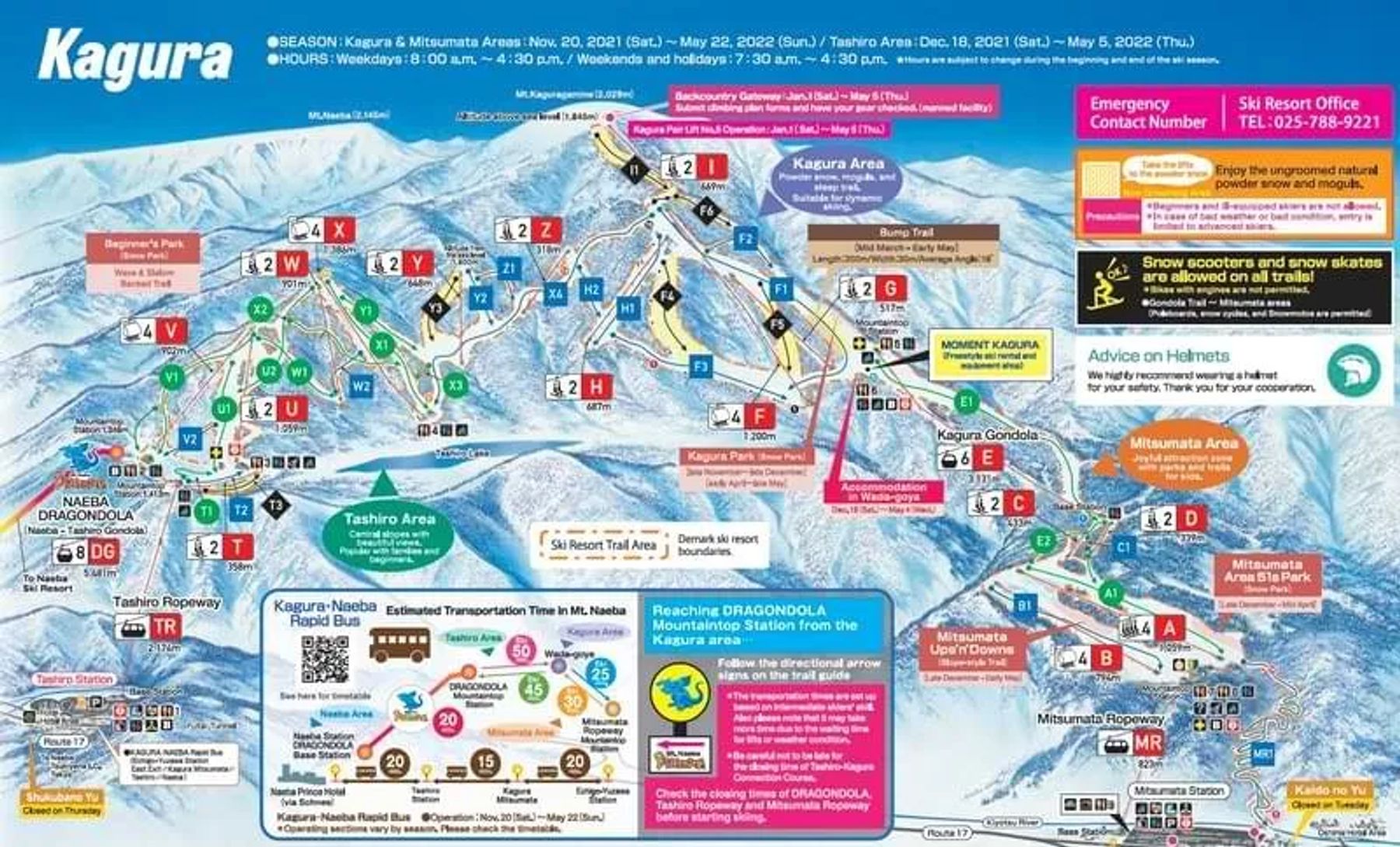
Kagura Trail Map
Downloadable Kagura trail map
Terrain split
32
runs
Beginner37%
Intermediate40%
Advanced19%
Expert4%
418 acres skiable169 hectares
Resort Stats
Elevation
Base620m
Summit1845m
Annual snowfall
10m
Season
2026 - 2027
28 Nov 2026 - 16 May 2027
Trail coverage
32 runs
418 acres (169 ha)
About Kagura's trail map
Explore Kagura's full trail map with 32 runs across the mountain, colour-coded by difficulty and shown alongside the terrain split. Use it to plan a day that matches your ability, find lift-served pockets of your favourite grade, and see how the resort links together. Download the piste map (PDF) ↗
More Kagura intelligence: snow report, lift system, webcams, resort overview.