
Kiroro
660m vertical, 27 runs, 21m annual snow. Hokkaido's powder destination 2hrs from New Chitose Airport.
Season 2026 - 2027
Opens
10 Dec 2026
Closes
11 Apr 2027
Days open
122
Annual snow
21m
The Overview
Michael Fulton
Melbourne-based skier and snowboarder with 50+ resorts across 5 continents. Specialises in Australian resorts and international resort comparisons.
Kiroro spans 660 metres of vertical drop between its 520-metre base and 1,180-metre summit across three interconnected peaks: Asari, Nagamine and Yoichi. The resort operates 27 runs across 297 acres, with 38 per cent beginner, 29 per cent intermediate, 25 per cent advanced and 8 per cent expert terrain. Annual snowfall averages 21 metres, positioning Kiroro among Hokkaido's snowiest destinations thanks to its proximity to the Sea of Japan, where cold Siberian air masses trigger heavy precipitation. The 2025-26 season runs from 30 November to 6 May, offering one of Japan's longest operating calendars.
Asari Peak at 1,180 metres serves as the highest summit, accessed via the 3.3-kilometre Kiroro Gondola or a series of chairlifts, whilst Nagamine Peak at 1,090 metres and Yoichi Peak at 900 metres provide varied terrain across distinct sectors. The longest run stretches four kilometres from Asari Peak to base, descending through well-spaced birch forest. Five designated off-piste zones within the resort boundary offer tree skiing through natural terrain, accessible via marked gates for riders with avalanche gear. The resort maintains smooth groomers across all peaks, with consistent pitch favouring confident intermediates.
The base village sits at 520 metres in Akaigawa, centred on the Mountain Centre facility with rental shops, restaurants and onsen access. Accommodation clusters around two Club Med properties and the Yu Kiroro ski-in/ski-out residences, creating a self-contained resort atmosphere without a traditional village. English-speaking staff, multilingual signage and efficient operations cater to international visitors. Night skiing operates from 13 December to 5 April until 7:00 PM on select lifts, extending daily riding hours through the core season.
Kiroro operates independently without major pass affiliations, though the resort offers season passes at ¥68,500 and multi-day packages with discounts for Hokkaido residents. Daily lift tickets range from ¥6,500 to ¥7,200 depending on season, with children five and under skiing free. The resort suits powder-focused intermediates and families seeking quieter slopes within 90 minutes of Sapporo, 50 kilometres from Niseko and two hours from New Chitose Airport. Established in 1991, Kiroro has evolved from a relative unknown to a recognised destination for deep snow and uncrowded tree skiing.
660m
Vertical
27
Runs
297 acres
Skiable
21m
Annual snow
The Terrain
27 runs across 297 acres skiable
Kiroro is a big, snowy mountain west of Sapporo, with around 120 hectares to explore and 27 runs dropping 660 vertical metres from the 1,180-metre Asari summit to a base at 520 metres. About 21 metres of snow falls in a typical year, drawn off the Sea of Japan. The grading is 38% beginner, 29% intermediate, 25% advanced and 8% expert, so there is meaningful steep terrain as well as easy cruising. Two gondolas, four quads and four double chairs link three peaks, Asari, Nagamine and Yoichi, and each has its own character. Good skiers can easily fill several days.
The longest run stretches about four kilometres from Asari through well-spaced birch forest, and the gondola climbs to the top in one smooth ride. Five off-piste zones sit inside the resort boundary, reached through marked gates and requiring avalanche gear, which suits skiers who want tree skiing with some structure. The black runs on Nagamine and Yoichi are relatively gentle, so strong intermediates can try small moguls without overreaching. Smooth groomers cover most of the mountain. Skiers who prioritise deep, reliable snow and tree runs over village nightlife will find Kiroro well matched, and beginners have a dedicated area near the base.
Terrain split
27
runs
27 runs across 4 grades
Beginner10 runs · 38%
Intermediate8 runs · 29%
Advanced7 runs · 25%
Expert2 runs · 8%
Time it right
When to visit Kiroro
The 2025-26 season opens 30 November and closes 6 May, delivering 158 days of operations across early, peak, spring and extended late-season periods. This timeline ranks among Hokkaido's longest, reflecting Kiroro's elevation advantage and north-facing aspects that preserve snow into Golden Week. Early season typically sees base-building through December, with full terrain access by mid-month once summit snowpack reaches operational depth. Spring conditions from April onwards offer softer snow and warming temperatures whilst maintaining rideable coverage to closure.
Kiroro averages 21 metres of annual snowfall, though historical data shows variability between 13 metres at base and 24 metres at summit depending on measurement location and season. The resort's position 43 kilometres west of Sapporo, near the Sea of Japan coast, funnels moisture-laden systems that dump 30 centimetres overnight during peak cycles between December and March. Average December-to-March temperatures hover around -6°C, cold enough to maintain dry powder quality even during late-season windows. Minimal snowmaking infrastructure exists given natural snowfall reliability.
January and February deliver peak powder conditions with the highest frequency of storm cycles, averaging six snowy days per week during mid-winter. Late December through early March offers optimal timing for guaranteed base depths and fresh snow, whilst late November and April suit skiers prioritising uncrowded slopes over deepest conditions. Mid-week visits throughout winter avoid weekend crowds from Sapporo. March and April maintain quality snow on north-facing runs when south-facing resorts deteriorate.
Night skiing runs from 13 December to 5 April on Center Express lift until 7:00 PM, illuminating select runs for extended riding hours. The Kiroro Snow Activity World opens 13 December, offering snow parks, tubing, snowmobiling and family activities alongside skiing. No major competitive events anchor the calendar, though the resort hosts occasional races and kids' programmes. The Otaru Snow Light Festival in February provides off-mountain cultural programming 50 minutes away.
Season 2026 - 2027
10 Dec 2026
Opens
11 Apr 2027
Closes
122
Days open
21 m
Annual snow
Getting there
Getting to Kiroro, and where to stay
Kiroro sits in Akaigawa village, Yoichi District, within the Shiribeshi Subprefecture of western Hokkaido, Japan. The resort occupies the eastern flank of the Akaigawa Caldera, a dormant volcanic basin surrounded by forested peaks 60 kilometres west of Sapporo. The base village sits at 520 metres elevation within mountainous terrain that comprises 80 per cent of Akaigawa's 280-square-kilometre area. Mount Yoichi at 1,488 metres dominates the skyline behind the ski area, whilst the caldera setting creates a natural amphitheatre trapping heavy snowfall.
Otaru, a historic port city 28 kilometres north, serves as the nearest substantial town with 40 minutes' drive time via local roads. Sapporo, Hokkaido's capital with two million residents, lies 43 kilometres east and 60-90 minutes by road depending on traffic and conditions. Kutchan, the gateway to Niseko 50 kilometres southwest, sits one hour away. Akaigawa village itself holds just 1,165 residents and minimal commercial infrastructure beyond the resort, though the Michi-no-Eki Akaigawa roadside station provides local produce and information.
Road access follows Route 393 from Otaru or the Hokkaido Expressway via Route 1 from Sapporo, requiring winter driving skills and appropriate tyres between November and April. Driving from Sapporo takes approximately 70 minutes in clear conditions, longer during snowstorms. Niseko resorts lie 50 kilometres southwest via mountain roads. No train service reaches Akaigawa; the nearest JR stations are Otaru and Otaru Chikko, 28 kilometres north, where travellers transfer to bus or taxi for the final 40-60 minutes.
New Chitose Airport serves as the primary gateway, located 110 kilometres southeast with two hours' transfer time via the Hokkaido Resort Liner bus (¥4,500, three daily departures at 10:00, 12:20 and 15:30) or private shuttle. JR trains connect the airport to Otaru in 70 minutes, followed by taxi or bus to Kiroro. Sapporo Station bus services operate daily, taking 90-150 minutes depending on route and stops. Rental cars from airport or Sapporo provide flexibility for exploring nearby Otaru attractions and accessing the resort.
Where to stay
Search all stays →Hotels and lodges near Kiroro, powered by Stay22.
Latest News
From the SnowStash desk

Four Dead After Avalanche Near Ski Portillo in Chile
A large avalanche struck near Laguna del Inca adjacent to Ski Portillo on Saturday afternoon, killing four people and injuring four others. The group were day visitors mountaineering in the backcountry after reportedly being warned about elevated avalanche risk by resort staff.
18 Oct 2026

Europe Ski Resorts Open Now: What Is Skiable in Mid-October 2026
Europe’s ski season is open, technically. After a record-warm summer, glaciers in Austria, Switzerland and Italy are running a few pistes apiece, Sölden, Stubai and Kitzsteinhorn started late, Titlis has pushed back to 24 October, and Zermatt reopens a few lifts on 14 October after more than two months shut. Finland’s Levi and Ruka are skiing on stored snow. Here is what is open, and what you actually get at each.
14 Oct 2026

Zermatt Plans World Cup Downhill Return on the Gornergrat for 2028
Zermatt is having another crack at a World Cup downhill, and this time nobody has to cross a border. Around 13 million Swiss francs is going into rebuilding the Gornergrat piste, including a jump fed by a roughly 300-metre in-run across the roof of the Gornergrat Railway gallery, with the Matterhorn lined up behind it for the TV cameras. First men’s race is pencilled in for March 2028, pending FIS homologation.
14 Oct 2026

Mt. Rose Begins Snowmaking for the 2026-27 Season at Lake Tahoe
Lake Tahoe’s highest base elevation is paying off early: Mt. Rose has started making snow for 2026-27 after the first flurries and a cold snap. The Nevada resort is backing it with nearly US$2 million in upgrades, including a replacement snowmaking main line, a new PistenBully groomer and restraint bars on every lift. Opening day is yet to be confirmed, though Heavenly and Northstar are already eyeing 20 November.
13 Oct 2026

Utah Ski Resorts 2026-27: What’s New at Alta, Deer Valley, Powder Mountain and More
Utah is still building flat out. For 2026-27, Powder Mountain opens a steep new Skytrac chair into more than 1,000 acres of advanced terrain, Deer Valley adds 200 acres on Hail Peak, Sundance gets a new quad and Park City adds a gondola from its new parking structure. Snowmaking is expanding almost everywhere, Eagle Point stays closed after the Cottonwood Fire, and the 2034 Games are setting the pace. Here’s what’s new, resort by resort.
13 Oct 2026

Mt Hutt Invests NZ$12 Million in Base Area, Tripling Its Sun Deck
Mt Hutt is getting busier, and its base lodge is about to catch up. NZ$12 million goes into a heated sun deck roughly three times the current size (430 m² to 1,300 m²), plus a new toilet block, heated steps down to snow level, extra storage and a new food and beverage outlet. Building starts after the 2026 season, with everything due for winter 2027.
11 Oct 2026

Vermont Ski Resort Opening Dates 2026-27: Few Dates Set, Killington Waits on the Cold
Vermont's season is slow to take shape. Stratton is tentatively targeting 18 November and Sugarbush 21 November, while Pico has Friday 11 December on the calendar. Killington never sets a date and opens when the snowmaking allows, and Vail Resorts has yet to name days for Stowe, Okemo and Mount Snow. The forecasts disagree about snow, and the main El Niño worry for the Green Mountains is warmth.
9 Oct 2026
Crans-Montana 2027 World Championships President Resigns Ahead of Fraud Hearing
Less than four months out from the Crans-Montana 2027 World Championships, the man running the organising committee has stepped down. Claude-Alain Schmidhalter resigned as Swiss-Ski vice president and OC president after being indicted over a business dispute unrelated to skiing. He denies the allegations and faces court on October 27. Interim leaders are in place for the February 1-14 event.
9 Oct 2026
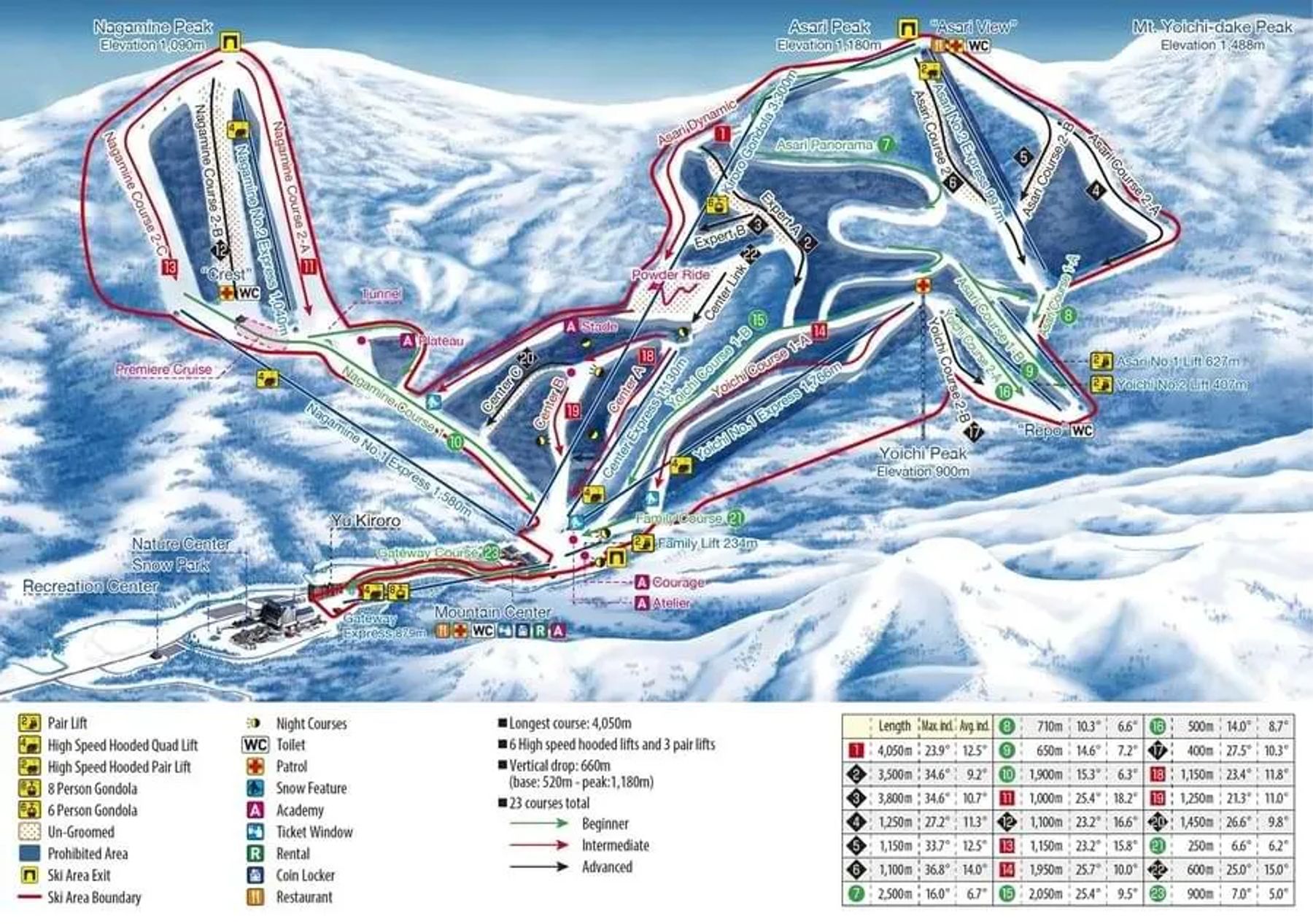
Kiroro Trail Map
Downloadable Kiroro trail map
Terrain split
27
runs
Beginner38%
Intermediate29%
Advanced25%
Expert8%
297 acres skiable120 hectares
Resort Stats
Elevation
Base520m
Summit1180m
Annual snowfall
21m
Season
2026 - 2027
10 Dec 2026 - 11 Apr 2027
Trail coverage
27 runs
297 acres (120 ha)
About Kiroro's trail map
Explore Kiroro's full trail map with 27 runs across the mountain, colour-coded by difficulty and shown alongside the terrain split. Use it to plan a day that matches your ability, find lift-served pockets of your favourite grade, and see how the resort links together. Download the piste map (PDF) ↗
More Kiroro intelligence: snow report, lift system, webcams, resort overview.