From City to Summit in Half an Hour
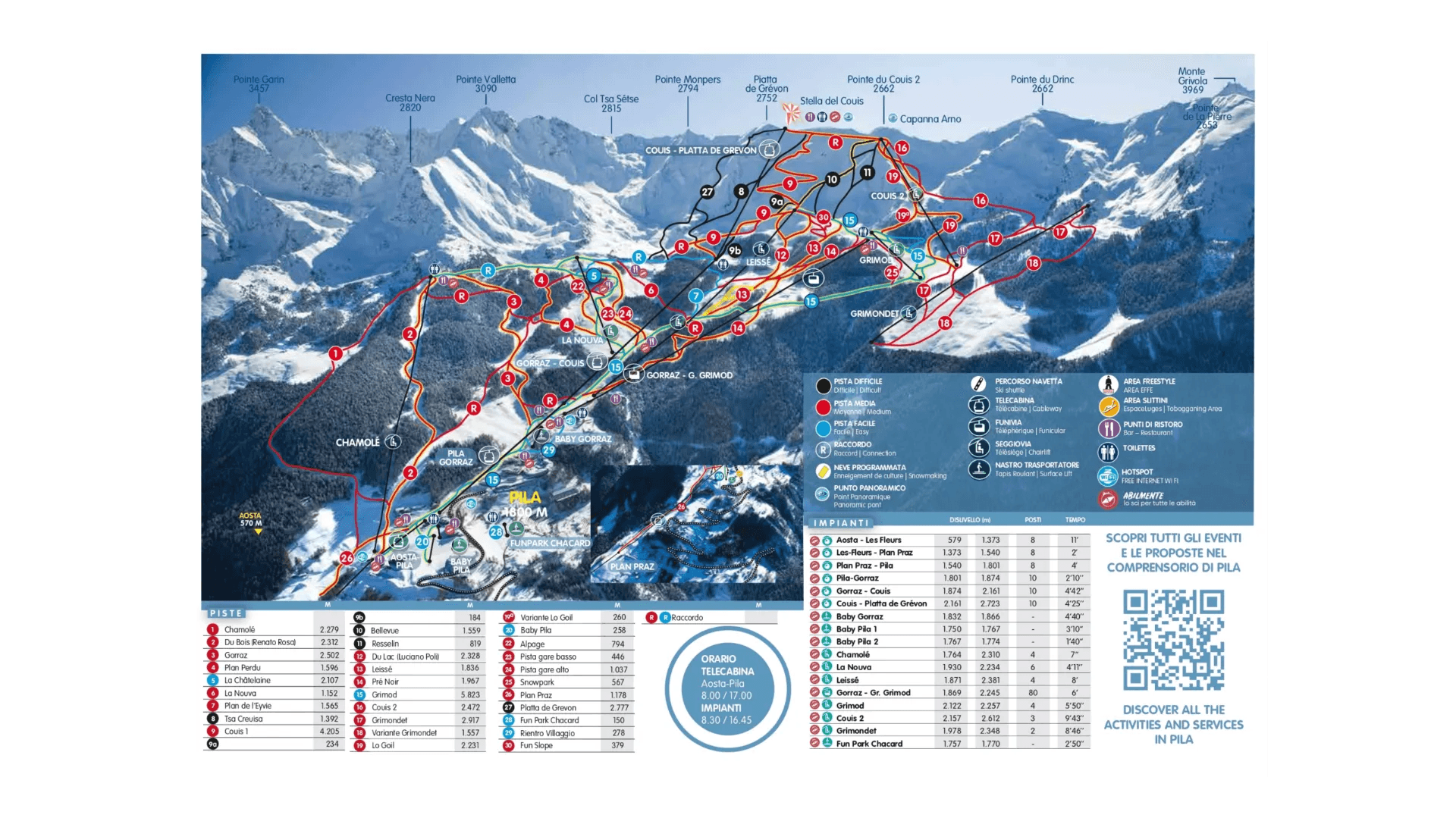
The complete gondola system operates across five stations, climbing 2,140 vertical metres from Aosta (583m) through Pila village (1,800m), Pila Gorraz (1,878m), and Couis 1 (2,165m) to the Stella del Couis at 2,723 metres. The system has a combined capacity of 2,400 people per hour, powered by 1,746kW motors across 112 gondola cabins.
Crucially, the gondola operates bidirectionally, allowing visitors to ascend purely for the summit experience without needing to ski down—a capability that transforms the infrastructure from ski-specific to year-round tourism asset.
For skiers and snowboarders, the transformation is dramatic. The old two-seater chairlift—slow, exposed to wind and cold, and prone to lengthy queues—has been replaced with gondola infrastructure that delivers riders to 2,700 metres in under five minutes from Couis 1. This improvement means skiers can spend approximately 30% more time actually skiing, rather than waiting or riding slow chairlifts.
The new ski route at the summit has also opened up terrain that was previously difficult to access, effectively connecting areas of the mountain that operated as separate zones. This creates better flow on busy days and gives intermediate skiers more options for exploring the upper mountain.
The Stella del Couis: Architecture Meets Alpine Landscape
The centrepiece of the project is the Stella del Couis (Star of Pila), the summit station and panoramic refuge designed by Italian architecture firm DeCarloGualla. The building's distinctive design has been visible throughout 2025 as construction progressed, but the 14 December opening marks the first time visitors can experience the interior spaces and dining facilities.
The architectural concept draws inspiration from the edelweiss flower and the "Rose of the Winds," with the building's form responding to the dramatic 360-degree alpine panorama surrounding the site. The structure features distinctive petal-shaped sections, each oriented toward specific peaks in the surrounding mountains.
Five main petals of the restaurant and bar area face the major 4,000-metre peaks: Gran Paradiso to the south, followed by Grande Rousse, Rutor Glacier, Mont Blanc, and Grand Combin. An additional viewing platform extends northward, cantilevered toward the Matterhorn in the distance.
The architects faced the challenge of creating a building that could withstand extreme alpine conditions at 2,723 metres—high winds, heavy snow loads, intense UV radiation, and dramatic temperature swings—whilst remaining visually striking and comfortable for visitors. Their solution employs Corten steel for the exterior cladding, which develops a protective rust patina over time; timber for warmth and structural expression; and extensive glazing designed to frame specific views while minimising heat loss.
The result is a contemporary interpretation of alpine architecture that makes a bold statement without overwhelming the mountain landscape. The petal-shaped design isn't merely aesthetic—it responds functionally to the multiple flows of visitors arriving and departing via gondola, ski runs, and viewing platforms.
Inside, the refuge features a full-service restaurant and bar operated in partnership with Skyway Monte Bianco, the company behind the famous Mont Blanc cable car and summit facilities. The interior continues the natural materials palette, with timber ceilings, stone accents, and carefully positioned glazing that frames views toward specific peaks. The dining areas can accommodate approximately 200 guests across the multiple "petals," with each section offering different perspectives on the surrounding mountains.
More Than Just Skiing
What distinguishes this project from typical ski lift replacement is Pila's explicit commitment to four-season mountain tourism. Unlike a chairlift, which primarily serves skiers, the gondola system is designed to operate year-round, making the alpine summit accessible to hikers, mountain bikers, families, and visitors with limited mobility.
This represents a strategic pivot for Pila, which has historically been known primarily as a convenient day-trip ski resort for residents of Aosta and nearby Turin. By investing in gondola infrastructure and creating an architecturally significant summit destination, the resort is positioning itself for a future where skiing may represent only part of its annual revenue.
The summer tourism potential is considerable. Mountain bikers can now access high-alpine trails without the gruelling climb from valley level. Hikers can start walks from 2,700 metres, exploring terrain that would otherwise require hours of ascent. And the growing market of visitors who want to experience alpine landscapes without significant physical exertion now has a compelling reason to visit Pila specifically.
The system can even operate at night for special events—a capability that opens possibilities for summit dining experiences, stargazing programmes, and evening events that would be virtually unique in the Italian Alps.
A Regional Tourism Strategy
For the Aosta Valley, Pila's new infrastructure represents more than just one resort's improvement. The proximity to Aosta—a city of 34,000 with significant Roman ruins, medieval architecture, and distinctive Franco-Italian alpine culture—creates opportunities for multi-day itineraries that combine urban and mountain experiences.
Visitors can now spend a morning exploring Aosta's remarkably preserved Roman theatre, Arch of Augustus, and medieval towers, have lunch at 2,700 metres overlooking Mont Blanc, and return to the city for aperitivo in one of the historic centre's cafes—all without needing a car or dealing with mountain road driving.
This accessibility is particularly valuable for international visitors unfamiliar with alpine driving conditions, elderly visitors for whom mountain roads can be intimidating, and families with young children who may not cope well with winding ascents. The barrier to experiencing high-alpine landscapes has been dramatically lowered.
The Aosta Valley regional government has supported the project as part of broader efforts to extend the tourism season and reduce economic dependence on winter snowfall. Climate change projections suggest lower-elevation ski resorts will face increasing snow reliability challenges in coming decades, making year-round tourism infrastructure a prudent long-term investment.
The Stella del Couis also creates a potential network effect with other major Aosta Valley attractions. Visitors to Skyway Monte Bianco in Courmayeur might add a day at Pila's summit refuge. Those exploring the Gran Paradiso National Park could incorporate the Stella del Couis for its views toward the park's peaks. The more high-quality alpine experiences the valley offers, the more compelling it becomes as a multi-day destination.
Economic Implications and Employment
Pila SpA, in partnership with Skyway Monte Bianco, has invested significantly in this project. While exact figures haven't been publicly disclosed, the construction of three lift stations, the complete gondola system, and the Stella del Couis refuge likely represents an investment exceeding €20 million—substantial for a resort of Pila's size.
The economic bet is that this infrastructure will pay dividends through multiple channels. Increased summer visitation represents new revenue that didn't previously exist. Higher spending per visitor at the summit refuge—where the captive audience and unique location support premium pricing—should generate strong margins. And positioning Pila as a more competitive year-round destination should increase overall visitor numbers and length of stay.
For employment, the year-round operating model potentially stabilises jobs in a sector traditionally characterised by seasonal work. Lift operators, mountain refuge staff, maintenance workers, and management personnel who might previously have worked five months per year could now work nine or ten months, improving income stability and making mountain tourism careers more viable.
The resort has also emphasised support for local businesses as a core objective. Increased visitor numbers benefit accommodation providers, restaurants, shops, and activity operators throughout Pila and in Aosta itself. The infrastructure essentially extends Aosta's "day trip radius" by making the alpine summit accessible within 30 minutes, potentially keeping visitors in the region for longer periods.
An International Perspective
For international skiers planning European trips, Pila has traditionally been a secondary option—known to insiders but overshadowed by mega-resorts in France, Switzerland, and Austria. The new gondola system and Stella del Couis change that calculation in several ways.
The practical advantages are considerable. Aosta is easily accessible from Milan (two hours by car) or Turin (90 minutes), both served by international flights. Accommodation in both Pila and Aosta tends to be more affordable than equivalent options in major French or Swiss resorts. The terrain, while not extensive by North American standards, offers good intermediate skiing with the reliable snowmaking that characterises modern Italian resorts.
The new gondola system specifically addresses one of the frustrations international visitors often encounter in European resorts: slow, cold chairlifts that limit vertical metres skied per day. The ability to reach 2,700 metres in minutes, in comfortable gondola cabins, maximises time on snow.
Beyond skiing, the Stella del Couis offers an experience difficult to replicate elsewhere: a gondola ride from a Roman city to an alpine summit restaurant with 360-degree views of 4,000-metre peaks. This combination of cultural and natural experiences—achievable in a single day, without significant physical exertion or technical skills—provides compelling content for travellers seeking diverse experiences.
For multi-generational family trips, where skiing ability and interest levels vary, the ability for non-skiers to meet skiers at the summit refuge for lunch creates flexibility that enhances the overall experience. Those who don't ski can still participate in the alpine experience; enthusiastic skiers can maximise their time on snow while others enjoy a leisurely gondola ride and summit lunch.
Competitive Context in the Alps
Pila now joins a select group of resorts that have invested heavily in architecturally significant summit stations. Across the Alps, mountain restaurants and summit buildings have become important differentiators in an increasingly competitive market where terrain and lift capacity alone no longer suffice.
Switzerland has several notable examples: the Chetzeron, a converted cable car station above Crans-Montana; the revolving restaurant Allalin at 3,500m in Saas-Fee; and various Ice Palace and summit restaurants across major resorts. Austria's Gaislachkogl summit restaurant in Sölden, designed by architect Johann Obermoser, has become an attraction in its own right, with distinctive angular design and gourmet dining.
In the Dolomites, the Col Rodella Panoramic Terrace and numerous other summit restaurants combine Italian food culture with dramatic mountain architecture. These destinations understand that modern mountain tourism extends beyond lift capacity and piste kilometres to encompass design, dining, and shareable experiences.
Pila's Stella del Couis now positions the resort within this competitive set. The architecture is distinctive enough to generate media coverage and social media sharing, whilst the panoramic views provide the visual content that drives word-of-mouth marketing.
Challenges Ahead
Despite the successful opening, Pila faces ongoing challenges common to European ski resorts. Snow reliability at lower elevations remains a concern, though the resort has invested in extensive snowmaking infrastructure. The complete gondola system makes upper terrain more accessible, but Pila's total skiable terrain—approximately 70 kilometres of pistes—remains modest compared to major French or Austrian destinations offering 200+ kilometres.
Summer tourism revenue, whilst promising, remains unproven at scale. The resort will need to develop compelling programming—guided hikes, mountain bike trails, photography tours, special dining events, possibly concerts or cultural programming—to convert the infrastructure investment into sustained summer visitation. Building this infrastructure was the foundation; programming it effectively year-round will require ongoing creativity and investment.
Competition is also intensifying. As more resorts recognise the importance of year-round tourism, Pila will face increasing competition for the same summer visitors. The Stella del Couis provides a competitive advantage now, but maintaining that edge will require ongoing investment in experience and service quality.
The partnership with Skyway Monte Bianco is both an asset and a potential complication. Skyway brings world-class expertise in operating high-alpine tourism infrastructure and managing the complex logistics of summit restaurants at extreme altitude. However, coordination between two organisations with different ownership structures and objectives can create operational challenges, particularly around pricing strategy, marketing, and long-term investment priorities.
Looking Forward
With the complete system now operational, Pila enters a new chapter in its 80-year history. Since the first Aosta-Pila cable car connection opened in 1945—itself pioneering at the time—the resort has consistently emphasised accessibility, based on the belief that alpine experiences should be available to the widest possible audience.
The Stella del Couis and the complete gondola system represent the fullest expression yet of that founding vision. A family from Aosta can now have breakfast in the city and be standing at 2,723 metres before mid-morning, all without needing specialised equipment, significant fitness, or technical mountaineering skills.
For skiers and snowboarders, the infrastructure dramatically improves the on-mountain experience. The elimination of the old two-seater chairlift removes a significant bottleneck, whilst the new ski route creates better flow and gives intermediate skiers more options for exploring the upper mountain.
For non-skiing visitors, the project opens up experiences previously reserved for those willing to hike for hours, hire expensive guides, or take helicopter tours. The ability to reach 2,700 metres comfortably and safely, regardless of age or fitness level, fundamentally changes who can access high-alpine landscapes.
The architectural statement of the Stella del Couis signals Pila's ambitions beyond functional infrastructure. This is a declaration that this relatively small Italian resort intends to compete on design, experience, and accessibility with far larger and better-known destinations across the Alps.
Whether this vision succeeds commercially will become clear over the next several seasons, as summer visitation data accumulates and the resort refines its year-round programming. Early indications will come quickly—if summer 2026 sees strong uptake of the gondola-to-summit experience, it will validate the investment strategy and likely encourage further development.
But for now, as the 2025/26 winter season begins, visitors to the Aosta Valley have something genuinely new: the ability to ride from a Roman city to an alpine summit in half an hour, taking in 2,000 vertical metres of landscape, culture, and architecture along the way.
The Stella del Couis is open, perched at 2,723 metres above Aosta, its distinctive petal-shaped design now visible from valleys throughout the region. The refuge offers what may be one of the most accessible high-alpine panoramic experiences in the entire Alps—no hiking required, no technical skills needed, no helicopter charter necessary. Just a 30-minute gondola ride from a city founded by the Romans 2,000 years ago.
For a resort that has always believed in sharing the mountains with everyone, it's a fitting achievement.