Resort Spotlight: Whitefish Mountain - Montana's Terrain-Rich Alternative to the Rockies

Michael FultonMichael Fulton

TL;DR

Whitefish Mountain delivers 5.87 metres of annual snowfall and 717 vertical metres across genuinely challenging terrain, all within sight of Glacier National Park. Montana's alternative to the Colorado crowds comes with trade-offs worth understanding.

Level Up Your Ski Day — Download SnowStash on the App Store

Most skiers looking at Montana immediately think Big Sky. Whitefish Mountain, 320 kilometres north near the Canadian border, rarely enters the conversation despite pulling in nearly six metres of snow annually and offering 50% advanced-to-expert terrain. The numbers alone suggest something worth investigating.

The resort sits just outside a small railroad town with actual year-round residents, not a purpose-built village. Glacier Park International Airport is 30 kilometres away. This is as far north as you can ski in the Lower 48 without crossing into Idaho, which explains both the snow totals and why it stays off most destination skiers' radars.

Whitefish Mountain Mountain Overview

The 717-metre vertical drop spreads across 113 runs served by 14 lifts. The terrain split - 12% beginner, 38% intermediate, 50% advanced and expert - tilts decisively toward capable skiers. Current conditions show 108 of 113 runs open with eight lifts running, which represents nearly full operation in mid-season.

The mountain's 5.87-metre annual snowfall average sits between Colorado's typical 8-9 metres and many Eastern resorts' 3-4 metres. This season has tracked 4.56 metres to date with 43 centimetres in the past week and a 51-centimetre base. Not exactly drought conditions, but the northern latitude and Continental Divide proximity mean the snow quality often exceeds what the totals suggest.

The advanced terrain concentrates on the summit and the mountain's backside. Expert runs comprise only 6% of the total, which means the truly hair-raising lines are limited but the 44% advanced category offers sustained pitch without requiring mountaineering skills. Intermediates get 38% of the mountain, though the beginner allocation of 12% suggests this isn't where you bring someone for their first day on skis.

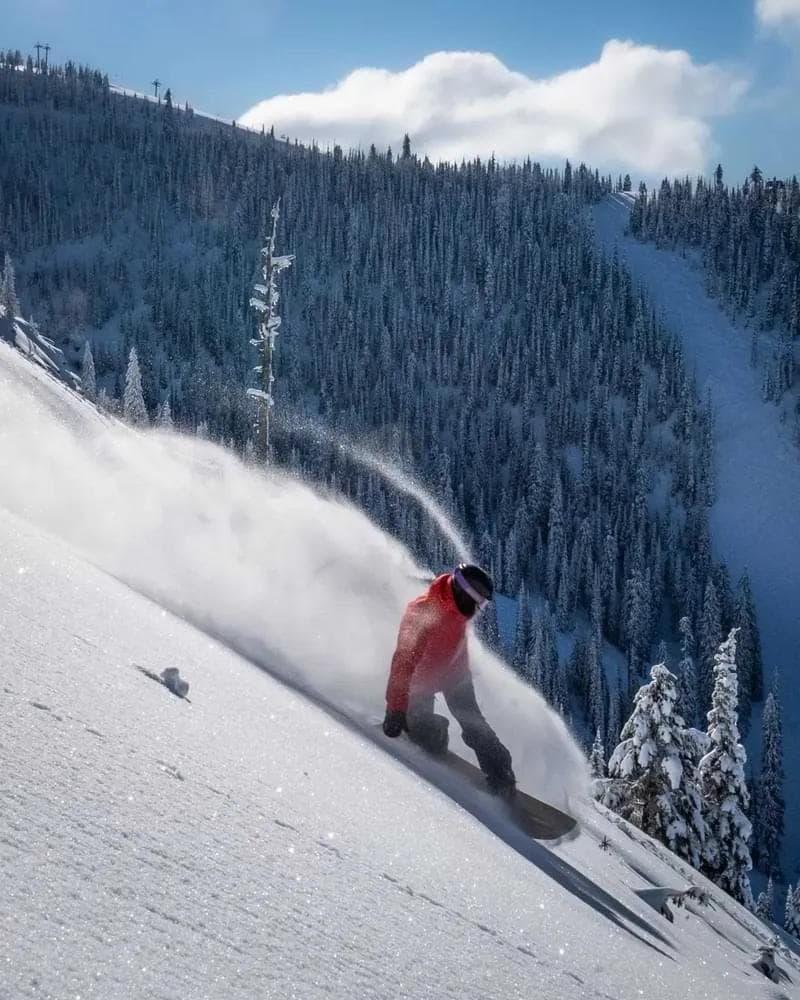
Skiers and snowboarders on mountain slopes with fresh powder
Skiing and snowboarding action at mountain resort showcasing the winter sports experience.

Who is Whitefish Mountain Best For

This mountain suits strong intermediates through advanced skiers looking for terrain variety without destination resort prices or crowds. The 50% advanced-and-up split means you can ski here for a week without repeating runs, assuming you're comfortable on black diamonds. Families with young children will find the 12% beginner terrain limiting compared to resorts that dedicate 20-30% to learning zones.

The location works particularly well for skiers who value town access over ski-in/ski-out convenience. Whitefish itself functions as an actual community rather than a resort village, which means better restaurant value and a notable lack of manufactured alpine atmosphere. The proximity to Glacier National Park creates an unusual ski-and-national-park combination that works if you're spending a week in the area.

Powder hunters should note the 5.87-metre average carefully. It's legitimate snowfall but roughly 30-40% less than Utah or interior British Columbia destinations. The trade-off comes in snow quality rather than quantity - the northern location and elevation produce reliably dry snow, and the relatively low skier traffic means untracked snow lasts longer than at more famous resorts.

Whitefish Mountain Snow & Season

The season runs early December through early April, which represents a solid four-month window. This season opened 6 December and runs through 6 April. The northern latitude extends the season slightly compared to similar-elevation resorts further south, though spring skiing here means March rather than May.

The 51-centimetre current base in mid-season with 43 centimetres over the past week suggests consistent mid-winter coverage. The 5.87-metre historical average translates to roughly 587 centimetres, which means you're looking at 20-25 significant snowfalls per season rather than the 30-35 you'd expect at Alta or Whistler. The snow arrives in discrete storms rather than constant accumulation.

The Canadian border proximity (roughly 100 kilometres north) means weather patterns push Arctic air masses through regularly, keeping snow temperatures cold and quality high even when totals moderate. February typically delivers the most consistent conditions, while December can be thin and April becomes variable.

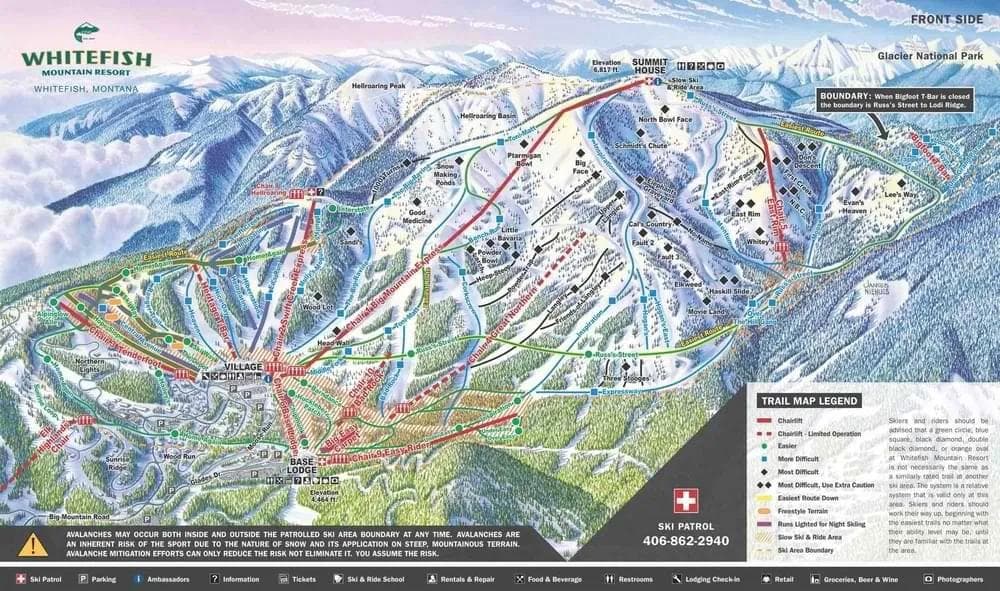
The trail map at Whitefish Mountain. © Whitefish Mountain

Getting to Whitefish Mountain

Glacier Park International Airport sits 30 kilometres from the resort, offering direct connections to major Western hubs. The airport handles roughly 500,000 passengers annually, which means limited flight options but manageable crowds. Car hire is essentially required unless you're staying in Whitefish town and using shuttle services.

The town of Whitefish sits at the mountain's base, roughly 10 kilometres from the resort via Highway 93. This creates a functional separation between accommodation and skiing that some will view as inconvenient and others will appreciate for the access to actual town amenities. The resort runs shuttles, though schedules may not align with first-chair aspirations.

Driving from major cities means 215 kilometres from Missoula, 480 kilometres from Spokane, or 550 kilometres from Calgary. Winter driving conditions require appropriate preparation - this is Montana in winter, not a maintained highway between resort villages.

Whitefish Mountain Lift Tickets

Adult day tickets cost $110 regardless of peak or regular designation, which represents honest pricing without the dynamic pricing complications increasingly common elsewhere. Juniors and seniors pay $94, children $55. These rates sit roughly 20-30% below comparable Colorado destination resorts.

The single-price structure simplifies planning but eliminates the advance-purchase discounts that can reduce costs at other mountains. No indication of multi-day ticket pricing or season pass options in the provided data, though the Ikon Pass includes Whitefish as a partner resort, which changes the calculation entirely for pass holders.

The $110 adult rate for 717 vertical metres and access to genuinely challenging terrain represents reasonable value, particularly when compared to $150-200 rates common at name-brand resorts. The lack of dynamic pricing means no punishment for last-minute decisions based on snow conditions.

The Verdict on Whitefish Mountain

Whitefish delivers legitimate advanced terrain and reliable northern snow quality without the crowds or prices that define Colorado's major resorts. The 12% beginner allocation and town-based accommodation model create specific limitations, but the 50% advanced-and-up terrain split and $110 daily rate make a compelling case for capable skiers. The location works particularly well combined with Glacier National Park exploration, creating a Northwest Montana trip rather than a pure ski destination. Full resort details, webcams, and trail maps are on the Snowstash resort page.

Full resort details, live webcams, and trail maps for Whitefish Mountain on Snowstash →

About the author

Michael Fulton

Michael Fulton

Melbourne-based skier and snowboarder with 50+ resorts across 5 continents. Specialises in Australian resorts and international resort comparisons.

50+ resorts visited15 years skiing

Keep reading

More from the SnowStash desk

FIS Weighs Holding World Championships in Almost Every Winter, Starting 2032

FIS Weighs Holding World Championships in Almost Every Winter, Starting 2032

The International Ski and Snowboard Federation is looking at a major shake-up to its title events calendar. From 2032, World Championships could run not just in odd-numbered years but in every non-Olympic winter too, effectively putting a global title event on the calendar almost every season. The FIS Council has approved the concept following a feasibility study, though an accelerated rollout as early as 2028 is also under consideration.

4 Sept 2026
Mount Buller Becomes Latest Australian Resort to Call Time Early on 2026

Mount Buller Becomes Latest Australian Resort to Call Time Early on 2026

Mount Buller closes out its 2026 season this Sunday, joining Falls Creek, Hotham and Charlotte Pass in a cluster of closures landing almost simultaneously and roughly a month ahead of schedule. The culprit is stark: Spencers Creek's benchmark snow depth hit 31.2cm on 3 September, just 18% of the 73-year average and an all-time low for this point in the season. Six of Victoria and NSW's best-known resorts will have shut their lifts early within a span of about two and a half weeks.

4 Sept 2026
Tremblant to Add New Timber Summit Ski Sector for 2027/28 Season

Tremblant to Add New Timber Summit Ski Sector for 2027/28 Season

Tremblant has confirmed a major expansion of its Quebec ski area, with a new Timber Summit sector adding 62 acres of terrain, eight trails and a high-speed quad chairlift for winter 2027/28. It's part of a CAD 42.5 million investment that also includes a new beginner learning zone at Versant Soleil opening this coming season. The project has grown considerably since it was first announced back in 2020, when it carried a far smaller budget and an opening date that never eventuated.

2 Sept 2026
Mount Hotham to Close for the 2026 Season on Sunday, September 6

Mount Hotham to Close for the 2026 Season on Sunday, September 6

We knew when the Bird Bath Pond Skim showed up on Hotham's Instagram that the season was on its way out. It's been a rough one - I only managed two days on snow all year, at Falls Creek - and now Baw Baw, Selwyn and Hotham have all called it, possibly the worst Australian season I've seen in a decade. Hotham's last day of lift operations is Sunday, 6 September, with a Retro Day, Father's Day après and closing sales before the lifts stop turning for good.

1 Sept 2026
Thredbo to Replace Ageing Gunbarrel Quad With New Six-Seat Chairlift for 2028

Thredbo to Replace Ageing Gunbarrel Quad With New Six-Seat Chairlift for 2028

Thredbo Alpine Resort has confirmed plans to replace its 37-year-old Gunbarrel quad chairlift with a new six-seat Doppelmayr D-Line, targeting winter 2028. The AUD 35 million project will keep travel time roughly the same but lift capacity from 2,800 to 3,000 skiers per hour. It's part of a broader investment push that also includes doubled snowmaking capacity at Friday Flat for 2027, with the ageing Kosciuszko Express now flagged as the resort's next major lift replacement after Gunbarrel.

31 Aug 2026
Aerial Tram Collides With Crane at Alpe d'Huez: 23 Injured

Aerial Tram Collides With Crane at Alpe d'Huez: 23 Injured

An aerial tram carrying around fifty passengers struck the boom of a construction crane on the route to Pic Blanc at Alpe d'Huez on Wednesday morning, injuring 23 people, three seriously. The cabin tipped on impact before the operator reversed it to right the car. Most of the injured were treated on site, with five taken to hospital in Grenoble, including a pregnant woman assessed as a precaution.

28 Aug 2026
Why Glaciers Are Collapsing - And What Happens When They Do

Why Glaciers Are Collapsing - And What Happens When They Do

A deadly flood on the Nepal-China border, a decade-old tragedy on Italy's Marmolada, and an unstable glacier right now above a village near Zermatt - three very different mountain ranges, the same underlying story. Warming ice is destabilising terrain that was considered settled for generations, and the results range from catastrophic floods to slow-motion monitoring situations that could go either way.

27 Aug 2026
Pitztal Glacier Set to Reopen for the 2026/27 Ski Season on 26 September

Pitztal Glacier Set to Reopen for the 2026/27 Ski Season on 26 September

Tyrol's highest ski area is gearing up to open a full month ahead of most of the Alps. The Pitztal Glacier is scheduled to start its 2026/27 season on Saturday 26 September, running through to 2 May 2027, with the lower-altitude Rifflsee area following in December. High-altitude terrain up to 3,440 metres gives the glacier a head start on snow, though as always, the actual opening extent will depend on how September's weather plays out. Early online ski pass bookings can save up to 30%.

26 Aug 2026