
Sunrise Park
69 runs, 1,900ft vertical, 1,200 acres across three peaks. Tribally owned, Indy Pass, four hours from Phoenix.
Season 2026 - 2027
Opens
11 Dec 2026
Closes
21 Mar 2027
Days open
100
Annual snow
21ft
The Overview
Michael Fulton
Melbourne-based skier and snowboarder with 50+ resorts across 5 continents. Specialises in Australian resorts and international resort comparisons.
Sunrise Park's summit reaches 11,099 feet, dropping 1,900 vertical feet to a base at 9,199 feet across 69 runs spread over 1,200 acres in Arizona's White Mountains. Terrain splits 48 per cent beginner, 28 per cent intermediate, 18 per cent advanced and 6 per cent expert, the most beginner-leaning mix of Arizona's two ski resorts. Average annual snowfall reaches roughly 250 inches. The resort operates on the Indy Pass and is owned by the White Mountain Apache Tribe.
Three peaks, Sunrise, Cyclone and Apache, make up the resort's terrain, giving Sunrise Park more acreage than Arizona Snowbowl further north. Seven lifts, including three quads and two triples, serve the 69-run network across the three mountains. The heavily beginner and intermediate-weighted terrain reflects the resort's origins and continued focus on accessible, family-oriented skiing. Sunrise Park is one of relatively few ski resorts in the United States owned and operated by a Native American tribe.
The White Mountain Apache Tribe has owned and operated Sunrise Park since 1970, an initiative led by then-tribal chairman Ronnie Lupe and other tribal citizens following a mid-1960s Bureau of Indian Affairs feasibility study and a 1969 Economic Development Administration grant. The resort opened on Christmas Day 1970 with a single mountain, Sunrise Peak, and three trails named Spruce Ridge, Crown Dancer and Lupe, despite a fire having destroyed a 50-room hotel wing shortly before opening. Cyclone and Apache Peaks were added in the 1980s, growing the resort to its current three-mountain, 69-run scale on the Fort Apache Indian Reservation.
Indy Pass holders get access to Sunrise Park alongside dozens of other independent resorts across North America. Adult day tickets range from 60 to 95 US dollars depending on date, with a season pass priced at 699 dollars regular. The resort suits Phoenix and Tucson-area families seeking accessible, beginner-friendly terrain across three connected peaks. Its tribal ownership and origin story distinguish it from every other major ski resort in the Southwest.
1,900ft
Vertical
69
Runs
1,200 acres
Skiable
21ft
Annual snow
Indy
Pass
The Terrain
69 runs across 1,200 acres skiable
Sunrise Park Resort, on the Fort Apache Indian Reservation in Arizona's White Mountains, is the state's biggest ski area, with 69 runs across about 1,200 acres (486 hectares) on three peaks. The base is at 9,200 feet (2,804 m) and the summit at 11,100 feet (3,383 m), a vertical of roughly 1,900 feet (579 m). Beginners hold 48% of the terrain, intermediates 28%, advanced skiers 18% and experts 6%. Three quads, two triples, a double and a surface lift serve the peaks, and about 250 inches of snow falls in a typical season.
The three mountains are Sunrise Peak, Cyclone Circle and Apache Peak. Sunrise Peak is the original, where the first runs opened in 1970, and it carries much of the gentler learning terrain. Cyclone Circle has the steepest runs, and Apache Peak reaches the highest point. Skiers move between the peaks by lift and trail, which makes the resort feel bigger than its acreage suggests. A terrain park with rails and a half pipe adds variety for freestylers. Sunrise Park suits families, beginners and developing intermediates, and advanced skiers can find steeper pitches on Cyclone.
Terrain split
69
runs
69 runs across 4 grades
Beginner33 runs · 48%
Intermediate19 runs · 28%
Advanced12 runs · 18%
Expert4 runs · 6%
Time it right
When to visit Sunrise Park
The 2025-26 season at Sunrise Park ran from 12 December 2025 to 11 March 2026, a roughly thirteen-week window, shorter than Arizona Snowbowl's season further north. The resort's operating window depends on both natural snowfall and the White Mountains' typically drier late-winter pattern compared with the San Francisco Peaks. Season dates can shift based on early and late-season snow. This comparatively shorter season is typical for the White Mountains region.
Average annual snowfall of roughly 250 inches is substantial for Arizona, drawing on the White Mountains' elevation to catch winter storm systems. Base depth and season length depend on this natural snowfall more heavily than at some higher-elevation, snowmaking-intensive competitors. Snowmaking coverage is not confirmed in available resort information. The White Mountains' more southerly and interior position compared with the San Francisco Peaks can produce a different storm pattern.
January and February typically offer the most reliable natural conditions across the three-peak terrain. The resort's 48 per cent beginner terrain share makes conditions somewhat less weather-dependent for newer skiers than at steeper Arizona competitors. Late-season visits in March can be inconsistent given the resort's earlier close date relative to Snowbowl. Weekday visits are generally quieter than weekends, given the resort's role serving Phoenix and Tucson day-trip and weekend visitors.
Sunrise Park's calendar centres on family-friendly skiing across its three peaks rather than festival programming. As a tribally owned resort on the Fort Apache Indian Reservation, its operations connect to the broader White Mountain Apache Tribe's economic development goals dating to the resort's 1970 founding. Specific event programming beyond standard operations is not confirmed in available resort information. The resort's identity centres on accessible, multi-peak skiing for Arizona's population centres.
Season 2026 - 2027
11 Dec 2026
Opens
21 Mar 2027
Closes
100
Days open
21 ft
Annual snow
Getting there
Getting to Sunrise Park, and where to stay
Sunrise Park sits in Arizona's White Mountains on the Fort Apache Indian Reservation, with a base elevation of 9,199 feet and a summit at 11,099 feet across a 1,900-foot vertical drop over 1,200 acres and three peaks. This is White Mountain Apache tribal land in east-central Arizona, distinct in character and ownership from the Coconino National Forest setting of Arizona Snowbowl further north. The White Mountains carry a high-elevation, forested character within an otherwise arid state.
There is no substantial non-reservation town immediately adjacent to Sunrise Park; the resort operates as part of the White Mountain Apache Tribe's own community and economic infrastructure. Show Low and Pinetop-Lakeside are the nearest towns of meaningful size, providing additional lodging and services beyond the resort itself. The broader White Mountains region draws visitors for both winter skiing and summer recreation. Phoenix and Tucson, Arizona's two largest cities, sit several hours away by road.
Arizona state highways provide access to Sunrise Park from Show Low and the broader White Mountains road network. The drive from Phoenix takes roughly four hours, making Sunrise Park more of a weekend destination than a day trip for most of the state's population. Winter driving on the approach roads can include snowpack given the elevation. No public transport service reaches the resort, making a car necessary for access.
Phoenix Sky Harbor International Airport is the nearest major airport with extensive commercial service, roughly four hours away by road. Tucson International Airport offers a further alternative for visitors from the south. Show Low Regional Airport provides limited general aviation access closer to the resort but minimal scheduled commercial service. Most visitors drive from Phoenix or Tucson rather than flying into a small regional airport near the resort.
Where to stay
Search all stays →Hotels and lodges near Sunrise Park, powered by Stay22.
Latest News
From the SnowStash desk
Alps Snow Forecast: Up to 64 cm Headed for the High Glaciers as the Snow Line Drops
The Alps are about to swap mild, sunny October weather for something far more wintry. A cold front arrives Tuesday, and SnowStash forecasts have Monterosa Ski out in front with 64 cm over 14 days, ahead of Blatten Belalp (55 cm) and Verbier (43 cm). The snow line should fall below 2000 metres by Wednesday night, and glaciers across Switzerland, Italy and Austria are in line for the best of it. The wind will have a say too.
20 Oct 2026
Four Dead After Avalanche Near Ski Portillo in Chile
A large avalanche struck near Laguna del Inca adjacent to Ski Portillo on Saturday afternoon, killing four people and injuring four others. The group were day visitors mountaineering in the backcountry after reportedly being warned about elevated avalanche risk by resort staff.
18 Oct 2026

Europe Ski Resorts Open Now: What Is Skiable in Mid-October 2026
Europe’s ski season is open, technically. After a record-warm summer, glaciers in Austria, Switzerland and Italy are running a few pistes apiece, Sölden, Stubai and Kitzsteinhorn started late, Titlis has pushed back to 24 October, and Zermatt reopens a few lifts on 14 October after more than two months shut. Finland’s Levi and Ruka are skiing on stored snow. Here is what is open, and what you actually get at each.
14 Oct 2026

Zermatt Plans World Cup Downhill Return on the Gornergrat for 2028
Zermatt is having another crack at a World Cup downhill, and this time nobody has to cross a border. Around 13 million Swiss francs is going into rebuilding the Gornergrat piste, including a jump fed by a roughly 300-metre in-run across the roof of the Gornergrat Railway gallery, with the Matterhorn lined up behind it for the TV cameras. First men’s race is pencilled in for March 2028, pending FIS homologation.
14 Oct 2026

Mt. Rose Begins Snowmaking for the 2026-27 Season at Lake Tahoe
Lake Tahoe’s highest base elevation is paying off early: Mt. Rose has started making snow for 2026-27 after the first flurries and a cold snap. The Nevada resort is backing it with nearly US$2 million in upgrades, including a replacement snowmaking main line, a new PistenBully groomer and restraint bars on every lift. Opening day is yet to be confirmed, though Heavenly and Northstar are already eyeing 20 November.
13 Oct 2026

Utah Ski Resorts 2026-27: What’s New at Alta, Deer Valley, Powder Mountain and More
Utah is still building flat out. For 2026-27, Powder Mountain opens a steep new Skytrac chair into more than 1,000 acres of advanced terrain, Deer Valley adds 200 acres on Hail Peak, Sundance gets a new quad and Park City adds a gondola from its new parking structure. Snowmaking is expanding almost everywhere, Eagle Point stays closed after the Cottonwood Fire, and the 2034 Games are setting the pace. Here’s what’s new, resort by resort.
13 Oct 2026

Mt Hutt Invests NZ$12 Million in Base Area, Tripling Its Sun Deck
Mt Hutt is getting busier, and its base lodge is about to catch up. NZ$12 million goes into a heated sun deck roughly three times the current size (430 m² to 1,300 m²), plus a new toilet block, heated steps down to snow level, extra storage and a new food and beverage outlet. Building starts after the 2026 season, with everything due for winter 2027.
11 Oct 2026

Vermont Ski Resort Opening Dates 2026-27: Few Dates Set, Killington Waits on the Cold
Vermont's season is slow to take shape. Stratton is tentatively targeting 18 November and Sugarbush 21 November, while Pico has Friday 11 December on the calendar. Killington never sets a date and opens when the snowmaking allows, and Vail Resorts has yet to name days for Stowe, Okemo and Mount Snow. The forecasts disagree about snow, and the main El Niño worry for the Green Mountains is warmth.
9 Oct 2026
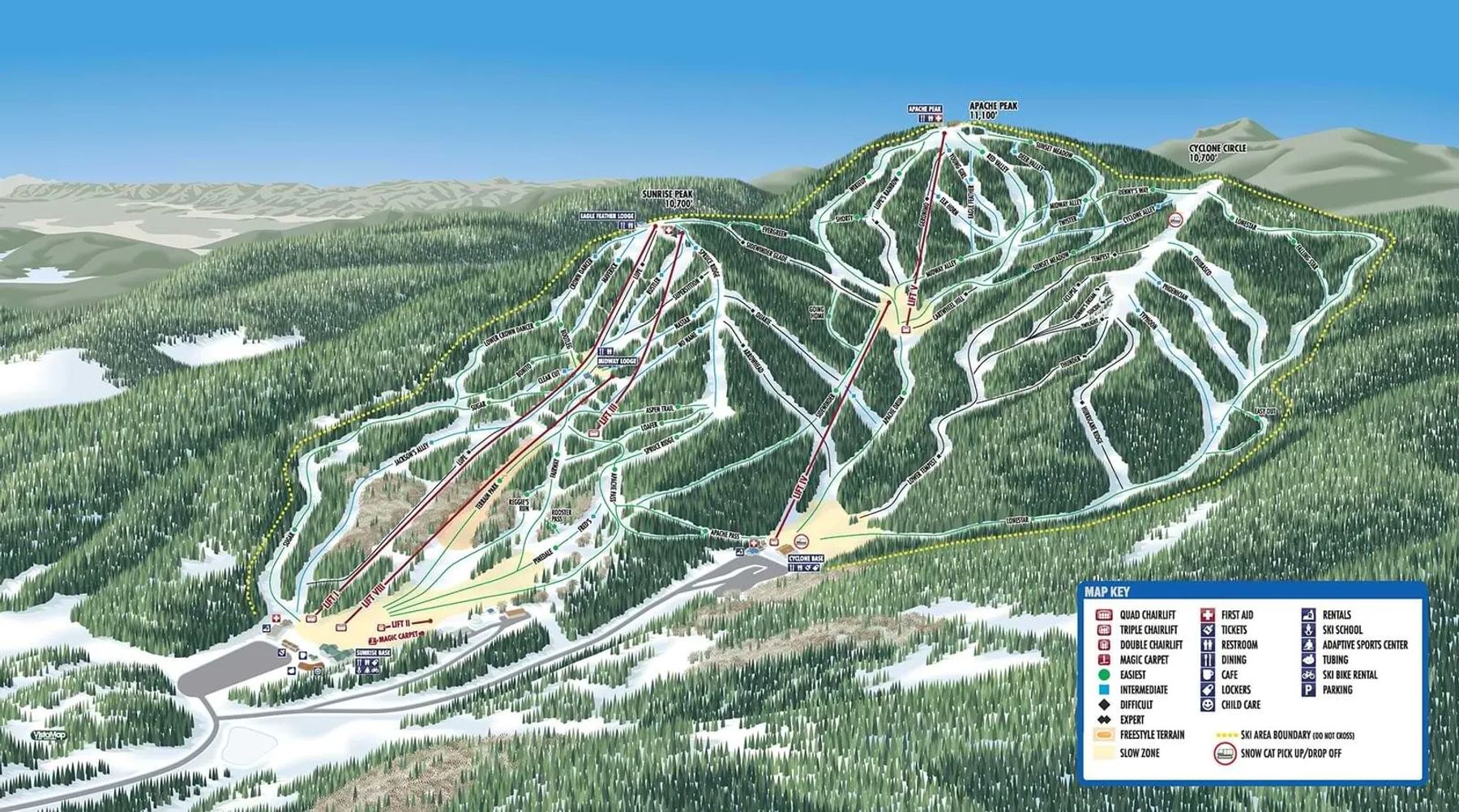
Sunrise Park Ski Trails
Downloadable Sunrise Park trail map
Terrain split
69
runs
Beginner48%
Intermediate28%
Advanced18%
Expert6%
1,200 acres skiable486 hectares
Resort Stats
Elevation
Base9,199ft
Summit11,099ft
Annual snowfall
21ft
Season
2026 - 2027
11 Dec 2026 - 21 Mar 2027
Trail coverage
69 runs
1,200 acres (486 ha)
Sunrise Park ski trails
Sunrise Park offers 69 runs across a mix of difficulties. The terrain split and trail map here show how the mountain breaks down so you can plan a day that suits your group.
- • Match runs to your ability - the terrain split shows how much of Sunrise Park is beginner, intermediate and advanced.
- • Check grooming and open-run status against the live conditions before committing to the upper mountain.
- • Early season and after fresh snow, favour the lifts serving your preferred grade to make the most of the day.
More Sunrise Park intelligence: trail map, lift system, resort overview.