
Mount Rose
Ski Tahoe's highest base elevation at 8,260ft in Nevada. 1,200 acres including The Chutes' 1,500ft vertical — just 25 minutes from Reno.
Season 2026 - 2027
Opens
20 Nov 2026
Closes
18 Apr 2027
Days open
149
Annual snow
29ft
The Overview
Michael Fulton
Melbourne-based skier and snowboarder with 50+ resorts across 5 continents. Specialises in Australian resorts and international resort comparisons.
Mt. Rose holds a clear positional advantage over every other ski area in the Lake Tahoe region: a base elevation of 8,260 feet — the highest in Tahoe — sitting at roughly the same altitude as the summit of several neighbouring resorts. The ski area spreads across 1,200 acres on the slopes of Slide Mountain in the Humboldt-Toiyabe National Forest, with 70 runs from base to a summit of 9,700 feet across a vertical of 1,440 feet.
The terrain profile is weighted toward skilled skiing: 20% beginner, 30% intermediate, 40% advanced and 10% expert, split across three main ski zones — the Rose side, the Slide side and the Winters Creek area — each with distinct character and aspect. The resort opened in 1953 as the Reno Ski Bowl and hosted the inaugural NCAA Skiing Championships in March 1954, establishing its credentials as a serious ski venue from its earliest years.
The defining feature of Mt. Rose is the Chutes — a series of north and east-facing double-black diamond lines delivering 1,500 feet of continuous vertical at gradients between 40 and 55 degrees, with some sections of unbroken steep terrain exceeding 1,000 feet.
The California Ski Industry Association describes the Chutes as offering some of the longest continuous vertical in North America for inbounds extreme terrain, a claim that draws expert skiers specifically for that characteristic. The Chutes access point from Winters Creek Lodge keeps this terrain separated from the main family traffic, and conditions there are frequently better than the groomed frontside — wind loading from storms deposits accumulation into the chute faces, often producing deeper powder in the Chutes than snowfall totals alone would indicate.
1,437ft
Vertical
70
Runs
1,200 acres
Skiable
29ft
Annual snow
The Terrain
70 runs across 1,200 acres skiable
Mount Rose covers 1,200 acres (486 hectares) on the Reno side of the Tahoe Basin, with 70 runs and a vertical of 1,440 ft (438 m). The base is at 8,260 ft (2,518 m), the highest of any Tahoe resort, and the summit reaches 9,700 ft (2,956 m). The split leans steeply: 40% advanced, 30% intermediate, 20% beginner and 10% expert. Two six-packs, two quads and two triples provide uphill capacity, so the high-altitude snow is easy to reach and lift lines tend to stay short.
The Chutes are the big attraction, a north-facing horseshoe of double black lines reached through gates, with long continuous pitches that draw experts after storms. Slide Bowl holds the Blazing Zephyr 6 and the Badlands and DoubleDown terrain parks, while Winters Creek has glade skiing among rock formations and steady lines for advanced skiers. Beginners stay mostly on the main side of the mountain. Mount Rose suits strong intermediates and experts who want serious steeps, high snow quality and an easy drive from Reno, plus families in a separate learning zone.
Terrain split
70
runs
70 runs across 4 grades
Beginner14 runs · 20%
Intermediate21 runs · 30%
Advanced28 runs · 40%
Expert7 runs · 10%
Time it right
When to visit Mount Rose
Mt. Rose operates from early November through to late April, with the 2025/26 season running 8 November to 27 April — one of the longer seasonal windows in the Lake Tahoe region, enabled by the highest base elevation in Tahoe and the predominantly north and east-facing aspects that preserve snow quality well into spring.
The resort averages over 350 inches of annual snowfall, and the elevation at 8,260 feet means the base holds cold temperatures and dry snow conditions on days when lower-elevation Tahoe resorts are dealing with rain or heavy wet snow. The current 2025/26 season has accumulated a base depth of approximately 60 inches with a season total exceeding 170 inches as of early March, reflecting consistent mid-winter snowfall at this elevation. One structural consideration: the exposed ridgeline position means wind holds and wind-affected snow quality are more frequent at Mt. Rose than at more sheltered Tahoe resorts, with the tradeoff that wind-deposited snow in the Chutes often arrives in volume when the frontside terrain has been scoured.
Spring skiing at Mt. Rose is consistently well regarded among Tahoe locals, with the 8,260-foot base holding cold temperatures and firm morning snow well into April when lower-elevation resorts are struggling with soft, variable conditions.
The north-facing Rose side groomers maintain excellent pitch and quality through the spring period, and the Chutes remain accessible and in competitive condition on good weather days through the extended season. The Fly & Ski programme offers discounted lift tickets for visitors presenting a same-day boarding pass from Reno-Tahoe International Airport — a direct acknowledgement of the airport's proximity and the resort's positioning as the obvious first stop for visitors flying into Reno for a Tahoe ski trip.
Season 2026 - 2027
20 Nov 2026
Opens
18 Apr 2027
Closes
149
Days open
29 ft
Annual snow
Getting there
Getting to Mount Rose, and where to stay
Mt. Rose sits on Nevada State Route 431 in the Sierra Nevada, approximately 22 miles south-southwest of Reno and 11 miles from Incline Village on the North Shore of Lake Tahoe. The drive from downtown Reno takes around 25 minutes under normal conditions — making Mt. Rose the closest ski resort to Reno and one of the more directly accessible large ski areas to a major airport in the western United States, with Reno-Tahoe International Airport around 30 minutes from the base lodge.
The same SR-431 highway connects the resort to Incline Village and the North Lake Tahoe shoreline in around 10-15 minutes, giving Mt. Rose an unusual dual catchment: Reno locals who can be on snow within half an hour of leaving home, and Tahoe visitors using the lake's North Shore as a base. The combination produces a visitor mix of Nevada regulars and out-of-state destination skiers that gives the resort a different atmosphere from the California-dominated resorts across the basin.
The resort operates under a Special Use Permit from the US Forest Service within the Humboldt-Toiyabe National Forest, placing it in a distinct administrative jurisdiction from most of the California-side Tahoe ski areas, which operate within the Tahoe National Forest.
The summit viewpoint at 9,700 feet delivers a perspective unavailable from any other Tahoe ski area: to the east, the terrain drops roughly 4,000 feet to the Reno basin and the Nevada high desert beyond, while to the west, Lake Tahoe is visible across the Sierra crest from the upper lifts. Incline Village, 11 miles down SR-431, provides the nearest concentration of lakeside accommodation, restaurants and services for visitors staying overnight in the region rather than commuting from Reno.
Where to stay
Search all stays →Hotels and lodges near Mount Rose, powered by Stay22.
Latest News
From the SnowStash desk
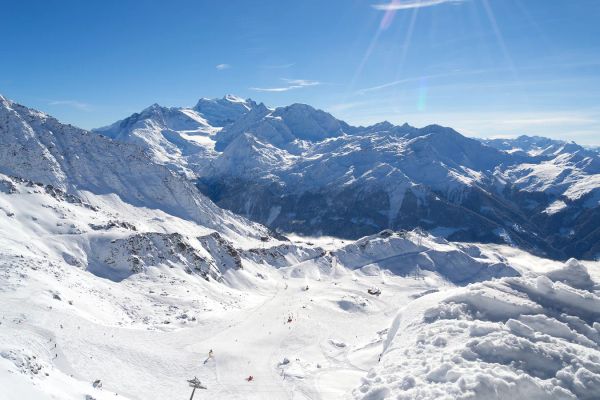
Alps Snow Forecast: Up to 64 cm Headed for the High Glaciers as the Snow Line Drops
The Alps are about to swap mild, sunny October weather for something far more wintry. A cold front arrives Tuesday, and SnowStash forecasts have Monterosa Ski out in front with 64 cm over 14 days, ahead of Blatten Belalp (55 cm) and Verbier (43 cm). The snow line should fall below 2000 metres by Wednesday night, and glaciers across Switzerland, Italy and Austria are in line for the best of it. The wind will have a say too.
20 Oct 2026

Four Dead After Avalanche Near Ski Portillo in Chile
A large avalanche struck near Laguna del Inca adjacent to Ski Portillo on Saturday afternoon, killing four people and injuring four others. The group were day visitors mountaineering in the backcountry after reportedly being warned about elevated avalanche risk by resort staff.
18 Oct 2026

Europe Ski Resorts Open Now: What Is Skiable in Mid-October 2026
Europe’s ski season is open, technically. After a record-warm summer, glaciers in Austria, Switzerland and Italy are running a few pistes apiece, Sölden, Stubai and Kitzsteinhorn started late, Titlis has pushed back to 24 October, and Zermatt reopens a few lifts on 14 October after more than two months shut. Finland’s Levi and Ruka are skiing on stored snow. Here is what is open, and what you actually get at each.
14 Oct 2026

Zermatt Plans World Cup Downhill Return on the Gornergrat for 2028
Zermatt is having another crack at a World Cup downhill, and this time nobody has to cross a border. Around 13 million Swiss francs is going into rebuilding the Gornergrat piste, including a jump fed by a roughly 300-metre in-run across the roof of the Gornergrat Railway gallery, with the Matterhorn lined up behind it for the TV cameras. First men’s race is pencilled in for March 2028, pending FIS homologation.
14 Oct 2026

Mt. Rose Begins Snowmaking for the 2026-27 Season at Lake Tahoe
Lake Tahoe’s highest base elevation is paying off early: Mt. Rose has started making snow for 2026-27 after the first flurries and a cold snap. The Nevada resort is backing it with nearly US$2 million in upgrades, including a replacement snowmaking main line, a new PistenBully groomer and restraint bars on every lift. Opening day is yet to be confirmed, though Heavenly and Northstar are already eyeing 20 November.
13 Oct 2026

Utah Ski Resorts 2026-27: What’s New at Alta, Deer Valley, Powder Mountain and More
Utah is still building flat out. For 2026-27, Powder Mountain opens a steep new Skytrac chair into more than 1,000 acres of advanced terrain, Deer Valley adds 200 acres on Hail Peak, Sundance gets a new quad and Park City adds a gondola from its new parking structure. Snowmaking is expanding almost everywhere, Eagle Point stays closed after the Cottonwood Fire, and the 2034 Games are setting the pace. Here’s what’s new, resort by resort.
13 Oct 2026

Mt Hutt Invests NZ$12 Million in Base Area, Tripling Its Sun Deck
Mt Hutt is getting busier, and its base lodge is about to catch up. NZ$12 million goes into a heated sun deck roughly three times the current size (430 m² to 1,300 m²), plus a new toilet block, heated steps down to snow level, extra storage and a new food and beverage outlet. Building starts after the 2026 season, with everything due for winter 2027.
11 Oct 2026

Vermont Ski Resort Opening Dates 2026-27: Few Dates Set, Killington Waits on the Cold
Vermont's season is slow to take shape. Stratton is tentatively targeting 18 November and Sugarbush 21 November, while Pico has Friday 11 December on the calendar. Killington never sets a date and opens when the snowmaking allows, and Vail Resorts has yet to name days for Stowe, Okemo and Mount Snow. The forecasts disagree about snow, and the main El Niño worry for the Green Mountains is warmth.
9 Oct 2026