
Ski Santa Fe
660 acres, 86 runs above Santa Fe. Independently owned since 1985, high-desert skiing above 10,000 feet.
Season 2026 - 2027
Opens
28 Nov 2026
Closes
4 Apr 2027
Days open
127
Annual snow
19ft
The Overview
Michael Fulton
Melbourne-based skier and snowboarder with 50+ resorts across 5 continents. Specialises in Australian resorts and international resort comparisons.
Ski Santa Fe's summit reaches 12,074 feet, dropping 1,723 vertical feet to a base at 10,351 feet across 86 runs spread over 660 acres in the Sangre de Cristo Mountains, 16 miles from Santa Fe, New Mexico. Terrain splits 47 per cent advanced, 32 per cent intermediate, 16 per cent beginner and 5 per cent expert, with average annual snowfall of roughly 225 inches. The resort remains privately owned and does not participate in the Epic, Ikon or Mountain Collective passes. Eight lifts, including two quad chairs and two triple chairs, serve the mountain alongside two double chairs and two surface lifts.
Ski Santa Fe is among the oldest and highest ski areas in the United States, with a base elevation above 10,000 feet giving it consistently cold, dry snow despite its southern latitude. It is the southernmost major ski resort in the Rocky Mountains, a distinction tied directly to its high-desert New Mexico setting. The resort's independence from the major multi-resort pass networks reflects a deliberate ownership choice rather than a lack of scale.
The area's skiing history began in 1936, when a rope tow powered by a Packard sedan engine, the first of its kind in New Mexico, was installed by retired lawyer and skier Robert Nordhaus at the future site of the resort. In 1949, the Sierras de Santa Fe group founded the Santa Fe Ski Basin and raised funds to build the area's first chairlift, and ski pioneer Ernie Blake helped open the resort in February 1950 before going on to found Taos Ski Valley several years later.
The Abruzzo family has owned Ski Santa Fe since 1985, having inherited the resort from their parents following a fatal plane crash. This continuous family ownership, combined with the resort's decision to remain outside the major pass networks, has kept Ski Santa Fe operating on its own terms relative to New Mexico's other major resorts. Adult daily tickets run from 89 to 109 US dollars.
1,722ft
Vertical
86
Runs
660 acres
Skiable
19ft
Annual snow
The Terrain
86 runs across 660 acres skiable
Ski Santa Fe covers 660 acres (267 hectares) across Tesuque Peak and Lake Peak, with 86 runs in the Sangre de Cristo Mountains. It sits very high: the base is at 10,350 feet and the summit at 12,070 feet (3,680 m), a vertical of 1,720 feet (525 m). Terrain is weighted toward advanced at 47%, with 32% intermediate, 16% beginner and 5% expert. Six chairs and two surface lifts spread skiers around the hill, and snowfall averages roughly 225 inches a year. The altitude matters here, so newcomers to elevation should allow a day to adjust.
From the summit ridge, the bald steeps of North Burn, South Burn and Cornice drop away, with Fall Line, Parachute and Gay Way close by; Parachute holds a consistent intermediate pitch. Avalanche Bowl, Desperado and Double Eagle V add more advanced options, and Tequila Sunrise gives tree skiing among widely spaced trees. Big Tesuque Bowl is an open, gladed area along the south boundary. With nearly half the runs graded advanced, Ski Santa Fe suits confident skiers who want steeper terrain at altitude, while beginners will find a smaller share of easy runs than at most areas.
Terrain split
86
runs
86 runs across 4 grades
Beginner14 runs · 16%
Intermediate28 runs · 32%
Advanced40 runs · 47%
Expert4 runs · 5%
Time it right
When to visit Ski Santa Fe
The 2025-26 season at Ski Santa Fe ran from 13 December 2025 to 22 March 2026, a roughly fourteen-week season. Average annual snowfall of around 225 inches, combined with the resort's high base elevation above 10,000 feet, supports consistently cold, dry conditions well suited to New Mexico's high-desert climate. Season dates can shift depending on early and late-season weather.
Midwinter, from January through February, typically offers the most reliable natural conditions across the resort's advanced-weighted terrain. As an independent resort outside the major pass networks, Ski Santa Fe draws primarily from Santa Fe and the broader northern New Mexico region rather than pass-driven destination traffic. Weekend crowds are generally heavier than weekdays.
The resort's Direct-to-Lift RFID ticketing and weekday discount pricing reflect a locally focused, value-conscious approach to season operations. As one of the oldest ski areas in the country, with roots tracing to 1936, Ski Santa Fe's programming leans toward straightforward, dependable operations rather than large festival-style events. School holiday periods bring increased family visitation.
Specific event programming beyond standard operations is not confirmed in available resort information. Continuous Abruzzo family ownership since 1985 has kept the resort's seasonal priorities focused on serving its Santa Fe-area community directly. The resort's status as the southernmost major Rocky Mountain ski area continues to draw visitors seeking a distinctly high-desert skiing experience.
Season 2026 - 2027
28 Nov 2026
Opens
4 Apr 2027
Closes
127
Days open
19 ft
Annual snow
Getting there
Getting to Ski Santa Fe, and where to stay
Ski Santa Fe sits in the Sangre de Cristo Mountains, 16 miles east of Santa Fe, New Mexico, with a base elevation of 10,351 feet and a summit at 12,074 feet across a 1,723-foot vertical drop over 660 acres. This makes it one of the highest-elevation ski areas in the country, set within New Mexico's high-desert mountain landscape.
Santa Fe itself, the state capital and a major arts and culture destination, provides extensive lodging, dining and services just a short drive from the resort. The historic Santa Fe Plaza and the city's broader cultural attractions give the area a four-season appeal well beyond winter skiing alone. Albuquerque, New Mexico's largest city, lies about an hour to the southwest.
New Mexico State Route 475, known as the Santa Fe Ski Basin Road, connects downtown Santa Fe directly to the resort, climbing steadily into the Sangre de Cristo Mountains over the 16-mile route. Winter driving conditions on this road can include snow and ice at elevation, and the route is well maintained given its role as the resort's sole access point. There is no direct public transport service to the mountain.
Santa Fe Regional Airport offers limited commercial service close to the resort, while Albuquerque International Sunport, roughly an hour away, provides substantially more extensive flight options. This combination of a short drive from historic Santa Fe and reasonable airport access makes Ski Santa Fe a practical stop for visitors combining culture and skiing in a single trip.
Where to stay
Search all stays →Hotels and lodges near Ski Santa Fe, powered by Stay22.
Latest News
From the SnowStash desk
Pinheiro Braathen Wins Sölden Giant Slalom Opener by 0.48 Seconds
Two days at Sölden, two races decided by a hundredth somewhere on the podium, and one very quick Brazilian. Lucas Pinheiro Braathen led from the first run to win the men’s World Cup opener by 0.48 seconds, with Loïc Meillard second and Marco Odermatt third. River Radamus charged from 15th to fourth on a rutted course, and Britain’s Freddy Carrick-Smith banked his first World Cup points. Braathen still hasn’t lost a giant slalom since Olympic gold.
25 Oct 2026

Alps Snow Forecast: Up to 64 cm Headed for the High Glaciers as the Snow Line Drops
The Alps are about to swap mild, sunny October weather for something far more wintry. A cold front arrives Tuesday, and SnowStash forecasts have Monterosa Ski out in front with 64 cm over 14 days, ahead of Blatten Belalp (55 cm) and Verbier (43 cm). The snow line should fall below 2000 metres by Wednesday night, and glaciers across Switzerland, Italy and Austria are in line for the best of it. The wind will have a say too.
20 Oct 2026

Four Dead After Avalanche Near Ski Portillo in Chile
A large avalanche struck near Laguna del Inca adjacent to Ski Portillo on Saturday afternoon, killing four people and injuring four others. The group were day visitors mountaineering in the backcountry after reportedly being warned about elevated avalanche risk by resort staff.
18 Oct 2026

Europe Ski Resorts Open Now: What Is Skiable in Mid-October 2026
Europe’s ski season is open, technically. After a record-warm summer, glaciers in Austria, Switzerland and Italy are running a few pistes apiece, Sölden, Stubai and Kitzsteinhorn started late, Titlis has pushed back to 24 October, and Zermatt reopens a few lifts on 14 October after more than two months shut. Finland’s Levi and Ruka are skiing on stored snow. Here is what is open, and what you actually get at each.
14 Oct 2026

Zermatt Plans World Cup Downhill Return on the Gornergrat for 2028
Zermatt is having another crack at a World Cup downhill, and this time nobody has to cross a border. Around 13 million Swiss francs is going into rebuilding the Gornergrat piste, including a jump fed by a roughly 300-metre in-run across the roof of the Gornergrat Railway gallery, with the Matterhorn lined up behind it for the TV cameras. First men’s race is pencilled in for March 2028, pending FIS homologation.
14 Oct 2026

Mt. Rose Begins Snowmaking for the 2026-27 Season at Lake Tahoe
Lake Tahoe’s highest base elevation is paying off early: Mt. Rose has started making snow for 2026-27 after the first flurries and a cold snap. The Nevada resort is backing it with nearly US$2 million in upgrades, including a replacement snowmaking main line, a new PistenBully groomer and restraint bars on every lift. Opening day is yet to be confirmed, though Heavenly and Northstar are already eyeing 20 November.
13 Oct 2026

Utah Ski Resorts 2026-27: What’s New at Alta, Deer Valley, Powder Mountain and More
Utah is still building flat out. For 2026-27, Powder Mountain opens a steep new Skytrac chair into more than 1,000 acres of advanced terrain, Deer Valley adds 200 acres on Hail Peak, Sundance gets a new quad and Park City adds a gondola from its new parking structure. Snowmaking is expanding almost everywhere, Eagle Point stays closed after the Cottonwood Fire, and the 2034 Games are setting the pace. Here’s what’s new, resort by resort.
13 Oct 2026

Mt Hutt Invests NZ$12 Million in Base Area, Tripling Its Sun Deck
Mt Hutt is getting busier, and its base lodge is about to catch up. NZ$12 million goes into a heated sun deck roughly three times the current size (430 m² to 1,300 m²), plus a new toilet block, heated steps down to snow level, extra storage and a new food and beverage outlet. Building starts after the 2026 season, with everything due for winter 2027.
11 Oct 2026
Ski Santa Fe Trail Map
Downloadable Ski Santa Fe trail map
Terrain split
86
runs
Beginner16%
Intermediate32%
Advanced47%
Expert5%
660 acres skiable267 hectares
Resort Stats
Elevation
Base10,351ft
Summit12,073ft
Annual snowfall
19ft
Season
2026 - 2027
28 Nov 2026 - 4 Apr 2027
Trail coverage
86 runs
660 acres (267 ha)
About Ski Santa Fe's trail map
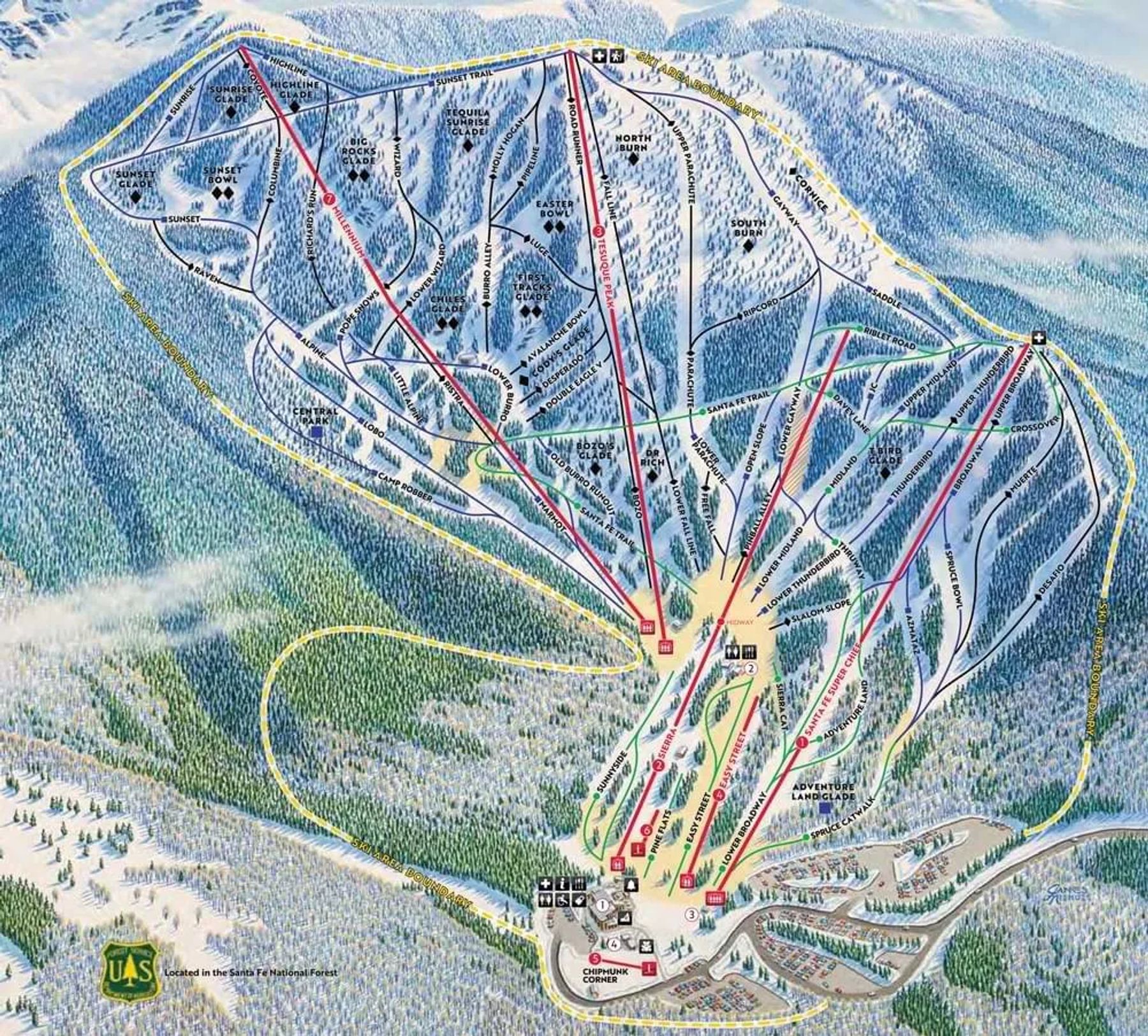
Explore Ski Santa Fe's full trail map with 86 runs across the mountain, colour-coded by difficulty and shown alongside the terrain split. Use it to plan a day that matches your ability, find lift-served pockets of your favourite grade, and see how the resort links together. Download the piste map (PDF) ↗
More Ski Santa Fe intelligence: snow report, lift system, webcams, resort overview.