
The Overview
Michael Fulton
Melbourne-based skier and snowboarder with 50+ resorts across 5 continents. Specialises in Australian resorts and international resort comparisons.
Brighton Resort delivers exceptional skiing and snowboarding across 1,050 acres of diverse terrain at the head of Big Cottonwood Canyon, with elevations ranging from 2,668m base to 3,200m summit. Utah's oldest ski resort combines 66 runs spanning all ability levels with some of the most reliable snowfall in North America, averaging 12.7m annually in one of the snowiest microclimates on the continent. The resort's claim to fame extends beyond daytime operations, offering over 200 acres of illuminated terrain across 32 runs six nights weekly, making Brighton the only Salt Lake area resort with extensive night skiing.
Brighton's authentic, welcoming atmosphere attracts everyone from first-time learners to expert cliff-huckers, earning consistent recognition from locals for best value and family-friendly terrain. The resort's historical significance as the first Utah ski area, established in 1936, blends seamlessly with modern lift infrastructure including the Crest Express, currently Utah's fastest chairlift. Five terrain parks cater to freestyle progression, whilst natural features including bowls, chutes, and extensive tree skiing provide endless exploration opportunities across two main zones.
The resort's straightforward layout and accessible pricing structure keep the focus squarely on quality skiing rather than resort frills. Children aged six and under ski free with paying adults, whilst direct connections to neighbouring Solitude Resort via the SolBright pass expand terrain options for multi-resort adventures in the legendary Cottonwood Canyons.
1,745ft
Vertical
66
Runs
1,050 acres
Skiable
42ft
Annual snow
Ikon
Pass
The Terrain
66 runs across 1,050 acres skiable
Brighton Resort sits at the head of Big Cottonwood Canyon in Utah's Wasatch Range, with 1,050 acres (425 hectares) of terrain and 66 runs. The base is at 8,750 ft (2,668 m) and the summit at 10,500 ft (3,200 m), giving 1,750 ft (532 m) of vertical. The difficulty split is 21% beginner, 39% intermediate, 25% advanced and 15% expert, a rounded spread with a strong intermediate core. Seven lifts serve the mountain, including Crest 6 Express, Utah's fastest chairlift, and three high-speed quads. Brighton also runs one of the largest night skiing programmes in the western United States, with lights over more than 200 acres.
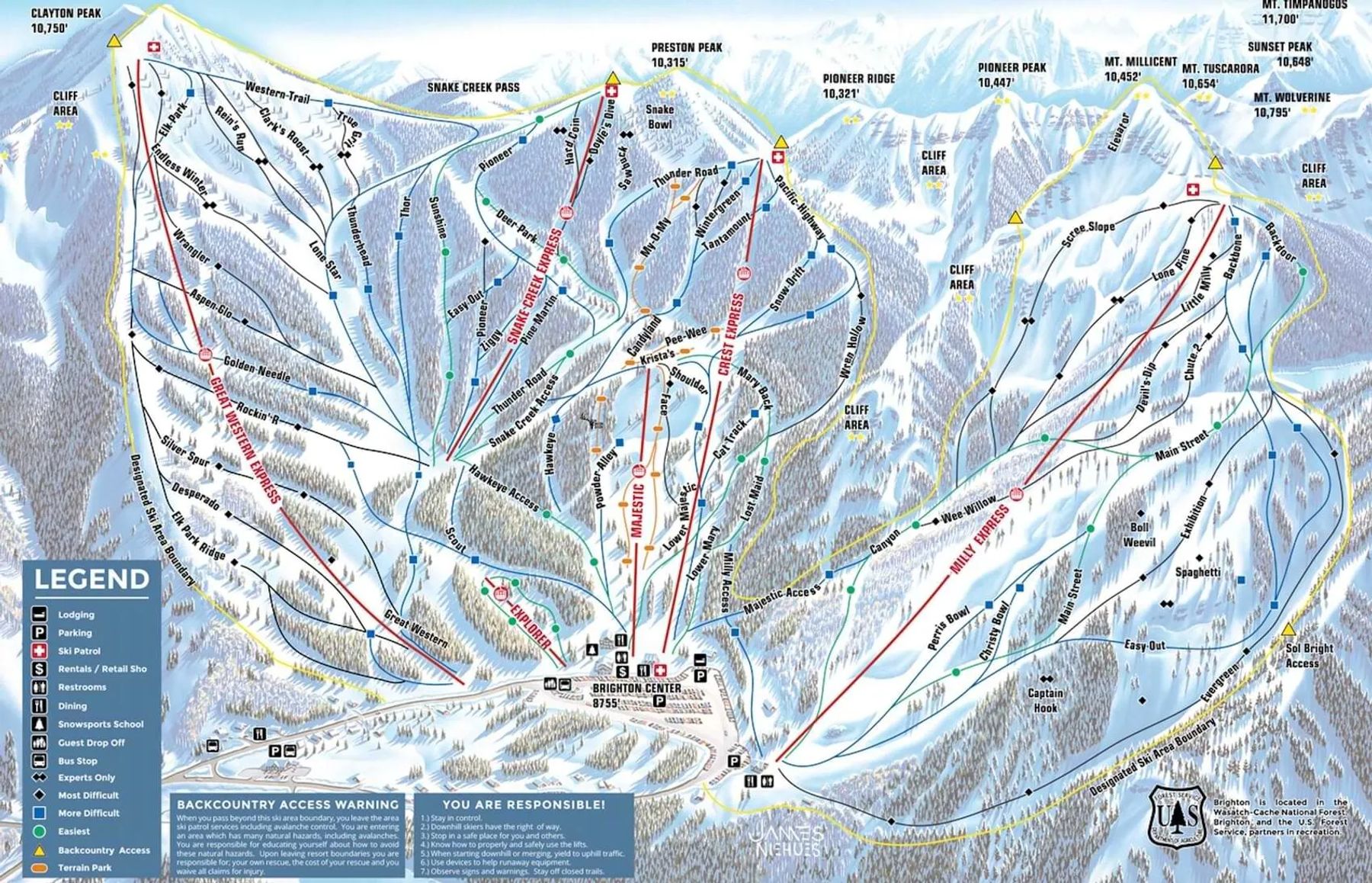
The Majestic and Explorer lifts serve the beginner zones, while the Millicent, Great Western and Snake Creek lifts open progressively harder intermediate and advanced runs, and Crest 6 Express reaches the upper mountain quickly. Night skiing runs from 4pm to 9pm, Monday to Saturday, on four lifts: Explorer, Majestic, Crest Express and Snake Creek Express. That makes Brighton a practical choice for after-work laps as well as full days. Brighton suits families, learners and keen intermediates, plus anyone wanting a session under lights. Neighbouring Solitude shares the SolBright pass, and the SolBright run loops from the top of Summit down to the Sunrise lift to link the two mountains.
Terrain split
66
runs
66 runs across 4 grades
Beginner14 runs · 21%
Intermediate26 runs · 39%
Advanced17 runs · 25%
Expert10 runs · 15%
Time it right
When to visit Brighton
Brighton typically operates from mid-November through mid-April, with the most consistent conditions occurring January through March when the Cottonwood Funnel microclimate delivers its legendary snowfall. The resort's elevated position between 2,668m and 3,200m combined with predominantly north-facing aspects creates exceptional snow preservation throughout the season, often maintaining quality conditions when lower-elevation resorts struggle. The 12.7m average annual snowfall frequently exceeds 500 inches in exceptional years, occasionally surpassing 700 inches during particularly active storm cycles.
Early season openings become possible through the resort's high base elevation and reliable pre-Christmas snowfall, whilst spring skiing extends well into April with excellent corn snow developing on sunny afternoons. The microclimate's position at the head of Big Cottonwood Canyon intercepts westerly storm flow efficiently, with the Wasatch Range forcing moisture-laden air upward where it condenses and deposits exceptionally dry, light powder across Brighton's varied terrain.
Night skiing operations run six nights weekly from mid-December through mid-March, offering extended riding opportunities under lights during the season's core months. The resort's snow quality benefits from Utah's famously low-density powder, creating forgiving conditions for progression whilst delivering the deep, consistent coverage that attracts powder seekers to the Cottonwood Canyons. Clear, sunny days provide spectacular alpine vistas whilst maintaining excellent snow quality on shaded aspects throughout winter.
Season 2026 - 2027
4 Dec 2026
Opens
9 May 2027
Closes
156
Days open
42 ft
Annual snow
Getting there
Getting to Brighton, and where to stay
Located at the top of Big Cottonwood Canyon approximately 58km southeast of downtown Salt Lake City, Brighton sits just 56km from Salt Lake City International Airport with drive times averaging 45-50 minutes under normal conditions. The resort's position in the Wasatch Range places it amongst North America's most accessible alpine skiing destinations, with the scenic Highway 190 canyon approach providing a straightforward route from the Salt Lake valley floor. Brighton's proximity to metropolitan Salt Lake creates convenient access to diverse accommodation options in surrounding communities including Cottonwood Heights, Sandy, and Midvale.
The resort shares Big Cottonwood Canyon with neighbouring Solitude Mountain Resort located just 3km away, with interconnecting terrain and combined SolBright passes allowing skiers to experience both mountains during single visits. This strategic canyon position creates a powder haven where orographic lift generates substantially higher snowfall than the valley below, whilst maintaining remarkably short transfer times from major transport hubs. Free UTA ski bus services connect downtown Salt Lake and park-and-ride facilities directly to the resort throughout winter, providing economical transport alternatives.
Brighton's location within the Wasatch-Cache National Forest surrounds visitors with pristine alpine scenery and direct backcountry access gates for adventurous skiers seeking terrain beyond the resort boundary. The canyon's year-round recreation opportunities extend Brighton's appeal beyond winter months, with lift-assisted mountain biking and disc golf available during summer. Weekend parking reservations become essential during peak periods, though the robust public transport network and carpool options provide practical alternatives to private vehicle access up the canyon.
Where to stay
Search all stays →Hotels and lodges near Brighton, powered by Stay22.
Latest News
From the SnowStash desk

Vermont Ski Resort Opening Dates 2026-27: Few Dates Set, Killington Waits on the Cold
Vermont's season is slow to take shape. Stratton is tentatively targeting 18 November and Sugarbush 21 November, while Pico has Friday 11 December on the calendar. Killington never sets a date and opens when the snowmaking allows, and Vail Resorts has yet to name days for Stowe, Okemo and Mount Snow. The forecasts disagree about snow, and the main El Niño worry for the Green Mountains is warmth.
9 Oct 2026

Crans-Montana 2027 World Championships President Resigns Ahead of Fraud Hearing
Less than four months out from the Crans-Montana 2027 World Championships, the man running the organising committee has stepped down. Claude-Alain Schmidhalter resigned as Swiss-Ski vice president and OC president after being indicted over a business dispute unrelated to skiing. He denies the allegations and faces court on October 27. Interim leaders are in place for the February 1-14 event.
9 Oct 2026

Kelly Canyon, Idaho, Adds Snowmaking, a Bigger Terrain Park and More Parking for 2026-27
Kelly Canyon had a rough 2025-26, and the Idaho resort has spent the summer making sure it doesn’t repeat. Snowmaking now reaches the top of Goldrush, the terrain park is doubling in size with a stereo system, lights and a snack shack, and the car park is getting bigger. Grooming is stepping up too. Target opening is December 4, conditions permitting.
9 Oct 2026

Valle Nevado Extends Season to November 8 After 108 cm in 48 Hours
Winter was meant to be winding down in Chile. Then Valle Nevado took 108 cm in 48 hours in early October, and the resort has pushed its closing date out to November 8 - its latest in 38 years of operation. That makes 143 days of skiing since opening day on June 19, with 690 cm banked for the season. Only part of the mountain is running while the storm settles, so check the mountain report before you plan a trip.
9 Oct 2026

Alps Snow Forecast: Cold Front Brings Thursday Snow to the High Alps
The Alps look a lot more like winter today, for a day or so. A cold front is moving west to east, dropping up to 35 cm on high glaciers and peaks, with snow levels falling to around 1,500-1,800 m at times. Don’t plan a trip around it: mid-elevation snow will be thin and wet, every area is closed bar a limited Sölden glacier opening tomorrow, and warmer weather returns by Monday.
8 Oct 2026

California Ski Resort Opening Dates 2026-27: Mammoth Leads, Tahoe Follows
Mammoth Mountain is first up in California, targeting Friday 13 November after a dusting of September snow. Heavenly and Northstar follow on 20 November, Palisades Tahoe on Wednesday 25 November and Sugar Bowl on 27 November, with Kirkwood on 4 December and June Mountain on 19 December. Plenty of smaller areas have no date yet. A super El Niño favours the Sierra, but a warmer storm track is the catch.
7 Oct 2026

Colorado Ski Resort Opening Dates 2026-27: A-Basin and Keystone Race to Be First
Arapahoe Basin, Keystone and Winter Park are all chasing an October start, though none has a firm date yet. The first dated openers are Breckenridge and Copper on Friday 6 November, then Vail on 13 November, with most of the rest bunched around US Thanksgiving. Hesperus did not open at all last season. A super El Niño offers hope but no guarantee, and forecasters say the southern mountains have the better odds.
5 Oct 2026
Dolomiti Superski 2026-27: Four New Gondolas, New Reservoirs and an €89 Peak Day Pass
Dolomiti Superski is spending around €100 million across its 12 areas before winter. Kronplatz gets a new 10-passenger gondola with a middle station, 3 Zinnen gets Helmissimo, and Val di Fassa swaps a chairlift for a gondola above Col Valvacin. New water-storage basins and upgraded snowmaking follow, and construction has started on the San Martino to Passo Rolle link. A peak adult day pass is €89.
4 Oct 2026
Brighton Trail Map
Downloadable Brighton trail map
Terrain split
66
runs
Beginner21%
Intermediate39%
Advanced25%
Expert15%
1,050 acres skiable425 hectares
Resort Stats
Elevation
Base8,753ft
Summit10,499ft
Annual snowfall
42ft
Season
2026 - 2027
4 Dec 2026 - 9 May 2027
Trail coverage
66 runs
1,050 acres (425 ha)
About Brighton's trail map
Explore Brighton's full trail map with 66 runs across the mountain, colour-coded by difficulty and shown alongside the terrain split. Use it to plan a day that matches your ability, find lift-served pockets of your favourite grade, and see how the resort links together. Download the piste map (PDF) ↗
More Brighton intelligence: snow report, lift system, webcams, resort overview.