
Killington
1,509 acres, 155 runs across six peaks. Eastern North America's largest resort, Ikon Pass, longest season.
Season 2026 - 2027
Opens
11 Nov 2026
Closes
24 May 2027
Days open
194
Annual snow
21ft
The Overview
Michael Fulton
Melbourne-based skier and snowboarder with 50+ resorts across 5 continents. Specialises in Australian resorts and international resort comparisons.
Killington's summit reaches 4,241 feet, dropping roughly 3,080 vertical feet to a base at 1,165 feet across 155 runs spread over 1,509 acres near Killington, Vermont. Terrain splits 40 per cent intermediate, 28 per cent advanced, 17 per cent beginner and 15 per cent expert, with average annual snowfall of roughly 250 inches. The resort carries Ikon Pass affiliation. Twenty-one lifts, including ten quad chairs and three gondolas, serve the mountain alongside one double chair, one six-person chair, two triple chairs, three surface lifts and one t-bar.
Killington holds the title of the largest ski resort in Eastern North America, spread across six connected peaks, and markets the longest ski season in the East, a combination that has earned it the enduring nickname the Beast of the East. This considerable scale, paired with a long tradition of skiing innovation, has made Killington one of the most significant resorts in Northeast skiing.
In 1954, 24-year-old ski enthusiast Preston Leete Smith approached Vermont state forester Perry Merrill about leasing state land on Killington Peak to develop what he called Killington Basin. Smith spent nearly four years amassing investor funding, eventually forming the Sherburne Corporation and raising 127,500 US dollars through stock sales at 250 US dollars a share, and Killington opened on 13 December 1958. Under Smith's leadership, the resort pioneered numerous industry innovations, including the ticket wicket, extending the season to six months by opening earlier and closing later, novice terrain served by chairlifts, and early snowmaking installations during the 1960s.
In 1984, the Sherburne Corporation restructured as S-K-I Limited, which also owned Sunday River in Maine and Mount Snow in Vermont, before Les Otten's American Skiing Company took over and listed on the New York Stock Exchange in 1997. Financial difficulties led Killington to become privately owned under Powdr Corp in 2007, and in August 2024 a group of local investors, including Killington homeowners Phill Gross and Michael Ferri, acquired controlling interest in Killington and neighbouring Pico Mountain from Powdr. Adult daily tickets run from 129 to 219 US dollars.
3,077ft
Vertical
155
Runs
1,509 acres
Skiable
21ft
Annual snow
Ikon
Pass
The Terrain
155 runs across 1,509 acres skiable
Killington covers 155 runs over 1,509 acres (611 hectares) across six peaks, rising from a base at 1,160 ft (355 m) to 4,240 ft (1,293 m) at the top, a vertical of 3,080 ft (938 m). The terrain leans intermediate at 40% blue square, with 28% black diamond, 17% green circle and 15% expert. About 250 inches of snow falls in a typical year. Three gondolas, ten quad chairs, a six-pack, two triples, a double, three surface lifts and a T-bar link Killington Peak, Skye Peak, Bear Mountain, Snowdon, Ramshead and Sunrise.
Bear Mountain holds the toughest skiing. Outer Limits is a steep mogul pitch averaging more than 29 degrees, and Devil's Fiddle is known for its cliff and corkscrew sections. Easier routes such as Bear Cub and Bear Trax lead back toward the Bear Mountain base. Superstar is a long trail whose natural snow pile keeps the season running into late May or June in good years. Terrain parks add freestyle options. Killington suits groups with mixed abilities, mogul skiers and anyone chasing early or late season turns in the East.
Terrain split
155
runs
155 runs across 4 grades
Beginner26 runs · 17%
Intermediate62 runs · 40%
Advanced43 runs · 28%
Expert23 runs · 15%
Time it right
When to visit Killington
The 2025-26 season at Killington ran from 22 November 2025 to 17 May 2026, an exceptionally long roughly twenty-six-week season, the longest in the East, supported by average annual snowfall of around 250 inches and extensive snowmaking across the resort's six peaks. This marketed longest season reflects decades of deliberate early-opening and late-closing strategy dating to founder Preston Smith's era.
Midwinter, from December through February, typically brings the most consistent conditions across Killington's considerable 1,509 acres. As an Ikon Pass resort, Killington draws substantial visitation from Ikon Pass holders alongside its traditional Northeast visitor base, supported by the resort's status as the largest in Eastern North America.
Killington's considerable scale supports strong visitor capacity during peak weekend and holiday periods, with terrain and lift infrastructure spread across six peaks to help manage crowds. School holiday periods bring substantial family visitation given the resort's varied terrain and legendary nightlife and entertainment options in the surrounding area. The resort has also hosted Women's World Cup ski racing.
Specific event programming beyond standard operations and World Cup racing is not confirmed in available resort information. Following the August 2024 acquisition by local investors from Powdr Corp, Killington continues building on nearly seven decades of history since Preston Smith's 1958 founding. The Beast of the East's considerable scale and marathon season remain central to its seasonal identity.
Season 2026 - 2027
11 Nov 2026
Opens
24 May 2027
Closes
194
Days open
21 ft
Annual snow
Getting there
Getting to Killington, and where to stay
Killington sits near Killington, Vermont, with a base elevation of 1,165 feet and a summit at 4,241 feet across a roughly 3,080-foot vertical drop over 1,509 acres spread across six connected peaks. This central Vermont setting places the resort within one of the most significant ski destinations in the Northeast.
The town of Killington and nearby Rutland offer extensive lodging, dining and nightlife within a short drive of the resort, giving Killington a genuine destination-resort character supported by its considerable scale. The broader Green Mountains region surrounds the resort with additional outdoor recreation across all seasons.
US Route 4 provides direct access to the resort from both the east and west, connecting to the broader Vermont and New England highway network. Winter driving conditions on this route can include snow and ice, though the well-travelled road is regularly maintained given Killington's status as a major regional destination. There is no direct public transport service to the mountain.
Rutland-Southern Vermont Regional Airport, within a reasonable drive, offers limited commercial service, while Burlington International Airport and airports in the greater Boston area serve as the primary gateways for visitors flying in from further afield.
Where to stay
Search all stays →Hotels and lodges near Killington, powered by Stay22.
Latest News
From the SnowStash desk

Alps Snow Forecast: Up to 64 cm Headed for the High Glaciers as the Snow Line Drops
The Alps are about to swap mild, sunny October weather for something far more wintry. A cold front arrives Tuesday, and SnowStash forecasts have Monterosa Ski out in front with 64 cm over 14 days, ahead of Blatten Belalp (55 cm) and Verbier (43 cm). The snow line should fall below 2000 metres by Wednesday night, and glaciers across Switzerland, Italy and Austria are in line for the best of it. The wind will have a say too.
20 Oct 2026

Four Dead After Avalanche Near Ski Portillo in Chile
A large avalanche struck near Laguna del Inca adjacent to Ski Portillo on Saturday afternoon, killing four people and injuring four others. The group were day visitors mountaineering in the backcountry after reportedly being warned about elevated avalanche risk by resort staff.
18 Oct 2026

Europe Ski Resorts Open Now: What Is Skiable in Mid-October 2026
Europe’s ski season is open, technically. After a record-warm summer, glaciers in Austria, Switzerland and Italy are running a few pistes apiece, Sölden, Stubai and Kitzsteinhorn started late, Titlis has pushed back to 24 October, and Zermatt reopens a few lifts on 14 October after more than two months shut. Finland’s Levi and Ruka are skiing on stored snow. Here is what is open, and what you actually get at each.
14 Oct 2026

Zermatt Plans World Cup Downhill Return on the Gornergrat for 2028
Zermatt is having another crack at a World Cup downhill, and this time nobody has to cross a border. Around 13 million Swiss francs is going into rebuilding the Gornergrat piste, including a jump fed by a roughly 300-metre in-run across the roof of the Gornergrat Railway gallery, with the Matterhorn lined up behind it for the TV cameras. First men’s race is pencilled in for March 2028, pending FIS homologation.
14 Oct 2026

Mt. Rose Begins Snowmaking for the 2026-27 Season at Lake Tahoe
Lake Tahoe’s highest base elevation is paying off early: Mt. Rose has started making snow for 2026-27 after the first flurries and a cold snap. The Nevada resort is backing it with nearly US$2 million in upgrades, including a replacement snowmaking main line, a new PistenBully groomer and restraint bars on every lift. Opening day is yet to be confirmed, though Heavenly and Northstar are already eyeing 20 November.
13 Oct 2026

Utah Ski Resorts 2026-27: What’s New at Alta, Deer Valley, Powder Mountain and More
Utah is still building flat out. For 2026-27, Powder Mountain opens a steep new Skytrac chair into more than 1,000 acres of advanced terrain, Deer Valley adds 200 acres on Hail Peak, Sundance gets a new quad and Park City adds a gondola from its new parking structure. Snowmaking is expanding almost everywhere, Eagle Point stays closed after the Cottonwood Fire, and the 2034 Games are setting the pace. Here’s what’s new, resort by resort.
13 Oct 2026

Mt Hutt Invests NZ$12 Million in Base Area, Tripling Its Sun Deck
Mt Hutt is getting busier, and its base lodge is about to catch up. NZ$12 million goes into a heated sun deck roughly three times the current size (430 m² to 1,300 m²), plus a new toilet block, heated steps down to snow level, extra storage and a new food and beverage outlet. Building starts after the 2026 season, with everything due for winter 2027.
11 Oct 2026

Vermont Ski Resort Opening Dates 2026-27: Few Dates Set, Killington Waits on the Cold
Vermont's season is slow to take shape. Stratton is tentatively targeting 18 November and Sugarbush 21 November, while Pico has Friday 11 December on the calendar. Killington never sets a date and opens when the snowmaking allows, and Vail Resorts has yet to name days for Stowe, Okemo and Mount Snow. The forecasts disagree about snow, and the main El Niño worry for the Green Mountains is warmth.
9 Oct 2026
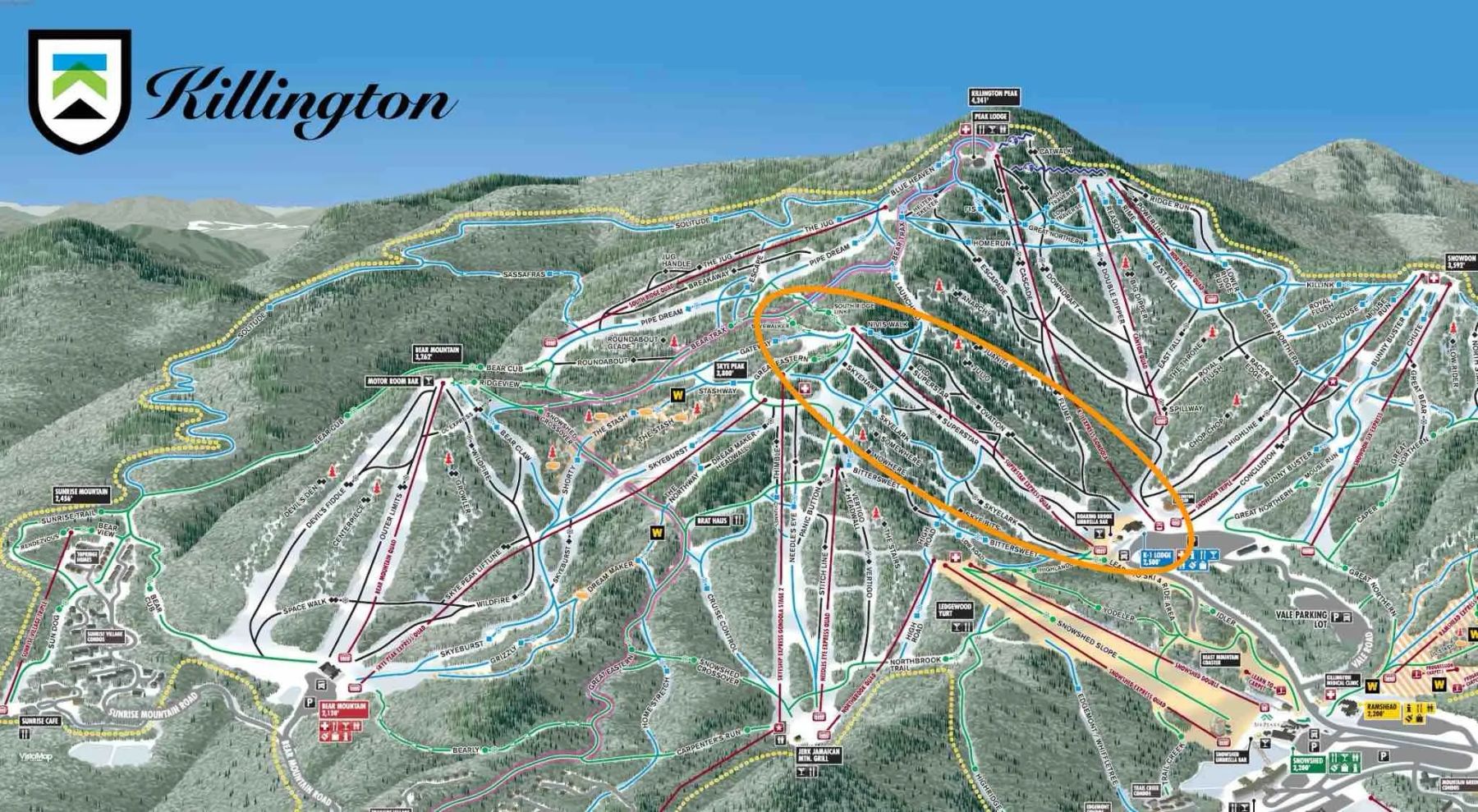
Killington Trail Map
Downloadable Killington trail map
Terrain split
155
runs
Beginner17%
Intermediate40%
Advanced28%
Expert15%
1,509 acres skiable611 hectares
Resort Stats
Elevation
Base1,165ft
Summit4,242ft
Annual snowfall
21ft
Season
2026 - 2027
11 Nov 2026 - 24 May 2027
Trail coverage
155 runs
1,509 acres (611 ha)
About Killington's trail map
Explore Killington's full trail map with 155 runs across the mountain, colour-coded by difficulty and shown alongside the terrain split. Use it to plan a day that matches your ability, find lift-served pockets of your favourite grade, and see how the resort links together. Download the piste map (PDF) ↗
More Killington intelligence: snow report, lift system, webcams, resort overview.