
Antelope Butte
28 runs across 250 acres in Wyoming's Bighorn Mountains. Nonprofit, Indy Pass-affiliated, 59 miles from Sheridan.
Season 2025 - 2026
Opens
20 Dec 2025
Closes
29 Mar 2026
Days open
99
Annual snow
200in
The Overview
Michael Fulton
Melbourne-based skier and snowboarder with 50+ resorts across 5 continents. Specialises in Australian resorts and international resort comparisons.
Antelope Butte's summit reaches 9,398 feet, dropping 1,000 vertical feet to a base at 8,399 feet across 28 runs spread over roughly 250 acres in the Bighorn National Forest. Terrain splits 18 per cent beginner, 25 per cent intermediate and 57 per cent advanced, with no expert-rated runs. The resort operates on Indy Pass, giving pass holders access to Wyoming's Bighorn Mountains without the crowds found at larger Rocky Mountain resorts. Annual snowfall averages roughly 200 inches, drawing on the range's high-elevation snowbelt.
Two double chairlifts and a single surface lift give access across the mountain's 28 runs, with the surface lift dedicated to lower-mountain beginner terrain. Advanced skiers account for 57 per cent of the trail count, against 25 per cent intermediate and 18 per cent beginner. That split makes Antelope Butte better suited to skiers already comfortable on steeper pitches than to first-timers, despite marketing that frames it as a family learning hill. The terrain covers roughly 250 acres within the Bighorn National Forest boundary.
Antelope Butte operates as a nonprofit, run by the Antelope Butte Foundation after the ski area sat closed from 2004 until volunteer restoration returned lifts to operation for the 2019-20 season. There is no on-site village; skiers arrive by car and the base area centres on a single lodge building. Lift queues are minimal given the area's small scale and remote Bighorn Mountains setting, roughly an hour's drive from the nearest town. The adjoining Nordic ski area adds five miles of groomed cross-country trail.
Indy Pass holders get two lift-ticket days at Antelope Butte per season, alongside access to other independent areas across North America under the same pass. A 2025/26 season pass cost 399 US dollars, with single adult day tickets at 50 dollars regular and 60 dollars on peak days. The resort suits skiers seeking an uncrowded, advanced-leaning mountain over a polished resort experience, given the absence of on-site lodging or commercial village infrastructure. Its nonprofit structure keeps prices well below those of larger Rocky Mountain resorts nearby.
1,001ft
Vertical
28
Runs
500 acres
Skiable
200in
Annual snow
Indy
Pass
The Terrain
28 runs across 500 acres skiable
Antelope Butte is a small, nonprofit-run ski area in the Bighorn National Forest, with about 500 acres (202 hectares) of terrain on Sanity's figures. The mountain rises from 8,400 ft (2,560 m) at the base to 9,400 ft (2,865 m) at the summit, a vertical of 1,000 ft (305 m). The 28 runs lean steep for the scale: 57% are advanced, 25% intermediate and 18% beginner, with no expert-rated terrain. Two double chairs and a surface lift handle all the uphill work, so the layout is simple to read and lift lines stay short. Expect an old-school, uncrowded Wyoming day rather than a resort village.
The gentler end of the mountain has beginner runs named Ho Ho Ha, Enchanted Forest and Happy Trails, which suit learners and families, while the upper chairs serve the steeper pitches that make up most of the trail count. The area also welcomes snowboarders, telemark skiers and backcountry travellers, and an adjoining Nordic network adds five miles of groomed cross-country track. Antelope Butte suits confident intermediates and advanced skiers after quiet terrain off US-14, along with beginners who want a low-key place to learn. Bring a packed lunch, because facilities are modest and the real attraction is space.
Terrain split
28
runs
28 runs across 4 grades
Beginner5 runs · 18%
Intermediate7 runs · 25%
Advanced16 runs · 57%
Expert0 runs · 0%
Time it right
When to visit Antelope Butte
The 2025-26 season at Antelope Butte ran from 20 December 2025 through 29 March 2026, a roughly fourteen-week window typical for this elevation band in the Bighorn Mountains. Dates shift year to year based on snowpack and the nonprofit foundation's staffing and grooming capacity. The mountain operates strictly as a winter destination during this window, alongside its separate Nordic ski trail system. Closing in late March means the season ends before many larger Rocky Mountain resorts, which often run into April.
Average annual snowfall at Antelope Butte runs to roughly 200 inches, reflecting the high-elevation snowbelt position of the Bighorn range between 8,399 and 9,398 feet. Base depth and season totals are tracked through the resort's own snow reporting rather than a regional avalanche centre feed. Snowmaking coverage is not documented for this area, leaving conditions more dependent on natural snowfall than at larger, investment-backed resorts. That natural dependency makes early and late-season depth more variable than at snowmaking-heavy competitors.
Mid-winter, from January through February, offers the most reliable base depth once early-season snowpack has built up across the terrain. Powder conditions favour storm-cycle timing given the reliance on natural snowfall rather than manufactured cover. Late-season visits in March can be inconsistent, with the area's 29 March close date reflecting typical spring snowpack decline at this elevation. Weekday visits year-round tend to be quieter than weekends, given the area's role as a regional rather than destination resort.
Antelope Butte does not operate night skiing, consistent with its scale and volunteer-supported operating model. The adjoining Nordic ski area, part of the Bighorn National Forest's winter sports programme, runs its own five-mile groomed trail season alongside the alpine lifts through the same window. As a nonprofit community resource rebuilt by volunteer labour after 2016, the mountain's calendar centres on keeping lifts running reliably through winter rather than hosting festivals or competitions. The Foundation relies on member and donor support to fund each season's operation.
Season 2025 - 2026
20 Dec 2025
Opens
29 Mar 2026
Closes
99
Days open
200 in
Annual snow
The record
Historical snowfall at Antelope Butte
Daily snow reports at Antelope Butte go back to 2025, 2 winters on the books. Open the record to compare winters, lifts and piste.
6 in
Snowiest day
8 Jan 2026
0 in
This winter · 2026-27
so far
14 in
Typical winter
average of complete seasons
Winter totals
in
Past wintersThis winter
Getting there
Getting to Antelope Butte, and where to stay
Antelope Butte sits inside the Bighorn National Forest in north-central Wyoming, with a base elevation of 8,399 feet in the Bighorn Mountains' northern range. The resort lies on the west side of the range along the US-14 corridor. Summit elevation reaches 9,398 feet, giving the ski area a 1,000-foot vertical drop within national forest land. The surrounding terrain is undeveloped forest and alpine ridge rather than a built-up resort village.
Sheridan, Wyoming, lies 59 miles east of the resort via US-14, the nearest town of meaningful size and home to the Antelope Butte Foundation's offices. Greybull sits roughly 28 miles away on the range's western side, providing a closer but smaller service town. Both towns supply the lodging and groceries that the resort itself does not, given the absence of an on-site village. The wider Bighorn Basin region carries a ranching and small-town character rather than a ski-town identity.
US Highway 14, known through this stretch as the Bighorn Scenic Byway, provides the only paved access route to Antelope Butte. The drive from Sheridan takes roughly 75 minutes, climbing through switchbacks typical of the byway's mountain crossing. Winter driving conditions on US-14 can include snowpack and ice, standard for a high-elevation forest highway in this range. No public transport service runs to the resort, making a car the only practical way to arrive.
Sheridan County Airport (SHR) is the nearest airport, roughly 66 miles from the resort and served by nonstop flights to Denver. Billings Logan International Airport in Montana offers a wider range of connections and sits within driving range for visitors flying from further afield. No rail service reaches this part of the Bighorn Basin, and no scheduled bus or shuttle connects Sheridan to the resort. Visitors typically rent a car in Sheridan or Billings for the final leg to Antelope Butte.
Where to stay
Search all stays →Hotels and lodges near Antelope Butte, powered by Stay22.
Latest News
From the SnowStash desk
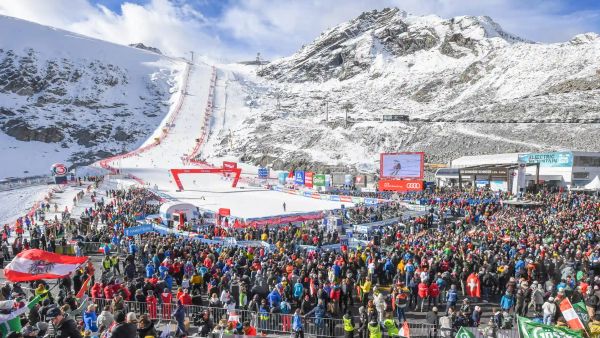
Pinheiro Braathen Wins Sölden Giant Slalom Opener by 0.48 Seconds
Two days at Sölden, two races decided by a hundredth somewhere on the podium, and one very quick Brazilian. Lucas Pinheiro Braathen led from the first run to win the men’s World Cup opener by 0.48 seconds, with Loïc Meillard second and Marco Odermatt third. River Radamus charged from 15th to fourth on a rutted course, and Britain’s Freddy Carrick-Smith banked his first World Cup points. Braathen still hasn’t lost a giant slalom since Olympic gold.
25 Oct 2026

Alps Snow Forecast: Up to 64 cm Headed for the High Glaciers as the Snow Line Drops
The Alps are about to swap mild, sunny October weather for something far more wintry. A cold front arrives Tuesday, and SnowStash forecasts have Monterosa Ski out in front with 64 cm over 14 days, ahead of Blatten Belalp (55 cm) and Verbier (43 cm). The snow line should fall below 2000 metres by Wednesday night, and glaciers across Switzerland, Italy and Austria are in line for the best of it. The wind will have a say too.
20 Oct 2026

Four Dead After Avalanche Near Ski Portillo in Chile
A large avalanche struck near Laguna del Inca adjacent to Ski Portillo on Saturday afternoon, killing four people and injuring four others. The group were day visitors mountaineering in the backcountry after reportedly being warned about elevated avalanche risk by resort staff.
18 Oct 2026

Europe Ski Resorts Open Now: What Is Skiable in Mid-October 2026
Europe’s ski season is open, technically. After a record-warm summer, glaciers in Austria, Switzerland and Italy are running a few pistes apiece, Sölden, Stubai and Kitzsteinhorn started late, Titlis has pushed back to 24 October, and Zermatt reopens a few lifts on 14 October after more than two months shut. Finland’s Levi and Ruka are skiing on stored snow. Here is what is open, and what you actually get at each.
14 Oct 2026

Zermatt Plans World Cup Downhill Return on the Gornergrat for 2028
Zermatt is having another crack at a World Cup downhill, and this time nobody has to cross a border. Around 13 million Swiss francs is going into rebuilding the Gornergrat piste, including a jump fed by a roughly 300-metre in-run across the roof of the Gornergrat Railway gallery, with the Matterhorn lined up behind it for the TV cameras. First men’s race is pencilled in for March 2028, pending FIS homologation.
14 Oct 2026

Mt. Rose Begins Snowmaking for the 2026-27 Season at Lake Tahoe
Lake Tahoe’s highest base elevation is paying off early: Mt. Rose has started making snow for 2026-27 after the first flurries and a cold snap. The Nevada resort is backing it with nearly US$2 million in upgrades, including a replacement snowmaking main line, a new PistenBully groomer and restraint bars on every lift. Opening day is yet to be confirmed, though Heavenly and Northstar are already eyeing 20 November.
13 Oct 2026

Utah Ski Resorts 2026-27: What’s New at Alta, Deer Valley, Powder Mountain and More
Utah is still building flat out. For 2026-27, Powder Mountain opens a steep new Skytrac chair into more than 1,000 acres of advanced terrain, Deer Valley adds 200 acres on Hail Peak, Sundance gets a new quad and Park City adds a gondola from its new parking structure. Snowmaking is expanding almost everywhere, Eagle Point stays closed after the Cottonwood Fire, and the 2034 Games are setting the pace. Here’s what’s new, resort by resort.
13 Oct 2026

Mt Hutt Invests NZ$12 Million in Base Area, Tripling Its Sun Deck
Mt Hutt is getting busier, and its base lodge is about to catch up. NZ$12 million goes into a heated sun deck roughly three times the current size (430 m² to 1,300 m²), plus a new toilet block, heated steps down to snow level, extra storage and a new food and beverage outlet. Building starts after the 2026 season, with everything due for winter 2027.
11 Oct 2026
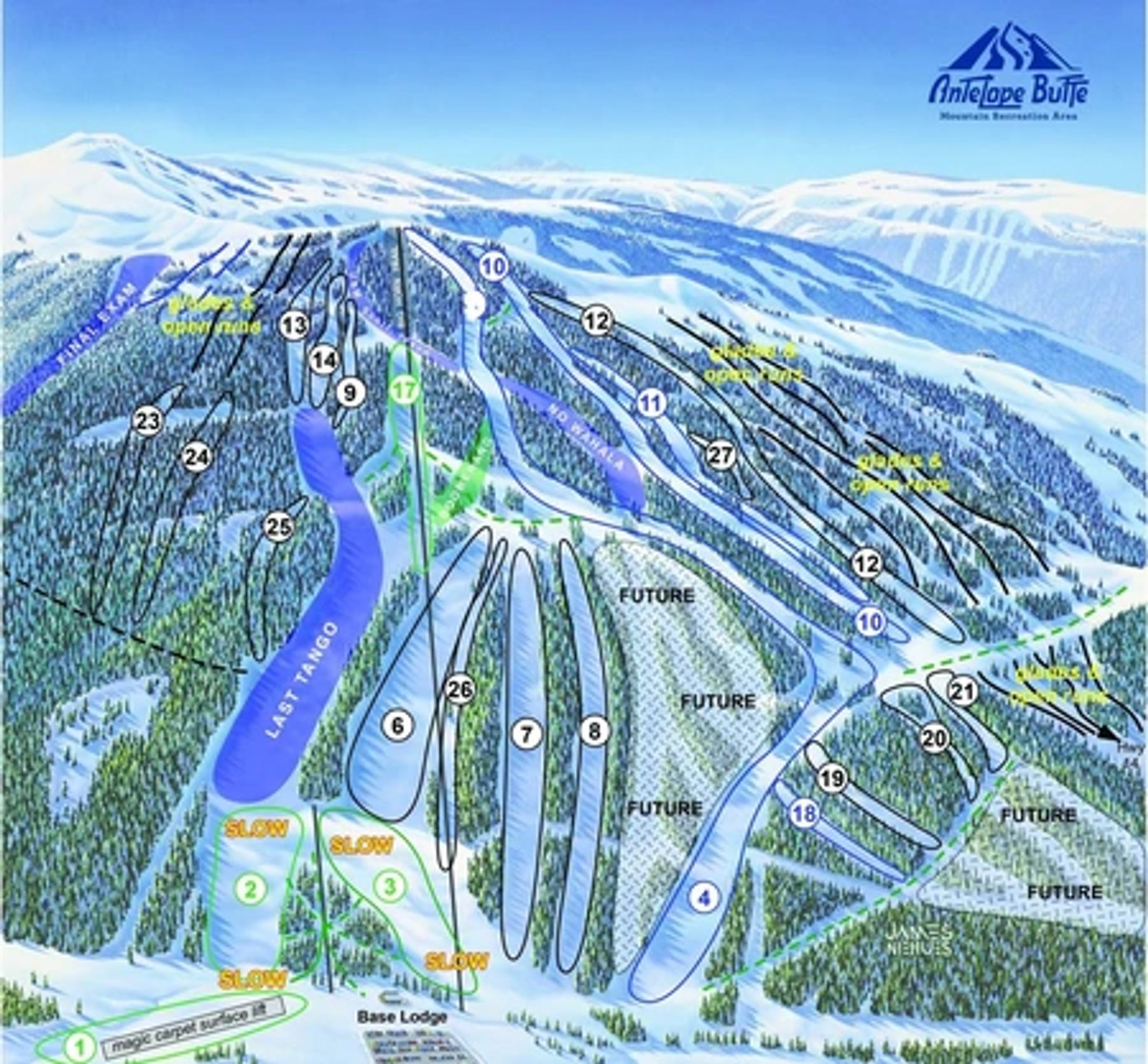
Antelope Butte Trail Map
Downloadable Antelope Butte trail map
Terrain split
28
runs
Beginner18%
Intermediate25%
Advanced57%
Expert0%
500 acres skiable202 hectares
Resort Stats
Elevation
Base8,399ft
Summit9,400ft
Annual snowfall
200in
Season
2025 - 2026
20 Dec 2025 - 29 Mar 2026
Trail coverage
28 runs
500 acres (202 ha)
About Antelope Butte's trail map
Explore Antelope Butte's full trail map with 28 runs across the mountain, colour-coded by difficulty and shown alongside the terrain split. Use it to plan a day that matches your ability, find lift-served pockets of your favourite grade, and see how the resort links together. Download the piste map (PDF) ↗
More Antelope Butte intelligence: snow report, lift system, webcams, resort overview.