
Awakino
Awakino: 430m vertical, 3 rope tows, 60% advanced terrain. NZ$60 day pass. Volunteer-run club field in Canterbury's St Marys Range.
Season 2026
Opens
4 July 2026
Closes
27 Sept 2026
Days open
85
Annual snow
3m
The Overview
Michael Fulton
Melbourne-based skier and snowboarder with 50+ resorts across 5 continents. Specialises in Australian resorts and international resort comparisons.
Awakino operates between 1,450 and 1,880 metres elevation across 100 hectares of skiable terrain in the St Marys Range. The field offers 22 runs with 430 metres of vertical drop, distributed as 10% beginner, 30% intermediate and 60% advanced terrain across 5 kilometres of slopes. Run by the Waitaki Ski Club since the late 1940s, the field receives approximately 2.5 metres of annual snowfall, with easterly exposure sheltering it from prevailing westerly systems whilst capturing southerly dumps. Adult day passes cost NZ$60, amongst the lowest in New Zealand.
Glacier Basin forms the advanced skiing heart of the field, featuring steep gullies and rock towers accessed from the ridge tows. Named runs include Arthur's Run and the old access tow gully, which provide ski access to the lodge below the main field. Intermediate terrain spreads across varied aspects, whilst learner slopes occupy the gentler base area serviced by a dedicated 70-metre rope tow. The north-facing valley orientation provides multiple aspects within a compact area, allowing riders to find variable snow conditions across a single session.
This volunteer-operated club field typically sees fewer than 20 skiers on a busy day, operating weekends and select long weekends from July through October. The historic 40-bunk lodge sits at 1,100 metres on the access road, 300 metres below base facilities, featuring coal burners, generated electricity, hot showers and an outdoor spa. No mobile coverage reaches the lodge. The 1980s Kassbohrer groomer fires up occasionally, but most terrain remains ungroomed. A WWII Nissan hangar serves as the base building, with a functioning red telephone box nearby.
Awakino operates independently without pass affiliations, requiring direct booking through the Waitaki Ski Club. Extensive ski touring extends onto the surrounding St Marys Range, with Te Kohurau peak at 2,010 metres accessible via skins or snowmobile for NZ$10 vehicle access. The field suits intermediate to advanced riders seeking uncrowded powder, backcountry access and authentic club skiing, though weekend-only operations and volunteer staffing demand flexible planning. Members contribute work hours in exchange for skiing access, maintaining the field's no-budget, self-reliant ethos established over seven decades.
430m
Vertical
22
Runs
124 acres
Skiable
3m
Annual snow
The Terrain
22 runs across 124 acres skiable
Awakino is a volunteer-run club field high in the St Marys Range of North Otago, covering about 50 hectares of open, easterly-facing slopes. Skiing drops 430 metres, from 1,880 to 1,450 metres, across 22 runs, and Sanity lists 10% beginner, 30% intermediate and 60% advanced. That weighting suits confident skiers, though the compact size keeps everything within reach. Three rope tows do the lifting, with a learner tow for first turns. The field opens on selected weekends rather than daily, and the last stretch of access road needs four-wheel drive or a ride from the lower car park.
The main tow and ridge tow feed Glacier Basin and the steeper gullies and rocky pockets above it, while mellower slopes spread around the base. Two side gullies, Arthurs Run and the old access tow gully, let skiers glide back toward the lodge on good snow. Beyond the ropes, ski touring climbs toward Te Kohurau on the surrounding range. Facilities are deliberately minimal, and crowds are tiny. Awakino suits self-reliant intermediate and advanced skiers who enjoy rope tows, quiet slopes and a genuine club atmosphere, and who will plan around its limited operating days.
Terrain split
22
runs
22 runs across 4 grades
Beginner2 runs · 10%
Intermediate7 runs · 30%
Advanced13 runs · 60%
Expert0 runs · 0%
Time it right
When to visit Awakino
The 2026 season operates from 4 July through 27 September, with the field typically open most weekends when snow conditions and volunteer availability align. Total season length spans approximately 12 weeks, though midweek and long weekend openings occur when conditions permit and advance bookings justify operations. The volunteer-run model means operational dates respond to group bookings rather than fixed daily schedules, requiring advance coordination through the club. Historical records show most weekend operations running July through October in typical seasons.
The St Marys Range receives most snowfall from southerly and south-easterly systems moving up the coast, with the field's easterly exposure capturing these storms whilst remaining sheltered during westerly flow. Annual snowfall averages 2.5 metres at the 1,600-metre mid-mountain elevation. Awakino remains known for deep wind-blown powder that accumulates in gullies and basins, often staying untracked for days due to minimal visitor numbers. The field prioritises natural snow over grooming, with the vintage Kassbohrer fired up only occasionally for key runs.
July and August deliver peak snowfall and most consistent base depths, with mid-winter southerly dumps producing the chalky powder conditions the field's devotees seek. Early season skiing from late June depends on elevation and aspect, whilst September brings spring corn as temperatures rise. Week four of May historically records the snowiest period with typically 2.4 snowy days and 16 centimetres of accumulation. The relatively isolated eastern position means weather forecasts and avalanche information remain limited compared to commercial fields, requiring backcountry awareness from all visitors.
No night skiing, terrain parks or formal events programme operates at Awakino. Occasional ski lessons run by arrangement at NZ$60 per hour for up to two people, subject to instructor availability. The draw remains weekend lodge stays combining skiing with the communal experience of coal-fired meals, spa sessions overlooking the Waitaki Valley, and morning skin tracks into fresh powder. Advance booking proves essential, as operations depend on sufficient numbers to justify volunteer staffing and field opening.
Season 2026
4 July 2026
Opens
27 Sept 2026
Closes
85
Days open
3 m
Annual snow
Getting there
Getting to Awakino, and where to stay
The field sits high in the St Marys Range within the Waitaki District of Canterbury, South Island, though geographically positioned in North Otago near the Canterbury-Otago boundary. The base lodge occupies 1,100 metres elevation with the skiing area extending to 1,880 metres across an easterly-facing bowl. The St Marys Range forms part of the broader Oteake Conservation Park, with tussock-covered slopes giving way to rocky alpine tops. Views extend across the Waitaki Valley and Hakataramea Valley, with Aoraki Mount Cook visible on clear days.
Kurow township, 16 kilometres east in the Waitaki Valley, provides the nearest services and road access departure point. Oamaru sits 45 kilometres east via State Highway 83, offering more comprehensive services including supermarkets and accommodation. The Waitaki Ski Club, founded in 1938, originally operated near Dansey's Pass before relocating to Awakino after World War II when New Zealand Post facilities became available. The region's farming heritage persists, with the access road traversing active high-country stations where gates must be left as found.
Access follows State Highway 82 or 83 to Kurow, then Manse Road to Cattle Valley Road, turning left onto Awakino Skifield Road. The 4WD-only route climbs through farmland, crossing the Awakino River at a ford before hairpin switchbacks ascend to the lower carpark suitable for 2WD vehicles. The final 2 kilometres to the lodge demands 4WD, often requiring chains in winter conditions. The steep section known as the Awakino Test challenges vehicle capability, with club members available to shuttle visitors from the lower carpark by arrangement. Total drive time from the lower carpark to lodge spans 30 minutes walking or 10 minutes by 4WD.
Christchurch Airport lies 272 kilometres north, requiring 3.5 hours driving via State Highway 1 and State Highway 82 through Timaru and Oamaru. Queenstown Airport sits 216 kilometres southwest with 2.5 hours driving via State Highway 8 through Omarama and the Lindis Pass. Dunedin Airport provides a third option 142 kilometres south. Richard Pearse Airport at Timaru operates 98 kilometres north with limited domestic services. No regular public transport serves Kurow or the Waitaki Valley, making private vehicle essential for field access.
Where to stay
Search all stays →Hotels and lodges near Awakino, powered by Stay22.
Latest News
From the SnowStash desk
Alps Snow Forecast: Up to 64 cm Headed for the High Glaciers as the Snow Line Drops
The Alps are about to swap mild, sunny October weather for something far more wintry. A cold front arrives Tuesday, and SnowStash forecasts have Monterosa Ski out in front with 64 cm over 14 days, ahead of Blatten Belalp (55 cm) and Verbier (43 cm). The snow line should fall below 2000 metres by Wednesday night, and glaciers across Switzerland, Italy and Austria are in line for the best of it. The wind will have a say too.
20 Oct 2026

Four Dead After Avalanche Near Ski Portillo in Chile
A large avalanche struck near Laguna del Inca adjacent to Ski Portillo on Saturday afternoon, killing four people and injuring four others. The group were day visitors mountaineering in the backcountry after reportedly being warned about elevated avalanche risk by resort staff.
18 Oct 2026

Europe Ski Resorts Open Now: What Is Skiable in Mid-October 2026
Europe’s ski season is open, technically. After a record-warm summer, glaciers in Austria, Switzerland and Italy are running a few pistes apiece, Sölden, Stubai and Kitzsteinhorn started late, Titlis has pushed back to 24 October, and Zermatt reopens a few lifts on 14 October after more than two months shut. Finland’s Levi and Ruka are skiing on stored snow. Here is what is open, and what you actually get at each.
14 Oct 2026

Zermatt Plans World Cup Downhill Return on the Gornergrat for 2028
Zermatt is having another crack at a World Cup downhill, and this time nobody has to cross a border. Around 13 million Swiss francs is going into rebuilding the Gornergrat piste, including a jump fed by a roughly 300-metre in-run across the roof of the Gornergrat Railway gallery, with the Matterhorn lined up behind it for the TV cameras. First men’s race is pencilled in for March 2028, pending FIS homologation.
14 Oct 2026

Mt. Rose Begins Snowmaking for the 2026-27 Season at Lake Tahoe
Lake Tahoe’s highest base elevation is paying off early: Mt. Rose has started making snow for 2026-27 after the first flurries and a cold snap. The Nevada resort is backing it with nearly US$2 million in upgrades, including a replacement snowmaking main line, a new PistenBully groomer and restraint bars on every lift. Opening day is yet to be confirmed, though Heavenly and Northstar are already eyeing 20 November.
13 Oct 2026

Utah Ski Resorts 2026-27: What’s New at Alta, Deer Valley, Powder Mountain and More
Utah is still building flat out. For 2026-27, Powder Mountain opens a steep new Skytrac chair into more than 1,000 acres of advanced terrain, Deer Valley adds 200 acres on Hail Peak, Sundance gets a new quad and Park City adds a gondola from its new parking structure. Snowmaking is expanding almost everywhere, Eagle Point stays closed after the Cottonwood Fire, and the 2034 Games are setting the pace. Here’s what’s new, resort by resort.
13 Oct 2026

Mt Hutt Invests NZ$12 Million in Base Area, Tripling Its Sun Deck
Mt Hutt is getting busier, and its base lodge is about to catch up. NZ$12 million goes into a heated sun deck roughly three times the current size (430 m² to 1,300 m²), plus a new toilet block, heated steps down to snow level, extra storage and a new food and beverage outlet. Building starts after the 2026 season, with everything due for winter 2027.
11 Oct 2026

Vermont Ski Resort Opening Dates 2026-27: Few Dates Set, Killington Waits on the Cold
Vermont's season is slow to take shape. Stratton is tentatively targeting 18 November and Sugarbush 21 November, while Pico has Friday 11 December on the calendar. Killington never sets a date and opens when the snowmaking allows, and Vail Resorts has yet to name days for Stowe, Okemo and Mount Snow. The forecasts disagree about snow, and the main El Niño worry for the Green Mountains is warmth.
9 Oct 2026
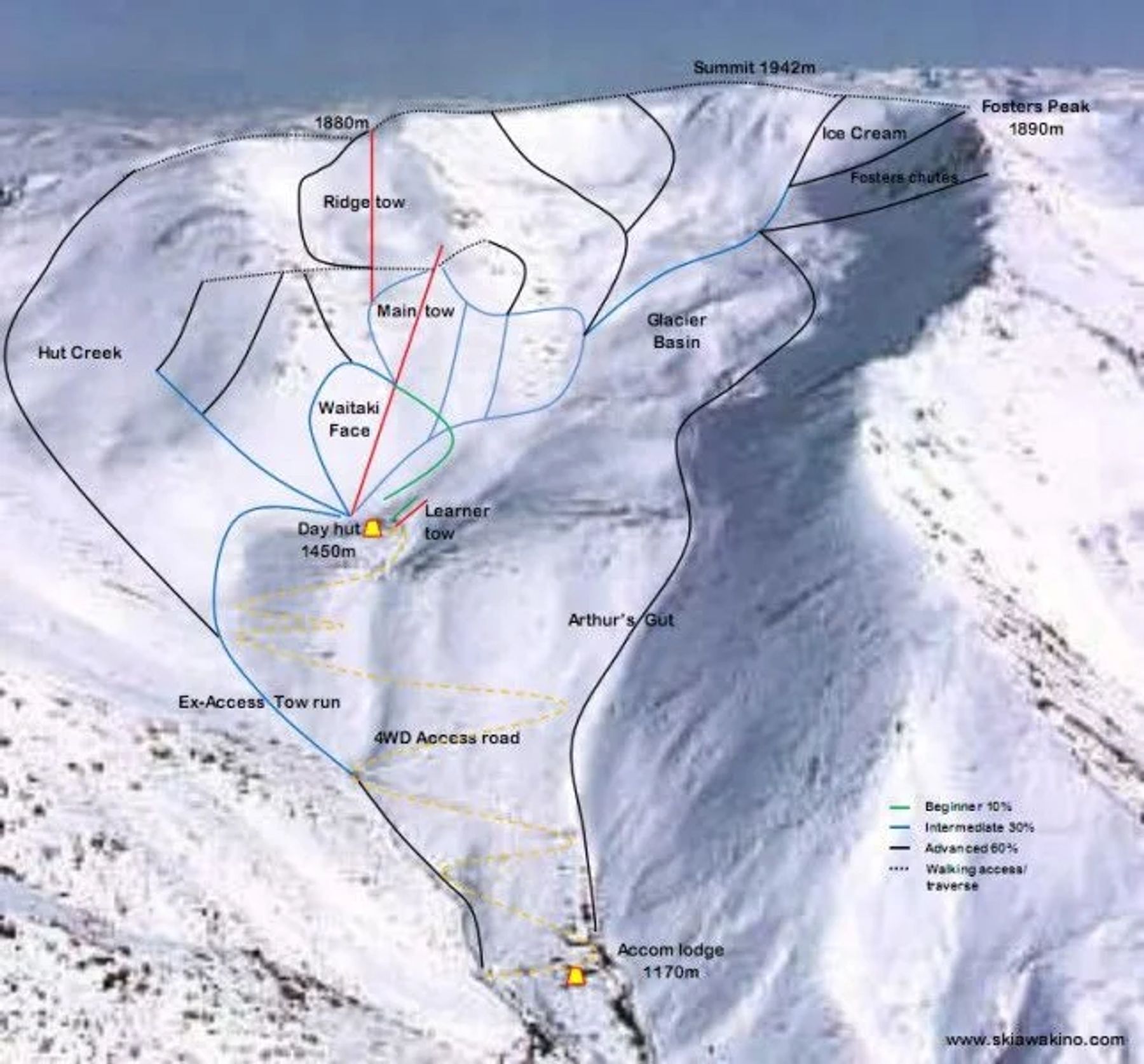
Awakino Trail Map
Downloadable Awakino trail map
Terrain split
22
runs
Beginner10%
Intermediate30%
Advanced60%
Expert0%
124 acres skiable50 hectares
Resort Stats
Elevation
Base1450m
Summit1880m
Annual snowfall
3m
Season
2026
4 July 2026 - 27 Sept 2026
Trail coverage
22 runs
124 acres (50 ha)
About Awakino's trail map
Explore Awakino's full trail map with 22 runs across the mountain, colour-coded by difficulty and shown alongside the terrain split. Use it to plan a day that matches your ability, find lift-served pockets of your favourite grade, and see how the resort links together. Download the piste map (PDF) ↗
More Awakino intelligence: snow report, lift system, webcams, resort overview.