SnowStash Logo
AustraliaCanadaEuropeJapanNew ZealandUnited StatesCompareNews
Sign InSign Up Free

Contact Us

hello@snowstash.com

Download Our App

Download on the App Store

Company

About UsCompare resortsWork With UsPrivacy PolicyMobile App

© 2026 Snowstash. All rights reserved.

    Back to News
    Resort Spotlight: Arnsberg - Where the Ruhr Valley Goes Skiing

    Resort Spotlight: Arnsberg - Where the Ruhr Valley Goes Skiing

    Published Date: May 31, 2026

    Michael Fulton

    Michael Fulton

    Melbourne-based skier and snowboarder with 50+ resorts across 5 continents. Specialises in Australian resorts and international resort comparisons.

    50+ resorts visited15 years skiing

    Categories

    Europe
    Resort Spotlight
    Arnsberg
    Germany

    An hour from Dortmund, Arnsberg offers something increasingly rare in European skiing - genuinely modest ambitions. This isn't a resort pretending to be something it's not. With 9.5 kilometres of predominantly beginner terrain, three lifts, and day tickets at €21, it's skiing stripped back to essentials. That clarity of purpose makes it unexpectedly useful.

    The numbers tell the story plainly enough. Arnsberg sits in the Sauerland region of North Rhine-Westphalia, easily reached from the industrial heartland of western Germany. The terrain spans 253 vertical metres between 590 and 843 metres elevation - modest by any standard, barely noticeable by Alpine measures. But for the millions living within 90 minutes' drive who want to introduce children to skiing or squeeze in an evening session after work, those metres are sufficient.

    Arnsberg Mountain Overview

    Five runs spread across 9.5 kilometres doesn't suggest variety, and indeed there isn't much. The terrain breakdown is 58% beginner, 42% intermediate, nothing advanced, nothing expert. Three lifts service the area - the resort is currently showing four lifts operating, suggesting perhaps a beginners' conveyor belt or similar learning facility.

    The vertical drop of 253 metres means runs are short. You're looking at perhaps 5-7 minutes from top to bottom on the longer intermediate runs, less on the beginner slopes. This scale works well for learning - you can drill turns repeatedly without the fatigue of long descents - but offers little for competent skiers beyond light exercise.

    Snowfall averages 122 centimetres annually, unremarkable but supplemented by snowmaking across the predominantly north-facing slopes. The current season has seen 140 centimetres total, with 8 centimetres in the past week. Base depth currently shows zero, though all 9.5 kilometres of terrain are reportedly open - likely maintained through snowmaking and grooming rather than deep natural cover. This typifies low-elevation German skiing: heavily managed, reliable within the season window, but entirely dependent on cold temperatures and snowmaking infrastructure.


    Who is Arnsberg Best For

    First-time skiers and families with young children learning to ski - that's the primary market, and Arnsberg serves it efficiently. The compact scale means parents can watch children from the base area, lessons are affordable, and the absence of challenging terrain removes the temptation for kids to venture beyond their ability.

    For competent intermediates or anyone seeking progression, Arnsberg offers little beyond convenient proximity. The 42% intermediate terrain amounts to perhaps four kilometres of blue-equivalent pistes. You could ski the entire area in under an hour. This works for evening sessions after work or maintaining basic fitness, but not for full-day skiing.

    The location favours residents of North Rhine-Westphalia's urban centres - Dortmund is 80 kilometres west, Kassel 70 kilometres east. For these populations, Arnsberg provides accessible skiing without the drive to the Alps or Black Forest. But if you're travelling from further afield or planning a dedicated ski holiday, dozens of larger Sauerland resorts offer better value.

    Arnsberg Snow and Season

    The season runs December through early March - the current year showing 20 December to 8 March. That's roughly 11 weeks, though reliable conditions typically concentrate in January and February when temperatures remain consistently below freezing for snowmaking.

    At 590-843 metres elevation, natural snow is unreliable. The 122-centimetre annual average sounds reasonable until you consider it falls across perhaps 30-40 snow days, often as wet snow requiring immediate grooming. The resort's viability depends entirely on snowmaking capacity and temperatures cold enough to run the guns.

    North-facing slopes help preserve whatever snow falls or is made, but warm spells still cause deterioration. The current season's 140-centimetre total with zero base depth but full operations demonstrates the grooming-dependent reality - spreading thin cover across prepared pistes rather than relying on natural accumulation.

    Weekend crowds can compress the limited terrain significantly when conditions are good and urban populations drive out en masse. Weekday skiing, particularly mid-January through mid-February, offers the best experience with uncrowded slopes and well-maintained surfaces.

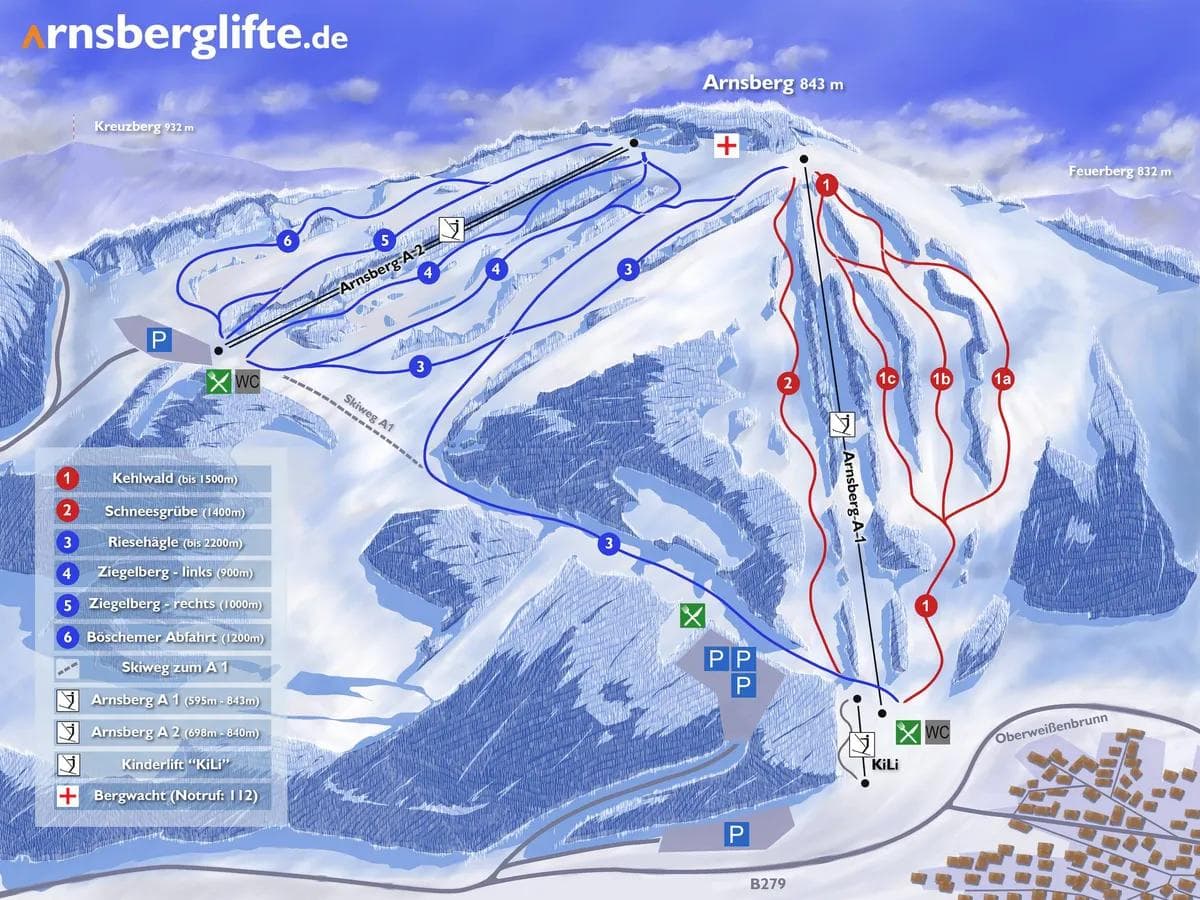
    The trail map at Arnsberg. © Arnsberg
    The trail map at Arnsberg. © Arnsberg

    Getting to Arnsberg

    Accessibility is Arnsberg's strongest asset. The resort sits just outside the historic town of Arnsberg in central North Rhine-Westphalia. From Dortmund, it's 80 kilometres east via the A46 and B7 - roughly an hour in normal traffic. Kassel lies 70 kilometres to the east.

    The nearest major airport is Dortmund (80 kilometres), though Düsseldorf and Cologne-Bonn airports offer better international connections at 120-140 kilometres distance. All are manageable as day-trip origins with an early start.

    Parking at the resort is straightforward - this isn't a destination with infrastructure challenges. The adjacent town of Arnsberg provides additional amenities, dining, and accommodation options, though most visitors treat this as day-trip skiing rather than a multi-day destination.

    Arnsberg Lift Tickets

    Adult day tickets cost €21, child tickets €16. These rates reflect the limited product accurately - you're paying for a few hours of skiing, not a full resort experience. For comparison, major Sauerland resorts charge €35-45 for day tickets with more extensive terrain.

    No online purchase URL is listed in the current information, suggesting tickets are sold at the base lodge. Season passes and multi-day tickets may offer better value for regular visitors, though specific pricing isn't available.

    The pricing makes Arnsberg viable for frequent short visits - taking children skiing every other weekend through January doesn't require significant financial commitment. For occasional skiers travelling from distance, the low ticket price doesn't offset the limited skiing available.

    The Verdict on Arnsberg

    Arnsberg succeeds by knowing exactly what it is - a small, local ski area serving nearby populations with accessible beginner terrain and reasonable prices. If you live within an hour's drive and want to introduce children to skiing or maintain basic skills through winter, it delivers that efficiently. If you're seeking a proper ski holiday or progression beyond basic intermediate level, you'll exhaust the terrain in a morning. Full resort details, webcams, and trail maps are on the Snowstash resort page.

    Full resort details, live webcams, and trail maps for Arnsberg on Snowstash →

    Latest News

    Timberline Lodge Drops Gondola Plan, Pivots to Two New Chairlifts on Oregon's Mt Hood

    Timberline Lodge Drops Gondola Plan, Pivots to Two New Chairlifts on Oregon's Mt Hood

    May 31, 2026

    Zermatt Replaces Its Oldest Chairlift: New Patrullarve Six-Seater Ready for 2026-27 Season

    Zermatt Replaces Its Oldest Chairlift: New Patrullarve Six-Seater Ready for 2026-27 Season

    May 30, 2026

    Schilthornbahn AG Posts Record Visitor Numbers in 2025 Despite Summit Closure

    Schilthornbahn AG Posts Record Visitor Numbers in 2025 Despite Summit Closure

    May 30, 2026

    Zell am See Gets a New Kapellenbahn Chairlift on the Schmittenhöhe for Winter 2026-27

    Zell am See Gets a New Kapellenbahn Chairlift on the Schmittenhöhe for Winter 2026-27

    May 30, 2026

    Snow Arrives Just in Time: Australian Alps Forecast Ahead of Kings Birthday Opening Weekend 2026

    Snow Arrives Just in Time: Australian Alps Forecast Ahead of Kings Birthday Opening Weekend 2026

    May 30, 2026