Dolomiti Superski's general assembly has unanimously re-elected Andy Varallo for a third consecutive term, running through 2029. Alongside the leadership renewal comes a bigger shift: a Smartpass that puts your ski pass on your smartphone, more AI in guest services, and an expanded Dolomiti Supersummer program. The 46-year-old Alta Badia cable car entrepreneur says the region's marketing is moving beyond skiing alone, toward positioning the Dolomites as a year-round destination.
Dolomiti Superski's general assembly has re-elected Andy Varallo for a third consecutive term, and the organisation is using the moment to lay out a digital overhaul that includes a smartphone-based ski pass.
The 46-year-old cable car entrepreneur from Alta Badia will lead Dolomiti Superski through 2029, having already served two previous terms. His re-election was unanimous.
Changes at board level
Daniele Dezulian, president of cable car company SIT Canazei, steps in as the new vice president. Siegfried Pichler, Zeno Kastlunger, Andreas Schenk and Sandro Lazzari were all confirmed on the board. Sergio Prà of Civetta joins as the new representative for the Veneto ski resorts, replacing Marco Zardini of Cortina d'Ampezzo. On the audit committee, Giuseppe Zorzi and Valeria Ghezzi were reconfirmed, joined by new member Walter Holzer.
The headline project for the coming term is the Smartpass - Dolomiti Superski's plan to move the traditional ski pass onto guests' smartphones. How the system will work technically, and when it will actually launch, hasn't been announced. What has been made clear is the intent: easier lift access, and less reliance on a physical card. The project builds on digital investments Dolomiti Superski has already made in its platform, customer service and data analysis systems over recent years. The Smartpass is being framed as the next stage of that work rather than a standalone initiative.
More personalised offers through apps and data
Beyond the pass itself, Dolomiti Superski wants to use digital applications and CRM systems to tailor its offering to individual visitors. Handled properly, that kind of system lets the organisation process information on existing and prospective guests in a structured way, rather than treating every visitor the same.
The practical case is straightforward. A family with young children wants something different from a skier chasing as much vertical as possible each day, and Dolomiti Superski's marketing has tended to speak to both at once. More direct communication with visitors is part of the same plan, with digital channels sitting alongside personal service rather than replacing it.
A bigger role for artificial intelligence
AI features in the same set of plans, though in less concrete terms. Dolomiti Superski sees potential in applying it to internal processes and guest services, without yet naming specific tools or use cases. The stated aim is efficiency gains on the operations side and better-tailored service on the guest-facing side. None of this changes the underlying structure of the organisation - Dolomiti Superski still functions as an umbrella body for twelve affiliated valley consortia, and coordination between them remains central to how any of these projects would actually get built.
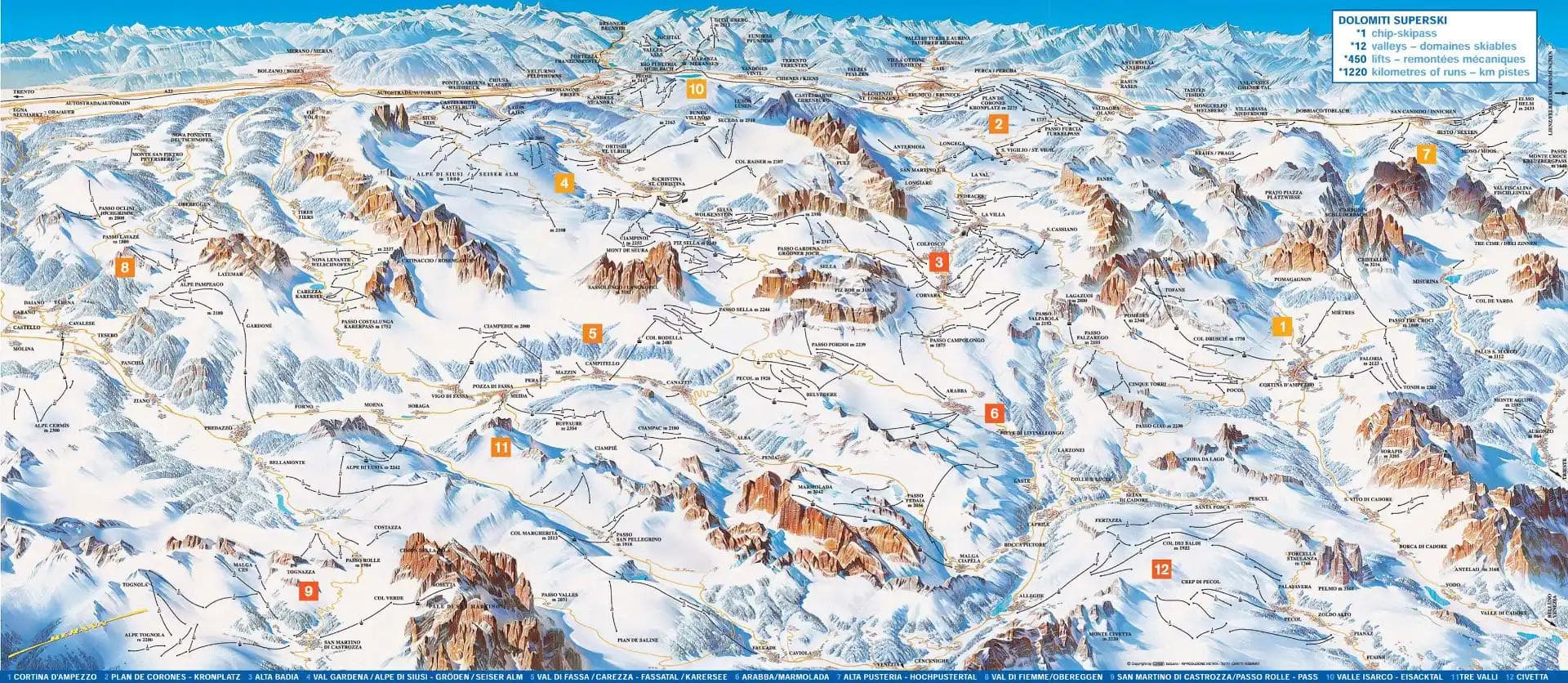
The full map of all the resorts and regions which make up the Dolomiti Superski region.
Marketing beyond the ski day
Varallo has also flagged a shift in how the region markets itself. Rather than leading with skiing alone, the plan is to put the wider Dolomites experience front and centre - landscape, local culture, and activities that happen off the piste. Personal storytelling and more direct guest contact are the tools Dolomiti Superski wants to use to present the region as a complete mountain destination rather than a collection of lift systems. Bringing in a younger generation of winter sports visitors is one of the stated priorities for the new term, and this broader framing is presented as part of how that happens.
Dolomiti Supersummer keeps growing
The Dolomiti Supersummer program is set to expand further. Dolomiti Superski's stated ambition is to be known as a year-round mountain activity provider, not purely a ski holiday organisation - meaning lifts, routes and other infrastructure would see more use outside the winter months. No specific summer projects have been announced yet. The logic behind the push is straightforward: valleys that can draw visitors across more of the year become less dependent on how any single ski season turns out.
Sustainability stays on the list
Dolomiti Superski says it wants to commit more firmly to what it calls credible sustainability - technically feasible measures aimed at reducing environmental impact, rather than symbolic gestures. No investment figures or specific projects have been attached to this commitment so far. The organisation names sustainability alongside innovation, collaboration and continuous investment as one of its stated pillars going into the new term.
Closing out a milestone term
The three years Varallo just completed included Dolomiti Superski's 50th anniversary in 2025 and the ski resorts' role during the Milano Cortina 2026 Winter Olympics - both used in the organisation's own account of the outgoing term as markers of how far the network has developed. Whether the Smartpass, AI initiatives and summer expansion land on the timeline Dolomiti Superski has sketched out will depend on details still to come. For now, the re-election gives the organisation continuity in leadership while it works through a genuinely broader set of ambitions than a typical ski-region announcement usually carries.