TL;DR
Finland's Levi and Ruka open for the 2026-27 season on October 2, more than seven weeks before most of Europe sees a lift turn. Neither resort is waiting on autumn snowfall - both are skiing on snow buried since last spring, insulated through the Finnish summer and dug back out for opening day. It is not a shortcut. It is a decades-old system now spreading from the Arctic Circle to Idaho, Utah, Vermont and Colorado. Here is how snow farming actually works, and why it is catching on.
Fewer than fifty days out, Finland's Levi and Ruka have already confirmed their opening date - October 2 - while most of the Northern Hemisphere is still weeks from its first lift turn.
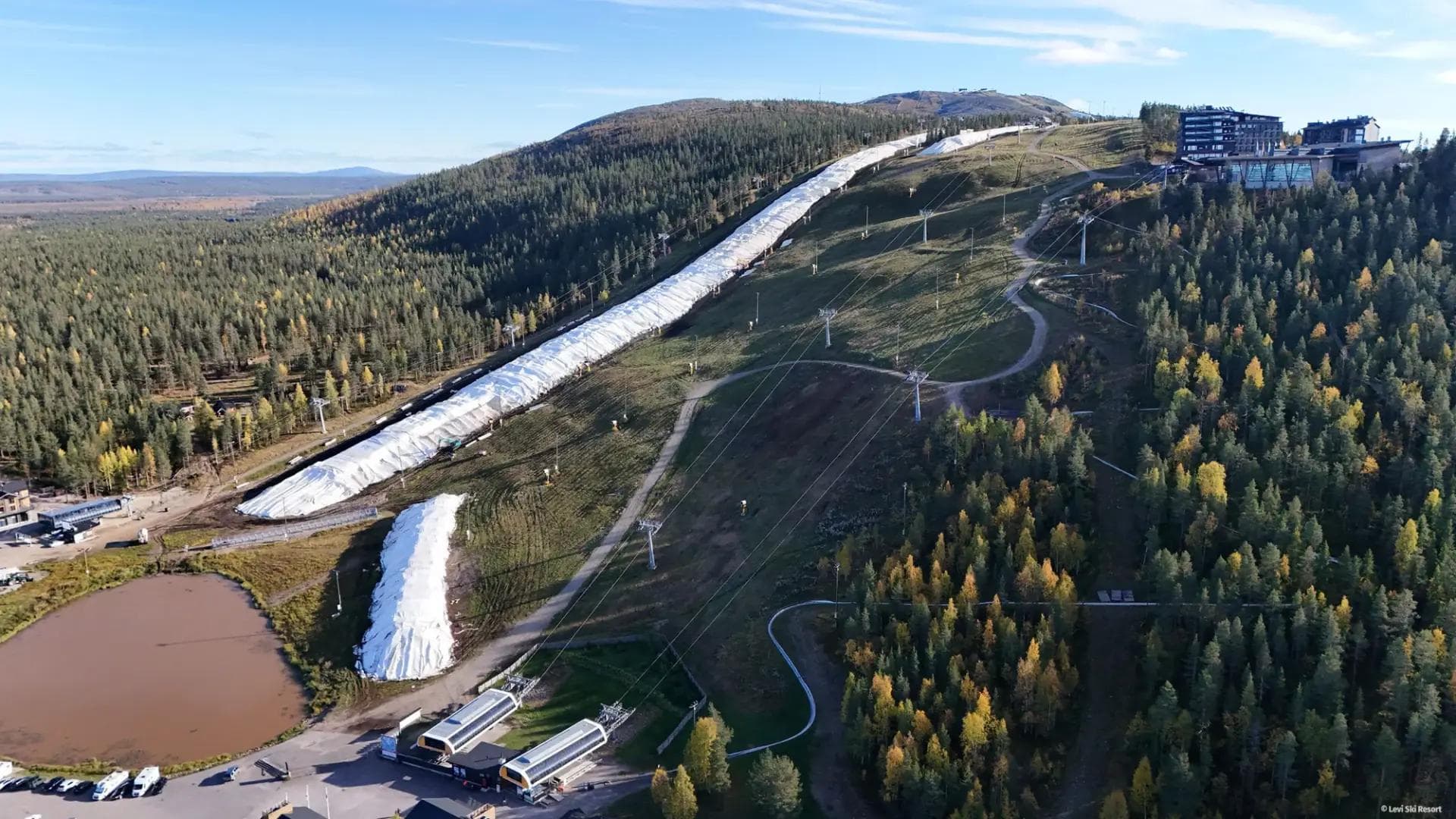
Both resorts are seasonal and non-glacial, which means neither has ice-covered terrain to fall back on the way Alpine glacier ski areas do. Instead, they get there early by farming their own snow. Rather than waiting on the first proper cold snap of autumn, Levi and Ruka spend the preceding winter making more snow than they need, then set a portion of it aside before spring arrives - stockpiling it into insulated mounds built to survive a Lapland summer and get dug back out in time for October.
How the storage actually works
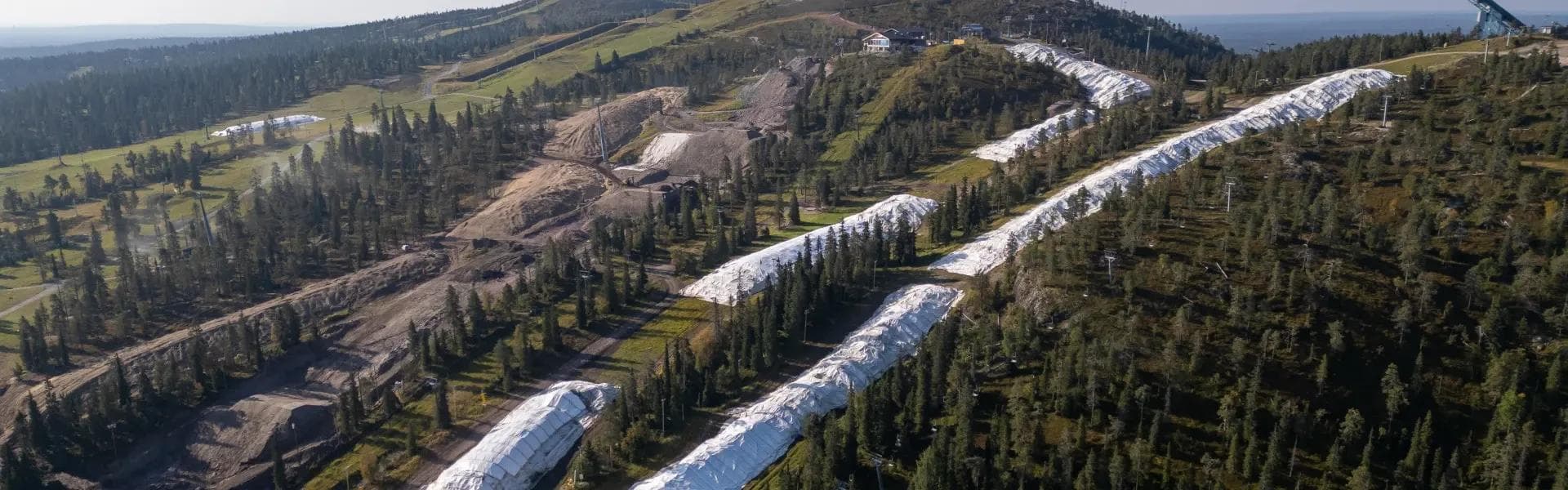
Ruka has been refining the process since the late 1990s and has opened reliably on stored snow every October since 2016. The resort currently uses three insulation methods side by side. Sawdust preserves around 80 percent of the stored volume but is unwieldy at scale, so it is used sparingly.

White insulating fabric is easier to handle but loses closer to 40 percent of the pile over summer. A purpose-built plastic insulation from the Finnish company Snow Secure sits between the two on handling, while matching sawdust on preservation at roughly 80 percent - the balance that has made it Ruka's preferred method going into most seasons.
Levi runs the same basic principle at a larger scale. Heading into the 2025-26 season the resort had close to 300,000 cubic metres of snow in storage, split between the front slope and the Levi Black World Cup run - terrain originally set aside to protect the race course from early-season cancellations before the technique was extended to public skiing.
That investment paid off: Levi closed out the season on May 10 after 220 days on snow, and logged a record 599,000 skier visits along the way.
What opens on day one
Neither resort will have full terrain running on October 2, and that is by design - the stored snow is spread thin enough to guarantee reliable cover rather than a complete mountain. At Ruka, opening operations centre on the Saarua slope area, with the Saarua Express, a Saarua chairlift and the gondola running from the first morning.
At Levi, both alpine and cross-country terrain open together: the Glacier Express and North chairlifts, an express cabin lift and a magic carpet on the alpine side, plus a stored-snow cross-country loop at Draivi. It is not the depth of midwinter skiing, but it is dependable terrain at a point in the calendar when the rest of Europe and North America are still watching the forecast.

A Finnish technique going global
What started as a way to protect a World Cup slalom course has become a broader piece of ski industry infrastructure. Hundreds of European resorts now farm snow in some form, including areas with summers considerably warmer than the Arctic Circle's. The approach has crossed the Atlantic too - Bogus Basin in Idaho and Aspen Snowmass in Colorado have both adopted Snow Secure's insulation system, with Aspen using it to protect man-made snow on Buttermilk and Snowmass mountains between seasons.
For resorts weighing whether an early or extended season is worth the investment, Levi and Ruka remain the clearest proof of concept in the sport - a low-tech idea, built almost entirely on materials science and patience, that has quietly reshaped what an opening date can mean.
About the author

Michael Fulton
Melbourne-based skier and snowboarder with 50+ resorts across 5 continents. Specialises in Australian resorts and international resort comparisons.