
The Overview
Michael Fulton
Melbourne-based skier and snowboarder with 50+ resorts across 5 continents. Specialises in Australian resorts and international resort comparisons.
Snowbasin spans 3,000 acres across six peaks in Weber County, Utah, with 107 runs distributed across a 884-metre vertical drop from 1,966 to 2,850 metres elevation. The resort hosted downhill, super-G and combined events at the 2002 Winter Olympics and will reprise this role in 2034. Terrain divides 7% beginner, 37% intermediate, 47% advanced and 9% expert, with an annual average snowfall of 762 centimetres supplemented by snowmaking across 21% of runs. The resort includes Ikon Pass access with 5 days for Base holders and 7 days for full passholders.
Three distinct zones define the mountain: Strawberry Gondola accesses wide bowls including Sisters Bowl and Middle Bowl Cirque, Needles Gondola serves groomed cruisers and terrain parks, whilst John Paul Express leads to steep tree skiing and the Olympic downhill courses. The Grizzly Downhill drops 884 metres over 3.2 kilometres and has been called the most difficult downhill in North America. The Allen Peak Tram rises an additional 155 metres from John Paul Lodge, providing access to expert chutes and panoramic views across five states on clear days. Elk Ridge off Strawberry ranks amongst Utah's longest runs at 4 kilometres top-to-bottom.
Three day lodges provide upmarket facilities: Earl's Lodge anchors the 1,925-metre base area with 4,181 square metres of space, whilst John Paul Lodge at 2,743 metres and Needles Lodge at 2,652 metres offer table-service dining with views of Ogden Valley and the Great Salt Lake. The Overlook bar opened in 2021 at Needles as a 21-plus venue. Parking capacity exceeds any Utah resort with no reservations required, and weekend carpool lanes prioritise vehicles with three or more occupants. Daily operations run 9am to 4pm with lodges opening from 8am.
Access via Ikon Pass has increased visitation since the resort joined the network, with weekends drawing Salt Lake crowds when Cottonwood Canyon resorts close due to avalanche risk. The 2025-26 season ran from 29 November to 22 March, closing earlier than planned due to limited snowfall. Snowbasin suits confident intermediates through experts who value wide groomers, Olympic terrain and fewer lift queues than Wasatch resorts 55 kilometres south. Three terrain parks range from Crazy Kat beginner features to advanced rails at Apex Park, whilst no on-mountain lodging keeps the focus on day skiing.
2,900ft
Vertical
107
Runs
3,000 acres
Skiable
25ft
Annual snow
Ikon
Pass
The Terrain
107 runs across 3,000 acres skiable
Snowbasin is a 2002 Winter Olympic venue in Weber County, Utah, with about 3,000 acres (1,214 hectares) of terrain and 107 runs. The base sits at 6,450 ft (1,966 m) and the highest lift reaches 9,350 ft (2,850 m), a vertical of 2,900 ft (884 m). Advanced terrain leads at 47%, followed by 37% intermediate, 9% expert and just 7% beginner, so this is a mountain for confident skiers rather than first-timers. Two gondolas and a tram spread skiers across three distinct sections: Strawberry, Needles and John Paul.
The Strawberry Gondola accesses wide bowl terrain for intermediate and advanced skiers, with the double black lines of Sister's Bowl, Middle Bowl Cirque and Lone Tree above, while Elk Ridge is the longest run on the hill at 3.5 miles. The Needles Gondola serves intermediate and advanced runs such as Dan's Run and Pork Barrel. At John Paul, the John Paul Express quad leads to the Olympic downhill courses, Grizzly for the men and Wildflower for the women, both deceptively steep, and the Allen Peak Tram climbs to the very top of the mountain. Snowbasin suits confident intermediates through to experts, though newcomers will find limited easy terrain.
Terrain split
107
runs
107 runs across 4 grades
Beginner7 runs · 7%
Intermediate40 runs · 37%
Advanced50 runs · 47%
Expert10 runs · 9%
Time it right
When to visit Snowbasin
The 2025-26 season operated from 29 November 2025 to 22 March 2026, closing earlier than the typical mid-April end date due to below-average snowfall. Standard seasons run late November through mid-April depending on conditions, with lifts operating 9am to 4pm daily throughout winter. Snowbasin opened in 1940 as one of America's oldest continually operating ski areas, originally developed by Ogden to restore the Wheeler Creek watershed with support from legendary skier Alf Engen and the Civilian Conservation Corps. The resort underwent major expansion in 1998 ahead of the 2002 Olympics, doubling terrain with new access to Allen Peak, Strawberry Peak and DeMoisy Peak.
Annual snowfall averages 762 centimetres at mid-mountain elevation, less than Cottonwood Canyon resorts 55 kilometres south but supplemented by extensive snowmaking covering 38 runs. Base elevation of 1,966 metres ranks amongst Utah's lowest, requiring artificial snow for early-season coverage and causing faster spring melt on sun-exposed terrain. Upper elevations hold snow well on north-facing aspects, particularly in Middle Bowl and terrain off Allen Peak. The resort averages 73% terrain open by Christmas, with 30% of seasons reaching less than half open by year-end. January week 2 historically delivers peak snowfall averaging 28 centimetres.
Optimal timing targets January through early March for powder and consistent coverage, with February offering the most reliable deep base and coldest temperatures. December conditions vary significantly depending on early-season storms and snowmaking progress. Late March and April provide spring corn skiing when temperatures cooperate, though south-facing terrain can become slushy by midday. Weekdays see substantially lighter crowds than weekends, when Ikon Pass access brings Salt Lake skiers to Ogden Valley. The resort remains quieter than Park City or Cottonwood resorts even on busy powder days.
Snowbasin hosts no regular night skiing but offers seasonal events including the Blues, Brews & BBQ summer concert series running Sundays from June through September. The resort operates Needles Gondola on summer weekends for hiking and mountain biking access, with services beginning in late June. Oktoberfest, Haunted Basin in October, and an annual spring pond skim in April round out the events calendar. The resort will host 2034 Olympic alpine events on the same courses used in 2002, with infrastructure already meeting international competition standards.
Season 2026 - 2027
27 Nov 2026
Opens
28 Mar 2027
Closes
121
Days open
25 ft
Annual snow
Getting there
Getting to Snowbasin, and where to stay
Snowbasin sits on the eastern slopes of Mount Ogden in Weber County, Utah, at the western terminus of State Route 226 in Huntsville. The base area elevation of 1,966 metres places the resort on the back side of the Wasatch Range, overlooking Ogden Valley and Pineview Reservoir to the east with views west toward the Great Salt Lake. Mount Ogden summit reaches 2,917 metres, whilst the resort's highest lift-served terrain tops out at 2,850 metres on Allen Peak. Approximately 60% of the resort operates on U.S. Forest Service land under special-use permit, with 557 hectares transferred to private ownership in 1996 as part of Olympic venue development.
Huntsville village lies 15 kilometres southeast of the resort with limited services, whilst Ogden (population 87,000) sits 27 kilometres west as the nearest substantial city. Eden and Liberty provide closer lodging options in Ogden Valley, 10 to 15 minutes from the mountain. Salt Lake City lies 53 kilometres southwest, a 45-minute drive via Interstate 84 and State Route 167. Park City sits 90 minutes southeast, making Snowbasin accessible for multi-resort itineraries. The resort operates in relative isolation compared to clustered Wasatch resorts, with no slopeside village or overnight accommodation at the mountain itself.
Road access follows Interstate 84 north from Salt Lake City to exit 96 at Mountain Green, then State Route 167 (Trappers Loop Road) east through Huntsville to State Route 226. The final approach climbs State Route 226 for 8 kilometres to the base area. Roads remain well-maintained through winter with rare closures, offering more reliable access than Cottonwood Canyon resorts subject to avalanche closures and traffic restrictions. The resort provides more free parking than any Utah resort across five lots, with Earl's Lot closest to base facilities and Canyon Rim expanded by 124 stalls in 2024.
Salt Lake City International Airport lies 53 kilometres south, a 45-minute transfer in typical conditions making same-day arrival and skiing feasible. Ogden-Hinckley Airport sits 23 kilometres west with limited commercial service. Utah Transit Authority operates ski buses on Route 675 from Ogden and Route 677 from Layton FrontRunner station mid-December through March, with Snowbasin season passholders receiving free UTA passes. Private shuttle companies including Black Diamond Shuttle, Canyon Hop and Utah Mountain Shuttles offer door-to-door transfers from Salt Lake airport and Park City. No passenger rail serves Ogden Valley directly, though FrontRunner commuter rail connects Salt Lake to Ogden with bus connections to the resort.
Where to stay
Search all stays →Hotels and lodges near Snowbasin, powered by Stay22.
Latest News
From the SnowStash desk

Vermont Ski Resort Opening Dates 2026-27: Few Dates Set, Killington Waits on the Cold
Vermont's season is slow to take shape. Stratton is tentatively targeting 18 November and Sugarbush 21 November, while Pico has Friday 11 December on the calendar. Killington never sets a date and opens when the snowmaking allows, and Vail Resorts has yet to name days for Stowe, Okemo and Mount Snow. The forecasts disagree about snow, and the main El Niño worry for the Green Mountains is warmth.
9 Oct 2026
Crans-Montana 2027 World Championships President Resigns Ahead of Fraud Hearing
Less than four months out from the Crans-Montana 2027 World Championships, the man running the organising committee has stepped down. Claude-Alain Schmidhalter resigned as Swiss-Ski vice president and OC president after being indicted over a business dispute unrelated to skiing. He denies the allegations and faces court on October 27. Interim leaders are in place for the February 1-14 event.
9 Oct 2026

Kelly Canyon, Idaho, Adds Snowmaking, a Bigger Terrain Park and More Parking for 2026-27
Kelly Canyon had a rough 2025-26, and the Idaho resort has spent the summer making sure it doesn’t repeat. Snowmaking now reaches the top of Goldrush, the terrain park is doubling in size with a stereo system, lights and a snack shack, and the car park is getting bigger. Grooming is stepping up too. Target opening is December 4, conditions permitting.
9 Oct 2026
Valle Nevado Extends Season to November 8 After 108 cm in 48 Hours
Winter was meant to be winding down in Chile. Then Valle Nevado took 108 cm in 48 hours in early October, and the resort has pushed its closing date out to November 8 - its latest in 38 years of operation. That makes 143 days of skiing since opening day on June 19, with 690 cm banked for the season. Only part of the mountain is running while the storm settles, so check the mountain report before you plan a trip.
9 Oct 2026
Alps Snow Forecast: Cold Front Brings Thursday Snow to the High Alps
The Alps look a lot more like winter today, for a day or so. A cold front is moving west to east, dropping up to 35 cm on high glaciers and peaks, with snow levels falling to around 1,500-1,800 m at times. Don’t plan a trip around it: mid-elevation snow will be thin and wet, every area is closed bar a limited Sölden glacier opening tomorrow, and warmer weather returns by Monday.
8 Oct 2026
California Ski Resort Opening Dates 2026-27: Mammoth Leads, Tahoe Follows
Mammoth Mountain is first up in California, targeting Friday 13 November after a dusting of September snow. Heavenly and Northstar follow on 20 November, Palisades Tahoe on Wednesday 25 November and Sugar Bowl on 27 November, with Kirkwood on 4 December and June Mountain on 19 December. Plenty of smaller areas have no date yet. A super El Niño favours the Sierra, but a warmer storm track is the catch.
7 Oct 2026
Colorado Ski Resort Opening Dates 2026-27: A-Basin and Keystone Race to Be First
Arapahoe Basin, Keystone and Winter Park are all chasing an October start, though none has a firm date yet. The first dated openers are Breckenridge and Copper on Friday 6 November, then Vail on 13 November, with most of the rest bunched around US Thanksgiving. Hesperus did not open at all last season. A super El Niño offers hope but no guarantee, and forecasters say the southern mountains have the better odds.
5 Oct 2026
Dolomiti Superski 2026-27: Four New Gondolas, New Reservoirs and an €89 Peak Day Pass
Dolomiti Superski is spending around €100 million across its 12 areas before winter. Kronplatz gets a new 10-passenger gondola with a middle station, 3 Zinnen gets Helmissimo, and Val di Fassa swaps a chairlift for a gondola above Col Valvacin. New water-storage basins and upgraded snowmaking follow, and construction has started on the San Martino to Passo Rolle link. A peak adult day pass is €89.
4 Oct 2026
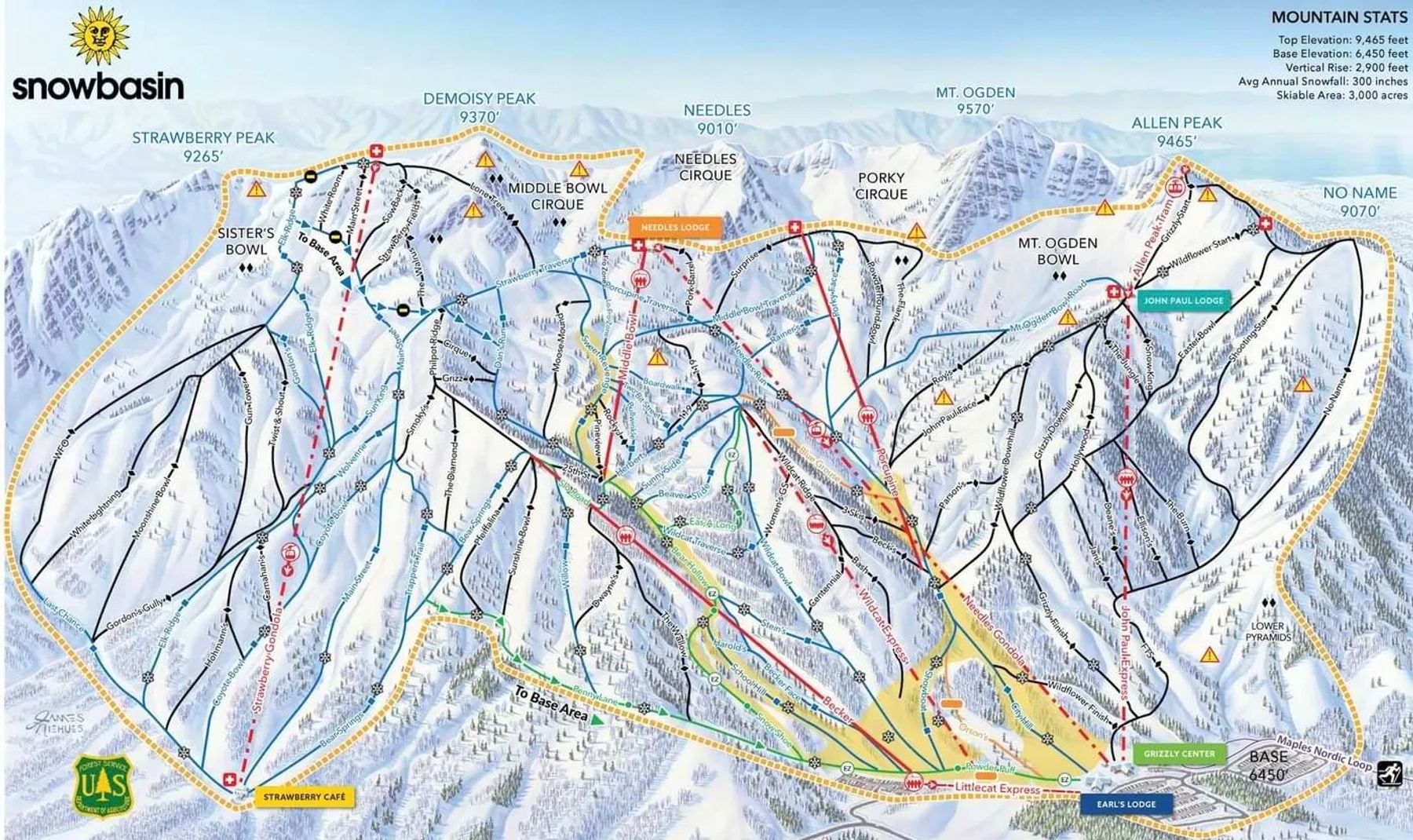
Snowbasin Trail Map
Downloadable Snowbasin trail map
Terrain split
107
runs
Beginner7%
Intermediate37%
Advanced47%
Expert9%
3,000 acres skiable1,214 hectares
Resort Stats
Elevation
Base6,450ft
Summit9,350ft
Annual snowfall
25ft
Season
2026 - 2027
27 Nov 2026 - 28 Mar 2027
Trail coverage
107 runs
3,000 acres (1,214 ha)
About Snowbasin's trail map
Explore Snowbasin's full trail map with 107 runs across the mountain, colour-coded by difficulty and shown alongside the terrain split. Use it to plan a day that matches your ability, find lift-served pockets of your favourite grade, and see how the resort links together. Download the piste map (PDF) ↗
More Snowbasin intelligence: snow report, lift system, webcams, resort overview.