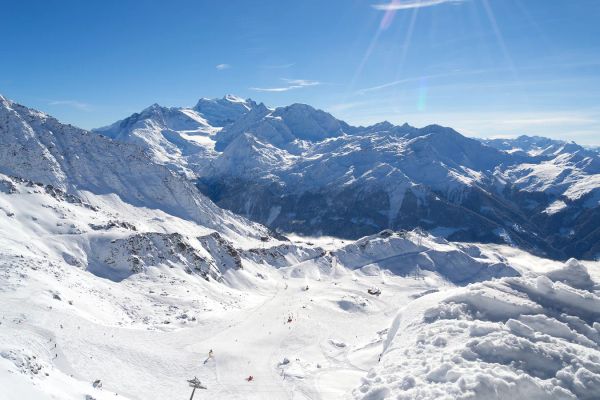
Four connected areas, 70 lifts and a World Championship course, yet Saalbach Hinterglemm still runs like a family holiday. Two days on snow and a Worlds Super-G later, here is who it suits, what the Ski ALPIN CARD covers and why Epic Pass holders should pay attention. Big on blues, light on steeps.
A resort that hosted the Alpine World Ski Championships and still runs like a family holiday
Saalbach Hinterglemm is hard to pin down with a single label. It has four interconnected areas, 70 lifts and a ticket that, on the right pass, reaches 408 kilometres of terrain across three resorts. I skied two days there in February 2025 and spent a third watching the men's Super-G at the FIS Alpine World Ski Championships, which Saalbach hosted that year. Lift access for the trip was provided by Saalbach Hinterglemm. Flights, accommodation and everything else were self-funded, and this review is not sponsored.
Resort overview
Saalbach and Hinterglemm are two villages that sit almost on top of each other in the Glemmtal valley in Salzburg province, at around 1,000 metres. Together with Leogang and Fieberbrunn on the far side of the range, they form the Skicircus: four base areas, one lift network and a single ticket.
Officially that means 270 kilometres of piste and 70 lifts, across an elevation range of 840 to 2,096 metres (about 2,760 to 6,880 feet). Mapping the resort boundary myself gave just over 90 square kilometres, or roughly 22,000 acres. Whistler Blackcomb sits at 8,171 acres and Park City at 7,300. I skied all four areas in two days and it was nowhere near enough. Plan on the best part of a week to get a handle on the place.
Families and mixed-ability groups may find the best beginner offering I have come across at any resort I have reviewed. All four areas have large collections of blue runs, which are green runs by North American standards. Short laps on easy platter and T-bar lifts suit anyone still building confidence, while full top-to-bottom descents let you cruise an entire mountain face without a mid-run lift change. Many resorts put their easy terrain either at the bottom or near the top and force a transfer to get back down. Saalbach does not.
Scale helps too. Once someone finds their feet, they are not stuck on one dedicated learner mountain, because the whole network follows the same gentle philosophy and progression happens across the resort rather than in one corner.
The route to Leogang in Saalbach Hinterglemm is the best beginner run at the resort.
My pick for a blue was the run linking piste 212 into 211. It drops about 900 metres of vertical with the Birnhorn and surrounding peaks standing in front of you the whole way. It is an easy cruise, and the view makes it memorable rather than merely functional.
Intermediate terrain
This is where Saalbach surprised me most, and it is spread across more of the resort than I expected.
Out of Saalbach village, the Kohlmaisbahn gondola and the six-person Panorama chair serve strong intermediate runs that are easy to lap without transfers. From the summit of Schattberg West, a long red run tracks back down to Hinterglemm with just over 1,000 metres of vertical in one descent, a serious amount of skiing on terrain that never tips past red.
The runs off the Schönleitenbahn drop just over 900 metres, but ski them in the morning. By early afternoon the sun reaches this aspect and turns it to chopped-up slush. For a lift you can lap without moving around the resort, head to the Spieleck and Hochalm chairs at the back of the resort near Hinterglemm. Both serve over 500 metres of vertical, with groomed red terrain and enough width between the marked pistes to vary your line each lap.
The intermediate terrain at Saalbach is everywhere and it rides excellent.
The single best run for me was on the Fieberbrunn back side, which links through to Hinterglemm. The descent drops from 2,020 metres to 1,074 metres, nearly 950 metres (a bit over 3,100 feet) in one continuous run. The upper section under the quad and gondola has real pitch and width, then eases into a blue cat-track cruise across the valley floor, which is welcome after a long stretch of moguls. Because this section is not tied to a main village base, it is also quieter than the areas closer to Saalbach.
Add up Kohlmais and Schattberg West, the Schönleitenbahn runs, Spieleck and Hochalm, and the Fieberbrunn back side, and an intermediate could spend four or five days here without repeating a run. Those are only my highlights.
Advanced and expert terrain
Saalbach is not a resort to build a trip around if steep or extreme terrain is the priority. It does not pretend otherwise.
What is here is decent. The standout is piste 36 on the Zwölferkogel, known as the Schneekristall, which hosted the men's downhill and Super-G at the 2025 World Championships. It was closed to the public during my visit because the event was using it, but a championship speed course inside a resort known for cruisy blues and reds says something. When open, it is a serious black run with real consequences for mistakes.
Looking straight up the number 1 piste at Saalbach Hinterglemm.
Piste 1 is the other one to seek out. It runs from the top of Schattberg Ost under the gondola and finishes in the centre of Saalbach village, and it is the closest thing to a proper black that most visitors will ski. Freestyle skiers should base themselves around Leogang and the Großer Asitz, where three eight-seater lifts head in different directions into a solid terrain park.
For a test of fitness rather than technique, there is the Skicircus Challenge: the whole interconnected network in a single day. That is 32 lifts, 65 kilometres of piste and 12,400 metres of descent, roughly six to seven hours for a fit skier who skips the long lunch. I did it on my second day, starting at 8am and following the guide on the resort's website. It is a lot of up-down-up-down, but you can track progress in the app and show your QR code to the ticketing team at the end for a small gift.
Snow and conditions
Saalbach is huge, but it is not high. The top of the network is 2,096 metres, well short of the 3,000 metres plus found at other Alpine resorts.
North-facing slopes hold snow well through the season, while south-facing terrain takes more sun, which matters mainly for late-season snow quality. That fit what I saw. Many lower south-facing sections were thin, yet everything within the marked ski area was properly covered, which says more about grooming and snowmaking than about the natural snowpack.
Both of my days were sunny, and by mid-afternoon the groomed runs had softened into moguls, which made for tougher skiing on tired legs. Sunshine, bumps and slush is still an enjoyable combination, even if it is not the cold, dry snow you would chase at altitude. Saalbach typically receives around 3 to 4 metres of natural snow in an average season, backed by one of the better snowmaking systems I have seen. It is not a powder destination and does not market itself as one, but with four areas of terrain a storm can still deliver a proper powder day.
Lift system
The lifts are where Saalbach separates itself from almost every other resort I have reviewed.
The Skicircus has 70 lifts: 29 gondolas, 22 chairlifts and 15 T-bar and button lifts, plus a couple of rope tows and a moving carpet at the beginner end. Together they move close to 145,000 people an hour across 69.7 kilometres of lift length. Gondolas leave from every village, and elsewhere the chairlifts have bubbles and heated seats. Walking into the Schönleitenbahn station felt more like entering a design gallery than joining a lift queue.
Brand new lifts are everywhere at Saalbach Hinterglemm.
The 12er Nord, which climbs 879 metres to the top of the Zwölferkogel, opened for 2024-25 and still felt brand new when I rode it. This ten-seat gondola replaced an older lift with open-air standing cabins. Fieberbrunn's Streubödenbahn opened the same season, and even its entry gates fold in a way I had not seen before.
With a World Championships under way, I expected serious queues and found none worth mentioning anywhere I skied. Either part of the usual crowd stayed away, or the network can absorb a championship crowd unnoticed. I suspect a bit of both.
Pricing
Lift access runs through the Ski ALPIN CARD, which is a three resort pass rather than a Saalbach ticket. It covers the Skicircus, Zell am See's Schmittenhöhe and the Kitzsteinhorn glacier at Kaprun: 408 kilometres of piste and 121 lifts. The three resorts are not lift-linked, but public transport runs between the bases.
For 2026-27, a main-season adult day pass is €82 and a six-day pass is €440. In the winter start period the day rate drops to €74. Check the official site for your dates before booking.
Epic Pass holders get five days across the same three resorts, since Saalbach and Zell am See-Kaprun joined the network for 2025-26. I hold an Epic Pass, and my plan for a return trip would be two days at Saalbach, two at Kitzsteinhorn and one at Zell am See. If you make the journey, do not ski only the Skicircus. Kitzsteinhorn and Schmittenhöhe are on the same ticket, and Kitzsteinhorn in particular has the advanced terrain Saalbach lacks.
Accommodation
Staying in Saalbach or Hinterglemm means walking distance to the lifts and the après scene on your doorstep. Expect to pay for it: a few hundred euros a night is typical, with everything from hotels and lodges to self-contained apartments that suit groups and families.
I based myself in Kaprun, about thirty minutes down the road past Zell am See, because I was also skiing Kitzsteinhorn and Schmittenhöhe. Beds around Zell am See and Kaprun run from about €100 a night to €600 or more in peak season (roughly US$110 to US$650). With the Ski ALPIN CARD covering all three resorts, staying outside Saalbach and driving in is a practical choice as much as a budget one.
The village of Saalbach is full of hotels and restaurants.
On-mountain amenities and après
Saalbach's après reputation is earned. The village comes alive after skiing, with a distinctly Austrian flavour, live music and a lively atmosphere most afternoons. After the Super-G I ended up in a bar and restaurant with locals I had met in the crowd, and the celebrations ran well into the night. Mountain huts across the resort get going around lunchtime and carry on through the afternoon. Pace yourself, because you still have to ski back to the village. The scene leans into the party reputation without losing its Austrian character, and the village is not built solely around it.
Whilst the world cup doesn't happen every year the après scene at Saalbach is world class.
Location and access
Saalbach and Hinterglemm sit in the Glemmtal valley in the Pinzgau region of Salzburg province, a short drive from Zell am See and Kaprun. Leogang is just over the ridge in the same province, but Fieberbrunn sits across the border in Tyrol. A single ten-seater gondola line ties it into the network, so you can ski from one Austrian state into another without noticing.
Salzburg is the closest airport for connections within Europe, about an hour and a half by road. Munich is the better choice for international flights, around two hours forty minutes, mostly on autobahn once you cross the border. By train, head for Zell am See or Maishofen station and pick up a bus. On the day I went to the Championships, buses ran roughly every thirty minutes and took about half an hour from the Zell am See depot into Saalbach.
I drove in from Kaprun on both ski days. Parking is paid at the main gondola base stations, but the 12er Nord gondola offers free parking, which adds up across a multi-day trip.
Verdict
Saalbach Hinterglemm earns its reputation as a family and mixed-ability resort. Beginners get some of the best blue terrain I have skied, spread across all four areas. Intermediates arguably get the best deal of anyone, with terrain rising straight out of Saalbach, quiet lapping at Spieleck and Hochalm, and a Fieberbrunn back side that is as good a piece of intermediate skiing as you will find in the Alps.
Advanced skiers will find pockets worth seeking out, piste 36 and its World Championship pedigree chief among them, but the better option for steeper terrain is Kitzsteinhorn, next door on the same pass.
The lifts, at 70 moving close to 145,000 people an hour, are as good as anything I have experienced. Combined with the Ski ALPIN CARD's three resort reach and the Epic Pass link, that makes a strong case for families, mixed-ability groups and anyone after a relaxed week on snow. For Epic Pass holders, a Saalbach, Kitzsteinhorn and Zell am See trip is hard to ignore on the numbers.
The views of the Wildseeloder which towers over the village of Fieberbrunn.